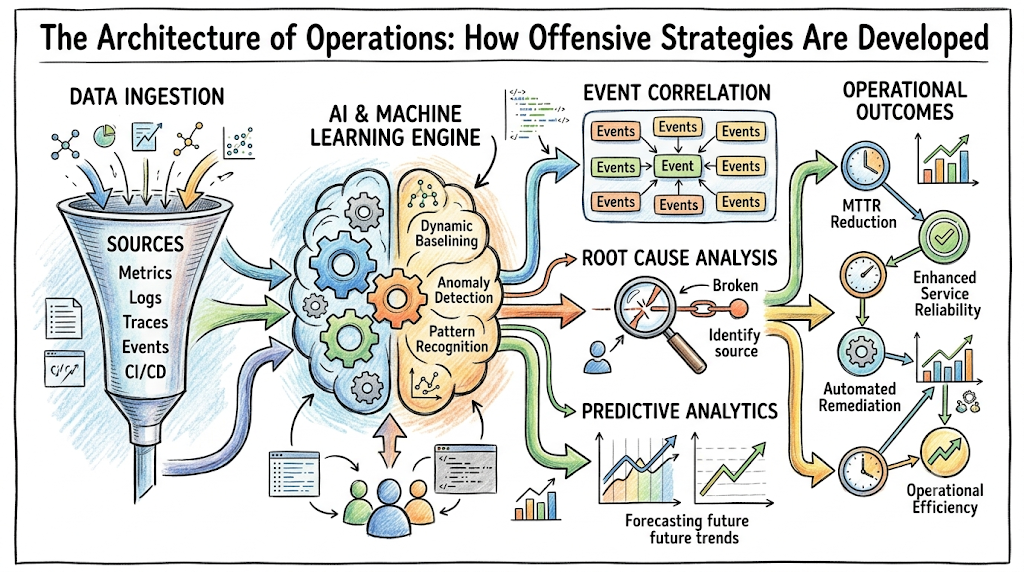
In the study of military history and defense analysis, a recurring truth emerges: victory is rarely an accident of the battlefield. Instead, it is the deliberate product of calculated planning, rigorous resource alignment, and structural foresight. For students of strategic studies, understanding the mechanics of how offensive strategies are developed is essential to deciphering both historical outcomes and contemporary security dynamics.
At WarOpsX, a premier educational guide for Military History & Strategic Studies, exploring these conceptual frameworks allows us to dissect complex campaigns beyond the lens of mere tactical engagements. True strategy operates above the noise of combat; it is the overarching architecture that connects national policy with operational execution.
Featured Snippet
How Are Offensive Strategies Developed?
Offensive strategies are developed through a structured process that translates high-level political objectives into actionable military campaigns. This planning cycle requires a comprehensive assessment of geopolitical realities, available logistics, and intelligence insights. Strategists map resource capabilities against adversary vulnerabilities, balance operational risks against strategic rewards, and design adaptive frameworks capable of maintaining the initiative under changing conditions.
Understanding Military Strategy
What Is Strategy?
At its core, strategy is the art and science of marshaling an organization’s resources—human, material, financial, and informational—to achieve specific, long-term objectives in the face of an adversary. Derived from the Greek word strategos (meaning “generalship”), the term has evolved from its literal roots of directing armies into a comprehensive academic and practical discipline focused on intent, capability, and environment.
Strategy vs. Operations vs. Tactics
To study military history effectively, one must distinguish between the three distinct levels of warfare. These echelons form a hierarchical chain of cause and effect:
[ STRATEGIC LEVEL ]  --> Defines the "Why" and "What" (National Policy & Goals)
        |
        v
[ OPERATIONAL LEVEL ] --> Defines the "Where" and "When" (Campaigns & Theaters)
        |
        v
[ TACTICAL LEVEL ]    --> Defines the "How" (Engagements & Battlefield Actions)
- Strategic Level: This is the highest tier, focusing on national or coalition objectives. It determines the “why” and “what” of a conflict. Strategy defines the ultimate goals, secures resources, manages alliances, and establishes the boundaries of engagement.
- Operational Level: The vital bridge between strategy and tactics. It focuses on the “where” and “when.” Operational art involves planning campaigns, positioning large-scale formations (such as corps or armies), and orchestrating multiple battles to achieve a broader strategic end.
- Tactical Level: The arena of direct engagement—the “how.” Tactics deal with the specific techniques, movements, and immediate decisions made by units on the battlefield during a confrontation.
Historical Evolution of Strategic Thinking
Strategic thinking has shifted over centuries from intuitive, leadership-dominant models to highly structured, institutionalized processes. Early strategic thought, dominated by figures like Sun Tzu and Thucydides, emphasized deception, political context, and the psychological state of the commander. By the 19th century, theorists like Carl von Clausewitz and Antoine-Henri Jomini institutionalized the discipline. Clausewitz famously noted that “war is the continuation of politics by other means,” cementing strategy as an extension of state policy. The Industrial Revolution added massive logistical and technological layers, transforming strategic planning into a science of industrial mobilization and managerial efficiency.
Why Strategy Shapes Outcomes
While superior tactics can win a single battle, a flawed strategy almost guarantees long-term failure. Strategy shapes outcomes because it dictates the distribution of sustainability. A well-conceived strategy ensures that victories on the ground aggregate toward a meaningful political objective, while preventing resources from being squandered on inconsequential targets.
Understanding Offensive Strategy
Definition of Offensive Strategy
An offensive strategy is a proactive blueprint designed to seize, retain, and exploit the initiative to force an adversary to yield to one’s will. It is characterized by imposing one’s timeline and choice of battleground onto the opponent, compelling them to react rather than act.
Strategic Objectives
The ultimate aim of an offensive strategy is to achieve a decisive shift in the status quo. This is achieved by target selection focused on the enemy’s Center of Gravity (CoG)—the primary source of their power, moral resistance, or structural cohesion.
Political and Military Goals
Every offensive strategy must serve a political purpose. Military goals (such as capturing a geographic region or neutralising an adversary’s fleet) are merely instruments used to achieve political goals (such as treaty revisions, regime changes, or resource acquisition). When military offenses are decoupled from clear political outcomes, campaigns degenerate into aimless attritional quagmires.
Historical Context
Academically, offensive strategies are analyzed based on the contemporary constraints of their eras. The success of an offensive plan cannot be detached from its historical context; the same strategic maneuver that yielded total victory in the ancient world might result in absolute catastrophe in an era of satellite reconnaissance and precision-guided munitions.
Foundations of Strategic Planning
Developing a coherent offensive strategy requires balancing several foundational pillars:
- National Objectives: The guiding light of any campaign. Strategists must clearly define what constitutes a successful post-war reality before designing an offensive.
- Leadership Vision: The capacity of senior commanders to see past the immediate chaos of planning and visualize the intended end-state, fostering unity of effort across diverse organizations.
- Resource Assessment: A cold, quantitative inventory of available assets. This includes personnel, industrial capacity, financial reserves, raw materials, and technological capabilities.
- Risk Evaluation: A calculated identification of vulnerabilities, potential failure points, counter-actions by the adversary, and unforeseen external variables.
- Long-Term Planning: The structural design of phases, branches, and sequels that allow an offensive to sustain its momentum over months or years, anticipating shifts in the strategic environment.
Key Factors Influencing Offensive Strategies
Geography
- Importance: Geography dictates the avenues of approach, boundaries of movement, and speed of maneuver.
- Historical Relevance: The impassable nature of the Pripyat Marshes during Eastern European campaigns historically forced offensive plans to divide along distinct northern and southern axes.
- Strategic Implications: Strategists must align their offensive vectors with the physical terrain, utilizing natural barriers as flank protection or exploiting open terrain for rapid mechanised advances.
Logistics
- Importance: Logistics represents the absolute limit of strategic capability. An army can only advance as far as its supply lines can sustain it.
- Historical Relevance: The stunning speed of General George S. Patton’s Third Army offensive across France in 1944 was ultimately halted not by German resistance, but by a systemic shortage of fuel supplies.
- Strategic Implications: Offensive planning requires calculating consumption rates for fuel, ammunition, food, and medical resources, ensuring that the operational tempo does not outpace transport infrastructure.
Intelligence
- Importance: Accurate intelligence removes the “fog of war,” allowing planners to match strength against weakness.
- Historical Relevance: The British interception and decoding of German communications via the Ultra project provided strategic clarity that guided Allied offensive planning throughout World War II.
- Strategic Implications: Intelligence operations must identify the enemy’s disposition, intentions, economic vulnerabilities, and social fracture points before an offensive plan is finalized.
Technology
- Importance: Technology introduces new vectors for power projection and alters the time-space calculations of a campaign.
- Historical Relevance: The introduction of the railroad and electric telegraph drastically accelerated Prussian mobilization and offensive execution during the Austro-Prussian War of 1866.
- Strategic Implications: Planners must analyze how technical asymmetries can be exploited to bypass enemy strongpoints or neutralize their defensive systems.
Economic Resources
- Importance: Modern warfare requires deep financial and industrial endurance.
- Historical Relevance: The industrial output of the United States under the Victory Program ensured that Allied offensive strategies were backed by an overwhelming material advantage.
- Strategic Implications: An offensive strategy must be sustainable within the economic limits of the state, ensuring that the cost of execution does not bankrupt the nation.
Public Support
- Importance: In modern strategic theory, public willpower is an essential component of the “Clausewitzian Trinity” (Government, Army, People).
- Historical Relevance: The erosion of domestic public support for the French campaigns in Indochina ultimately forced a strategic withdrawal despite maintaining tactical superiorities.
- Strategic Implications: Strategists must evaluate the societal tolerance for prolonged operations and casualties, tailoring the speed and narrative of the offensive accordingly.
Alliances and Diplomacy
- Importance: Diplomatic isolation can ruin an offensive strategy, while robust coalitions multiply available resources.
- Historical Relevance: Prior to the Crimean War, meticulous diplomatic alignment ensured that Britain and France successfully isolated the Russian Empire before launching their regional offensive.
- Strategic Implications: Planning must incorporate coalition interoperability, political consensus-building, and measures to prevent external powers from intervening on behalf of the adversary.
Role of Intelligence in Strategic Planning
Intelligence acts as the foundational baseline for all strategic design. Without verified data, offensive planning is reduced to dangerous guesswork.
Information Gathering
The intelligence cycle begins with multi-source collection: human assets, signals interception, open-source analysis, and imagery. Planners use this raw data to build a comprehensive map of the adversary’s strategic layout.
Threat Assessment
This involves identifying not just what the enemy can do, but what they are likely to do. It analyzes enemy doctrine, training standards, leadership psychology, and historical behavioral patterns.
Risk Identification
Intelligence identifies hidden dangers, such as secret defensive alliances, hidden reserves, or alternative supply networks that could compromise the momentum of an offensive.
Decision Support
During the planning phase, intelligence answers critical questions for commanders, allowing them to allocate resources efficiently and select the exact points where the enemy is most vulnerable.
Historical Example
Prior to the Battle of Midway (1942), U.S. naval intelligence successfully cracked the Japanese JN-25 naval code. This allowed Admiral Chester Nimitz to transition from a blind defensive posture to a brilliant, targeted offensive ambush. By knowing the exact targets and timelines of the Japanese fleet, a numerically inferior U.S. force altered the course of the Pacific War.
Leadership and Strategic Decision-Making
Command Structures
An effective offensive strategy requires a unified, clear command structure. History demonstrates that divided commands or committee-style decision-making often stalls the speed and decisiveness essential for offensive success.
Leadership Qualities
Strategic leaders must possess cognitive flexibility—the ability to adapt their mental models when presented with conflicting reality—and emotional resilience to handle massive responsibility under immense pressure.
Strategic Vision
The ability to see the “forest for the trees” is paramount. A great strategic leader avoids getting bogged down in localized tactical emergencies, focusing instead on maintaining the overall momentum toward the primary campaign objective.
Crisis Management
When an offensive hits an unexpected obstacle, the leader’s role shifts to crisis management. This involves rapid re-evaluation, realigning resources, and maintaining organizational discipline under stress.
Historical Leadership Examples
During the planning and execution of Operation Overlord, General Dwight D. Eisenhower demonstrated exemplary strategic leadership. He successfully balanced the competing egos of Allied generals, managed complex political demands from Roosevelt and Churchill, and made the agonizing, solitary decision to launch the invasion during a narrow weather window on June 6, 1944. His vision remained fixed firmly on the long-term liberation of Western Europe.
Strategic Planning Framework
Military historians and defense analysts often utilize a standardized framework to break down how strategic plans are formulated:
[1. Goal Definition] ------> Clear identification of the political end-state.
         |
         v
[2. Situation Assessment] --> Internal audit and comprehensive enemy analysis.
         |
         v
[3. Resource Evaluation] ---> Alignment of industrial, financial, and military power.
         |
         v
[4. Scenario Planning] -----> War-gaming alternative outcomes and enemy counters.
         |
         v
[5. Decision Making] -------> Selection of the primary line of effort (Course of Action).
         |
         v
[6. Review & Adaptation] ---> Continuous monitoring and adjustments during execution.
Historical Evolution of Offensive Doctrine
Ancient Warfare
In antiquity, offensive doctrine was bound by physical endurance and seasonal agricultural cycles. Strategies focused on decisive, single-day set-piece battles or prolonged sieges of fortified political centers. The strategic focus was geographic and immediate.
Medieval Campaigns
The medieval era saw decentralised offensive operations. Strategic doctrine focused heavily on the chevauchée—destructive raids designed to demoralize an adversary’s population, disrupt economic productivity, and force an opposing lord into an unfavorable treaty without risking a costly pitched battle.
Industrial-Era Warfare
The American Civil War and the Franco-Prussian War marked the transition to industrial warfare. Doctrine shifted toward mass mobilization, total economic targeting, and deep operational maneuvers facilitated by railways, mass-produced artillery, and rapid-fire small arms.
Modern Strategic Doctrine
The 20th century introduced combined arms and multi-domain operations. The integration of armored formations, mechanized infantry, and tactical air power aimed to bypass fixed defensive positions, strike deep into the enemy’s rear echelons, and paralyze their command networks before they could mount a coherent response.
Contemporary Security Studies
Today, strategic doctrine has evolved into Multi-Domain Integration, where traditional physical domains (Land, Sea, Air) are synchronized with Space, Cyber, and Information environments to achieve cognitive dominance over an adversary.
Famous Historical Case Studies
1. Alexander the Great’s Persian Campaigns (334–331 BCE)
- Historical Context: Alexander inherited a stabilized Macedonia and set out to dismantle the massive Achaemenid Empire under Darius III.
- Strategic Objectives: Neutralize Persian naval advantages by capturing their Mediterranean ports via land, overthrowing Darius, and absorbing the empire’s immense wealth.
- Challenges: Vastly outnumbered by Persian forces; operating thousands of miles away from home territory with limited supply chains.
- Outcomes: Total collapse of the Persian Empire following decisive victories at Issus and Gaugamela.
- Lessons Learned: Striking the enemy’s political and psychological Center of Gravity (Darius himself) can shatter a massive, multi-ethnic empire from within.
2. Roman Expansion Strategies: The Third Punic War (149–146 BCE)
- Historical Context: Despite losing previous wars, Carthage remained an economic competitor that Rome viewed as a permanent threat.
- Strategic Objectives: The absolute destruction of Carthage as a political and commercial entity to secure total Roman dominance in the Western Mediterranean.
- Challenges: Carthage was heavily fortified, requiring an intensive, resource-draining siege that tested Roman domestic political patience.
- Outcomes: The complete destruction of the city, enslavement of the population, and annexation of Carthaginian territory as a Roman province.
- Lessons Learned: When an offensive strategy aims for total security, it demands an uncompromising commitment of resources to eliminate an opponent’s long-term revival capacity.
3. Napoleonic Campaign Planning: The Ulm-Austerlitz Campaign (1805)
- Historical Context: Napoleon faced a powerful coalition of the Austrian and Russian Empires moving to encircle France.
- Strategic Objectives: Defeat the fragmented Coalition armies individually before they could unite into an overwhelming force.
- Challenges: Operating across massive distances under severe time constraints, while facing armies with superior numbers.
- Outcomes: Napoleon rapidly marched his Grande Armée around the Austrian General Mack at Ulm, capturing his entire army, and then decisively defeated the combined Austro-Russian forces at Austerlitz.
- Lessons Learned: Speed, deception, and the exploitation of interior lines can disrupt an enemy’s coalition strategy before it can ever be executed.
4. World War Strategic Lessons: Operation Overlord (1944)
- Historical Context: Nazi Germany had fortified Western Europe into an “Atlantic Wall” to prevent an Allied amphibious landing.
- Strategic Objectives: Establish a viable lodgment in Northern Europe, liberate France, and drive directly into the German industrial heartland.
- Challenges: Executing history’s largest amphibious assault against heavily fortified positions, requiring complex multi-national coordination.
- Outcomes: Successful landings on D-Day, leading to the collapse of the German western front within months.
- Lessons Learned: Modern offensive success requires absolute air superiority, massive logistical preparation, and a highly sophisticated deception plan (such as Operation Fortitude) to misdirect enemy reserves.
Offensive Strategy vs. Defensive Strategy
| Area | Offensive Strategy | Defensive Strategy |
| Objectives | Seize initiative; alter status quo; capture targets. | Conserve forces; deny goals; exhaust the attacker. |
| Resource Requirements | High concentration of mobile assets and supplies. | Efficient use of terrain, fortifications, and interior lines. |
| Risk Profile | High; exposed supply lines and vulnerability to counter-attacks. | Moderate; runs the risk of isolation and loss of territory. |
| Leadership Demands | Boldness, rapid decision-making, high momentum. | Patience, structural discipline, flexible resilience. |
| Planning Complexity | High; requires complex synchronization of time and space. | Moderate; focuses on reaction, preparation, and anticipation. |
| Historical Examples | German invasion of France (1940); Operation Desert Storm (1991). | Battle of Kursk (1943); Battle of Britain (1940). |
Benefits and Risks of Offensive Strategies
Potential Advantages
- Seizing the Initiative: Forces the adversary to play catch-up, disrupting their long-term planning and reducing their options.
- Psychological Dominance: Morale generally favors the advancing force, while defenders often suffer from anxiety, isolation, and reactive stress.
- Choice of Time and Place: The attacker dictates when, where, and under what conditions the confrontation occurs.
Strategic Opportunities
A successful offensive can yield massive geopolitical dividends: the acquisition of key resources, the liberation of allied populations, and the permanent removal of security threats.
Resource Demands
Offensives consume immense amounts of fuel, material, money, and human capital. The rate of expenditure rises exponentially with the duration and depth of the advance.
Uncertainty and Risk
The deeper an offensive pushes into enemy territory, the more vulnerable it becomes. Strategists must face Clausewitz’s concept of the Culminating Point of the Attack—the exact moment where the attacker’s strength is so depleted by logistics and friction that a counter-offensive by the defender is likely to succeed.
Common Strategic Mistakes in History
By studying the failures of past campaigns, strategic studies students can identify recurring pitfalls in offensive planning:
- Overconfidence: Believing your own propaganda or assuming the adversary will collapse at the first blow without verified data.
- Poor Intelligence: Miscalculating the enemy’s numbers, morale, hidden reserves, or structural willpower.
- Resource Mismanagement: Launching an ambitious operation without securing the long-term industrial production or financial backing required to see it through.
- Underestimating Opponents: Assuming an adversary is static, incompetent, or incapable of rapid tactical innovation and adaptation.
- Ignoring Logistics: Planning brilliant geometric maneuvers on a map while failing to build the roads, rail lines, or supply hubs needed to sustain the forces.
- Lack of Adaptability: Adhering rigidly to an outdated timeline or plan when the operational reality on the ground has completely changed.
Strategic Thinking Beyond the Military
The conceptual models developed in military history translate directly into non-military domains:
Business Competition
Modern corporations routinely utilize offensive strategies to enter new markets, launch disruptive products, or capture market share from entrenched incumbents. Frameworks like the “Blue Ocean Strategy” focus on bypassing competitor strengths to exploit uncontistered market spaces.
Political Campaigns
Campaign managers use strategic planning to allocate advertising dollars, deploy candidates to swing districts, and build messaging narratives that capture the cultural initiative, forcing opposing campaigns into reactive damage control.
Sports Strategy
In professional sports, coaching staffs design offensive systems that exploit specific defensive asymmetries in their opponents, controlling the tempo of the game to exhaust the opposition.
Organizational Leadership
Executive leaders across sectors use strategic planning frameworks to align internal talent, manage financial risks, and pivot their organizations during major technological disruptions.
Skills Needed to Study Strategy
For those looking to build a career or deep expertise in defense analysis and strategic studies, a specific roadmap of intellectual skills is required:
[CRITICAL THINKING] ------------> Deconstruct complex scenarios without bias.
[HISTORICAL ANALYSIS] ----------> Identify recurring patterns across eras.
[LEADERSHIP UNDERSTANDING] -----> Evaluate decision-making under high pressure.
[RISK ASSESSMENT] --------------> Quantify variables and identify points of failure.
[GEOPOLITICAL AWARENESS] -------> Understand how geography shapes political intent.
[RESEARCH METHODOLOGY] ---------> Extract actionable insights from primary sources.
Future of Strategic Planning
Artificial Intelligence in Analysis
AI systems can process vast amounts of historical, economic, and terrain data to run thousands of predictive war-game simulations, highlighting hidden risks and optimal operational pathways for human planners.
Data-Driven Decision Making
Modern strategic planning relies increasingly on real-time data tracking, automated supply management systems, and instant global sensor arrays to reduce the traditional “fog of war.”
Cyber and Information Domains
Future offensive strategies will likely place a high priority on non-kinetic vectors. Disabling an opponent’s command networks via cyber operations or disrupting public willpower through information campaigns will occur long before physical forces cross borders.
Predictive Analytics
Advanced modeling software allows security researchers to identify impending geopolitical instability, resource scarcity crises, and defensive vulnerabilities with far greater accuracy.
Case Study Section (Hypothetical Educational Models)
Case Study 1: Resource-Constrained Strategic Planning
- Context: State A wishes to conduct a regional offensive against State B but faces an acute shortage of domestic oil reserves and a tight six-month window before international sanctions take effect.
- Challenge: Launching a traditional attritional campaign will deplete resources before achieving the strategic objective.
- Planning Considerations: Planners must prioritize speed and high mobility, avoiding protracted sieges or deep geographic penetrations.
- Decisions Made: A fast, targeted offensive designed to isolate and capture State B’s primary port facilities within 30 days, using maritime leverage to force a negotiated settlement.
- Lessons Learned: Severe resource constraints require a narrow, sharp strategic focus that trades broad territorial ambitions for rapid, high-leverage political wins.
Case Study 2: Alliance-Based Campaign Preparation
- Context: A coalition of three distinct nations (Nations X, Y, and Z) plans a joint multi-axis offensive to open a closed international waterway.
- Challenge: The nations have different military doctrines, un-aligned communication systems, and competing long-term political goals.
- Planning Considerations: Establishing a unified command structure, choosing a single shared objective, and creating secure communication networks.
- Decisions Made: Created a Supreme Coalition Command where each nation was given exclusive control over a specific domain (Nation X handled Maritime, Nation Y handled Air, Nation Z handled Ground Support), all tied to a singular political end-state.
- Lessons Learned: Alliance-based strategies cannot rely on vague consensus; they require a clear division of operational responsibilities tied to a unified command architecture.
Case Study 3: Intelligence-Led Decision Framework
- Context: State Alpha plans an offensive against State Beta’s heavily fortified mountain border network.
- Challenge: A direct, frontal assault will result in catastrophic casualties and operational failure.
- Planning Considerations: Utilizing signals and human intelligence to locate structural gaps, monitoring shift rotations, and identifying supply vulnerabilities in the defensive line.
- Decisions Made: Intelligence identified an unmonitored, difficult pass deemed impassable by State Beta. Alpha deployed specialized alpine units to bypass the main defenses, cutting off the strongpoints from behind.
- Lessons Learned: Accurate, actionable intelligence can render the most imposing physical fortifications completely irrelevant by revealing exploitable structural blind spots.
Case Study 4: Crisis Response Planning
- Context: During an ongoing offensive, a sudden, unpredicted major economic collapse occurs within the attacking nation’s home territory.
- Challenge: The industrial output supporting the campaign drops by 40%, threatening to strand forward forces.
- Planning Considerations: Evaluating whether to abort the offensive, transition to a defensive posture, or accelerate operations to force an immediate conclusion.
- Decisions Made: The leadership immediately halted the broader geographical advance, pulled forward forces back to easily defensible terrain, and shifted to a defensive holding posture to conserve resources while domestic stabilization occurred.
- Lessons Learned: Strategic maturity requires the flexibility to immediately abandon an active offensive when external existential risks threaten the core stability of the state.
Case Study 5: Multi-Domain Strategic Coordination
- Context: A modern state plans an offensive to reclaim a strategic island territory protected by advanced anti-ship missile defense systems.
- Challenge: A standard naval approach will lead to heavy losses from long-range missile strikes.
- Planning Considerations: Synchronizing cyber, space, air, and sea capabilities to blind, confuse, and disable the defensive umbrella before any surface ships enter the area.
- Decisions Made: Launched a coordinated cyber attack to disable radar systems, deployed space-based assets to jam GPS guidance, used electronic warfare aircraft to decoy missile batteries, and followed with a rapid amphibious and airborne assault.
- Lessons Learned: Modern offensive planning cannot rely on a single branch of service; success depends on integrating multiple domains to overwhelm an adversary’s cognitive and technical capacity.
Strategic Maturity Model
The Strategic Maturity Model (SMM) is an analytical framework used by historians and defense analysts to evaluate the institutional planning capacity of military organizations throughout history.
Level 1 – Reactive Planning
- Characteristics: Ad-hoc decision-making; absence of long-term planning; purely reactive posture driven by immediate crises.
- Assessment Criteria: No formal doctrine; leadership relies entirely on personal intuition; logistics are completely uncoordinated.
Level 2 – Structured Planning
- Characteristics: Emergence of standardized tactical formations and basic operational planning; clear awareness of geographic constraints.
- Assessment Criteria: Basic written orders; institutionalized training frameworks; logistics are treated as an explicit, though separate, concern.
Level 3 – Intelligence-Informed Planning
- Characteristics: Systematic integration of intelligence gathering into the planning cycle; understanding of the adversary’s doctrine.
- Assessment Criteria: Dedicated intelligence units; systematic war-gaming of alternative courses of action; supply lines are calculated ahead of execution.
Level 4 – Integrated Strategic Management
- Characteristics: Seamless synchronization of national political goals, industrial capacity, and multi-domain military operations.
- Assessment Criteria: Formal joint-staff structures; deep integration of logistical planning with combat assets; comprehensive risk-mitigation frameworks.
Level 5 – Adaptive Strategic Leadership
- Characteristics: Real-time data-driven optimization; continuous adaptation of strategic doctrine during execution; cognitive dominance over the adversary.
- Assessment Criteria: Decentralised execution within unified intent; deep integration of emerging technologies (AI, cyber, space); institutional capacity to pivot strategies instantly without organizational breakdown.
FAQ Section
- What is an offensive strategy?
An offensive strategy is a proactive blueprint designed to seize, retain, and exploit the initiative to compel an adversary to yield to one’s will, dictating the time, location, and terms of engagement. - How is strategy different from tactics?
Strategy focuses on long-term national or campaign-level goals and resource allocation (“why” and “what”), whereas tactics deal with the direct techniques and immediate movements used by units during a battlefield engagement (“how”). - Why is intelligence critical in strategic planning?
Intelligence removes the “fog of war” by providing verified data on an adversary’s disposition, capabilities, vulnerabilities, and intentions, allowing planners to minimize risk and match strength against weakness. - What role does leadership play in strategy?
Leadership provides the unifying vision, command structure, and cognitive flexibility needed to manage crises, balance political and military goals, and maintain campaign direction under immense pressure. - What is the “Center of Gravity” in military theory?
Popularized by Carl von Clausewitz, the Center of Gravity is the primary source of an adversary’s power, moral resistance, or structural cohesion—the critical node that, if neutralized, leads to the collapse of their entire system. - What is the “Culminating Point of the Attack”?
It is the exact moment during an offensive campaign where the attacker’s forward momentum is spent due to logistical strain, exhaustion, and friction, leaving them highly vulnerable to a defensive counter-offensive. - How do geographic factors influence offensive planning?
Geography determines the feasible avenues of approach, boundaries of movement, and speed of maneuver, forcing planners to build their strategies around terrain realities like rivers, mountains, and supply corridors. - Can a brilliant tactical victory save a flawed strategy?
Rarely. History shows that while tactical victories can delay failure, a fundamentally flawed strategy will ultimately exhaust resources and fail to connect battlefield actions with meaningful political outcomes. - What is a common mistake made in offensive planning?
One of the most frequent mistakes is overconfidence combined with a disregard for logistics—planning rapid geometric movements on a map without securing the supply lines needed to sustain those forces. - How do historians analyze past military strategies?
Historians evaluate strategy by examining primary sources, analyzing the contemporary constraints (technology, resources, intelligence) available to leaders at the time, and measuring whether the military actions successfully achieved the political objectives. - What is “Multi-Domain Integration” in modern doctrine?
It is the synchronous coordination of traditional physical arenas (Land, Sea, Air) alongside newer operational environments (Space, Cyber, and Information) to achieve unified, rapid effects against an opponent. - How does public support affect strategic design?
Public support forms an essential part of the domestic willpower required for prolonged campaigns. A strategy must align its timeline and anticipated cost with the societal tolerance for casualties and financial strain. - What is the difference between an operational plan and a strategic plan?
A strategic plan sets the overarching political-military goals and secures national resources, while an operational plan translates those goals into specific regional campaigns and large-scale troop movements. - How apply military strategic principles to business?
Businesses use these concepts to allocate resources, assess competitor vulnerabilities, analyze market constraints, and execute proactive initiatives (such as entering a new market) to capture market share from incumbents. - What is a “branch” and a “sequel” in strategic planning?
A branch is an alternative option built into a plan to handle deviations from expected enemy reactions, while a sequel is the planned next phase of an operation based on the outcome of the current phase. - Why did industrialization change offensive strategy?
Industrialization introduced mass mobilization, railways for rapid movement, telegraphs for instant communication, and mass-produced weaponry, turning strategy into an exercise of industrial output and managerial scale. - What skills are most valuable for a defense analyst?
Valuable skills include objective critical thinking, historical analysis, geopolitical awareness, quantitative risk assessment, and a deep understanding of organizational and leadership structures. - What role do alliances play in offensive strategies?
Alliances act as resource multipliers and provide geopolitical legitimacy, but they also introduce complexities regarding shared command structures, interoperability, and aligned political end-states. - How is AI altering the future of strategic planning?
AI enhances planning by processing immense amounts of terrain, logistical, and historical data to run thousands of war-game simulations, identifying subtle vulnerabilities and optimizing supply chains faster than human analysts. - Can strategic principles be studied effectively without personal military experience?
Yes. Strategic studies is a well-established academic discipline. By studying historical patterns, systemic frameworks, and institutional decision-making, analysts can develop a profound, objective understanding of strategic dynamics.
Final Summary
The study of how offensive strategies are developed reveals a discipline rooted in balance, calculation, and structural foresight. From ancient campaigns to contemporary multi-domain security challenges, successful strategic planning requires translating high-level political intent into clear, resourced, and flexible operational designs. It demands an objective understanding of environmental constraints, adversary capabilities, and logistical boundaries.
By analyzing past victories and failures through structured frameworks like the Strategic Maturity Model, we learn that strategy is not about chasing battlefield glory—it is about managing risk, maintaining the initiative, and aligning power with policy. As technology and geopolitical landscapes continue to shift, these foundational principles remain the primary tools for defense analysts and historians alike.