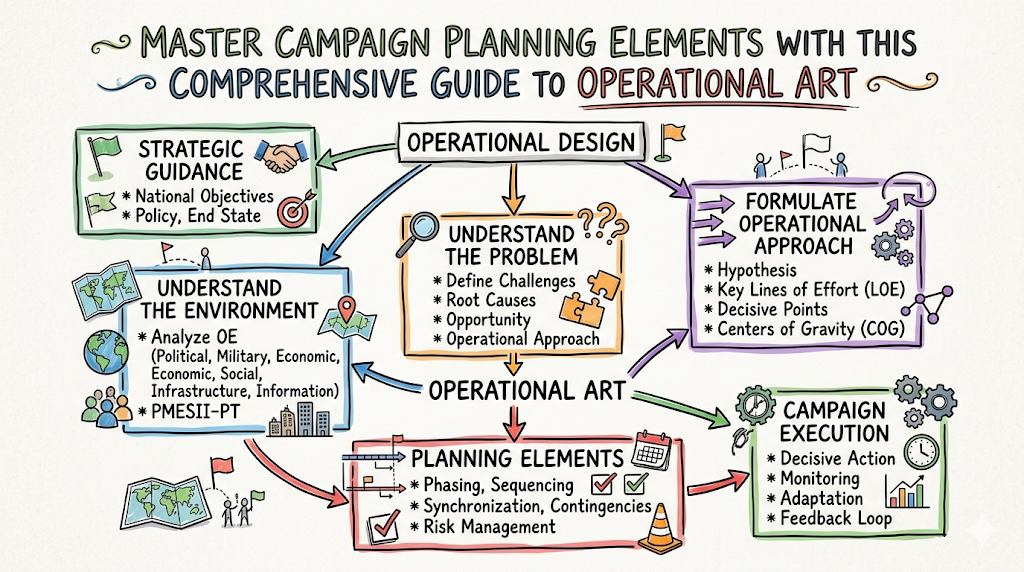
In simple terms, operational art is the skill of using tactical battles to achieve broad strategic objectives. It is the bridge between the grand vision of politicians and the gritty reality of soldiers on the ground. Without this crucial bridge, military campaigns fall apart. A nation might win every single fight on the battlefield but still completely fail to achieve its long-term goals. Understanding how these levels connect is the first step to mastering military history and strategic studies. In this deep-dive guide, you will learn how military planners think, design, and execute large-scale campaigns. We will explore historical roots, core principles, and how modern forces manage multi-front conflicts. If you are eager to deepen your knowledge of defense analysis and campaign design, explore the expert-curated resources provided by WarOpsX, your premium gateway to professional military education and strategic operational studies. Now let’s understand how this vital discipline came to be.
The Origins of Operational Art
Early Military Campaigns and Strategic Coordination
For centuries, armies were relatively small and easy to manage on a single field. A king or a general stood on a high hill, looked down at the battlefield, and gave direct orders. Warfare was direct, local, and contained.
Strategic objectives were achieved through single, decisive engagements. If you broke the enemy line in one afternoon, you often won the entire war. Force deployment was limited by the speed of marching soldiers and horse-drawn supply wagons.
The Evolution from Tactics to Campaign Design
As populations grew and industrial production soared, armies became far too massive for a single battlefield. Suddenly, wars stretched across entire continents. No single clash could decide the outcome of a conflict anymore.
Many beginners confuse tactics with operational art because both involve fighting. However, the rise of mass mobilization forced a massive change. Military leaders realized they needed a system to coordinate multiple interconnected battles over weeks and months.
The Emergence of Modern Operational Art
By the late nineteenth and early twentieth centuries, military theorists recognized a massive gap in traditional military doctrine. The scale of combat during major global conflicts demanded a new level of command and control.
Soviet military thinkers in the 1920s and 1930s were among the first to formalize this study. They called it “operational art” to distinguish it from small-scale tactical operations and high-level national military strategy. It emerged as a distinct discipline to govern the planning and execution of large-scale campaigns.
Understanding Operational Art in Warfare
The Core Concept of Operational Art
At its heart, operational art is a creative intellectual process. It is not a rigid checklist or a simple set of rules. Instead, it is the method used by commanders to organize thoughts, forces, and resources into a coherent campaign design.
In simple terms, it answers one fundamental question: “How do we string together a series of tactical actions to achieve a major strategic goal?” It requires a deep understanding of time, space, and human behavior.
Why Operational Art Matters
Without operational art, military strategy is just a list of wishful goals, and tactics are just random acts of violence. It matters because it ensures that every drop of fuel spent and every soldier deployed serves a larger purpose.
It manages the massive friction of war by balancing resources, keeping lines of communication open, and anticipating enemy reactions. This becomes critical when linking battlefield actions to strategic goals in highly volatile environments.
Strategy vs. Operational Art vs. Tactics
To fully grasp military doctrine, you must understand the classic three-tiered hierarchy of warfare:
- Strategic Level: This is the highest level, focused on national policy, long-term goals, and total resource mobilization.
- Operational Level: This is the middle bridge, where theater commanders design campaigns and sequence multiple operations over time.
- Tactical Level: This is the ground level, focused on the specific mechanics of individual battles, engagements, and small-unit movements.
The Campaign-Oriented Mindset
Operational thinkers do not focus on winning an isolated battle tomorrow morning. They possess a campaign-oriented mindset that looks weeks or months into the future.
They treat the entire theater of war as an evolving puzzle. They ask how a victory in one sector will create a vulnerability in another, constantly pushing toward the final strategic objective.
The 7 Core Principles of Operational Art
1. Objective
Every single military campaign must have a clear, realistic, and attainable objective. This objective guides every operational planning decision made by the staff.
Without a well-defined objective, forces drift into aimless operations, wasting valuable lives and resources. The operational commander must ensure that tactical victories directly advance this primary goal.
2. Mass
Mass means concentrating overwhelming combat power at the most critical time and place. It does not simply mean gathering the largest crowd of soldiers.
True mass involves synchronizing fires, electronic warfare, air power, and ground forces to shatter the enemy’s weakest point. It is about creating a localized advantage that changes the course of the campaign.
3. Maneuver
Maneuver is the art of positioning your forces to gain a position of relative advantage over the enemy. It focuses on flexibility, speed, and surprise.
By moving forces dynamically, you force the enemy to react constantly, disrupting their plans. Effective maneuver allows a smaller, faster force to defeat a much larger, static opponent.
4. Unity of Effort
A modern military campaign involves thousands of moving parts across land, sea, and air. Unity of effort ensures that all these diverse organizations work toward the exact same goal.
It requires clear command and control structures and open communication lines. When every branch and unit coordinates smoothly, the total combat power multiplies exponentially.
5. Sustainment and Logistics
An army cannot fight if it runs out of fuel, ammunition, or clean water. Sustainment is the continuous flow of supplies and services to units in the field.
Operational art places logistics at the center of all planning. A brilliant operational design is completely useless if the supply lines cannot keep pace with the advancing combat forces.
6. Operational Reach
Operational reach is the distance and time over which a military force can successfully suffer combat power. It defines the geographic limits of a campaign.
Commanders extend their reach by securing forward bases, improving logistics networks, and using long-range fires. When an army pushes beyond its operational reach, it risks sudden collapse.
7. Tempo and Initiative
Tempo is the speed and rhythm of military operations relative to the enemy. Maintaining a high tempo allows you to seize and keep the initiative.
By acting faster than the enemy can think and react, you dictate the terms of the conflict. You force them into a purely defensive mindset, destroying their cohesion.
Key Operational Art Concepts Every Beginner Must Know
Center of Gravity — Explained Simply
In simple terms, the Center of Gravity is the primary source of moral or physical strength, power, and resistance for an enemy force. It is the hub of all power that holds everything together.
If you protect your own Center of Gravity while destroying or neutralizing the enemy’s, you win the campaign. Identifying this critical point is the foundational step of any successful campaign design.
Lines of Operation and Lines of Effort
Lines of operation connect a military force from its starting base to its physical objectives on the map. They chart the physical movement of troops across a geographic landscape.
Lines of effort, on the other hand, link multiple tasks across non-physical domains, such as political influence, economic stability, and information operations, toward a single goal.
Operational Reach and Culmination
Every offensive campaign eventually runs out of steam. Culmination is the exact point in time and space where a military force can no longer sustain its advance or maintain its defensive posture.
An attacking force culminates when casualties, exhaustion, and stretched supply lines drain its combat power. Recognizing your own culmination point before it happens is a hallmark of great operational art.
Decisive Points
A decisive point is a specific geographic location, an event, or a critical capability that gives a commander a major advantage over the opponent. It is not the Center of Gravity itself, but it is a key that unlocks access to it.
Examples include a vital bridge, a major logistics hub, or an enemy communication center. Capturing these points systematically weakens the enemy’s overall cohesion.
Operational Design
Operational design is the intellectual framework that helps commanders understand unfamiliar, complex situations. It uses visualization to structure the campaign before writing detailed orders.
It forces planners to ask deep questions about the nature of the conflict, the enemy’s true motivations, and the desired future state of the region.
The Four Pillars of Successful Campaigns
- Leadership: Empowered commanders who can adapt to rapid chaos on the battlefield.
- Logistics: The unyielding backbone of supply lines that keeps the fighting forces fed and fueled.
- Intelligence: Accurate, timely situational awareness that reveals enemy intent and vulnerabilities.
- Coordination: Harmonious collaboration between different military branches and allied organizations.
Strategy vs. Operational Art vs. Tactics — What’s the Real Difference?
The Philosophy Difference
The difference between these three levels lies entirely in their scope, time horizons, and ultimate purpose. Strategy focuses on the “why” of a war, aiming for long-term political outcomes and peace terms.
Operational art looks at the “how” of a campaign, translating those political desires into achievable military milestones. Tactics deals exclusively with the “execute” phase, focusing on immediate physical combat on the ground.
Roles & Responsibilities Compared
- Strategic Leaders: Presidents, prime ministers, defense ministers, and top generals who balance international diplomacy, budgets, and national resource allocation.
- Operational Commanders: Theater commanders and joint task force leaders who allocate forces across a region and design long-term campaigns.
- Tactical Leaders: Battalion commanders, pilots, ship captains, and squad leaders who direct weapon systems and soldiers in direct contact with the enemy.
Can These Levels Function Independently?
Absolutely not. They are deeply interdependent and rely entirely on one another to achieve genuine victory. A brilliant strategy fails miserably if tactical operations cannot clear objectives.
Conversely, spectacular tactical victories mean absolutely nothing if they are not bound together by sound operational art. They must function as a single, unified system.
Which Level Has the Greatest Influence on Campaign Success?
While all levels matter, history shows that the operational level often exerts the greatest influence on the outcome of a campaign. It is where resource limitations meet strategic ambitions.
If a military gets its operational art wrong, even elite tactical troops will eventually be ground down by poor positioning, terrible logistics, and aimless battles.
Real-World Applications of Operational Art
Coordinating Multi-Front Campaigns
Imagine fighting an opponent who attacks from the north, south, and east simultaneously. Operational art provides the tools to balance forces across these multiple fronts safely.
Commanders decide where to accept risks by holding defensive lines with minimal forces, allowing them to mass decisive combat power on a single offensive front.
Joint Operations Across Military Branches
Modern warfare is rarely fought by an army alone. Success requires joint operations that blend land, air, maritime, cyber, and space capabilities into a single fist.
Operational art synchronizes these domains. For example, it ensures that air forces drop bridges to isolate an area just as ground forces begin their main assault.
Logistics and Sustainment Planning
Real operational planning involves moving mountains of material long before the first shot is fired. It requires predicting fuel consumption rates and setting up medical evacuation networks.
A master of operational art builds massive logistics hubs within safe distances, ensuring the frontline units never experience a sudden pause in combat capability.
Humanitarian and Stability Operations
Operational art is not strictly limited to high-intensity combat operations. It applies equally to massive disaster relief efforts and complex peacekeeping missions.
Planners use the exact same principles to coordinate food distribution, secure infrastructure, and restore local government services across chaotic, broken regions.
Modern Complex Operational Environments
Today’s operational environments are incredibly messy, filled with dense urban cities, dense civilian populations, and constant media scrutiny.
Operational art helps commanders filter through this noise. It allows them to design campaigns that achieve security goals while minimizing unintended damage and protecting critical infrastructure.
Common Misconceptions About Operational Art
Misconception 1 — Operational Art Is Just Large-Scale Tactics
Many people believe that operational art is just tactics with more tanks and larger maps. This is completely false.
Tactics is about the physics of fighting. Operational art is about the synergy of campaigns, focusing on the broader effects of those fights over time.
Misconception 2 — Strategy Alone Determines Victory
It is easy to look at history and assume that the nation with the biggest economy or smartest strategy always wins. However, excellent strategy fails without proper execution.
Operational art is the difficult, practical work of turning a great idea into an actual, functional reality on the ground.
Misconception 3 — Operational Art Applies Only to Major Wars
Some students assume this discipline is only useful during massive global conflicts. In reality, operational thinking is vital for limited brushfire wars and small interventions.
Even in a small-scale conflict, you must link your limited actions to a clear long-term political goal.
Misconception 4 — Logistics Is Secondary to Combat
Amateurs talk about weapons and tactics, while professionals study logistics. A common misconception is that logistics is just a boring background task.
In truth, logistics dictates the exact boundaries of what is operationally possible. It is the foundation of all operational art.
Misconception 5 — Technology Replaces Operational Thinking
Advanced sensors, drones, and satellite communications provide incredible amounts of data to modern command centers. However, data is not wisdom.
Technology cannot replace the creative human judgment required to outthink a clever opponent who is actively trying to deceive you.
Misconception 6 — Operational Art Is Only Relevant to Military Professionals
Many believe this field is too specialized for ordinary citizens. In truth, corporate leaders, historians, and policymakers benefit immensely from studying operational art.
It teaches you how to manage complex projects, align resources, and achieve large goals in highly competitive environments.
Essential Elements Supporting Operational Art
Command and Control Systems
Command and control systems are the nervous system of an army. They allow commanders to receive battlefield updates, process intelligence, and send out orders instantly.
Modern operational art relies on reliable, secure communications that connect high-level headquarters to front-line units without causing information overload.
Intelligence and Information Operations
You cannot plan a successful campaign in the dark. Intelligence provides an accurate picture of enemy locations, capabilities, and future intentions.
Information operations complement this by shaping public perception, confusing enemy scouts, and protecting your own plans from being discovered.
Logistics and Sustainment Networks
These networks include everything from deep-water ports and cargo aircraft to maintenance depots and field hospitals. They provide the endurance required for long campaigns.
An effective sustainment network adapts quickly, rerouting vital supplies when traditional routes are blocked or attacked by the enemy.
Joint and Combined Operations
Combined operations involve working smoothly alongside international allies who may speak different languages and use different equipment.
Operational art creates a common framework, ensuring that multinational forces work together effectively without dangerous misunderstandings.
Military Doctrine and Professional Education
Doctrine is the accumulated wisdom of past wars, written down to guide future actions. It provides a shared language for all military planners.
Professional education institutions keep this doctrine alive, challenging students to analyze past mistakes and develop innovative solutions for future challenges.
Becoming a Student of Operational Art
Essential Skills for Understanding Operational Art
To excel in this field, you must develop a specific set of intellectual skills. Chief among these is critical thinking, the ability to question assumptions and look at problems from multiple angles.
You also need a deep grasp of history, strong analytical skills, and the leadership capacity to make tough decisions with highly incomplete information.
Step-by-Step Learning Path
Start by studying simple tactical engagements to understand how basic combat works. Next, read about major historical campaigns, focusing heavily on how commanders handled supply lines and troop movements.
Finally, progress to analyzing modern military doctrine and strategic studies, looking at how nations blend military power with economic and political pressure.
Educational Programs and Study Resources Worth Exploring
Look for university courses in strategic studies, military history, or international relations. Read foundational texts by classical theorists and modern defense analysts.
Wargaming and campaign simulations are also fantastic tools, allowing you to test your planning skills against a dynamic, adaptive opponent.
Educational Resources with WarOpsX
If you are ready to take your education seriously, look no further than the specialized learning pathways available today. You can master these complex concepts easily with the training guides and expert analysis provided by WarOpsX.
The Future of Operational Art
Technology and Decision Support Systems
As we look ahead, artificial intelligence and advanced data processing are transforming how military staffs analyze information on the battlefield.
These decision support systems can instantly calculate fuel consumption, track thousands of assets, and predict enemy movements, allowing commanders to make decisions much faster.
Multi-Domain Operations
Future conflicts will not be restricted to land, sea, and air. They will simultaneously explode across the cyber world, electromagnetic spectrum, and outer space.
Operational art must adapt to synchronize these new domains, protecting vital satellite networks while launching targeted cyber disruptions against the adversary.
Information and Cognitive Dimensions of Warfare
Warfare is ultimately a clash of human wills. The cognitive dimension focuses on influencing the minds of enemy leaders, soldiers, and civilian populations.
Controlling the narrative through strategic communications and digital media has become just as important as capturing a physical hill.
Skills That Will Matter Most in Future Military Planning
The future military planner must be incredibly adaptable. They must balance deep technical literacy with an old-school understanding of human nature and grit.
Above all, the ability to think holistically, manage vast systems, and maintain clear head spaces amidst chaotic information overload will define the masters of future operational art.
FAQ Section
- What is operational art in simple terms?
Operational art is the intellectual bridge that connects high-level military strategy with ground-level tactics. It is the process where commanders design and execute interconnected campaigns to achieve large political goals.
- How does operational art differ from tactics?
Tactics focuses on winning individual battles and short-term engagements on the ground. Operational art looks at the bigger picture, focusing on how to sequence those individual battles over time to win an entire campaign.
- Why is logistics so important to operational art?
Logistics dictates the boundaries of what a military force can actually achieve. Without constant food, fuel, and ammunition, an advancing army will quickly culminate, leaving it vulnerable to defeat.
- Who created the concept of operational art?
While elements existed throughout history, modern operational art was formalized by Soviet military theorists during the 1920s and 1930s to handle the massive scale of industrial warfare.
- Can operational art be applied outside of traditional military conflicts?
Yes, its core principles of coordination, resource allocation, and goal alignment are heavily used in humanitarian disaster relief, corporate management, and complex government planning.
- How is technology changing the future of operational planning?
Technology provides massive amounts of real-time data and automated analysis, which helps commanders make decisions much faster across land, sea, air, space, and cyber domains simultaneously.
- What does the term Center of Gravity mean in campaign planning?
In simple terms, the Center of Gravity is the primary source of physical or moral strength that gives a military force its power and will to fight. Protecting yours while neutralizing the enemy’s is the key to winning a campaign.
- What happens when a military force experiences operational culmination?
Culmination occurs when an army completely runs out of momentum, supplies, or physical energy. At this exact point, the force can no longer safely continue its advance and must switch to a defensive posture to avoid collapse.
- How do lines of operation differ from lines of effort?
Lines of operation trace the physical, geographic movement of forces toward an objective on a map. Lines of effort connect non-physical actions, such as political influence, economic aid, or information campaigns, to achieve a strategic goal.
- Why is unity of effort critical in modern joint operations?
Modern campaigns involve diverse forces across land, sea, air, space, and cyber networks. Unity of effort ensures all branches share identical goals and clear command structures, preventing chaotic mistakes and multiplying overall combat power.
Final Summary
Operational art remains the vital link that transforms random tactical violence into meaningful, long-term strategic victory. By mastering concepts like the Center of Gravity, operational reach, and joint coordination, planners ensure that military forces operate with maximum efficiency and clear purpose. As warfare expands into the cyber and space domains, this creative intellectual discipline becomes more critical than ever before.