Introduction
The CDOM – Certified DataOps Manager is a professional credential designed to bridge the gap between data engineering, quality assurance, and IT operations. This guide is crafted for engineers and managers who recognize that data pipelines are now as critical as software delivery pipelines. As organizations move toward cloud-native architectures, the need for a structured approach to data management has become a primary requirement for platform engineering teams.
This comprehensive overview helps professionals navigate the complexities of data orchestration and lifecycle management. By understanding the core pillars of the Dataopsschool curriculum, you can make informed decisions about your career trajectory. This guide serves as a roadmap for those looking to transition from traditional operational roles into high-impact leadership positions within the data ecosystem.
What is the CDOM – Certified DataOps Manager?
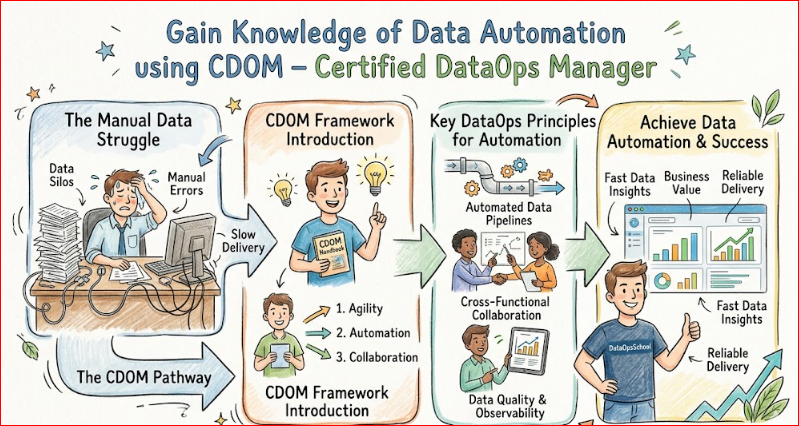
The CDOM – Certified DataOps Manager represents a shift in how modern enterprises handle data delivery. It is not merely a theoretical certification but a framework that emphasizes production-focused learning. It exists to solve the “data silo” problem by applying DevOps principles—such as continuous integration, continuous delivery, and automated testing—to data analytics and engineering workflows.
The certification focuses on the practical application of orchestration tools, data versioning, and environment management. It aligns with modern engineering workflows by treating data as code. Professionals who hold this credential are expected to manage complex environments where data freshness, accuracy, and security are handled through automated enterprise practices rather than manual intervention.
Who Should Pursue CDOM – Certified DataOps Manager?
This program is specifically designed for data engineers, site reliability engineers (SREs), and cloud architects who are tasked with scaling data infrastructure. It is equally valuable for engineering managers who need to oversee cross-functional teams consisting of data scientists and developers. Beginners with a strong foundation in Linux and cloud basics will find it a structured entry point into the world of data operations.
In the tech landscape and the global market, there is a massive surge in demand for professionals who can manage petabyte-scale data pipelines. Managers who want to understand the technical nuances of data governance and security should pursue this to better lead their teams. Experienced engineers looking to specialize in a niche yet high-paying domain will find this certification provides the necessary technical edge.
Why CDOM – Certified DataOps Manager is Valuable in the Future
The demand for DataOps expertise is driven by the sheer volume of data that enterprises must process in real-time. Unlike specific tool certifications that may lose relevance as technology shifts, this certification focuses on methodologies and architectural patterns. It ensures that professionals stay relevant by mastering the underlying principles of data flow and pipeline reliability that apply across any cloud provider or toolset.
Enterprise adoption of DataOps is increasing as companies realize that data quality issues directly impact their bottom line. By earning this certification, you demonstrate a commitment to operational excellence and cost-efficiency. It offers a significant return on time investment because it maps directly to the current pain points of modern businesses: speed of insight, data reliability, and regulatory compliance.
CDOM – Certified DataOps Manager Certification Overview
The program is delivered via the official portal and hosted on the primary website platform. The certification approach is heavily weighted toward practical assessments rather than just multiple-choice questions. It aims to validate that a candidate can actually build and manage a DataOps ecosystem in a simulated production environment.
The structure is divided into distinct levels that cater to different stages of a professional’s career. Ownership of the certification resides with the central training body, ensuring that the curriculum is updated regularly to reflect changes in industry standards. This practical approach ensures that the manager or engineer can walk into a real-world scenario and immediately begin optimizing data workflows.
CDOM – Certified DataOps Manager Certification Tracks & Levels
The certification is structured into three primary levels: Foundation, Professional, and Advanced. The Foundation level focuses on the “what” and “why” of DataOps, introducing core concepts like the DataOps Manifesto and basic pipeline automation. It is the starting point for those new to the intersection of data and operations.
The Professional level dives deep into specialization tracks including DevOps integration, SRE for data, and FinOps for cloud data costs. The Advanced level is geared toward leadership and strategy, focusing on building a DataOps culture and managing large-scale transformations. These levels align with a typical career progression from an individual contributor to a technical lead and finally to an engineering manager.
Complete CDOM – Certified DataOps Manager Certification Table
| Track | Level | Who it’s for | Prerequisites | Skills Covered | Recommended Order |
|---|---|---|---|---|---|
| Core DataOps | Foundation | Aspiring DataOps Engineers | Basic Cloud Knowledge | Data Pipelines, CI/CD Basics | 1 |
| Engineering | Professional | Data & DevOps Engineers | Experience in IT | Pipeline Orchestration, Testing | 2 |
| Architecture | Professional | SREs & Architects | Advanced Infrastructure | Data Monitoring, Scalability | 3 |
| Management | Advanced | Engineering Managers | Leadership Experience | Governance, ROI, Team Culture | 4 |
Detailed Guide for Each CDOM – Certified DataOps Manager Certification
CDOM – Certified DataOps Manager – Foundation
What it is This certification validates a candidate’s understanding of the fundamental principles of DataOps. It covers the core philosophy of improving data quality and reducing the cycle time of data analytics.
Who should take it It is suitable for junior data engineers, system administrators, and project managers. It is intended for those who need a solid conceptual base before moving into technical implementation.
Skills you’ll gain
- Understanding the DataOps Manifesto and its principles.
- Knowledge of basic data pipeline components and workflows.
- Familiarity with the concepts of continuous integration for data.
- Ability to identify bottlenecks in traditional data management.
Real-world projects you should be able to do
- Documenting a manual data workflow and proposing an automated alternative.
- Setting up a basic version control system for data transformation scripts.
- Creating a visual map of a data supply chain for a small organization.
Preparation plan
- 7-14 Days: Focus on the theoretical core and the DataOps Manifesto.
- 30 Days: Explore basic tools like Git and fundamental SQL for data movement.
- 60 Days: Detailed review of the integration between development and operations.
Common mistakes
- Overlooking the cultural aspects of DataOps in favor of only learning tools.
- Failing to understand how DataOps differs from traditional DevOps.
Best next certification after this
- Same-track option: CDOM – Professional Engineer.
- Cross-track option: Cloud Practitioner Certification.
- Leadership option: Project Management Professional (PMP).
CDOM – Certified DataOps Manager – Professional
What it is This level focuses on the technical execution of DataOps strategies. It validates the ability to build, monitor, and scale automated data pipelines using industry-standard tools and practices.
Who should take it Mid-level engineers, SREs, and data architects. It is for those who are responsible for the daily uptime and performance of enterprise data systems.
Skills you’ll gain
- Mastery of orchestration tools and pipeline management.
- Implementation of automated data quality testing and validation.
- Managing “Data as Code” using containerization and versioning.
- Configuring monitoring and alerting for complex data flows.
Real-world projects you should be able to do
- Building an end-to-end automated ETL pipeline with built-in testing.
- Implementing a data observability dashboard to track pipeline health.
- Automating the provisioning of data environments using Infrastructure as Code (IaC).
Preparation plan
- 7-14 Days: Review advanced SQL and Python scripting for data.
- 30 Days: Hands-on practice with orchestration and container tools.
- 60 Days: Building a full-scale capstone project that simulates a production failure.
Common mistakes
- Neglecting the security and compliance aspects of data movement.
- Building pipelines that are too rigid and cannot handle schema evolution.
Best next certification after this
- Same-track option: CDOM – Advanced Manager.
- Cross-track option: Certified SRE Professional.
- Leadership option: Technical Lead Certification.
CDOM – Certified DataOps Manager – Advanced
What it is This is a leadership-focused certification that validates the ability to lead a DataOps transformation. It covers strategy, organizational change, and high-level governance for data.
Who should take it Senior engineers, lead architects, and engineering managers. It is for professionals who want to move into senior director roles in data-driven companies.
Skills you’ll gain
- Developing a long-term DataOps strategy for an enterprise.
- Managing budgets and calculating the ROI of DataOps initiatives.
- Leading cross-functional teams and resolving cultural friction.
- Implementing advanced data governance and security frameworks.
Real-world projects you should be able to do
- Creating a roadmap for transitioning a legacy data warehouse to a DataOps model.
- Designing a governance framework for data privacy and compliance.
- Conducting a cost-benefit analysis of cloud data migrations.
Preparation plan
- 7-14 Days: Focus on leadership case studies and organizational theory.
- 30 Days: Study data governance laws and enterprise architecture patterns.
- 60 Days: Drafting a comprehensive digital transformation proposal.
Common mistakes
- Focusing too much on technical details and losing sight of business value.
- Underestimating the resistance to change within legacy teams.
Best next certification after this
- Same-track option: Specialized FinOps Certification.
- Cross-track option: Executive leadership training.
- Leadership option: Chief Data Officer preparation.
Choose Your Learning Path
DevOps Path
Engineers coming from a DevOps background should focus on applying their CI/CD knowledge to data. This path involves learning how “data” behaves differently than “compiled code,” particularly regarding state and volume. You will focus on automating data schema changes and integrating data quality checks into existing pipelines. The goal is to make data delivery as predictable as application deployment through the use of automated testing and versioning.
DevSecOps Path
The security path emphasizes the protection of sensitive data within the pipeline. Professionals here will learn about automated data masking, encryption at rest and in transit, and access control. You will focus on integrating security scanning tools into the data lifecycle to ensure compliance without slowing down the engineering team. This path is critical for industries like banking and healthcare that deal with highly sensitive consumer information.
SRE Path
The Site Reliability Engineering path focuses on the “Ops” side of DataOps. You will study service level indicators (SLIs) and service level objectives (SLOs) specifically for data pipelines. This includes learning how to manage “data toil” and implementing self-healing mechanisms for failed data jobs. It is about ensuring the high availability and performance of the data platform by treating it as a critical piece of operational infrastructure.
AIOps Path
This path explores how machine learning can be used to improve IT operations. You will learn to use models to predict pipeline failures, detect anomalies in data traffic, and automate root cause analysis. It involves a deep dive into the intersection of data operations and artificial intelligence to create “smarter” infrastructure that learns from its own telemetry and adjusts to changes automatically.
MLOps Path
MLOps is a specialized version of DataOps focused on the machine learning lifecycle. This path covers model versioning, feature stores, and the deployment of models into production. You will learn how to manage the unique data requirements of models, such as training data drift and model performance monitoring. It bridges the gap between data science and production engineering to ensure model reliability.
DataOps Path
This is the core path for those who want to be pure specialists in data flow. It focuses heavily on orchestration, data quality, and the collaborative aspects of the DataOps manifesto. You will spend most of your time mastering tools that manage the end-to-end journey of data from source to consumption. This path is ideal for those who want to build the “plumbing” of the modern data-driven enterprise.
FinOps Path
The FinOps path deals with the financial management of data infrastructure. As data storage and processing costs in the cloud can spiral out of control, this path teaches you how to optimize spend. You will learn about cost allocation, reserved instances for data clusters, and building dashboards that show the direct cost of every data query or pipeline run, ensuring maximum efficiency.
Role → Recommended CDOM – Certified DataOps Manager Certifications
| Role | Recommended Certifications |
|---|---|
| DevOps Engineer | CDOM Foundation, CDOM Professional Engineering |
| SRE | CDOM Professional Architecture, SRE Certification |
| Platform Engineer | CDOM Professional, Kubernetes Administrator |
| Cloud Engineer | CDOM Foundation, Cloud Architect Professional |
| Security Engineer | CDOM DevSecOps Track, Security Specialist |
| Data Engineer | CDOM Foundation, CDOM Professional Engineering |
| FinOps Practitioner | CDOM FinOps Track, FinOps Associate |
| Engineering Manager | CDOM Advanced Manager, Strategic Leadership |
Next Certifications to Take After CDOM – Certified DataOps Manager
Same Track Progression
Once you have mastered the CDOM Advanced level, you should look toward hyper-specialization in data engineering tools. This might include deep-dive certifications in cloud-native data warehouses and advanced distributed computing. Staying within the same track allows you to become a recognized subject matter expert who can handle the most complex data challenges an organization faces in its daily operations.
Cross-Track Expansion
To become a more versatile professional, consider expanding into the SRE or Security domains. A CDOM professional who also holds a Kubernetes certification or a security credential is exceptionally valuable. This broadening of skills allows you to understand how the data platform interacts with the underlying infrastructure and the broader security posture of the company, making you a more effective architect.
Leadership & Management Track
For those aiming for executive roles, the next step is often a move toward broader business management. Credentials focused on enterprise architecture or strategic leadership can complement your technical CDOM background. This transition is about moving from technical execution to business strategy, focusing on human capital management, budget oversight, and long-term organizational growth in a data-centric economy.
Training & Certification Support Providers for CDOM – Certified DataOps Manager
DevOpsSchool is a pioneer in the technical training space, offering extensive resources for professionals looking to master the DevOps and DataOps landscape. They provide a community-driven approach with a focus on real-world scenarios and hands-on labs that simulate production issues. Their trainers bring practical experience to the classroom, ensuring students learn skills that are immediately applicable. The institute has a strong reputation for producing engineers who are ready for high-stakes enterprise environments. They offer a blend of self-paced and instructor-led training to suit different learning styles and schedules. Their curriculum is frequently updated to include the latest industry standards, making them a reliable partner for career growth.
Cotocus stands out for its focus on enterprise-grade training and laboratory environments designed for high-performance teams. They specialize in high-end technical training for corporate groups, helping large organizations transition to modern cloud-native workflows effectively. Their approach to the CDOM program is deeply technical, focusing on the intricate details of pipeline orchestration and infrastructure as code. They provide a robust support system for students, including career counseling and technical mentorship throughout the certification journey. The training materials are designed to be practical, ensuring that participants can apply their learning to their professional tasks immediately. Their focus on quality and depth makes them a preferred choice for senior technical professionals.
Scmgalaxy is widely recognized for its vast repository of documentation, tutorials, and open-source contributions to the community. They offer a unique learning experience that is grounded in the reality of software configuration management and delivery systems. Their support for CDOM candidates includes a deep dive into the tools that facilitate DataOps, such as Git, Docker, and various CI/CD platforms. They foster a large community where professionals can share knowledge and solve complex technical problems together in a collaborative environment. Their training programs are known for being thorough and well-structured, catering to both beginners and advanced practitioners. They emphasize the importance of continuous learning and community engagement in the tech field.
BestDevOps focuses on providing career-centric training that helps engineers land high-impact roles in the global tech industry. Their CDOM curriculum is tailored to meet the specific demands of recruiters and hiring managers who look for specialized data talent. They offer personalized coaching and resume building services alongside technical training to ensure student success. Their instructors focus on the most relevant skills that are currently in high demand, ensuring a high return on investment for the students. The institute has a track record of successful placements in top-tier tech companies across various sectors. Their practical labs are designed to simulate the challenges faced by modern data teams.
Devsecopsschool is the primary destination for professionals who want to integrate security into every stage of the data lifecycle. They offer specialized modules that complement the CDOM certification, focusing on automated security testing and compliance for data pipelines. Their training emphasizes the “Security as Code” philosophy, teaching students how to build secure pipelines from the ground up. They provide hands-on experience with security scanning tools and threat modeling techniques specific to data infrastructure. This is an essential training partner for those working in highly regulated industries like finance. Their curriculum ensures that security is a fundamental component of the engineering workflow rather than an afterthought.
Sreschool provides a specialized focus on the reliability and availability aspects of modern DataOps ecosystems. Their training for the CDOM credential involves a deep understanding of monitoring, logging, and incident management for complex data systems. They teach the principles of SRE as applied to data, including error budgets and automated post-mortem analysis. Their labs are designed to teach students how to handle production outages and performance bottlenecks with precision and speed. This provider is ideal for engineers who want to ensure that their data platforms are robust and resilient under heavy loads. They bridge the gap between software reliability and data management with a highly practical curriculum.
Aiopsschool focuses on the cutting edge of operational intelligence and automated decision-making. They provide training on how to use artificial intelligence to automate and optimize IT operations for data-heavy organizations. Their support for CDOM includes teaching students how to implement AI-driven monitoring and anomaly detection in data pipelines. This training is crucial for organizations looking to scale their operations without significantly increasing manual oversight. Their instructors are experts in both AI and traditional operations, providing a unique perspective on the future of the industry. The courses are designed for forward-thinking professionals who want to lead the next wave of technological innovation in the cloud.
Dataopsschool is the central authority for the CDOM certification and provides the most direct and comprehensive training for the program. They own the curriculum and ensure that all training materials are perfectly aligned with the certification exam objectives. Their instructors are the very people who defined the standards for the CDOM credential, offering an unparalleled depth of insight. They offer a deep look into the DataOps manifesto and its practical applications across various industry sectors. The training includes access to exclusive labs and study groups that provide a collaborative learning environment. For those seeking the most direct path to certification, this is the primary provider to consider.
Finopsschool addresses the growing need for financial accountability and cost optimization in the cloud data world. They provide specialized training on how to manage and optimize the costs associated with massive data storage and processing. Their modules for CDOM candidates focus on cloud cost management tools, budgeting, and forecasting for data projects. They teach professionals how to build a culture of financial responsibility within engineering teams to avoid waste. This training is vital for managers and leads who need to justify their infrastructure spend to business stakeholders. Their approach combines financial literacy with technical expertise, providing a unique and highly valuable skill set for modern managers.
Frequently Asked Questions (General)
1. How long does it take to get certified?
Most professionals complete the foundation level in 4 weeks, while the professional and advanced levels typically require 8 to 12 weeks of dedicated study.
2. Is there a prerequisite for the foundation level?
There are no formal prerequisites for the foundation level, but a basic understanding of Linux, databases, and general IT operations is highly recommended.
3. How much hands-on experience is required for the professional level?
We recommend having a background in data engineering or DevOps to fully grasp the technical implementations covered in the professional track.
4. Can I take the exam online?
Yes, the exams are typically proctored online, allowing candidates from across the globe to take the certification from the comfort of their home or office.
5. What is the passing score for the CDOM exams?
The passing score is generally 70%, though this can vary slightly depending on the specific track and level of the certification program.
6. Do I need to know how to code?
For the engineering and professional tracks, a working knowledge of scripting and SQL is essential, as many labs involve automated data manipulation.
7. Is the certification recognized globally?
Yes, the CDOM credential is recognized by major enterprises worldwide as a benchmark for excellence in data operations and management.
8. How often do I need to recertify?
The certification is usually valid for two to three years, after which you may need to demonstrate continuous professional development or pass a bridge exam.
9. Are there group discounts for corporate teams?
Most training providers offer customized packages and discounts for organizations looking to certify their entire engineering or data management team.
10. What kind of tools will I learn?
You will gain exposure to a wide range of tools including orchestration platforms, container systems, and various cloud-native data services from major providers.
11. Is DataOps just for big data?
While it is essential for big data, DataOps principles are beneficial for any organization that relies on data for decision-making, regardless of volume.
12. How does this differ from a Data Engineering certification?
While data engineering focuses on building the pipelines, DataOps focuses on the operational excellence, quality, and speed of delivery of those pipelines.
FAQs on CDOM – Certified DataOps Manager
1. What makes the CDOM unique compared to other data certifications?
The CDOM focuses specifically on the “operational” side of data, emphasizing automation, quality control, and the cultural shift required to treat data with rigor.
2. Can a manager with no coding background pass the CDOM?
The Advanced Manager track is designed for leadership and focuses on strategy rather than deep coding, though a conceptual understanding of the technical stack is required.
3. How does CDOM address data privacy laws?
The curriculum includes specific modules on automated compliance and data governance, teaching you how to build privacy-by-design into your data pipelines from the start.
4. Is there a specific cloud provider focus in the CDOM?
No, the certification is cloud-agnostic, focusing on principles that can be applied to any major cloud provider or on-premises infrastructure effectively.
5. Does the CDOM cover machine learning operations?
While there is a dedicated MLOps path, the core CDOM certifications cover the foundational data delivery requirements that all machine learning models depend on for accuracy.
6. What is the ROI of getting a CDOM certification?
Professionals often see access to more senior roles, while organizations benefit from reduced cycle times and much higher data reliability across the enterprise.
7. Are the labs based on real-world scenarios?
Yes, the labs are designed to simulate actual production environments, including common failure modes, scaling challenges, and complex integration patterns found in the industry.
8. Is there community support for CDOM students?
Yes, most providers offer access to forums and study groups where you can interact with peers and mentors to solve technical hurdles during your preparation.
Final Thoughts
As a career mentor, I often tell engineers that the best investments are those that move you toward where the industry is going, not where it has been. DataOps is not a passing trend; it is the inevitable evolution of data engineering. The CDOM – Certified DataOps Manager is worth the effort because it provides a structured framework to master this evolution. It moves you away from firefighting data issues and toward building resilient, automated systems that drive business value.
If you are looking to future-proof your career and move into a high-impact role, this path is highly recommended. It offers a clear advantage in a competitive market where data is the primary asset. Focus on the learning, not just the badge, and you will find that the skills gained are immediately applicable and highly valued by any modern enterprise. This is about becoming a professional who can deliver data with the speed and reliability that today’s global businesses demand.