Introduction
The modern IT landscape is shifting from manual intervention to automated, intelligent operations. This guide is designed for professionals who want to master the intersection of artificial intelligence and IT operations through the Certified AIOps Architect program. Whether you are a DevOps engineer looking to scale or an SRE aiming for proactive reliability, understanding AIOps is no longer optional. This comprehensive roadmap, hosted by AIOpsSchool, provides the clarity needed to navigate advanced automation.
As organizations move toward cloud-native architectures, the sheer volume of telemetry data makes human monitoring impossible. This guide helps engineers and technical leaders understand how to apply machine learning to operations to reduce noise and improve mean time to resolution. By following this path, professionals can make informed career decisions that align with the future of autonomous infrastructure.
What is the Certified AIOps Architect?
The Certified AIOps Architect is a professional designation that validates an individual’s ability to design and implement AI-driven operational frameworks. It represents a shift from reactive monitoring to predictive and prescriptive analytics within the IT environment. Unlike theoretical courses, this program focuses on how to actually deploy machine learning models that manage logs, metrics, and traces at scale.
This certification exists because enterprise environments have become too complex for traditional rule-based systems. It aligns with modern engineering workflows by integrating with existing CI/CD pipelines and observability stacks. By mastering this domain, architects can ensure that their organization’s infrastructure is self-healing and capable of handling massive data throughput without increasing headcount.
Who Should Pursue Certified AIOps Architect?
This certification is ideally suited for SREs, DevOps engineers, and Platform engineers who are responsible for maintaining high-availability systems. Senior cloud professionals and security analysts who need to automate threat detection also find immense value in these advanced modules. While the program is technical, engineering managers who oversee digital transformation initiatives will benefit from the architectural insights provided.
Beginners with a strong foundation in Linux and cloud computing can use this certification to leapfrog into high-demand roles. For experienced engineers in India and across the globe, it serves as a differentiator in a saturated job market. Professionals working in high-growth sectors like Fintech, E-commerce, and SaaS will find the skills directly applicable to their day-to-day production challenges.
Why Certified AIOps Architect is Valuable Beyond Today
The demand for AIOps expertise is growing as enterprises realize that manual scaling is a bottleneck to innovation. Longevity in an engineering career today requires staying ahead of the automation curve, and this program provides that edge. By moving beyond simple scripts to intelligent algorithms, professionals can ensure their skills remain relevant as the industry moves toward autonomous environments.
Enterprise adoption of AI for IT operations is no longer a luxury but a necessity for survival in a data-driven economy. Investing time in this certification offers a high return on investment by positioning the professional as a strategic asset rather than just a tool operator. It empowers architects to lead high-impact projects that directly contribute to organizational efficiency and cost reduction.
Certified AIOps Architect Certification Overview
The program is delivered via the official portal at Certified AIOps Architect and is hosted on the AIOpsSchool platform. It is structured to provide a logical progression from fundamental concepts to complex architectural design. The assessment approach is rigorous, involving both theoretical examinations and practical laboratory evaluations to ensure hands-on competence.
Ownership of the certification rests with industry experts who have built and managed large-scale production environments. The structure is broken down into specific tracks that cater to different organizational needs, ensuring that the learning is modular. This practical approach ensures that the certificate holder is ready to lead AIOps implementations in real-world enterprise settings.
Certified AIOps Architect Certification Tracks & Levels
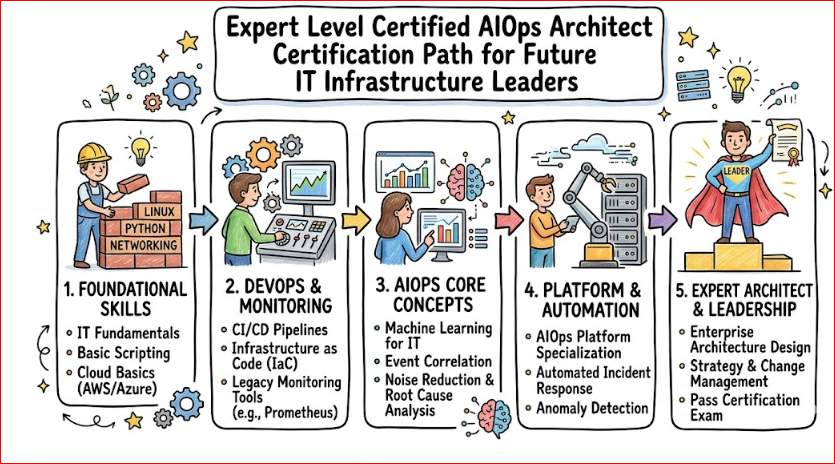
The certification is divided into three primary levels: Foundation, Professional, and Advanced. The Foundation level focuses on the terminology, data sources, and basic ML concepts required for IT operations. It acts as the gateway for those new to the field, ensuring a common language and understanding of the AIOps lifecycle across the entire organization.
The Professional level dives deeper into specific implementation tracks such as AIOps for SRE or AIOps for FinOps. The Advanced level is where candidates learn to architect end-to-end autonomous systems, integrating multi-cloud environments and complex data lakes. These levels align with career progression, moving from individual contributor roles to lead architect and technical director positions.
Complete Certified AIOps Architect Certification Table
| Track | Level | Who it’s for | Prerequisites | Skills Covered | Recommended Order |
| Core AIOps | Foundation | Beginners, Managers | Basic IT Ops | Data types, NLP basics, Monitoring | 1st |
| Operations | Professional | SREs, DevOps | Foundation Level | Anomaly detection, Root cause analysis | 2nd |
| Architecture | Advanced | Senior Engineers | Professional Level | Scalable ML pipelines, Model Governance | 3rd |
| Optimization | Specialization | FinOps, DataOps | Professional Level | Cost optimization, Data quality | Optional |
Detailed Guide for Each Certified AIOps Architect Certification
Certified AIOps Architect – Foundation
What it is
This certification validates the fundamental understanding of how artificial intelligence intersects with IT operations. It covers the basic vocabulary, the need for AIOps, and the various types of data used in machine learning models.
Who should take it
It is designed for junior engineers, IT managers, and traditional operations staff who want to understand the modern automation landscape. No deep coding experience is required, but a general understanding of IT infrastructure is helpful.
Skills you’ll gain
- Understanding the AIOps lifecycle.
- Identifying different data sources like logs, metrics, and events.
- Basic understanding of supervised vs. unsupervised learning in Ops.
- Knowledge of incident management workflows.
Real-world projects you should be able to do
- Map an existing monitoring stack to an AIOps framework.
- Categorize IT data for ingestion into a machine learning platform.
Preparation plan
- Explain 7–14 days: Focus on terminology and the official study guide. 30 days: Review case studies of enterprise AIOps implementations. 60 days: Not typically required for this level unless new to IT.
Common mistakes
- Overcomplicating the math behind the algorithms instead of focusing on use cases. Ignoring the cultural shift required for AIOps adoption.
Best next certification after this
- Same-track option: Professional Level AIOps.
- Cross-track option: Foundation SRE.
- Leadership option: Technical Product Management.
Certified AIOps Architect – Professional
What it is
This level focuses on the practical implementation of AI tools within existing DevOps and SRE workflows. It validates the ability to configure and manage AIOps platforms to solve specific operational problems.
Who should take it
Active SREs, DevOps Engineers, and Cloud Architects who have at least two years of experience in managing production environments. It is for those who are ready to move from manual monitoring to automated insights.
Skills you’ll gain
- Implementing anomaly detection algorithms.
- Configuring automated root cause analysis (RCA).
- Managing event correlation to reduce alert fatigue.
- Integrating AI insights into CI/CD pipelines.
Real-world projects you should be able to do
- Reduce alert noise by 50% using event correlation techniques.
- Set up a predictive scaling mechanism for a Kubernetes cluster.
Preparation plan
- Explain 7–14 days: Brush up on Python and basic data science libraries. 30 days: Complete hands-on labs on anomaly detection. 60 days: Full deep dive into log aggregation and ML integration.
Common mistakes
- Failing to clean and normalize data before feeding it into models. Setting thresholds too tight, leading to false positives.
Best next certification after this
- Same-track option: Advanced Architect Level.
- Cross-track option: MLOps Certification.
- Leadership option: Engineering Manager Track.
Certified AIOps Architect – Advanced
What it is
The Advanced level is the pinnacle of the program, validating the ability to design global-scale, autonomous IT systems. It focuses on governance, model lifecycle management, and enterprise-wide architectural strategy.
Who should take it
Principal Engineers, Chief Architects, and Senior Technical Leads who are responsible for the overall technology strategy of an organization. Candidates should have extensive experience in distributed systems.
Skills you’ll gain
- Designing multi-tenant AIOps platforms.
- Implementing ModelOps for operational machine learning.
- Governance and ethical AI practices in operations.
- Advanced cost-benefit analysis of AI implementations.
Real-world projects you should be able to do
- Architect a cross-cloud autonomous monitoring fabric.
- Design a self-healing system that resolves 30% of incidents without human intervention.
Preparation plan
- Explain 7–14 days: Review high-level architectural patterns. 30 days: Deep dive into enterprise security and governance. 60 days: Focus on multi-tool integration and custom model development.
Common mistakes
- Focusing on a single vendor tool rather than an agnostic architecture. Underestimating the storage and compute costs of AIOps at scale.
Best next certification after this
- Same-track option: Specialized FinOps for AIOps.
- Cross-track option: Data Strategy Architect.
- Leadership option: CTO Leadership Program.
Choose Your Learning Path
DevOps Path
The DevOps path focuses on integrating intelligence into the software delivery lifecycle. Professionals start by automating testing and deployment feedback loops using AI. The goal is to move from continuous integration to “intelligent” integration where the system predicts deployment failures. This path is ideal for those who want to reduce the friction between development and operations teams by using data to justify changes.
DevSecOps Path
In this path, the focus is on utilizing AI for proactive threat detection and vulnerability management. Architects learn how to use machine learning to identify patterns of malicious behavior that traditional signature-based tools miss. It emphasizes the “Security as Code” philosophy powered by autonomous response mechanisms. This is critical for organizations operating in highly regulated industries that require constant compliance monitoring and rapid remediation.
SRE Path
The Site Reliability Engineering path centers on using AIOps to maintain and improve Service Level Objectives. It involves building systems that can automatically perform root cause analysis and execute remediation scripts. Professionals learn to balance the error budget using predictive analytics to forestall outages. This path is the most common for those seeking to reduce on-call fatigue and improve the overall life of the engineering team.
AIOps Path
The pure AIOps path is dedicated to the holistic management of IT ecosystems through artificial intelligence. It covers everything from data ingestion and normalization to complex event processing and prescriptive actions. This path focuses on the overarching architecture of the modern operations center. It is designed for those who want to be the primary architects of intelligent infrastructure and lead the transition to autonomous systems.
MLOps Path
The MLOps path bridges the gap between data science and production engineering. It focuses on the lifecycle of machine learning models themselves—ensuring they are deployed, monitored, and retrained effectively. While AIOps uses ML to run IT, MLOps uses IT principles to run ML. This is a vital specialization for companies that rely on proprietary AI models for their core business and need to ensure model reliability.
DataOps Path
DataOps focuses on the automated, policy-based management of data pipelines that feed into AIOps systems. This path ensures that the fuel for AI is high-quality, timely, and compliant. Professionals learn how to treat data as code and apply DevOps principles to data engineering. It is essential for ensuring the accuracy and reliability of AI-driven insights across the enterprise.
FinOps Path
The FinOps path leverages AIOps to manage and optimize cloud spending in real-time. By using predictive models, architects can forecast cloud bills and identify anomalous spending patterns before they become a problem. This path focuses on the unit economics of the cloud, helping organizations achieve maximum value from their infrastructure investment. It is a high-growth area as cloud budgets continue to expand and require tighter control.
Role → Recommended Certified AIOps Architect Certifications
| Role | Recommended Certifications |
| DevOps Engineer | Foundation + Professional (Ops Track) |
| SRE | Professional (SRE Track) + Advanced |
| Platform Engineer | Professional + Advanced Architect |
| Cloud Engineer | Foundation + Cloud Specialization |
| Security Engineer | DevSecOps Track + Professional |
| Data Engineer | DataOps Track + Professional |
| FinOps Practitioner | FinOps Specialization |
| Engineering Manager | Foundation + Advanced (Strategy Focus) |
Next Certifications to Take After Certified AIOps Architect
Same Track Progression
For those who wish to go deeper into the world of intelligent operations, the next step involves pursuing specialized micro-certifications. These could include deep dives into specific algorithmic sets like Natural Language Processing for log analysis or reinforcement learning for autonomous scaling. Deepening your expertise ensures you remain the go-to authority for AI-driven transformation within your vertical.
Cross-Track Expansion
Broadening your skills is essential for a well-rounded architect. After mastering AIOps, moving into MLOps or DataOps provides a more comprehensive view of the modern data-driven enterprise. Understanding how the models are built and how data flows through the organization allows an architect to solve problems at their source rather than just at the operational layer.
Leadership & Management Track
If you are looking to transition into leadership, the next logical step is moving toward strategic certifications. This involves learning about technology governance, team building, and the financial management of large-scale engineering departments. Combining technical AIOps mastery with leadership skills makes you a prime candidate for Director of Engineering or VP of Infrastructure roles.
Training & Certification Support Providers for Certified AIOps Architect
DevOpsSchool
DevOpsSchool is a pioneer in technical training, offering an extensive library of courses that cover the entire DevOps and AIOps spectrum. They focus on providing hands-on experience through a combination of live instructor-led sessions and recorded modules. Their curriculum is updated frequently to reflect the latest industry trends and toolsets, making them a reliable choice for professionals. With a large community of alumni and expert trainers, they offer significant support for candidates preparing for architectural certifications. Their training style is geared toward practical application, ensuring that students can apply what they learn immediately in their professional roles.
Cotocus
Cotocus specializes in consulting-led training, which means their instructors are often active practitioners who bring real-world scenarios into the classroom. They provide a tailored approach to learning, focusing on the specific needs of enterprise teams and individual professionals alike. Their training modules for AIOps are designed to bridge the gap between traditional IT management and modern AI-driven practices. By emphasizing architectural patterns and best practices, Cotocus helps students build a solid foundation for high-level certifications. They are known for their interactive sessions and comprehensive study materials that simplify complex technical concepts for better retention.
Scmgalaxy
Scmgalaxy is more than just a training provider; it is a massive community hub for software configuration management and DevOps professionals. They offer a wealth of free resources, tutorials, and blogs that supplement their formal certification programs. Their AIOps training is grounded in the reality of managing complex software supply chains and production environments. For candidates who prefer a community-driven learning environment, Scmgalaxy provides the perfect platform to interact with peers and experts. Their commitment to knowledge sharing makes them a valuable resource for anyone looking to stay updated on the latest automation technologies.
BestDevOps
BestDevOps focuses on delivering high-quality, career-oriented training that targets specific job roles within the modern IT ecosystem. Their AIOps certification support is structured to help professionals transition into senior roles by focusing on the most in-demand skills. They provide a blend of theoretical knowledge and intensive lab work to ensure that candidates are ready for the rigors of the certification exam. BestDevOps is recognized for its clear instructional design and the ability to break down advanced architectural concepts into digestible modules. Their focus on student success is evident in their personalized mentorship and comprehensive career guidance.
devsecopsschool.com
This provider is the go-to resource for professionals looking to integrate security into their automated workflows. DevSecOpsSchool offers specialized training that highlights the intersection of security, development, and operations through the lens of AI. Their curriculum is essential for AIOps architects who need to understand how to protect intelligent systems from emerging threats. They provide deep insights into automated compliance, vulnerability scanning, and proactive threat hunting. By focusing on “Security as Code,” they empower engineers to build resilient and secure autonomous infrastructures. Their courses are highly technical and designed for those who want to lead security-first engineering initiatives.
sreschool.com
SRESchool is dedicated entirely to the discipline of Site Reliability Engineering, making it an ideal partner for AIOps candidates. Their training programs focus on the core pillars of reliability, such as monitoring, incident response, and capacity planning, enhanced by AI. They teach students how to use machine learning to manage error budgets and improve system uptime. The courses at SRESchool are built around the practical challenges faced by SRE teams in high-scale environments. For those pursuing an AIOps Architect certification, SRESchool provides the deep operational context required to implement AI tools effectively for maximum reliability.
As the primary host and provider of the Certified AIOps Architect program, AIOpsSchool offers the most direct and comprehensive learning path. They are specialists in this specific niche, ensuring that every module is aligned with the latest advancements in AI for IT operations. Their platform is designed for a seamless learning experience, featuring integrated labs and assessment tools. They provide the most authoritative content for the certification, backed by a faculty of industry veterans. Choosing AIOpsSchool ensures that you are learning from the source, with a curriculum that is specifically designed to meet the certification standards.
dataopsschool.com
DataOpsSchool addresses the critical need for efficient data management within the AIOps ecosystem. Their training focuses on building automated data pipelines that are robust, scalable, and secure. Since AIOps is only as good as the data it consumes, the skills taught here are foundational for any aspiring architect. They cover data quality, orchestration, and governance using modern DevOps principles. Professionals learn how to treat data as a first-class citizen in the automation world. This training is vital for those who want to ensure that their AI-driven insights are accurate and actionable in a production setting.
finopsschool.com
FinOpsSchool provides the specialized training needed to manage the financial aspects of cloud computing through intelligent automation. Their courses teach professionals how to use AI to drive accountability and optimize cloud costs across the enterprise. This is an essential skill for AIOps architects who need to justify the ROI of their automation projects. They focus on the cultural shift of cloud financial management and the technical tools needed to achieve it. By learning at FinOpsSchool, candidates gain the ability to align technical infrastructure with business value, making them invaluable to their organizations’ leadership.
Frequently Asked Questions (General)
- How difficult is the certification?
The difficulty increases with each level. The Foundation is accessible, while the Advanced level requires deep architectural knowledge and experience.
- What are the prerequisites for the Architect level?
Typically, you need to have completed the Professional level or have equivalent industry experience in senior SRE or DevOps roles.
- How long does it take to get certified?
Depending on your experience, it can take anywhere from one month for the Foundation to six months for the full Architect path.
- Is there a recertification requirement?
To ensure you stay updated with rapidly changing technology, recertification is usually required every two to three years.
- What is the ROI of this certification?
Professionals often see significant salary increases and better job opportunities as they move into high-demand AI and automation roles.
- Can the exam be taken online?
Yes, most providers, including AIOpsSchool, offer proctored online examinations for the convenience of global candidates.
- Is coding required for AIOps?
A basic to intermediate understanding of Python or Go is highly recommended for implementing and customizing ML models.
- Does this certification cover specific tools?
While it covers popular tools, the focus is on architectural principles that can be applied to any AIOps vendor or open-source stack.
- Are there lab components in the exam?
For the Professional and Advanced levels, practical lab exercises are a core part of the assessment process to prove skill.
- Is this recognized globally?
The Certified AIOps Architect designation is recognized by major tech hubs in India, the US, Europe, and beyond.
- How does this differ from a standard AI certification?
This is specifically focused on IT operations, not general AI research or traditional software development.
- Can managers benefit from this?
It provides the strategic framework needed to lead teams and make informed procurement decisions for automation tools.
FAQs on Certified AIOps Architect
- What specific problems does AIOps solve in the enterprise?
AIOps addresses the challenge of data silos and alert fatigue by correlating vast amounts of telemetry data. It helps teams identify the root cause of issues faster than manual investigation, preventing major outages. It also enables predictive scaling, ensuring that resources are available before they are needed.
- How does AIOps integrate with existing SRE practices?
AIOps enhances SRE by automating the toil associated with monitoring and incident response. It provides the data-driven insights needed to manage SLOs and SLIs more effectively. Instead of manually setting thresholds, SREs use AI to detect dynamic anomalies in system behavior.
- Is AIOps only for cloud-native environments?
While AIOps is highly effective in cloud-native setups, it is equally valuable for hybrid and on-premise legacy infrastructures. The principles of data-driven automation apply whenever there is a large volume of operational data. It helps bridge the gap during complex digital transformations.
- What is the role of an AIOps Architect in a team?
The architect designs the strategy for data ingestion, model selection, and integration with existing tools. They ensure that the AIOps platform aligns with business goals and scales with the organization. They also oversee the governance and maintenance of the operational models.
- Is a data science background necessary to succeed?
A data science background is not required. You need to be a data-aware engineer who understands how to apply machine learning models to solve operational problems. The focus is on the application of the technology, not the research.
- What are the key data sources for AIOps?
The three main pillars are logs, metrics, and traces. Additionally, AIOps platforms often ingest event data, change requests, and incident tickets to provide a holistic view of the IT environment. This diversity of data is what makes AI insights powerful.
- Can AIOps automate incident remediation?
One of the advanced goals of AIOps is closed-loop automation. This involves the system not only identifying a problem but also executing a verified script to fix it. This significantly reduces the time that human engineers spend on repetitive issues.
- How can AIOps costs be justified to leadership?
Focus on the reduction in Mean Time to Resolution and the prevention of downtime costs. Mention the efficiency gains from reducing alert fatigue and the ability to scale operations without proportional increases in headcount.
Final Thoughts
From a mentor’s perspective, the answer depends on your career trajectory. If you plan to stay in the operations or infrastructure space, then moving toward intelligent automation is inevitable. The days of manual system administration are fading, and being an architect who can leverage AI is a significant career advantage. This certification provides a structured and validated way to prove that you have those skills.
However, do not view this as a magic bullet. A certification is only as good as the practical experience you build alongside it. Use the knowledge gained here to solve real problems in your current role. If you are willing to put in the effort to master both the theory and the hands-on application, the Certified AIOps Architect program is a highly valuable investment in your professional future.