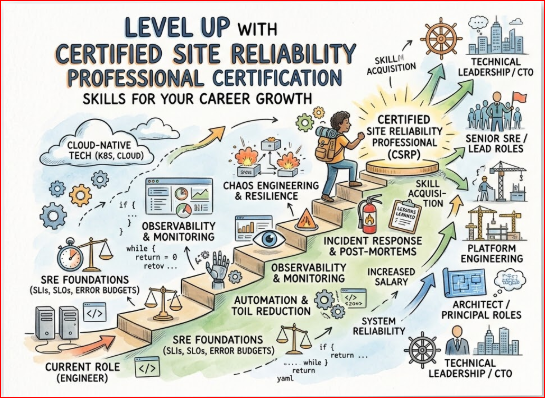
The Certified Site Reliability Professional is an industry-leading credential designed for engineers who want to bridge the gap between software development and systems operations. This guide, curated by Sreschool, serves as a strategic roadmap for professionals navigating the complexities of modern cloud-native ecosystems and distributed systems. By focusing on reliability as a first-class feature, this certification helps engineers move beyond reactive troubleshooting into proactive system engineering and architecture. This guide is built to help managers and engineers make informed decisions about their technical career path within the global DevOps and SRE landscape.
What is the Certified Site Reliability Professional?
The Certified Site Reliability Professional is a specialized program that codifies the practices required to run large-scale, fault-tolerant systems in production. It goes beyond the basic “how-to” of tools and focuses on the “why” and “how” of engineering for high availability, performance, and latency. The curriculum emphasizes real-world application, ensuring that practitioners can handle the pressure of live production environments using software engineering disciplines. It aligns perfectly with modern enterprise practices where the speed of delivery must be balanced with the stability of the platform.
Who Should Pursue Certified Site Reliability Professional?
This certification is designed for software engineers, DevOps practitioners, and platform engineers who are responsible for the uptime and health of digital services. It is equally valuable for security professionals and data engineers who need to understand the operational constraints of the systems they support. In the Indian market and across the global tech landscape, this credential serves as a benchmark for technical leaders and engineering managers. Whether you are a beginner looking to enter the field or a veteran looking to formalize your experience, this track provides the necessary rigor.
Why Certified Site Reliability Professional is Valuable Today and Beyond
The demand for reliability expertise is skyrocketing as organizations move away from traditional infrastructure toward complex, microservices-based architectures. This certification ensures that you remain relevant by teaching principles like error budgets and toil reduction that are independent of specific cloud providers. As companies prioritize customer experience, the ability to maintain a reliable service becomes a major competitive advantage for both the firm and the individual. Investing time in this certification provides a high return by positioning you for high-impact roles in the most technologically advanced companies.
Certified Site Reliability Professional Certification Overview
The program is delivered via the official course curriculum hosted on the Sreschool website and follows a tiered approach to professional development. It covers various certification levels that assess a candidate’s ability to handle incident management, observability, and automation at scale. The ownership of the program lies with industry veterans who ensure that the assessment criteria remain aligned with current industry benchmarks and technical shifts. By focusing on practical assessments, the program ensures that every certified professional is ready to contribute to a production team immediately.
Certified Site Reliability Professional Certification Tracks & Levels
The certification is structured into Foundation, Professional, and Advanced levels to cater to different stages of an engineer’s career. The Foundation level introduces the SRE mindset, while the Professional level focuses on implementation strategies like SLOs and error budgets in active environments. The Advanced level is reserved for those designing entire reliability frameworks and managing cross-functional technical debt at the enterprise level. These levels allow for a natural progression, enabling a professional to grow from an individual contributor to a technical architect or leader over time.
Complete Certified Site Reliability Professional Certification Table
| Track | Level | Who it’s for | Prerequisites | Skills Covered | Recommended Order |
| Core SRE | Foundation | Junior Engineers, Students | Basic Linux & Coding | SRE Mindset, SLIs, SLOs | 1st |
| Implementation | Professional | DevOps & Cloud Engineers | 2+ Years Production Exp | Error Budgets, Toil, Incident Mgmt | 2nd |
| Strategy | Advanced | Senior SREs, Architects | 5+ Years Industry Exp | Disaster Recovery, Chaos Eng | 3rd |
| Leadership | Management | Tech Leads, Managers | Leadership Background | SRE Culture, Metrics, Hiring | Optional |
Detailed Guide for Each Certified Site Reliability Professional Certification
Certified Site Reliability Professional – Foundation
What it is
This entry-level certification validates a professional’s understanding of the core Site Reliability Engineering vocabulary and the cultural shift from traditional Ops to SRE. It ensures that the candidate understands the fundamental goal of balancing feature velocity with system stability.
Who should take it
This is intended for recent graduates, junior system administrators, and software developers who are new to the operational side of cloud-native applications. It is also a great starting point for product managers who want to understand the technical constraints of their engineering teams.
Skills you’ll gain
- Defining and measuring Service Level Objectives (SLOs) and Indicators (SLIs).
- Understanding the concept of “Toil” and how to identify it in daily tasks.
- Basic understanding of monitoring, alerting, and logging systems.
- Familiarity with the SRE manifesto and Google’s reliability principles.
Real-world projects you should be able to do
- Create a simple dashboard showing the health of a web service using SLIs.
- Draft a basic incident response plan for a small-scale application.
- Identify and document three manual tasks that can be automated to reduce toil.
Preparation plan
- 7-14 Days: Focus on the official glossary and read the introductory chapters of the SRE Handbook.
- 30 Days: Complete the foundational video modules and take multiple practice quizzes to reinforce core concepts.
- 60 Days: This timeframe is usually reserved for those with zero technical background to learn basic Linux and networking alongside the SRE content.
Common mistakes
- Confusing SRE with just a “newer version of DevOps” without understanding the specific reliability metrics.
- Focusing purely on monitoring tools while ignoring the human and cultural aspects of the SRE role.
Best next certification after this
- Same-track option: Certified Site Reliability Professional – Professional
- Cross-track option: Certified DevOps Professional
- Leadership option: Engineering Management Foundation
Certified Site Reliability Professional – Professional
What it is
This certification validates the practical ability to implement SRE frameworks in a production-grade environment. It proves that the engineer can manage error budgets, lead an on-call rotation, and build automated systems to handle repetitive operational burdens.
Who should take it
This level is designed for mid-level DevOps engineers and SREs who have at least two years of experience in managing cloud infrastructure. It is the gold standard for professionals who are responsible for the daily uptime of high-traffic digital platforms.
Skills you’ll gain
- Implementing and managing Error Budgets to negotiate deployment frequency.
- Advanced incident response, including incident command structures and post-mortems.
- Automating operations through infrastructure-as-code and self-healing scripts.
- Designing and implementing observability stacks with Prometheus and Grafana.
Real-world projects you should be able to do
- Configure a full observability stack that alerts based on SLO burn rates rather than simple CPU spikes.
- Conduct a blameless post-mortem for a simulated production failure and implement the resulting action items.
- Build an automated canary release pipeline that rolls back based on real-time health metrics.
Preparation plan
- 7-14 Days: Review advanced SLO mathematics and incident management protocols used in enterprise settings.
- 30 Days: Hands-on lab work focusing on setting up alerts and automating response scripts for common failure modes.
- 60 Days: Deep dive into case studies of major outages and the architectural solutions that were used to prevent them.
Common mistakes
- Creating “alert fatigue” by setting up too many notifications that don’t require immediate action.
- Failing to prioritize blamelessness during post-mortems, which leads to hidden errors and recurring incidents.
Best next certification after this
- Same-track option: Certified Site Reliability Professional – Advanced
- Cross-track option: Certified DevSecOps Professional
- Leadership option: Technical Lead Certification
Certified Site Reliability Professional – Advanced
What it is
The Advanced certification validates the expertise required to design resilient distributed systems at a global scale. It focuses on the architectural decisions, disaster recovery strategies, and the organizational leadership required to maintain reliability across multiple products.
Who should take it
This is meant for Senior SREs, Principal Engineers, and Architects who have over five years of experience in high-scale environments. It is for those who are responsible for the long-term technical strategy and reliability roadmap of an entire organization.
Skills you’ll gain
- Designing distributed systems for high availability and cross-region disaster recovery.
- Implementing chaos engineering practices to proactively find system weaknesses.
- Managing technical debt and reliability across complex multi-cloud environments.
- Leading organizational change and establishing a high-performance SRE culture.
Real-world projects you should be able to do
- Design a multi-region architecture that can survive a total regional failure with zero data loss.
- Establish a chaos engineering experiment that tests the resilience of a critical payment gateway.
- Create an enterprise-wide reliability framework that standardizes SLOs across fifty different microservices.
Preparation plan
- 7-14 Days: Review high-level system design patterns and distributed consensus algorithms like Raft or Paxos.
- 30 Days: Focus on the strategy of reliability, including hiring practices and organizational design for SRE teams.
- 60 Days: Complete a comprehensive architectural audit and draft a three-year reliability strategy for a hypothetical enterprise.
Common mistakes
- Focusing too much on “perfect” reliability instead of the reliability that is actually required by the business and the users.
- Ignoring the cost implications of high-availability designs, leading to architectures that are too expensive to maintain.
Best next certification after this
- Same-track option: SRE Fellowship or Distinguished Engineer Track
- Cross-track option: Certified Cloud Solutions Architect
- Leadership option: Director of Reliability or CTO Training
Choose Your Learning Path
DevOps Path
The DevOps path focuses on the speed and quality of software delivery. By integrating the Certified Site Reliability Professional knowledge, DevOps engineers can ensure that their CI/CD pipelines are not just fast, but also resilient. This path is ideal for those who want to build the automation that connects developers with production environments.
DevSecOps Path
The DevSecOps path integrates security into the heart of the reliability and delivery lifecycle. Engineers on this path use SRE principles to automate security scanning and response, ensuring that the system is as secure as it is stable. It is a critical path for anyone working in highly regulated industries or sensitive data environments.
SRE Path
The pure SRE path is the most direct way to become an expert in system performance and reliability. This path focuses on observability, capacity planning, and the engineering of the internal platforms that support the company’s applications. It is the best choice for engineers who enjoy deep technical challenges and solving production mysteries.
AIOps Path
The AIOps path focuses on using machine learning and data science to improve operational efficiency. Professionals on this path apply SRE metrics to the models that predict outages and automate incident resolution. It is a specialized track for those looking to manage the next generation of intelligent, self-healing infrastructure.
MLOps Path
The MLOps path is dedicated to the unique challenges of running machine learning models in production at scale. SRE principles are used here to monitor model health, manage data drift, and ensure that the inference infrastructure is always available. This is an essential path for organizations that are integrating AI into their core product offerings.
DataOps Path
The DataOps path applies the rigor of reliability engineering to data pipelines and big data clusters. It ensures that data is high-quality, available, and consistent for the downstream applications that depend on it. Engineers on this path treat data pipelines as production code, applying SLOs to data latency and accuracy.
FinOps Path
The FinOps path combines SRE disciplines with financial accountability to manage the cost of cloud services. SREs on this path use their technical knowledge to automate cost optimization and provide visibility into the financial impact of architectural decisions. It is a vital role for companies looking to scale their cloud footprint efficiently.
Role → Recommended Certified Site Reliability Professional Certifications
| Role | Recommended Certifications |
| DevOps Engineer | Foundation, Professional |
| SRE | Foundation, Professional, Advanced |
| Platform Engineer | Professional, Advanced |
| Cloud Engineer | Foundation, Professional |
| Security Engineer | Foundation (Focus on Observability) |
| Data Engineer | Foundation (Focus on Pipelines) |
| FinOps Practitioner | Foundation (Focus on Cost Efficiency) |
| Engineering Manager | Foundation, Leadership Track |
Next Certifications to Take After Certified Site Reliability Professional
Same Track Progression
After reaching the Advanced level, the next step is deep specialization in specific areas of reliability. You might look toward becoming an expert in Chaos Engineering or specialized Database Reliability. The goal is to move from being a generalist SRE to a specialized authority in a critical technical domain. This progression usually leads to “Principal” roles where your influence spans the entire engineering organization.
Cross-Track Expansion
Broadening your skills into areas like DevSecOps or DataOps will make you a more versatile engineering leader. Understanding how to apply SRE principles to different types of workloads allows you to solve more complex business problems. This expansion is highly recommended for those who want to move into architectural roles that require a holistic view of the technology stack. It ensures you can lead teams across different engineering disciplines effectively.
Leadership & Management Track
For those who want to transition from individual contribution to people management, the leadership track is essential. This involves moving into Engineering Manager or Director of SRE roles where you focus on building teams and culture. You will use your technical background to set the standards for how your organization approaches reliability and incident management. This path is for those who find satisfaction in mentoring others and driving organizational excellence.
Training & Certification Support Providers for Certified Site Reliability Professional
DevOpsSchool
DevOpsSchool is a premier training provider that has established itself as a cornerstone of the technical education industry. Their program for the Certified Site Reliability Professional is built on years of training thousands of engineers globally. They offer a blended learning approach that includes high-quality video content, live instructor-led sessions, and an extensive library of hands-on labs. The curriculum is constantly updated to reflect the latest shifts in cloud-native technologies, ensuring that students are learning current skills. Their focus on the “how-to” makes them a favorite for engineers who need to quickly gain practical proficiency in production environments. DevOpsSchool also provides a strong community network where learners can connect with industry experts for long-term career growth.
Cotocus
Cotocus stands out as a specialized provider that focuses on the architectural and high-level technical aspects of SRE and DevOps. Their support for the Certified Site Reliability Professional includes deep-dive workshops on Kubernetes, distributed systems, and advanced observability. Cotocus is known for its “hands-on-first” philosophy, where theory is always secondary to building and breaking real systems. They often work with large enterprises to train entire teams, meaning their curriculum is battle-tested in actual corporate environments. For the individual learner, Cotocus offers a path to move from a basic understanding to expert-level mastery of complex technical stacks. Their instructors are typically active practitioners who bring real-world outage stories and solutions to every training session.
Scmgalaxy
Scmgalaxy is a massive knowledge hub that has been supporting the DevOps and SRE community for over a decade. It provides an unparalleled amount of free and premium resources, including tutorials, scripts, and exam preparation guides for the Certified Site Reliability Professional. The platform acts as a support system for self-paced learners who need to dive deep into specific technical topics like Jenkins pipelines or Prometheus configurations. Their active forums and community groups allow candidates to ask questions and get answers from a global pool of experts. Scmgalaxy is particularly valuable for those looking to stay updated on the vast landscape of open-source tools that support SRE practices. It is a must-visit resource for anyone serious about a career in reliability engineering.
BestDevOps
BestDevOps is committed to providing high-quality, curated training experiences that focus on career transformation rather than just exam passing. Their approach to the Certified Site Reliability Professional curriculum is designed to be concise, removing the fluff and focusing on the skills that actually matter in an interview and on the job. They offer personalized mentorship and career coaching, helping students build resumes that highlight their new SRE competencies effectively. BestDevOps is known for its high-quality production of training materials and its emphasis on the “Engineering” part of Site Reliability Engineering. Their students often report high levels of satisfaction due to the clear, logical structure of their courses and the responsiveness of their support staff.
devsecopsschool.com
Devsecopsschool.com is the definitive resource for engineers who want to bridge the gap between security and reliability. They support the Certified Site Reliability Professional by providing specialized modules on how to build systems that are secure and resilient. Their training covers how to automate security checks within the SRE workflow and how to manage security incidents using the same blameless culture used for operational outages. This is a critical support provider for engineers working in finance, healthcare, or any sector where data security is a top priority. Their courses ensure that an SRE is not just making the system fast and stable, but also hardening it against modern cyber threats.
sreschool.com
Sreschool.com is the official home of the Certified Site Reliability Professional and provides the most comprehensive support available. As the primary platform for this certification, it offers a structured learning environment that guides students from basic principles to advanced architectural design. The site features a range of resources including interactive labs, practice exams, and direct access to the program’s architects. Sreschool.com is unique because it focuses exclusively on SRE, ensuring a depth of knowledge that generalist platforms cannot match. Whether you are looking for foundational knowledge or expert-level specialization, this platform provides the definitive path to achieving and maintaining your certification in a rapidly changing field.
aiopsschool.com
Aiopsschool.com is at the forefront of the shift toward intelligent, data-driven operations. They support the Certified Site Reliability Professional program by teaching engineers how to integrate AI and machine learning into their operational workflows. Their curriculum includes training on predictive analytics for outages, automated root-cause analysis, and managing the massive amounts of telemetry data generated by modern systems. This is an essential support provider for SREs who want to lead their organizations into the future of automated system management. Their courses provide the technical skills needed to build and manage the AI models that are becoming a standard part of the SRE toolkit.
dataopsschool.com
Dataopsschool.com brings the principles of DevOps and SRE to the world of big data and analytics pipelines. They support the Certified Site Reliability Professional by teaching how to apply reliability metrics like SLOs and SLIs to data delivery and quality. Their training is essential for SREs who are responsible for the uptime of data lakes, warehouses, and real-time processing clusters. Dataopsschool.com provides practical techniques for reducing “data toil” and automating the recovery of complex data jobs. This ensuring that the data infrastructure is just as reliable as the application code, preventing the “garbage in, garbage out” problem that plagues many modern data-driven organizations.
finopsschool.com
Finopsschool.com addresses the critical intersection of cloud reliability and financial management. They support the Certified Site Reliability Professional program by providing the training needed to manage the unit cost of cloud resources alongside system performance. Their curriculum teaches SREs how to build cost-efficient architectures and how to use automation to optimize cloud spend without impacting availability. As cloud bills become a major part of enterprise budgets, the skills taught at Finopsschool.com are increasingly in demand. They provide the financial literacy that SREs need to communicate effectively with business stakeholders and ensure that the technology stack is financially sustainable for the long term.
Frequently Asked Questions (General)
- How difficult is the Certified Site Reliability Professional exam?
The difficulty is progressive; the Foundation level is accessible for most beginners, while the Professional and Advanced levels require a deep understanding of production environments and analytical problem-solving.
- How long does it take to prepare for the certification?
On average, a professional with some DevOps experience will spend about 30 to 45 days of consistent study to feel confident for the Professional level exam.
- Are there any prerequisites for the Foundation level?
There are no formal prerequisites, but having a basic understanding of how the web works and some familiarity with the command line will make the learning process much smoother.
- What is the ROI of getting this certification?
Professionals often see significant salary increases and gain the ability to apply for roles at high-growth tech companies that specifically look for the SRE mindset and title.
- Does the certification expire?
The certification is usually valid for two to three years, reflecting the fast-paced nature of the industry, and can be renewed by taking a higher-level exam or completing continuing education.
- Is the exam multiple-choice or performance-based?
The exams typically feature a mix of scenario-based multiple-choice questions and, at higher levels, performance-based tasks that test your ability to solve real-world problems.
- Can I take the exam from home?
Yes, most exams are proctored online, allowing you to take them from anywhere in the world as long as you have a stable internet connection and a private space.
- What kind of companies look for this certification?
Virtually any company with a large online presence, from global giants like Google and Amazon to fintech startups and major Indian unicorns, values SRE-certified professionals.
- How does SRE differ from DevOps in this curriculum?
The curriculum treats SRE as a specific implementation of DevOps, focusing on the engineering and mathematical principles used to manage systems rather than just the delivery process.
- Are the study materials provided with the exam fee?
This depends on the provider, but sreschool.com and its partners typically offer comprehensive study packages that include all necessary reading materials and lab access.
- Is there a community for certified professionals?
Yes, being certified gives you access to an exclusive community of SRE practitioners where you can share insights, job opportunities, and technical solutions.
- Can a manager benefit from this certification?
Absolutely; the Foundation and Leadership tracks are specifically designed to help managers understand how to build and measure the success of their engineering teams.
FAQs on Certified Site Reliability Professional
- How does this certification help in reducing system downtime?
It teaches you to identify high-risk areas of your architecture and implement automated self-healing and better alerting to catch issues before they impact users.
- What is the focus on “Toil” in the Professional level?
The Professional level teaches you how to measure manual, repetitive tasks and provides strategies to eliminate them through engineering and automation.
- Does the exam cover observability beyond just monitoring?
Yes, it covers the full spectrum of observability, including tracing, logging, and metrics, and how to use them to find the “unknown unknowns” in your system.
- Is chaos engineering included in the curriculum?
Chaos engineering is a core part of the Advanced track, where you learn how to inject failure into systems to verify their resilience.
- How does the program address incident response?
It provides a framework for managing incidents, including the roles of an incident commander and how to facilitate a blameless post-mortem process.
- Is the certification cloud-agnostic?
The principles taught are entirely cloud-agnostic, meaning you can apply them whether you are using AWS, Azure, GCP, or your own data centers.
- How much coding is required for the Professional level?
You should be comfortable with at least one scripting or programming language, such as Python or Go, as automation is a key part of the SRE role.
- Does this certification help with career progression in India?
Yes, India has one of the fastest-growing markets for SRE roles, and having a formal certification is a major differentiator in a competitive job market.
Conclusion
As a mentor who has seen the transition from manual “racking and stacking” to the automated cloud era, I can tell you that the SRE mindset is the most valuable asset an engineer can have today. The Certified Site Reliability Professional isn’t just a badge; it’s a commitment to a higher standard of engineering. If you find yourself constantly fighting the same fires and want to move toward a more strategic, engineering-focused career, then this path is absolutely worth the effort. It provides the structure you need to master the most difficult part of software—running it reliably at scale. My honest advice is to start with the Foundation level and let the principles guide your daily work; the career rewards will follow naturally.