Introduction
Cloud security is no longer an afterthought; it is the very foundation of modern IT infrastructure. With organizations migrating critical workloads to Microsoft Azure, the demand for professionals who can secure these environments has skyrocketed. Through my years of guiding engineering teams and securing complex cloud architectures, I have seen firsthand how a single misconfiguration can lead to a massive breach. This is why the Azure Security Engineer Associate (AZ-500) certification is one of the most critical credentials in the cloud ecosystem today. This guide is built for working software engineers, DevOps professionals, and engineering managers globally who want to master Azure security. I will walk you through everything you need to know about the AZ-500 certification, the skills you will gain, and the exact roadmap to conquer it.
Certification Overview: Azure Security Engineer Associate (AZ-500)
| Certification | Track | Level | Who it’s for | Prerequisites | Skills Covered | Recommended Order |
|---|---|---|---|---|---|---|
| Azure Security Engineer Associate (AZ-500) | Security / Cloud | Associate | Security Engineers, Cloud Engineers, DevOps Engineers | None required (AZ-900 / AZ-104 highly recommended) | Identity & Access, Network Security, Compute/Storage Security, Security Operations | After AZ-104, before AZ-305 or SC-100 |
What it is
The AZ-500 certification validates your ability to implement security controls, maintain an organization’s security posture, and identify and remediate security vulnerabilities in Microsoft Azure. It proves you can protect identity, access, data, applications, and networks in cloud and hybrid environments.
Who should take it
- Cloud and Security Engineers tasked with securing Azure or hybrid infrastructures.
- DevOps and Platform Engineers who need to integrate security into their CI/CD pipelines and Kubernetes clusters.
- Systems Administrators looking to transition into a dedicated cloud security role.
- Engineering Managers wanting a deep technical understanding of cloud security to better lead their teams.
Skills you’ll gain
- Manage Identity and Access: Implement Azure Active Directory (Azure AD), Conditional Access, MFA, and Privileged Identity Management (PIM).
- Secure Networking: Configure Virtual Networks (VNets), Network Security Groups (NSGs), Azure Firewall, and Web Application Firewall (WAF).
- Secure Compute, Storage, and Databases: Implement container security (AKS), secure serverless functions, deploy storage encryption, and manage SQL database auditing and data masking.
- Manage Security Operations: Use Microsoft Defender for Cloud and Azure Monitor to proactively identify threats, investigate incidents, and enforce governance policies.
Real-world projects you should be able to do after it
- Architect and deploy a highly secure, Zero-Trust network topology using Azure Firewall, WAF, and private endpoints for a microservices application.
- Implement automated identity governance using Azure AD PIM to ensure just-in-time (JIT) and least-privilege access for engineering teams.
- Secure a multi-node Azure Kubernetes Service (AKS) cluster by enforcing network policies, role-based access control (RBAC), and container image scanning.
- Design a centralized security monitoring dashboard using Microsoft Defender for Cloud to detect and auto-remediate configuration drift.
Preparation plan
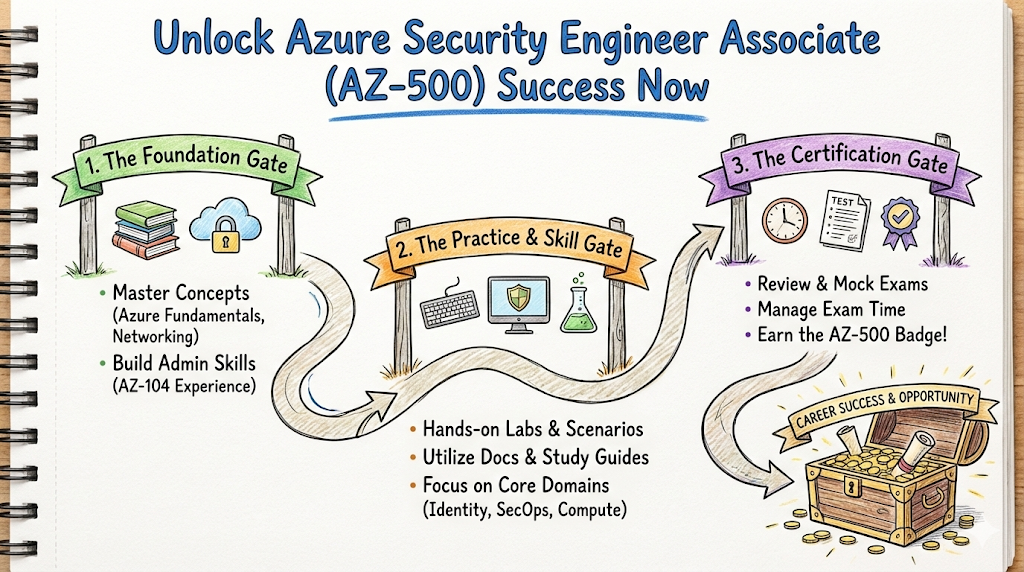
- 7–14 Days (For highly experienced Azure professionals): Focus heavily on practice exams and Microsoft Learn documentation. Spend 6–8 hours daily targeting your weak areas, particularly identity management and security operations.
- 30 Days (For those with moderate Azure experience): Dedicate 2–3 hours daily. Spend the first two weeks reviewing the official curriculum and the final two weeks doing extensive hands-on labs and mock exams.
- 60 Days (For beginners to Azure Security): Take a structured approach. Spend 4 weeks learning concepts via courses, 2 weeks building hands-on projects in an Azure Free Tier account, and 2 weeks doing rigorous practice tests.
Common mistakes
- Ignoring Hands-on Practice: Relying only on theory will fail you. You must configure PIM, WAF, and Key Vaults in a real Azure portal.
- Underestimating Identity (Azure AD): Identity and Access Management makes up 30-35% of the exam. Do not skim this section.
- Confusing Microsoft Defender Plans: Failing to understand the specific capabilities and differences between the various Microsoft Defender tiers.
- Skipping Microsoft Learn Updates: Azure changes rapidly. Always check the official exam study guide for the latest syllabus changes before sitting for the exam.
Best next certification after this
1. Microsoft Cybersecurity Architect Expert (SC-100)
This is the top choice if you want to stay strictly in the security domain and reach the architect level. It upgrades your skills from configuring Azure tools to designing organization-wide security strategies. You will learn how to build Zero Trust architectures and manage overall enterprise risk.
2. Azure DevOps Engineer Expert (AZ-400)
If you want to become a DevSecOps expert, this is your perfect next step. You will learn how to integrate the security controls you learned in AZ-500 directly into CI/CD pipelines. This ensures that every software release is automatically secure, tested, and compliant before it reaches production.
3. Azure Solutions Architect Expert (AZ-305)
This is the best path if you are aiming for a senior technical leadership or cloud architect role. It teaches you how to design large-scale cloud solutions that perfectly balance cost, performance, and strong security. It is ideal for engineers who want to see the bigger picture and guide engineering teams.
Choose Your Path
Security is integral to every technical domain. Here are six specialized learning paths to consider:
- DevOps Path: Focuses on integrating continuous security and compliance into automated deployment pipelines.
- DevSecOps Path: The ultimate extension of AZ-500, focusing on shifting security left, container security, and code-scanning within CI/CD.
- SRE (Site Reliability Engineering) Path: Focuses on secure observability, incident response, and maintaining highly available, attack-resilient systems.
- AIOps / MLOps Path: Securing data lakes, protecting AI models, and ensuring secure compute environments for machine learning workloads.
- DataOps Path: Focuses on data governance, encryption at rest/transit, and securing large-scale data pipelines.
- FinOps Path: Balancing security investments with cloud cost optimization, ensuring security tools do not cause budget overruns.
Role → Recommended Certifications
| Role | Recommended Certifications |
|---|---|
| DevOps Engineer | AZ-104 → AZ-400 → AZ-500 |
| SRE | AZ-104 → AZ-500 → AZ-400 |
| Platform Engineer | CKA → AZ-104 → AZ-500 |
| Cloud Engineer | AZ-900 → AZ-104 → AZ-305 |
| Security Engineer | SC-900 → AZ-500 → SC-100 |
| Data Engineer | DP-900 → DP-203 → AZ-500 |
| FinOps Practitioner | AZ-900 → FinOps Certified Practitioner |
| Engineering Manager | AZ-900 → AZ-500 → AZ-305 |
Next Certifications to Take
To continue your growth after achieving the AZ-500, consider these options based on your career goals:
- Same Track (Security Mastery): Microsoft Cybersecurity Architect Expert (SC-100).
- Cross-Track (DevOps & Engineering): Microsoft Cybersecurity DevOps Engineer Expert (AZ-400).
- Leadership (Architecture): Azure Solutions Architect Expert (AZ-305).
Top Institutions for AZ-500 Training
If you are looking for structured training and hands-on guidance, these are the top institutions to consider:
- DevOpsSchool: Offers comprehensive, hands-on, instructor-led training tailored for working professionals aiming to master Azure security and DevOps integrations.
- Cotocus: Specializes in corporate training and deep-dive technical workshops for cloud infrastructure and security.
- Scmgalaxy: A great community-driven platform providing resources, tutorials, and structured learning paths for software configuration and cloud security.
- BestDevOps: Focuses on practical, real-world DevOps and cloud security scenarios to ensure you are job-ready.
- devsecopsschool.com: The ideal choice if you want to strictly align your AZ-500 knowledge with modern DevSecOps practices.
- sreschool.com: Excellent for those combining security with Site Reliability Engineering to build fault-tolerant systems.
- aiopsschool.com: Offers forward-looking training on securing cloud environments that run AI and machine learning workloads.
- dataopsschool.com: Focuses on the intersection of data engineering and cloud security, perfect for securing data pipelines.
- finopsschool.com: Teaches how to implement robust cloud security measures while optimizing overall cloud spend.
Frequently Asked Questions (FAQs)
1. How difficult is the AZ-500 exam?
The AZ-500 is widely considered one of the more challenging associate-level exams because it requires deep practical knowledge of Azure services, networking, and identity management. It is not a theoretical test; you must know how to configure services in the portal.
2. How much time do I need to prepare?
For most working professionals with some Azure experience, 6 to 12 weeks of consistent study (around 10-15 hours per week) is the sweet spot. Highly experienced engineers might do it in 2-4 weeks.
3. Are there any mandatory prerequisites for the AZ-500?
No, Microsoft does not enforce any mandatory prerequisites. However, attempting this exam without first passing or studying the AZ-104 (Azure Administrator) is highly discouraged, as you need a strong foundational understanding of Azure networking and compute.
4. What is the format of the exam?
The exam usually contains 40-60 questions, including multiple-choice, drag-and-drop, and case studies. You have roughly 100 minutes to complete the technical questions.
5. How much does the AZ-500 exam cost?
The exam costs $165 USD. For test-takers in India, the cost is typically around ₹4,800 INR (plus applicable taxes).
6. Does the AZ-500 certification expire?
Yes, like all Microsoft role-based certifications, the AZ-500 is valid for one year. You can renew it for free by taking an online, open-book assessment on Microsoft Learn before it expires.
7. Is AZ-500 enough to get a cloud security job?
While the AZ-500 proves your technical capability on Azure, landing a job usually requires a mix of this certification, hands-on project portfolio, and an understanding of general security principles (like OWASP and Zero Trust).
8. Should I take AZ-500 or SC-200/SC-300?
Take AZ-500 if you want to be a generalist Azure Security Engineer managing infrastructure. Take SC-200 if you want to focus purely on Security Operations (SOC) and incident response. Take SC-300 if you want to specialize exclusively in Identity and Access Management.
9. Does the exam include hands-on labs?
Microsoft periodically adds or removes performance-based labs from their exams. You should prepare as if there will be labs, meaning you must know how to navigate the Azure Portal and configure settings manually.
10. What is the passing score for the AZ-500?
The passing score is 700 out of 1000. This is a scaled score, meaning some questions are worth more than others based on difficulty.
11. Will learning AZ-500 help me with Kubernetes security?
Yes. A significant portion of the modern AZ-500 curriculum covers container security, including securing Azure Container Registry (ACR) and configuring network policies and RBAC for Azure Kubernetes Service (AKS).
12. In what order should I take my Azure certifications if my goal is DevSecOps?
The most effective sequence for a DevSecOps career is: AZ-900 (Fundamentals) → AZ-104 (Administrator) → AZ-500 (Security) → AZ-400 (DevOps Expert).
Testimonials
“I spent weeks trying to understand the nuances of Azure Active Directory and network security groups. Following a structured guide and doing hands-on labs made all the difference. Passing the AZ-500 completely changed how I approach infrastructure design in my current role.”
— Rahul M., Cloud Security Engineer
“As an Engineering Manager, I didn’t want to just rely on my team; I wanted to understand the security architecture deeply. The AZ-500 journey was tough but incredibly rewarding. It gave me the vocabulary and technical depth to lead secure cloud migrations confidently.”
— Sarah J., Director of Cloud Engineering
Conclusion
Securing cloud infrastructure is a continuous, evolving challenge. The Azure Security Engineer Associate (AZ-500) certification is not just a badge to add to your resume; it is a rigorous validation that you understand how to protect critical assets in a modern threat landscape. By following the preparation plan, utilizing the recommended training partners, and committing to hands-on practice, you will not only pass the exam but become an invaluable asset to any engineering team.