Introduction
The landscape of modern IT operations is shifting from reactive manual intervention to proactive, data-driven automation. As systems grow in complexity, the Certified AIOps Professional designation has emerged as a critical benchmark for engineers who want to stay ahead of the curve. This guide is designed for professionals looking to navigate the intersection of Artificial Intelligence and IT Operations, providing a clear roadmap for career advancement. Whether you are currently working in DevOps, Cloud-Native development, or Platform Engineering, understanding AIOps is no longer optional; it is a necessity for managing hyperscale environments. By following this guide, you will gain the insights needed to make informed career decisions and understand how Aiopsschool can help you achieve your professional goals in an increasingly automated world.
What is the Certified AIOps Professional?
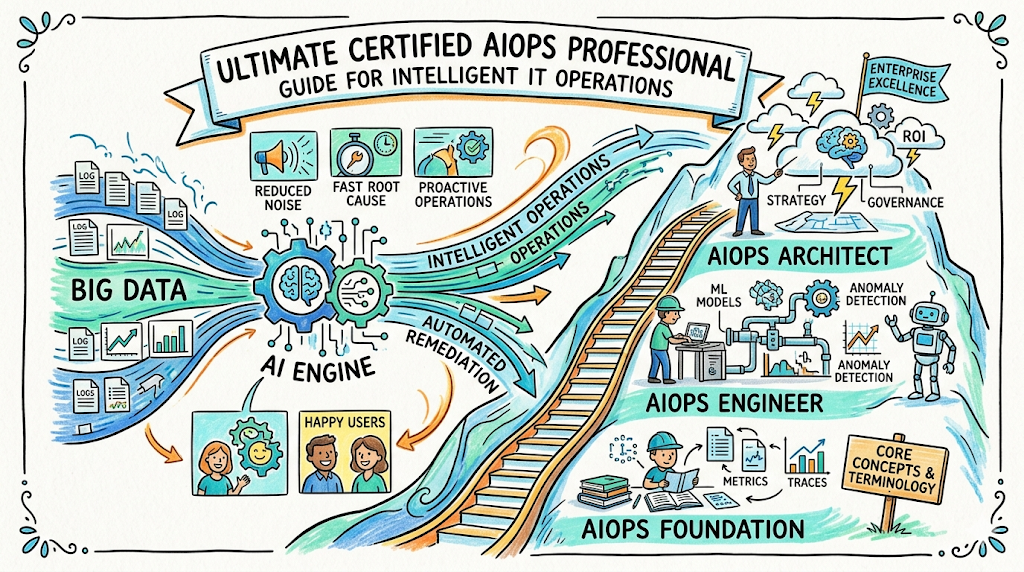
The Certified AIOps Professional is a comprehensive validation of an engineer’s ability to apply machine learning and data science techniques to IT operational data. It represents a shift away from traditional rule-based monitoring toward intelligent, predictive systems that can identify issues before they impact the end user. This certification exists because modern distributed systems generate a volume of logs, metrics, and traces that far exceed human cognitive capacity. By focusing on real-world, production-focused learning, the program ensures that candidates are not just learning theoretical algorithms but are mastering the practical implementation of AI within modern engineering workflows. It aligns perfectly with enterprise practices that demand higher uptime, faster incident response, and reduced operational overhead.
Who Should Pursue Certified AIOps Professional?
This program is specifically designed for a wide range of technical professionals who are responsible for the reliability and performance of digital services. Site Reliability Engineers (SREs), DevOps practitioners, and Cloud Architects will find the curriculum directly applicable to their daily tasks of managing complex infrastructure. Security professionals can use these skills for intelligent threat detection, while data professionals can pivot their expertise toward operational intelligence. Even engineering managers and technical leaders should pursue this certification to better understand the capabilities and limitations of AI-driven tools within their organizations. In both the Indian tech hub and the global enterprise market, this certification serves as a powerful signal of high-level technical competency and forward-thinking leadership.
Why Certified AIOps Professional is Valuable Today and Beyond
The value of this certification lies in its focus on the long-term evolution of IT infrastructure rather than fleeting tool-specific knowledge. As enterprises continue to adopt multi-cloud and hybrid-cloud strategies, the demand for professionals who can implement cross-platform intelligent operations is skyrocketing. This certification ensures longevity in a career because it teaches the underlying principles of data-driven decision-making, which remain relevant regardless of which specific AI tool or cloud provider is currently in favor. The return on investment for this career move is reflected in higher salary brackets, more significant organizational influence, and the ability to lead high-impact automation projects. By becoming an expert in AIOps, you move from being a firefighter to a system architect, making you an indispensable asset to any modern enterprise.
Certified AIOps Professional Certification Overview
The program is delivered via the official training portal and hosted on the specialized platform for operational intelligence. It is structured to cater to different career stages, ranging from entry-level practitioners to senior architects. The assessment approach is rigorous, combining theoretical examinations with practical lab scenarios that mimic real-world production incidents. This ensures that a certified professional is capable of handling the pressure and technical requirements of a live environment. The certification is owned and maintained by industry experts who continuously update the curriculum to reflect the latest advancements in machine learning, observability, and automated remediation strategies.
Certified AIOps Professional Certification Tracks & Levels
The certification is organized into three distinct levels to support continuous career progression. The Foundation level introduces the core concepts of big data, machine learning basics, and the AIOps lifecycle. The Professional level dives deep into the integration of AI with DevOps and SRE practices, focusing on anomaly detection and noise reduction. Finally, the Advanced level is designed for those who want to architect entire AIOps ecosystems and lead organizational-wide transformations. There are also specialization tracks that allow professionals to tailor their learning toward specific domains like FinOps for cost optimization or DevSecOps for intelligent security operations, ensuring that the certification aligns with individual career goals.
Complete Certified AIOps Professional Certification Table
| Track | Level | Who it’s for | Prerequisites | Skills Covered | Recommended Order |
| Core Operations | Foundation | Aspiring AIOps Engineers | Basic IT knowledge | Data collection, ML basics | 1 |
| Core Operations | Professional | Experienced SREs/DevOps | Foundation Cert | Anomaly detection, RCA | 2 |
| Architectural | Advanced | Principal Engineers/Architects | Professional Cert | System design, Strategy | 3 |
| Specialized | FinOps | Cloud Cost Managers | Basic Cloud knowledge | Predictive billing, Analysis | 2 (Optional) |
| Specialized | DevSecOps | Security Engineers | DevOps knowledge | Intelligent threat hunting | 2 (Optional) |
Detailed Guide for Each Certified AIOps Professional Certification
Certified AIOps Professional – Foundation
What it is
2–3 lines explaining what this certification validates. This certification validates a candidate’s understanding of the fundamental building blocks of AI-driven operations. It confirms that the individual understands how data flows through an operational pipeline and the role of machine learning in improving system visibility.
Who should take it
This is ideal for junior engineers, students, or traditional sysadmins who are looking to transition into modern automated environments. It is also suitable for managers who need a conceptual understanding of AIOps to lead their teams effectively.
Skills you’ll gain
- Understanding the AIOps market landscape and core terminology.
- Knowledge of data ingestion methods for logs, metrics, and traces.
- Basic understanding of descriptive versus predictive analytics.
- Familiarity with the common tools and platforms in the AIOps ecosystem.
Real-world projects you should be able to do
- Configure a basic data pipeline for monitoring a single application.
- Identify different types of operational noise in a standard dashboard.
- Create basic visualization reports for historical performance data.
Preparation plan
- 7–14 days: Focus on vocabulary, the AIOps lifecycle, and basic ML concepts found in the core study guide.
- 30 days: Review case studies of enterprise AIOps adoption and experiment with open-source monitoring tools.
- 60 days: Conduct a deep dive into data structures and practice the sample exam questions repeatedly.
Common mistakes
- Skipping the mathematical basics of data science.
- Focusing too much on specific vendor tools rather than general concepts.
- Ignoring the “Ops” side of the equation in favor of only the “AI” side.
Best next certification after this
- Same-track option: Certified AIOps Professional – Professional Level.
- Cross-track option: Cloud Practitioner or SRE Foundation.
- Leadership option: ITIL or Digital Transformation Management.
Certified AIOps Professional – Professional
What it is
2–3 lines explaining what this certification validates. This certification validates the ability to implement and manage AIOps solutions in a production environment. It proves that the engineer can use AI to reduce Mean Time to Repair (MTTR) and improve system reliability through intelligent automation.
Who should take it
Mid-level DevOps engineers, SREs, and Platform engineers who are responsible for maintaining high-availability systems. It is for those who are ready to move beyond simple alerts to predictive maintenance.
Skills you’ll gain
- Advanced anomaly detection using statistical and ML models.
- Automated Root Cause Analysis (RCA) implementation.
- Incident correlation and noise reduction techniques.
- Integration of AIOps tools with CI/CD pipelines and ITSM platforms.
Real-world projects you should be able to do
- Implement an automated incident response workflow based on ML triggers.
- Build a noise-reduction layer for a high-traffic microservices architecture.
- Design a predictive scaling model for cloud resources based on traffic patterns.
Preparation plan
- 7–14 days: Intensive review of machine learning algorithms used specifically in time-series data.
- 30 days: Hands-on lab work focusing on integrating monitoring tools with ML libraries.
- 60 days: Conduct a full-scale mock implementation of an AIOps platform and troubleshoot common integration errors.
Common mistakes
- Underestimating the importance of data quality and cleaning.
- Over-automating without human-in-the-loop validation.
- Failing to align AIOps goals with business KPIs.
Best next certification after this
- Same-track option: Certified AIOps Professional – Advanced Level.
- Cross-track option: Certified MLOps Professional.
- Leadership option: DevOps Leader or Engineering Manager Certification.
Choose Your Learning Path
DevOps Path
The DevOps path focuses on integrating AIOps into the continuous integration and continuous deployment cycle. Engineers on this path learn how to use AI to validate releases, predict deployment failures, and optimize resource allocation in development environments. By adding intelligent gates to the pipeline, DevOps professionals can ensure that only high-quality code reaches production while reducing manual testing efforts. This path is essential for organizations looking to scale their software delivery without increasing their operational headcount significantly. It bridges the gap between fast delivery and stable operations.
DevSecOps Path
In the DevSecOps path, the focus shifts toward using AI for proactive security and compliance. This involves using machine learning to detect unusual user behavior, identify potential vulnerabilities in code, and automate the response to security incidents. Professionals on this path learn how to integrate security into the AIOps framework, ensuring that the intelligent operations center is also a secure operations center. This path is critical for highly regulated industries like finance and healthcare where security is a top priority. It transforms security from a manual bottleneck into an automated, intelligent safeguard.
SRE Path
The Site Reliability Engineering path is the most natural fit for AIOps, focusing on system availability, performance, and latency. SREs use AIOps to move from manual threshold-based alerting to dynamic, intelligent monitoring that understands the normal state of a complex system. This path emphasizes automated incident remediation, predictive capacity planning, and the use of AI to manage Service Level Objectives (SLOs). It is the ideal route for those managing large-scale distributed systems who want to reduce the toil associated with manual operations. It enables engineers to maintain high availability with minimal manual intervention.
AIOps Path
The dedicated AIOps path is for those who want to specialize exclusively in the platform and data aspects of operational intelligence. These professionals focus on the data science side of IT operations, selecting the right algorithms for anomaly detection and building the underlying data pipelines. They act as the bridge between the data science team and the IT operations team, ensuring that AI models are practical and impactful. This path is perfect for engineers who are passionate about data-driven automation and the architectural design of intelligent systems. It focuses on the creation of the intelligence layer itself.
MLOps Path
The MLOps path focuses on the operationalization of machine learning models themselves, ensuring they are deployed, monitored, and retrained efficiently. While AIOps uses AI to help IT, MLOps uses IT practices to help AI, creating a symbiotic relationship. Professionals on this path learn about model versioning, feature stores, and automated retraining pipelines. This is a specialized route for those who want to ensure that the AI models being used by the business remain accurate and reliable over time in a production environment. It ensures that the intelligence being used is always current and high-performing.
DataOps Path
The DataOps path focuses on the quality and flow of data that powers the AIOps engines. Without high-quality, real-time data, AIOps cannot function, making DataOps professionals the fuel providers for the intelligent enterprise. This path covers data orchestration, data quality testing, and the management of large-scale data lakes and warehouses. It is a vital path for ensuring that the insights generated by AI are based on a foundation of clean, reliable, and accessible information across the entire organization. It manages the lifecycle of data from ingestion to consumption by the AI models.
FinOps Path
The FinOps path leverages AIOps to bring financial accountability to the variable spend of the cloud. By using predictive analytics, FinOps practitioners can forecast cloud costs, identify waste, and automate the rightsizing of resources. AIOps helps in identifying cost anomalies that might indicate a runaway process or a misconfigured service before the monthly bill arrives. This path is increasingly important for organizations looking to optimize their cloud investment and ensure that every dollar spent on infrastructure delivers business value. It combines financial management with technical intelligence to drive maximum efficiency.
Role → Recommended Certified AIOps Professional Certifications
| Role | Recommended Certifications |
| DevOps Engineer | Certified AIOps Professional – Foundation, Professional |
| SRE | Certified AIOps Professional – Professional, Advanced |
| Platform Engineer | Certified AIOps Professional – Foundation, Professional |
| Cloud Engineer | Certified AIOps Professional – Foundation, FinOps Specialist |
| Security Engineer | Certified AIOps Professional – Foundation, DevSecOps Specialist |
| Data Engineer | Certified AIOps Professional – Foundation, DataOps Specialist |
| FinOps Practitioner | Certified AIOps Professional – Foundation, FinOps Specialist |
| Engineering Manager | Certified AIOps Professional – Foundation, Advanced |
Next Certifications to Take After Certified AIOps Professional
Same Track Progression
Once the Professional level is completed, the focus should shift toward the Advanced or Expert tiers. This progression involves mastering the architectural side of AIOps, including the design of multi-tenant data pipelines and the governance of AI models at scale. Moving deeper into the same track allows an engineer to become the primary technical authority for automation within their organization. It prepares you for roles like Principal Engineer or Chief Architect, where you are responsible for the long-term technical vision of the company.
Cross-Track Expansion
Expanding skills into related tracks like MLOps or DevSecOps creates a highly versatile professional profile. An AIOps expert who understands how to secure their pipelines or how to operationalize machine learning models is much more valuable than a specialist in just one area. This cross-track expansion is particularly useful for engineers in startup or scale-up environments where roles are often fluid and require a broad range of high-level skills. It ensures that you can handle the security, financial, and operational aspects of a system simultaneously.
Leadership & Management Track
For those moving into management, certifications that focus on digital transformation and DevOps leadership are the next logical step. The transition to leadership involves moving from executing technical tasks to defining the strategy and culture that allow technical teams to thrive. Since AIOps is about data-driven decision-making, it provides a strong foundation for management roles that rely on KPIs and performance metrics. Leadership training helps you manage the human side of the transition to AI-driven operations, ensuring that the team remains productive and engaged.
Training & Certification Support Providers for Certified AIOps Professional
DevOpsSchool
DevOpsSchool is a leading provider of technical training that specializes in end-to-end automation and modern engineering practices. They offer a deep curriculum that covers everything from basic scripting to advanced architectural design for distributed systems. Their instructors are typically industry veterans who bring years of practical experience into the virtual or physical classroom, ensuring that students learn more than just theory. DevOpsSchool has established a strong reputation for helping professionals in India and beyond transition into high-paying roles by providing hands-on labs and real-world project scenarios. Their support for AIOps training is comprehensive, focusing on the integration of AI tools with existing DevOps pipelines to create a seamless, intelligent workflow for modern software delivery.
Cotocus
Cotocus focuses on providing specialized training for the next generation of cloud and platform engineers. They pride themselves on a curriculum that is constantly updated to reflect the rapid changes in the tech industry, ensuring that their students are always learning the most relevant skills. Cotocus offers a blend of instructor-led sessions and self-paced learning, making it an ideal choice for busy professionals who need flexibility. Their training programs emphasize the practical application of AIOps, teaching students how to build robust monitoring and remediation systems that can scale with the needs of a modern enterprise. They are known for their personalized approach and dedicated support for certification exam preparation, helping students navigate the complexities of AI-driven operational management.
Scmgalaxy
Scmgalaxy has been a pillar of the software configuration management and DevOps community for years, providing a wealth of resources and training for engineers. Their approach to AIOps training is rooted in the history of IT operations, helping students understand how we moved from manual sysadmin tasks to fully automated, intelligent systems. Scmgalaxy provides a vast library of tutorials, webinars, and certification bootcamps that are highly regarded by the technical community. They focus on the practical tools and techniques that make AIOps work in the real world, ensuring that their graduates can immediately contribute to their teams’ success. Their forums and community resources provide ongoing support and networking opportunities long after the formal training is complete.
BestDevOps
BestDevOps offers a curated learning experience designed to turn technical professionals into elite engineering leaders. Their programs are highly focused on the latest trends in AIOps, SRE, and cloud-native architecture, providing students with a competitive edge in the job market. BestDevOps utilizes a project-centric teaching methodology, where students spend the majority of their time working on actual problems found in production environments. This ensures that the learning is deeply ingrained and that students are prepared for the rigors of certification exams and professional challenges. Their AIOps courses are particularly strong in the areas of incident management and predictive analytics, making them a top choice for aspiring SREs who want to master intelligent automation.
devsecopsschool.com
DevSecOpsSchool is the premier destination for engineers who want to integrate security into every stage of the software development and operations lifecycle. They recognize that AIOps is a game-changer for security, and their curriculum reflects the intersection of AI, security, and operations. Their training programs teach students how to use machine learning for automated threat detection, vulnerability management, and compliance auditing. By focusing on the security aspect in DevSecOps, they provide a unique perspective on AIOps that is highly valued in industries with strict regulatory requirements. Their instructors are experts in both security and automation, providing a well-rounded and deeply technical learning experience for all students looking to secure their intelligent operations.
sreschool.com
SRESchool is dedicated to the discipline of Site Reliability Engineering, providing focused training on system availability, performance, and scalability. Their AIOps curriculum is designed specifically for SREs who want to use AI to manage their Service Level Objectives and reduce operational toil. Students at SRESchool learn how to build intelligent observability platforms, implement automated error budget tracking, and design self-healing infrastructure. The training is highly technical and lab-intensive, mimicking the high-pressure environments that SREs face every day. SRESchool is widely recognized for its ability to produce graduates who can manage complex, hyperscale systems with confidence and precision through the power of intelligent operations and data-driven reliability engineering.
Aiopsschool is the primary specialized platform for those seeking to master the specific domain of Artificial Intelligence for IT Operations. Unlike generalist training providers, Aiopsschool focuses exclusively on the AIOps lifecycle, offering deep dives into data science, machine learning, and operational automation. Their curriculum is designed by AIOps practitioners for AIOps practitioners, ensuring that every lesson is grounded in real-world application. Aiopsschool provides a clear certification path from foundation to advanced levels, making it the go-to resource for anyone serious about a career in this field. Their platform features advanced lab environments where students can practice with the latest AIOps tools and data sets in a safe, simulated production environment.
dataopsschool.com
DataOpsSchool addresses the critical need for high-quality data in the age of AI and automation. Their training programs focus on the principles of DataOps, teaching students how to build reliable, scalable, and secure data pipelines that power AIOps engines. Students learn about data orchestration, quality control, and the integration of diverse data sources like logs, metrics, and events. DataOpsSchool is essential for anyone who wants to understand the behind-the-scenes work required to make AIOps successful. Their graduates are experts in ensuring that the data used by AI models is accurate and timely, which is the foundation of any successful intelligent operations strategy in a modern enterprise and distributed cloud environment.
finopsschool.com
FinOpsSchool is the leader in training professionals to manage the financial aspects of the cloud through data and automation. They provide a comprehensive curriculum that covers cloud cost optimization, predictive billing, and automated resource rightsizing. By incorporating AIOps into their FinOps training, they teach students how to use AI to identify cost anomalies and forecast future spend with high accuracy. FinOpsSchool is the ideal choice for cloud architects and financial managers who want to bring fiscal discipline to their organization’s cloud journey. Their certification programs are recognized globally and are highly valued by enterprises looking to maximize the return on their significant investments in cloud infrastructure and modern digital services.
Frequently Asked Questions (General)
- How difficult is it to get certified in AIOps?
The difficulty level is moderate to high, as it requires a solid understanding of both IT operations and basic data science. However, with the right training and consistent hands-on practice, most engineers find it achievable.
- How much time do I need to prepare for the Professional exam?
A typical preparation period is between 30 to 60 days, assuming you can dedicate several hours each week to both reading and practical lab exercises.
- Are there specific prerequisites for the Foundation level?
There are no formal prerequisites, but having a basic understanding of Linux, cloud computing, and monitoring concepts will significantly help you grasp the material faster.
- What is the financial value of this certification?
Certified AIOps Professionals often see a significant salary increase and are eligible for senior roles that command higher compensation due to the specialized nature of the skill set.
- Is the certification exam conducted online?
Yes, most certification providers for this program offer online proctored exams, allowing you to take the test from the comfort of your home or office.
- Do I need to be an expert in Python to take this course?
You do not need to be an expert, but having a basic understanding of Python will help you understand how data is manipulated and how AI models are implemented.
- How is AIOps different from traditional monitoring?
Traditional monitoring uses fixed thresholds and rules to trigger alerts, while AIOps uses machine learning to dynamically identify anomalies and predict potential failures.
- Is the Certified AIOps Professional valid internationally?
Yes, the certification is recognized by global technology firms and enterprises as a standard of excellence in intelligent IT operations.
- Do I need to learn about data science for this?
You will need to learn the operational aspects of data science, such as how to choose the right model for anomaly detection and how to evaluate its performance.
- When does the certification expire?
Most certifications in this field are valid for two or three years, after which you may need to take a refresher course or a recertification exam to stay current.
- What kind of tools are covered in the curriculum?
The curriculum covers a broad range of open-source and commercial tools used for log management, metric collection, and machine learning integration.
- Does the training include any practical projects?
Yes, the professional and advanced levels are heavily focused on practical projects, such as building automated incident response systems and predictive scaling models.
FAQs on Certified AIOps Professional
- Why should I choose this specific certification over a general AI course?
This certification is designed specifically for IT professionals, focusing on operational data like logs and metrics, which general AI courses often overlook.
- Is this certification relevant for the Indian IT market?
Yes, India is a major hub for global IT operations, and there is a massive demand for AIOps skills in Indian tech companies and global service providers.
- Can I skip the Foundation level and go directly to Professional?
It is generally recommended to follow the sequence, but if you have significant experience in automation and data, you may be able to challenge the Professional exam directly.
- Does the course cover multi-cloud AIOps strategies?
Yes, the training is cloud-agnostic and teaches you how to implement intelligent operations across various platforms including AWS, Azure, and Google Cloud.
- What kind of support is available after I get certified?
Certified individuals often get access to exclusive alumni networks, ongoing webinars, and community forums where they can stay updated on the latest trends.
- Is generative AI included in the AIOps curriculum?
The curriculum is updated regularly and now includes sections on how generative AI can be used for incident summarization and generating automated remediation scripts.
- Are lab environments provided for the training?
Yes, most training providers include access to dedicated cloud labs where you can practice without having to set up your own complex infrastructure.
- What is the typical passing score for the AIOps exams?
The passing score is usually set at 70%, which ensures that only those with a strong grasp of the material and practical skills are certified.
Final Thoughts
From the perspective of a senior mentor, the answer is a definitive yes. We are entering an era where the sheer volume of operational data makes manual monitoring obsolete. Those who can bridge the gap between operations and artificial intelligence will be the architects of the future. This certification is not about collecting a badge; it is about fundamentally changing your approach to problem-solving in a digital environment. It provides you with the mental framework and technical toolkit to build systems that are not just automated, but truly intelligent. If you are looking to secure your place in the next decade of technology, investing in your AIOps skills is one of the smartest moves you can make. The transition may be challenging, but the reward is a career that is both intellectually stimulating and financially rewarding.