Introduction
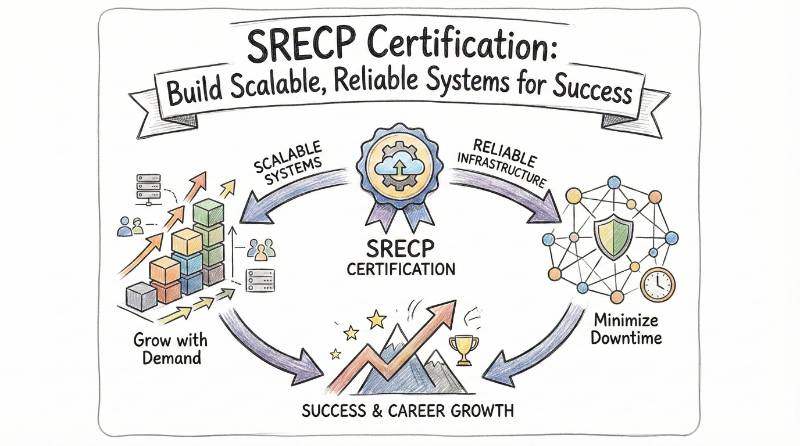
Site Reliability Engineering (SRE) is a discipline that integrates software engineering with IT operations to create scalable, reliable, and efficient systems. As organizations continue to scale and adopt complex infrastructure, the role of Site Reliability Engineers has become more essential in ensuring systems run smoothly. The Site Reliability Engineering Certified Professional (SRECP) certification is designed for professionals who want to prove their proficiency in applying SRE principles in real-world scenarios. In this comprehensive guide, we will walk you through the details of the SRECP certification, the skills it provides, and how to prepare for the exam. By the end, you will have a clear understanding of the certification process, the benefits, and the best path to success.
What is the SRECP Certification?
The Site Reliability Engineering Certified Professional (SRECP) certification is a specialized credential designed to validate the skills of professionals in the domain of site reliability engineering. This certification covers key areas such as building reliable systems, automating operations, designing scalable architectures, managing incidents, and ensuring the overall health of services.
Key Focus Areas of SRECP:
- Reliability Engineering: Understanding the importance of reliability and how to measure it.
- Automation: The ability to automate operational tasks and reduce human errors.
- Monitoring and Metrics: Setting up monitoring systems to detect failures and measure service health.
- Incident Management: Managing outages and minimizing system downtime.
- Scalability: Designing systems that can scale effectively while maintaining reliability.
By earning the SRECP certification, you prove that you have the technical expertise and skills required to ensure that systems and services run without interruptions, even under heavy load.
Who Should Take the SRECP Certification?
The SRECP certification is ideal for professionals who work with large-scale, mission-critical systems and services. It’s suitable for:
- Site Reliability Engineers (SRE): Professionals responsible for ensuring the uptime and reliability of systems.
- DevOps Engineers: Engineers who integrate development and operations to deliver software more efficiently.
- Platform Engineers: Engineers who manage the infrastructure required to run applications at scale.
- Cloud Engineers: Professionals who work with cloud services to deliver scalable and reliable solutions.
- IT Operations Managers: Managers who oversee the operational aspects of system reliability and performance.
- Software Engineers: Developers who are interested in learning how to build reliable software and services.
If you are looking to expand your knowledge in system reliability and automation while taking your career to the next level, the SRECP certification is a valuable investment.
Skills You’ll Gain
Upon completing the SRECP certification, you will gain critical, real-world skills that you can apply to ensure the reliability of services and systems at scale. Some of the skills you’ll acquire include:
- Service Level Indicators (SLIs), Service Level Objectives (SLOs), and Service Level Agreements (SLAs): Learn how to define, measure, and manage these core reliability metrics.
- Incident Response: Master the process of managing and resolving incidents to minimize downtime and service disruption.
- Monitoring and Observability: Understand how to monitor the health of systems, set up effective alerting systems, and analyze metrics to identify performance bottlenecks.
- Automation: Develop the skills to automate manual operational tasks to improve efficiency and reduce human error.
- Scalable System Design: Learn how to design and architect systems that can scale effectively to meet growing demands.
- Cultural Transformation: Gain an understanding of how to foster a culture of reliability and resilience within engineering and operations teams.
Real-World Projects You Should Be Able to Do After SRECP
After completing the SRECP certification, you will be well-equipped to work on a wide variety of real-world projects, including:
- Designing and Implementing Service Level Objectives (SLOs): You’ll be able to create and manage clear objectives for service reliability, and measure the performance of systems accordingly.
- Managing and Responding to Incidents: Gain hands-on experience in managing system failures, resolving incidents, and leading post-mortem reviews to improve future response strategies.
- Building Monitoring and Alerting Systems: Develop systems for monitoring the health and performance of infrastructure to proactively identify potential issues.
- Automating Key Operational Tasks: Implement automation tools to reduce manual intervention and improve system efficiency.
- Designing and Deploying Distributed Systems: Work on designing resilient and scalable distributed systems capable of handling large volumes of traffic without affecting performance or availability.
- Establishing Reliability Best Practices: Lead the creation and implementation of reliability best practices within engineering and operations teams.
Preparation Plan
7–14 Days Preparation Plan
If you’re short on time and need to get up to speed quickly, the 7-14 day preparation plan focuses on foundational knowledge and practical exercises. Here’s how to structure your study:
- Study Focus:
- Learn the basics of Service Level Indicators (SLIs), Service Level Objectives (SLOs), and Service Level Agreements (SLAs).
- Understand the importance of incident management and post-mortem analysis.
- Review monitoring and alerting concepts and how they play into system reliability.
- Practical Tasks:
- Practice setting up basic monitoring systems for a sample application.
- Work on an incident management plan and simulate a system failure scenario.
- Review:
- Take mock tests and focus on areas where you’re weakest.
30 Days Preparation Plan
The 30-day plan is more detailed and involves a deeper dive into incident response and automation. Here’s how you can structure your study:
- Study Focus:
- Dive deeper into incident management, including advanced troubleshooting techniques.
- Explore automation tools that help improve system reliability, such as Ansible, Terraform, and Kubernetes.
- Learn about scalable systems design, focusing on cloud infrastructure and distributed architectures.
- Practical Tasks:
- Work on automating the deployment and monitoring of a distributed system.
- Simulate real-world scenarios, such as system failures or high-traffic spikes, and practice your response.
- Review:
- Complete mock tests and analyze your performance.
60 Days Preparation Plan
For those with more time and aiming for a deeper understanding of the topic, the 60-day plan is comprehensive and covers all aspects of the certification in great detail:
- Study Focus:
- Master service reliability metrics (SLOs, SLIs, and SLAs), and explore advanced monitoring systems like Prometheus and Grafana.
- Study advanced topics such as load balancing, failure detection, and auto-scaling systems.
- Learn how to manage large-scale distributed systems and design infrastructure that supports rapid scaling.
- Practical Tasks:
- Build and deploy a scalable application with integrated monitoring, alerting, and incident response processes.
- Focus on real-world scenarios, such as managing downtime during critical incidents, and document your post-mortem findings.
- Review:
- Take practice exams and identify any remaining knowledge gaps.
Common Mistakes to Avoid
While preparing for the SRECP certification, here are some common mistakes to avoid:
- Not Understanding Service Level Objectives (SLOs): SLOs are a cornerstone of SRE, and failing to grasp their importance can hinder your ability to implement effective reliability measures.
- Skipping Practical Exercises: SRE is hands-on, and neglecting to practice the concepts in real-world scenarios can lead to a shallow understanding.
- Ignoring Automation: Automation is key to reducing errors and ensuring system reliability. Failing to practice automation tools will limit your ability to implement them effectively.
- Overlooking Incident Management: Incident management is a critical aspect of SRE. Skipping this part of your preparation can leave you unprepared for handling real-world outages.
- Not Focusing on Scalability: As systems scale, their reliability becomes more complex. Focusing only on smaller systems will leave you unprepared for large-scale deployments.
Best Next Certifications After SRECP
After earning your SRECP certification, consider these additional certifications to further enhance your career:
- Same Track: Certified DevOps Professional (CDP) – Enhances your DevOps and SRE expertise, with an emphasis on continuous integration and continuous deployment (CI/CD).
- Cross-Track: Certified Cloud Architect – Learn how to design and implement cloud architectures that support large-scale, reliable systems.
- Leadership: Certified Engineering Manager – Transition into a leadership role with this certification, focusing on managing large teams and leading engineering initiatives.
Choose Your Path
After completing the SRECP certification, you can explore different learning paths to enhance your career further:
- DevOps: Focus on optimizing the integration of development and operations.
- DevSecOps: Specialize in securing applications throughout the lifecycle.
- SRE: Deepen your expertise in Site Reliability Engineering and managing the reliability of large systems.
- AIOps/MLOps: Dive into AI and machine learning operations.
- DataOps: Focus on automating and improving data operations and processes.
- FinOps: Learn how to manage cloud costs and financial operations.
Role → Recommended Certifications
| Role | Recommended Certifications |
|---|---|
| DevOps Engineer | Certified DevOps Professional (CDP), Certified SRE Professional (SRECP) |
| SRE | Certified SRE Professional (SRECP), Certified DevOps Engineer (CDE) |
| Platform Engineer | Certified Cloud Architect, Certified SRE Professional (SRECP) |
| Cloud Engineer | Certified Cloud Architect, Certified DevOps Professional (CDP) |
| Security Engineer | Certified DevSecOps Professional (DSOCP), Certified SRE Professional (SRECP) |
| Data Engineer | Certified DataOps Professional, Certified Cloud Architect |
| FinOps Practitioner | Certified FinOps Professional, Certified Cloud Architect |
| Engineering Manager | Certified Engineering Manager, Certified DevOps Professional (CDP) |
FAQs on Site Reliability Engineering Certified Professional (SRECP)
- What is the SRECP certification?
- The Site Reliability Engineering Certified Professional (SRECP) certification is a specialized credential designed to validate your skills and knowledge in applying SRE principles to ensure reliable, scalable, and efficient systems. It focuses on automation, incident management, service monitoring, and designing scalable infrastructures.
- What is the difficulty level of the SRECP certification?
- The SRECP certification is intermediate to advanced in difficulty. It requires a strong understanding of both the theoretical aspects of Site Reliability Engineering (SRE) and practical experience in automating operations, managing incidents, and building reliable systems.
- How much time is required to prepare for the SRECP exam?
- Preparation time can vary depending on your prior experience. Typically, you should expect to spend anywhere from 30 to 60 days preparing for the exam. If you have a strong background in DevOps or cloud engineering, the time might be reduced. However, if you are new to SRE concepts, it might take closer to 60 days.
- What are the prerequisites for taking the SRECP exam?
- There are no formal prerequisites for taking the SRECP exam. However, a strong foundation in software engineering, cloud infrastructure, and IT operations is highly recommended. Familiarity with DevOps, incident management, and monitoring systems will also be beneficial.
- Can I take the SRECP exam online?
- Yes, the SRECP exam is available online, and you can take it from anywhere. The exam is typically proctored remotely, allowing you to complete it at your convenience.
- How is the SRECP exam structured?
- The SRECP exam consists of multiple-choice questions that cover key SRE topics such as incident management, automation, service level objectives (SLOs), scalable system design, and system reliability monitoring. It tests both theoretical knowledge and practical application of SRE concepts.
- What is the passing score for the SRECP exam?
- The passing score for the SRECP exam is typically around 70-80%, but this may vary slightly depending on the exam version. Make sure to check the official exam guide for the exact passing criteria.
- How much does the SRECP certification cost?
- The exam fee for the SRECP certification can be found on the official website, and it may vary based on your region. It typically ranges between $200 to $400. Check the official website for the most up-to-date pricing.
- What is the value of the SRECP certification?
- The SRECP certification is highly valued in the industry as it demonstrates your expertise in managing service reliability at scale. It enhances your credibility and can open doors to advanced roles in system reliability, cloud infrastructure, and DevOps. It is recognized by companies that prioritize service uptime and performance.
- What are the career outcomes after earning the SRECP certification?
- Earning the SRECP certification can significantly improve your career prospects. It qualifies you for advanced roles such as Site Reliability Engineer (SRE), DevOps Engineer, Platform Engineer, and Cloud Engineer. Additionally, you may move into leadership roles such as Engineering Manager or Reliability Architect.
- How long is the SRECP certification valid?
- The SRECP certification is valid for three years. After that, you will need to recertify to ensure that you are up-to-date with the latest advancements and best practices in Site Reliability Engineering.
- What are the best next certifications after completing the SRECP?
- After completing the SRECP certification, you can consider pursuing the following certifications:
- Same Track: Certified DevOps Professional (CDP) to further enhance your DevOps and SRE skills.
- Cross-Track: Certified Cloud Architect to specialize in cloud infrastructure and system design.
- Leadership: Certified Engineering Manager for those interested in moving into leadership and management roles within engineering teams.
- After completing the SRECP certification, you can consider pursuing the following certifications:
FAQs on Site Reliability Engineering Certified Professional (SRECP)
- What is the SRECP certification?
- The Site Reliability Engineering Certified Professional (SRECP) certification is a credential that validates your expertise in applying Site Reliability Engineering principles to ensure the reliability, scalability, and efficiency of large-scale systems and services.
- Who should consider taking the SRECP certification?
- The SRECP is ideal for Site Reliability Engineers (SREs), DevOps Engineers, Platform Engineers, Cloud Engineers, Software Engineers, and IT professionals who want to specialize in system reliability, automation, and performance at scale.
- What are the main benefits of earning the SRECP?
- Earning the SRECP certification can significantly boost your career prospects by demonstrating your ability to manage the reliability and scalability of complex systems. It also shows employers that you are skilled in areas like incident management, automation, and system design.
- How long does it take to prepare for the SRECP exam?
- The preparation time for the SRECP exam can range from 30 to 60 days depending on your experience level. If you’re already familiar with concepts like automation and monitoring, you may need less time. For those new to SRE, a longer preparation period might be necessary.
- What is the difficulty level of the SRECP exam?
- The SRECP exam is intermediate to advanced in difficulty. It requires a solid understanding of both theoretical concepts and hands-on practical experience in Site Reliability Engineering, including managing incidents, setting up monitoring systems, and automating infrastructure.
- How is the SRECP exam structured?
- The SRECP exam consists of multiple-choice questions that cover topics like incident management, automation, system reliability, scalable system design, and monitoring. The questions are designed to assess both your theoretical knowledge and practical ability to apply SRE concepts in real-world situations.
- What are common mistakes candidates make when preparing for the SRECP?
- Some common mistakes include neglecting practical exercises, not focusing enough on incident management, and overlooking the importance of scalability and automation. It’s crucial to practice hands-on tasks and understand the real-world application of concepts to ensure success.
- What are the next steps after obtaining the SRECP certification?
- After earning the SRECP certification, you may consider pursuing other advanced certifications such as Certified DevOps Professional (CDP) or Certified Cloud Architect to deepen your expertise. Additionally, moving into leadership roles, such as Certified Engineering Manager, can be a great way to advance your career further.
Top Institutions for SRECP Training and Certification
1. DevOpsSchool
DevOpsSchool is a leading provider of DevOps and SRE training. They offer specialized courses in Site Reliability Engineering, focusing on practical, hands-on experience with SRE tools and methodologies. Their expert instructors ensure that you are well-prepared for the SRECP certification exam.
2. Cotocus
Cotocus provides comprehensive DevOps and SRE training that includes live instructor-led sessions, industry-recognized certifications, and practical labs. They are known for their personalized learning approach, offering training tailored to real-world scenarios, which helps candidates excel in SRE roles.
3. Scmgalaxy
Scmgalaxy offers in-depth training for SRE certification, focusing on building highly reliable, scalable, and resilient systems. They provide hands-on experience with industry-leading tools and technologies, making them a great option for professionals looking to advance in SRE and DevOps careers.
4. BestDevOps
BestDevOps is known for its specialized certification programs in DevOps, SRE, and cloud infrastructure management. Their SRECP training program equips professionals with the necessary skills and knowledge to design, deploy, and maintain reliable systems while preparing them for the certification exam.
5. DevSecOpsSchool
DevSecOpsSchool focuses on integrating security with DevOps practices and offers a certification program for Site Reliability Engineering professionals. Their SRECP training incorporates security practices, ensuring that candidates are ready to handle complex, secure, and resilient systems in real-world environments.
6. SRESchool
SRESchool specializes in Site Reliability Engineering and offers a range of training programs aimed at equipping professionals with the skills needed to handle system reliability, scalability, and incident management. Their training is designed for those looking to build expertise in maintaining and optimizing large-scale systems.
7. AIOpsSchool
AIOpsSchool provides training for AIOps and Site Reliability Engineering, helping professionals integrate AI and machine learning into SRE practices. Their program is ideal for those who want to leverage AI technologies to improve system reliability, incident management, and automation in modern IT operations.
8. DataOpsSchool
DataOpsSchool offers a specialized certification track in DataOps and SRE, focusing on data pipeline management and the reliability of data systems. Their courses are designed for professionals looking to bridge the gap between SRE and data engineering, ensuring high availability and performance for data-driven applications.
9. FinOpsSchool
FinOpsSchool offers training that combines financial operations with Site Reliability Engineering. Their program focuses on cloud cost management, resource optimization, and ensuring financial efficiency in large-scale cloud systems, making it a perfect choice for professionals managing both reliability and financial aspects of IT infrastructure.
Conclusion
The Site Reliability Engineering Certified Professional (SRECP) certification is an excellent way to advance your career in the tech industry, particularly in roles related to system reliability, cloud infrastructure, and DevOps. Whether you’re a DevOps Engineer, SRE, or Cloud Engineer, this certification will provide you with the skills needed to tackle real-world reliability challenges and improve the performance of critical systems. By following a structured preparation plan and avoiding common mistakes, you’ll be well on your way to earning your SRECP and enhancing your career prospects.