Introduction
In the fast-moving world of technology, the way we build and deliver software has changed forever. It is no longer enough to just write code or just manage servers. The industry now demands professionals who can handle everything—from the first line of code to the final deployment and the security of the entire system. This is what we call Master in DevOps Engineering (MDE). Whether you are a software engineer in India looking to level up or a manager leading a global team, this guide will show you how to master the DevOps ecosystem.
What is the Master in DevOps Engineering (MDE)?
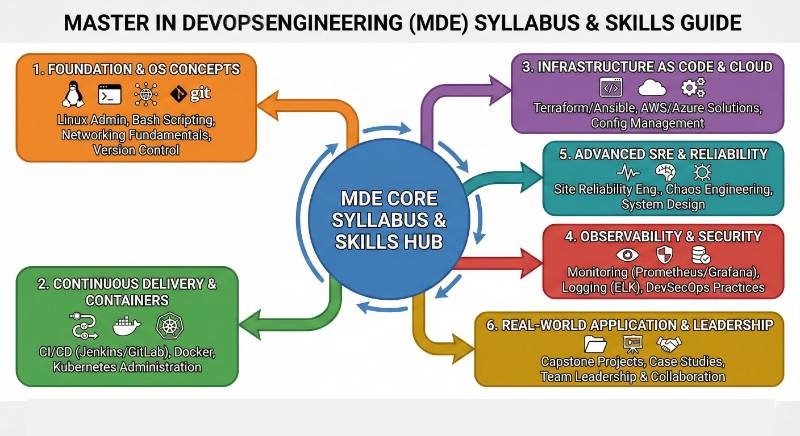
The Master in DevOps Engineering (MDE) is an elite, all-in-one certification program. It is designed to turn engineers into high-level architects. Unlike basic courses that teach you one or two tools, the MDE program covers the entire software lifecycle.
It combines three major areas: DevOps, DevSecOps, and Site Reliability Engineering (SRE). By the end of this program, you won’t just be an “operations person”—you will be a master of automation, cloud architecture, and system reliability.
Detailed Certification Breakdown: The MDE Core
To become a master, you must understand each part of the process. Below is the breakdown of the MDE certification modules.
1. Master in DevOps Engineering (MDE) Core
What it is: A comprehensive 120-hour program that covers everything from Linux and Git to advanced Kubernetes and Cloud management.
Who should take it: Software Engineers, System Admins, and IT Managers who want to lead technical teams.
Skills you’ll gain:
- Automation: Building pipelines that test and deploy code automatically.
- Cloud Management: Handling AWS, Azure, and Google Cloud at an expert level.
- Container Mastery: Scaling applications using Docker and Kubernetes.
- Infrastructure as Code (IaC): Writing code to create and manage servers.
Real-world projects you should be able to do:
- End-to-End CI/CD: Build a pipeline that takes a developer’s code and puts it into production with zero human help.
- Multi-Cloud Architecture: Set up a system that works across different cloud providers like AWS and Azure.
- Self-Healing Apps: Create an environment where if a server fails, the system automatically replaces it.
Common mistakes to avoid:
- Learning only tools: Don’t just learn “how” to use a tool like Jenkins; learn the logic behind why you are using it.
- Skipping Linux: Almost all DevOps tools run on Linux. If your Linux skills are weak, your DevOps skills will be too.
Choose Your Path: 6 Specialized Learning Paths
DevOps is a huge field. Depending on your career goals, you can choose one of these specialized paths within the MDE framework:
- The DevOps Path: The standard route. It focuses on the culture of collaboration and the main technical tools like Git, Jenkins, and Docker.
- The DevSecOps Path: The security route. You learn how to “shift left”—which means putting security checks at the very beginning of the coding process.
- The SRE (Site Reliability Engineering) Path: The reliability route. You focus on making sure systems are always up and running, using software to solve operational problems.
- The AIOps/MLOps Path: The intelligence route. You learn how to use Artificial Intelligence to manage IT operations and how to deploy Machine Learning models safely.
- The DataOps Path: The data route. You focus on automating data pipelines to ensure that data scientists have clean, fast data to work with.
- The FinOps Path: The financial route. You learn how to manage cloud costs so that your company doesn’t waste money on unused resources.
Role → Recommended Certifications Mapping
| Your Current Role | Recommended Certification Path |
| DevOps Engineer | MDE → DevSecOps Master |
| SRE | MDE → Site Reliability Engineering (SRE) Master |
| Platform Engineer | MDE → Kubernetes Specialist |
| Cloud Engineer | MDE → Multi-Cloud Architect |
| Security Engineer | MDE → DevSecOps Master Professional |
| Data Engineer | MDE → DataOps Specialist |
| FinOps Practitioner | MDE → FinOps Master |
| Engineering Manager | MDE Leadership Track |
MDE Certification Summary Table
| Track | Level | Who it’s for | Prerequisites | Skills Covered | Recommended Order |
| Core MDE | Expert | Engineers/Managers | Basic Linux/Git | CI/CD, K8s, Cloud, IaC | 1 |
| DevSecOps | Advanced | Security Pros | MDE Basics | Vault, SonarQube, OPA | 2 |
| SRE | Expert | Ops Engineers | Admin Experience | SLOs, SLIs, Error Budgets | 2 |
| DataOps | Advanced | Data Engineers | SQL/MDE Basics | Data Pipelines, Data Quality | 3 |
| AIOps | Advanced | AI/Ops Engineers | MDE Basics | AI for Monitoring, Log Analytics | 3 |
| FinOps | Advanced | Cloud Managers | Cloud Basics | Cost Optimization, ROI | 2 |
Preparation Plans: How to Succeed
The 7-Day Sprint (For Experienced Pros)
Focus only on the gaps in your knowledge. If you are an expert in AWS but never used Terraform, spend your time there. Review the “Master” architecture designs to see how all the tools fit together.
The 30-Day Deep Dive (For Intermediate Engineers)
- Week 1: Master Git and CI/CD (Jenkins).
- Week 2: Learn Containers (Docker) and Orchestration (Kubernetes).
- Week 3: Focus on Infrastructure as Code (Terraform) and Configuration (Ansible).
- Week 4: Study Monitoring (Prometheus/Grafana) and Cloud Security.
The 60-Day Mastery (For Beginners)
Spend the first 15 days just on Linux and Shell Scripting. You cannot build a DevOps career without these. Then, follow the 30-day plan above, but spend more time doing the hands-on labs.
Top Institutions for MDE Training
To get certified, you need the right training. Here are the top providers:
- DevOpsSchool: The global leader in MDE. They provide 120+ hours of live training and 3-4 major real-world projects. Their instructors have over 20 years of experience, and they offer lifetime support.
- Cotocus: Known for “Project-First” learning. They help you build a professional portfolio while you learn, which is great for getting hired quickly.
- Scmgalaxy: A massive community platform. They offer deep technical resources and specialized training for build and release engineering.
- BestDevOps: Focuses on corporate-style training. They tailor their courses to the exact tools that top global companies are using right now.
- DevSecOpsSchool: The go-to place for security. If you want to master the “Sec” in DevSecOps, this is the best institution for you.
- SreSchool: Dedicated entirely to Site Reliability. They teach you how to manage systems the way Google and Netflix do.
- AIOpsSchool: Focused on the future. They teach you how to use AI and Machine Learning to make your servers smarter.
- DataOpsSchool: Perfect for data professionals. They teach you how to bring DevOps speed and quality to your data pipelines.
- FinOpsSchool: The best place to learn cloud financial management. They teach you how to save your company money on cloud costs.
General FAQs
1. Is the MDE certification difficult?
It is an expert-level certification, so it is challenging. However, because it starts with the basics and builds up, anyone with dedication can pass it.
2. How long does it take to finish the course?
Most people finish the full training in about 3 to 4 months. If you study every day, you can do it faster.
3. What are the prerequisites?
You should know the basics of how computers work and be comfortable using a command-line interface (CLI).
4. What sequence should I follow?
Start with Linux → Git → CI/CD → Docker → Kubernetes → Terraform → Monitoring.
5. Is the certification valuable?
Yes. MDE-certified engineers are in high demand and often earn significantly higher salaries than non-certified peers.
6. What are the career outcomes?
You will be qualified for roles like DevOps Architect, Senior SRE, Platform Engineer, and Cloud Lead.
7. Can I switch from a non-IT background?
Yes, but you will need to spend extra time learning Linux and Networking foundations first.
8. Does the certification expire?
It is recommended to refresh your knowledge every 2-3 years because technology changes so fast.
9. Is there job assistance?
Yes, most top institutions like DevOpsSchool provide resume help and mock interviews.
10. How is the exam held?
The exam is usually an online test with multiple-choice questions and real-world scenarios.
11. Do I need a powerful computer?
No. Most of your work will be done in cloud labs provided by the training school.
12. Why choose MDE over a basic course?
A basic course teaches you a tool. MDE teaches you how to design a complete system and lead a team.
Master in DevOps Engineering (MDE) Specialized FAQs
To truly master a field, you need to go beyond the surface. These questions dive deeper into what makes the Master in DevOps Engineering (MDE) the gold standard for high-level technical professionals.
1. What is the fundamental difference between a basic DevOps certificate and the “Master” (MDE) designation?
Most standard certifications focus on a single tool (like just learning Jenkins or just Docker). The MDE is different because it is a competency-based program. It focuses on the “Architect” mindset. Instead of just teaching you how to run a command, it teaches you how to design an entire ecosystem where security, scalability, and cost-efficiency work together. You aren’t just an engineer; you become the person who designs the blueprint for the entire company’s infrastructure.
2. How does the MDE program handle the reality of Multi-Cloud and Hybrid-Cloud environments?
In the real world, big companies don’t just use one cloud. They often use AWS for some things and Azure or Google Cloud for others. The MDE curriculum is built to be Cloud-Agnostic. This means you learn the core principles of “Cloud-Native” engineering. Whether you are deploying on-premises or on a major provider, you will have the skills to move workloads seamlessly between them using tools like Terraform and Kubernetes.
3. What exactly is the “Capstone Project,” and why is it a mandatory requirement?
You cannot become a Master by just passing a multiple-choice test. The Capstone Project is a final, real-world challenge where you must build a complete production environment from scratch. You will be tasked with setting up a secure, auto-scaling, and self-healing system that includes a full CI/CD pipeline and monitoring. This project serves as your “proof of work” to future employers, showing that you can handle the pressure of a live environment.
4. Who are the Domain Experts behind the MDE curriculum?
The program wasn’t designed by academics; it was built by people who have spent decades in the “trenches” of IT. Lead trainers, such as Rajesh Kumar, bring over 20 years of global experience working with Fortune 500 companies. This means the curriculum isn’t just theory—it’s filled with “war stories” and solutions to real problems that you will actually face on the job.
5. Is the training purely theoretical, or will I get actual hands-on lab time?
The MDE program follows a 70/30 rule: 70% of your time is spent in the terminal doing hands-on labs, and 30% is spent on theory and strategy. You will get access to dedicated lab environments where you can “break things” and learn how to fix them. This “learn-by-doing” approach is the fastest way to build the muscle memory required for a high-level DevOps role.
6. Does the MDE certification hold weight in international markets like the US, Europe, and the Middle East?
Absolutely. The tools and methodologies taught (like SRE and DevSecOps) are the global standards for modern software delivery. Companies everywhere—from startups in Bangalore to tech giants in Silicon Valley—are looking for “MDE-level” talent because they need people who can manage complex, distributed systems at scale.
7. What kind of community support can I expect after the program ends?
Mastery is a journey, not a destination. When you join the MDE program through institutions like DevOpsSchool, you gain lifetime access to a community of thousands of DevOps professionals. Whether you need help solving a production bug six months from now or you are looking for your next big career move, this network is one of the most valuable parts of the certification.
8. How do I verify the curriculum and ensure I’m getting the official training?
To ensure you are receiving the most up-to-date and official curriculum, you should always refer to the verified provider.
Conclusion
The journey to becoming a Master in DevOps Engineering (MDE) is a commitment to reaching the top level of our profession. It is about moving beyond just learning tools and instead mastering the entire lifecycle of how software is built, secured, and scaled. By integrating DevSecOps, SRE, and cloud-native architecture, this program gives you the bird’s-eye view needed to lead major digital transformations. Whether you are aiming for a lead role in India or a global architect position, this mastery provides the technical confidence and strategic mindset required to stay ahead in an industry that never stops moving.