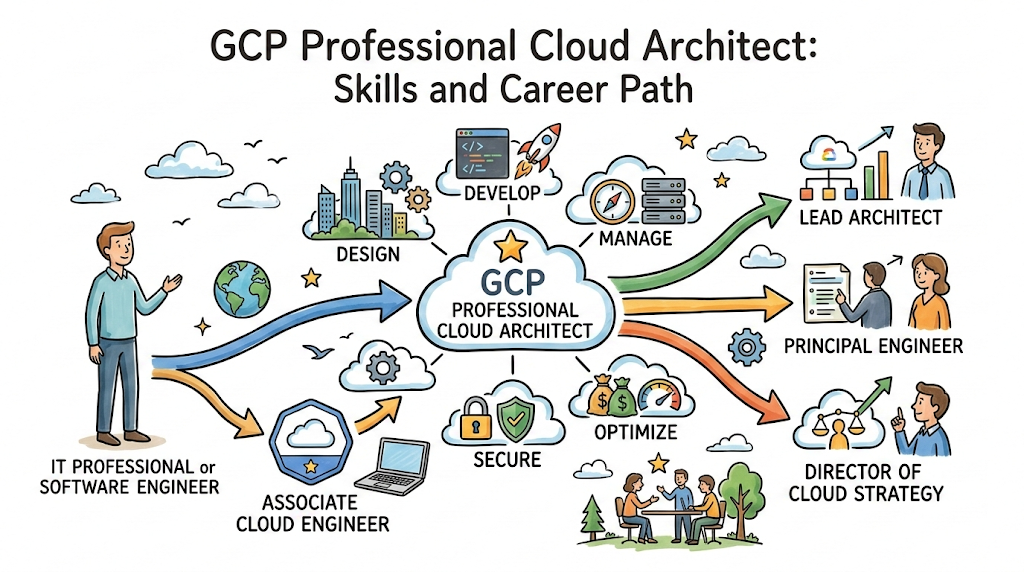
Introduction
Cloud architecture is no longer just about picking the right virtual machines; it is about designing robust, highly scalable, and secure systems that drive business innovation. As organizations aggressively migrate to Google Cloud, the demand for experts who can orchestrate these complex environments has skyrocketed. Whether you are an infrastructure engineer looking to level up or an engineering manager wanting to guide your team’s cloud strategy, mastering Google Cloud Platform (GCP) architecture is a game-changer. This guide breaks down the GCP Professional Cloud Architect certification, showing you exactly how to prepare, what skills you will gain, and how it accelerates your career.
Certification Overview
| Track | Level | Who it’s for | Prerequisites | Skills covered | Recommended order |
|---|---|---|---|---|---|
| Architecture | Professional | Cloud Architects, SREs, Systems Engineers | 3+ years industry experience, 1+ year on GCP (recommended) | Compute, Storage, Networking, Security, Migration, Optimization | After GCP Associate Cloud Engineer |
GCP Professional Cloud Architect
What it is
The GCP Professional Cloud Architect certification validates your ability to design, build, and manage scalable, highly available, and secure solutions on Google Cloud Platform. It proves you can translate business requirements into technical cloud architectures.
Who should take it
This certification is ideal for Cloud Architects, Systems Engineers, DevOps practitioners, and Engineering Managers who are responsible for designing enterprise-cloud strategies and leading GCP migrations.
Skills you’ll gain
- Designing cloud architectures for high availability, fault tolerance, and disaster recovery.
- Managing and provisioning infrastructure using compute, storage, and networking services.
- Designing for security, identity management (IAM), and compliance standards.
- Analyzing and optimizing cloud systems for cost, performance, and reliability.
- Ensuring smooth operational processes and reliable deployments.
Real-world projects you should be able to do after it
- Designing and implementing a secure, multi-tier hybrid network connecting on-premises data centers to GCP via Dedicated Interconnect.
- Architecting a globally scalable web application using Google Kubernetes Engine (GKE), Cloud Load Balancing, and Cloud SQL.
- Building a serverless event-driven data pipeline utilizing Cloud Run, Pub/Sub, and BigQuery.
- Executing a seamless lift-and-shift migration of legacy virtual machines to Compute Engine while optimizing costs.
Preparation plan
- 7–14 days: For highly experienced GCP architects who only need to review the official exam guide, study the business case studies, and take a few practice exams.
- 30 days: For professionals with solid cloud experience but who need to fill knowledge gaps in specific GCP services, networking, and IAM policies through focused hands-on labs.
- 60 days: For engineers transitioning from AWS or Azure who need to learn GCP-specific terminology, core infrastructure components, and complete full training courses before testing.
Common mistakes
- Memorizing product documentation without understanding the “why” behind architectural trade-offs.
- Ignoring the official exam case studies, which make up a significant portion of the test questions.
- Overlooking identity and access management (IAM) hierarchies and least-privilege principles.
- Neglecting the nuances of GCP networking, such as shared VPCs and hybrid connectivity options.
Best next certification after this
Once you have conquered the Professional Cloud Architect exam, the best logical step is to specialize based on your daily responsibilities. If you focus on security, the GCP Professional Cloud Security Engineer is excellent. If your focus is on automation and reliability, the GCP Professional Cloud DevOps Engineer is highly recommended.
Choose your path
The GCP ecosystem is vast, and your certification journey should align with your specific career discipline. Here is how different operational practices map to Google Cloud expertise.
DevOps
For those focused on continuous integration, continuous delivery (CI/CD), and automation, the path involves mastering tools like Cloud Build, Artifact Registry, and Cloud Deploy. You will architect deployment pipelines that seamlessly push code from repositories to GKE or Cloud Run.
DevSecOps
If security is your priority, this path emphasizes integrating automated security checks, vulnerability scanning, and IAM policies directly into the delivery pipeline. You will focus on building secure-by-default architectures and ensuring compliance from the code level up to the infrastructure layer.
SRE
Site Reliability Engineering (SRE) on GCP revolves around observability, incident management, and error budgets. This path focuses on utilizing Cloud Monitoring, Cloud Logging, and designing systems that automatically scale and self-heal to maintain strict Service Level Objectives (SLOs).
AIOps/MLOps
For those working with artificial intelligence, this path focuses on operationalizing machine learning models. You will design architectures using Vertex AI, orchestrate ML pipelines, and ensure models are reliably deployed, monitored, and scaled in production environments.
DataOps
DataOps professionals focus on building robust, automated data pipelines. This path requires deep knowledge of Pub/Sub for streaming data, Dataflow for processing, and BigQuery for analytics, ensuring data is accurate, accessible, and delivered in real-time.
FinOps
Cloud financial management is critical for enterprise success. The FinOps path involves architecting for cost optimization, utilizing sustained use discounts, configuring billing alerts, and designing systems that automatically scale down during off-peak hours to eliminate resource waste.
Role → Recommended certifications
| Role | Foundation | Core Architecture | Specialization / Next Step | Goal / Impact |
|---|---|---|---|---|
| DevOps Engineer | Associate Cloud Engineer | Professional Cloud Architect | Professional Cloud DevOps Engineer | Build scalable platforms, automate secure CI/CD pipelines, and manage reliable infrastructure. |
| SRE | Associate Cloud Engineer | Professional Cloud Architect | Professional Cloud DevOps Engineer | Design for high availability, implement strict SLOs, and automate incident response and recovery. |
| Platform Engineer | Associate Cloud Engineer | Professional Cloud Architect | CKA (Certified Kubernetes Admin) | Architect repeatable internal developer platforms and manage complex GKE container environments. |
| Cloud Engineer | Associate Cloud Engineer | Professional Cloud Architect | Professional Cloud Network Engineer | Transition from basic resource provisioning to designing advanced enterprise cloud architectures. |
| Security Engineer | Associate Cloud Engineer | Professional Cloud Security Engineer | Professional Cloud Architect | Ensure compliance, enforce zero-trust IAM policies, and integrate security into foundational designs. |
| Data Engineer | Associate Cloud Engineer | Professional Data Engineer | Professional Cloud Architect | Architect robust streaming pipelines, optimize BigQuery analytics, and design secure data lakes. |
| FinOps Practitioner | Associate Cloud Engineer | Professional Cloud Architect | FinOps Certified Practitioner | Design cost-aware architectures, implement automated scaling, and enforce strict cloud budget controls. |
| Engineering Manager | Associate Cloud Engineer | Professional Cloud Architect | TOGAF / ITIL | Evaluate technical trade-offs, align cloud strategy with business goals, and lead enterprise migrations. |
Next certifications to take
After achieving the GCP Professional Cloud Architect certification, you can expand your expertise in a few different directions depending on your career goals.
Same track
If you want to stay strictly within architecture and infrastructure, look into the GCP Professional Cloud Network Engineer certification. It dives deep into VPCs, hybrid connectivity, and network security, complementing your architectural knowledge perfectly.
Cross-track
To broaden your skill set into specific operational domains, pursue the GCP Professional Cloud Database Engineer or GCP Professional Data Engineer. These will allow you to design the underlying infrastructure while also expertly managing the data living within it.
Leadership
If you are moving into management or enterprise strategy, consider vendor-neutral certifications like TOGAF or ITIL. These frameworks help you align your deep technical GCP knowledge with high-level enterprise business architecture and service management.
Top Training Institutions for GCP Professional Cloud Architect
DevOpsSchool
Offers comprehensive, instructor-led training programs that blend theoretical knowledge with heavy hands-on labs. Their curriculum is highly aligned with industry demands and real-world enterprise architectures.
Cotocus
Provides specialized IT consulting and training with a strong focus on cloud migrations and infrastructure automation, ensuring students learn practical, job-ready GCP skills.
Scmgalaxy
A community-driven platform that offers extensive resources, tutorials, and structured courses tailored for cloud professionals looking to master GCP and software configuration management.
BestDevOps
Focuses on delivering high-quality, intensive bootcamps that cover the entire cloud architecture and DevOps lifecycle, preparing professionals for immediate project deployment.
devsecopsschool.com
Ideal for architects who want to ensure their cloud designs are heavily fortified. They provide training that deeply integrates security principles into GCP infrastructure planning.
sreschool.com
Specializes in training engineers on reliability and observability, perfectly complementing the GCP Cloud Architect curriculum by focusing on system uptime and performance monitoring.
aiopsschool.com
Offers advanced training for cloud architects looking to integrate artificial intelligence into their IT operations, teaching how to build smart, self-healing GCP architectures.
dataopsschool.com
Provides focused education on building agile and automated data pipelines, helping cloud architects master GCP data services like BigQuery, Dataflow, and Pub/Sub.
finopsschool.com
Teaches the financial principles of cloud computing, helping architects design highly cost-optimized GCP environments and manage cloud spend effectively across large organizations.
FAQs
1. How difficult is the GCP Professional Cloud Architect exam?
It is widely considered one of the most challenging cloud certifications in the industry. It requires not just memorization of services, but a deep understanding of architectural trade-offs, business requirements, and complex case studies.
2. How much time do I need to prepare for this certification?
Most professionals require between 40 to 80 hours of dedicated study time. This usually translates to 1 to 3 months of preparation, depending on your prior experience with Google Cloud and general system architecture.
3. Are there any mandatory prerequisites for this exam?
Google does not enforce any strict prerequisites. However, they highly recommend having at least three years of industry experience, including one year designing and managing solutions specifically on Google Cloud.
4. Should I take the Associate Cloud Engineer exam first?
Yes, it is highly recommended. The Associate exam builds your foundational knowledge of GCP console operations and CLI commands, allowing you to focus purely on high-level design and strategy when studying for the Architect exam.
5. How does this certification impact my career and salary?
Achieving this certification significantly boosts your credibility and often leads to senior roles like Enterprise Architect or Lead Cloud Engineer. It is consistently ranked as one of the highest-paying IT certifications globally.
6. Do the case studies change frequently on the exam?
Google updates the case studies periodically to reflect modern architectural challenges. You must review the current case studies provided in the official exam guide well before your test date to ensure you understand the fictional companies’ business and technical requirements.
7. Is coding knowledge required to pass this exam?
Deep coding expertise is not required, as the exam focuses on architecture and design. However, you must understand development methodologies, CI/CD pipelines, and how applications interact with databases and APIs within a cloud environment.
8. How long is the certification valid?
The GCP Professional Cloud Architect certification is valid for two years from the date you pass the exam. To maintain your certified status, you must recertify by taking the current version of the exam before your credential expires.
FAQs: Your Guide to the Architect Exam
1. How hard is the GCP Professional Cloud Architect exam?
It is one of the toughest cloud exams available. It tests your ability to solve real business problems, not just your memory of cloud tools. You need to think like a consultant to pass.
2. How much time do I need to prepare for the exam?
If you already work with Google Cloud every day, 30 days of focused study might be enough. If you are new to the platform, plan for 2 to 3 months of steady learning and hands-on practice.
3. What are the official prerequisites for the exam?
Google does not have strict rules to take the exam. Anyone can register. However, they highly recommend having at least three years of general industry experience, with at least one year managing solutions directly on Google Cloud.
4. Should I take the Associate Cloud Engineer exam first?
Yes, I strongly suggest it. The Associate exam builds your technical foundation. The Architect exam assumes you already know the basics of deploying apps and managing networks, so skipping the Associate level can make things much harder.
5. Do I need a strong coding background to pass?
You do not need to be a daily programmer. However, you must understand how software works, how to read basic scripts, and how applications connect to databases and networks in the background.
6. Is the exam mostly theory or practical?
It is highly practical. A large part of the exam uses long case studies. You will read about a fictional company and choose the best design to solve their specific problems. You cannot just guess the answers.
7. Is the GCP Cloud Architect certification worth the cost and effort?
Absolutely. It proves you can design secure, cost-effective, and scalable systems. Companies highly value this skill, making it one of the most respected badges in the IT industry today.
8. Will this certification help me get a job in India or globally?
Yes. The demand for cloud architects is huge in tech hubs like Bangalore, Pune, Hyderabad, and worldwide. Companies are actively looking for certified professionals to lead their digital growth.
9. What kind of career outcomes can I expect?
You can step into senior roles like Lead Cloud Architect, Principal Engineer, or Director of Cloud Strategy. It opens doors to leadership positions where you guide entire engineering teams and make big business decisions.
10. Can engineering managers benefit from this certification?
Yes, very much so. It gives managers the technical grounding they need to understand their team’s work, estimate cloud costs accurately, and speak confidently with business leaders.
11. How does this certification compare to AWS or Azure?
All three are valuable, but GCP is often chosen by companies focusing heavily on data analytics, machine learning, and open-source tools like Kubernetes. This certification proves you are an expert in these specific areas.
12. What is the best certification to take after this one?
If you want to stay deeply technical, the Professional Cloud Security Engineer is a great next step. If you want to focus on big data, go for the Professional Data Engineer track.
Testimonials
“Earning the GCP Professional Cloud Architect certification completely transformed my approach to system design. I stopped looking at individual services and started seeing the entire enterprise ecosystem. It gave me the confidence to lead our massive migration project seamlessly.”
— Lead Infrastructure Architect
“The focus on the business case studies during the exam preparation was invaluable. It forced me to think like a CTO rather than just an engineer. This certification directly helped me secure a promotion to Engineering Manager, as I can now effectively bridge the gap between technical execution and business goals.”
— Engineering Manager
Conclusion
The journey to becoming a GCP Professional Cloud Architect is rigorous, but the rewards are immense. This credential proves you have moved beyond simply deploying virtual machines to architecting highly resilient, secure, and cost-effective enterprise solutions. By mastering the core principles of compute, storage, networking, and security, you position yourself as a vital asset to any organization navigating its digital transformation. Follow a structured preparation plan, dive deep into the real-world case studies, and leverage hands-on training to bridge the gap between theory and practice. The cloud is evolving rapidly, and this certification ensures you are ready to lead the charge.