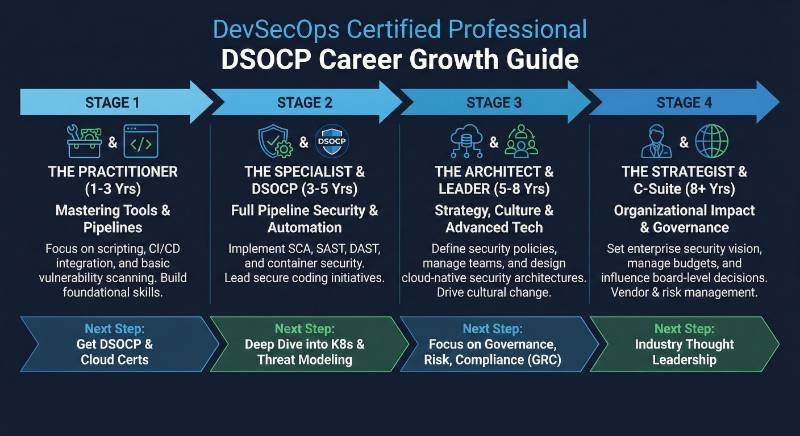
Introduction
Software teams today release faster than ever. At the same time, security risks have also increased—because modern apps depend on open-source libraries, containers, cloud services, APIs, and automated pipelines. One small mistake, like a leaked secret, a vulnerable dependency, or an over-permitted cloud role, can create a serious incident. That’s why DevSecOps has become a must-have skill. It is a practical way to build security into daily development and delivery work—so security checks happen automatically inside the same CI/CD pipeline that ships your code. Instead of slowing teams down, DevSecOps helps teams move faster with fewer surprises. The DevSecOps Certified Professional (DSOCP) is designed for working engineers and managers who want to build real DevSecOps capability. This master guide explains what DSOCP covers, who should take it, what skills and projects you should be able to deliver after it, how to prepare in 7–14 / 30 / 60 days, and what to learn next—using only the official reference provided.
Why DSOCP matters in real work
Why it matters for engineers
Most production issues and security issues happen during change. A small code change can pull a new dependency, create a new API path, change a container image, or change cloud permissions. DevSecOps gives you repeatable ways to reduce those risks:
- You detect problems early (before release).
- You enforce basic rules automatically (so you don’t rely on memory).
- You keep proof of what happened (important for audits and post-incident reviews).
- You reduce “last-minute security surprise” delays.
Why it matters for managers
Managers care about delivery and reliability, but also about “risk you can explain.” DSOCP-style DevSecOps helps you create:
- Clear standards for what “safe to release” means
- Measurable reporting (how many issues, how quickly fixed, what is blocked)
- Predictable delivery (less firefighting and fewer urgent rollbacks)
- Shared ownership between dev, ops, and security
What DSOCP is actually teaching you
DSOCP is not only “tool learning.” It is learning how to design a secure delivery system. That system usually has five layers:
- Code layer – safe coding habits + reviews + basic checks
- Build layer – dependency checks + build integrity
- Pipeline layer – gates, approvals, traceability, safe releases
- Runtime layer – container/Kubernetes and cloud controls
- Operations layer – monitoring, detection, incident response, learning loops
Certification table
| Certification (as shown on the page) | Track | Level | Who it’s for | Prerequisites | Skills covered | Recommended order |
|---|---|---|---|---|---|---|
| Master in DevOps Engineering (MDE) | DevOps + DevSecOps + SRE | Master program | Engineers/managers wanting end-to-end capability | None required (page says no prerequisites) | DevOps, DevSecOps, SRE concepts + tools + projects | 4 |
| SRE Site Reliability Engineering | SRE | Professional | SREs, ops, platform teams | Monitoring + incident basics (recommended) | SLI/SLO, reliability practices, on-call readiness | 3 |
| (DSOCP) DevSecOps Certified Professional | DevSecOps | Professional | DevOps + security-focused engineers | CI/CD + Git + Linux (recommended) | Secure pipelines, security automation, runtime basics | 2 |
| DCA Docker Certified Associate | Containers | Associate | Developers/DevOps using Docker daily | Docker basics | images, registries, runtime, troubleshooting | 1–2 |
| CKA Certified Kubernetes Administrator | Kubernetes | Professional | Platform/K8s admins, SRE/DevOps | Docker + Linux + YAML basics | cluster operations, workloads, networking, troubleshooting | 3–4 |
| Splunk Master in Splunk Engineering | Observability / SecOps | Advanced | Monitoring/SOC/ops engineers | Log basics | dashboards, alerts, investigations, log pipelines | optional |
| Python Master in Python Programming | Programming / Automation | Foundation+ | Anyone doing automation | None | scripting for automation, tooling, glue code | optional |
DevSecOps Certified Professional (DSOCP)
What it is
DSOCP is a professional certification focused on building secure software delivery workflows. It teaches how to shift security left, automate security checks in CI/CD, and apply practical runtime and cloud security basics so teams can release faster with less risk.
Who should take it
DSOCP is a strong fit if you are in any of these situations:
- DevOps Engineer / Platform Engineer: you build pipelines, manage containers/Kubernetes, and want security to be part of your platform.
- Software Engineer: you ship microservices and want fewer production and security issues caused by dependencies, secrets, and misconfigurations.
- Security Engineer moving into DevSecOps: you want to create guardrails in pipelines instead of doing only manual reviews.
- Cloud Engineer: you manage IAM, permissions, and infrastructure and want delivery processes to be safer by default.
- Engineering Manager / Tech Lead: you want to guide teams to ship faster without “security drama” before release.
Skills you’ll gain
Below are the real skills that make you valuable after DSOCP. These are written in a “what you can do” style.
- Secure CI/CD design: build pipelines that test, scan, and validate every change.
- Security gates: define what should block a release (and what should only warn).
- Dependency risk handling: detect vulnerable libraries and manage upgrades safely.
- Supply chain thinking: understand why artifact integrity matters and how teams reduce tampering risk.
- Secrets hygiene: stop secrets from leaking into repos, logs, and builds.
- Container hardening: reduce image size, reduce attack surface, and apply scanning properly.
- Kubernetes security basics: RBAC, namespaces, secure configs, and baseline isolation practices.
- Cloud access control basics: least privilege, service identities, and audit-friendly permissions.
- Runtime monitoring for security: detect suspicious patterns and respond fast.
- Incident-ready operations: build a simple response flow so teams act quickly and calmly.
Real-world projects you should be able to do after it
Project 1: Secure CI/CD pipeline with real gates
You should be able to build a pipeline that includes:
- Code checks (linting, tests)
- Dependency scan step
- Container build + scan step
- Quality and security gate rules (fail vs warn)
- Artifact publishing
- Deployment to staging with automated validation
- Controlled promotion to production
Outcome: You can explain exactly why the build is blocked and what fixes are needed.
Project 2: Container security workflow for a microservice
You should be able to deliver:
- Minimal base image selection
- Proper tagging strategy (no “latest” in production)
- Vulnerability scanning and severity thresholds
- Policy check approach (what is allowed to run)
- Registry hygiene (signed images, trusted sources mindset)
Outcome: Your container pipeline is consistent and repeatable.
Project 3: Kubernetes security baseline for a small platform
You should be able to implement:
- RBAC roles for different teams
- Namespace-based separation approach
- Basic workload security controls (resource limits, secure defaults)
- Admission control strategy (how you prevent risky deployments)
- Logging and monitoring for cluster-level events
Outcome: Your cluster is harder to misuse and easier to audit.
Project 4: Secrets handling and rotation plan
You should be able to deliver:
- A safe pattern for secrets usage (no secrets in code)
- Secrets injection method for applications
- Rotation steps and ownership
- “What to do if secret leaks” quick runbook
- Review and audit process (basic but real)
Outcome: Secrets become manageable, not scary.
Project 5: Vulnerability management workflow that doesn’t slow teams
You should be able to define:
- Severity rules (what is urgent, what is scheduled)
- SLA approach (how fast to fix)
- Exception handling (time-bound and tracked)
- A dashboard or report format teams can understand
- A review meeting rhythm (lightweight, not heavy)
Outcome: Findings lead to fixes, not just reports.
Preparation plan
7–14 days plan (fast track)
This plan works if you already do DevOps work (pipelines, deployments, basic containers).
Days 1–2: Foundation refresh
- CI/CD stages and why each stage exists
- Git branching basics and change review habits
- Basic Linux commands used in pipelines
- Typical failures: tests, builds, deployment configs
Days 3–4: Dependency + build security basics
- How dependency issues happen
- How teams handle vulnerable versions
- What “breaking changes” look like during upgrades
- How to stop accidental risky upgrades
Days 5–6: Container security fundamentals
- Image hygiene: size, layers, base image choice
- What scanners actually detect (and what they don’t)
- Common container mistakes that create vulnerabilities
Days 7–9: Kubernetes + cloud security basics
- RBAC concept and least privilege
- Namespaces and basic isolation
- Misconfiguration patterns (too-open access)
- Simple monitoring signals and logs
Days 10–12: Build one capstone pipeline
- Pick a sample service (even a simple API)
- Build: test → scan → build image → scan → deploy staging → validate
- Document the rules: what fails, what warns, what to fix first
Days 13–14: Review + exam practice
- Review weak topics
- Practice common scenario questions
- Finalize a one-page summary of your pipeline flow and rules
30 days plan (balanced, best for most working professionals)
Week 1: Delivery basics that security depends on
- CI/CD pipelines in depth (stages, gating, promotions)
- Environments: dev/stage/prod differences
- Deployment strategies: safe rollouts and rollback thinking
- Ownership model: who fixes what
Week 2: Secure SDLC essentials
- Threat modeling “lite” (simple questions: what can go wrong?)
- Dependency checks and patch habits
- Code review patterns that catch security mistakes early
- Secrets hygiene rules your team can follow
Week 3: Container + Kubernetes baseline security
- Container runtime risks and how teams reduce them
- Kubernetes basics (RBAC, namespaces, workload controls)
- Cluster visibility: what to log and why
- Handling misconfigurations as part of CI/CD
Week 4: Cloud IAM + monitoring + incident readiness
- Least privilege and audit-friendly permissions
- Security signals in logs and metrics
- Incident response basics: detect → contain → fix → learn
- Final capstone project + documentation
60 days plan (career transition path)
This plan fits if you are moving into DevSecOps from dev, QA, or operations.
Weeks 1–2: Strong foundations
- Linux, Git, CI/CD, container basics
- Build/test discipline and artifact understanding
Weeks 3–4: DevSecOps pipeline mastery
- Dependency and container scanning
- Gate rules and exception rules
- How to keep pipelines fast and stable
Weeks 5–6: Kubernetes + cloud security basics
- RBAC, isolation, safe configs
- IAM patterns and least privilege approach
- Secrets management patterns and rotation
Weeks 7–8: Production realism
- Monitoring for security signals
- Incident response and runbooks
- Post-incident learning and measurable improvements
- Two capstones: (1) secure pipeline, (2) Kubernetes/cloud baseline
Common mistakes
- “We ran scans, so we are secure.”
Scans without clear decisions do not reduce risk. You need rules: what blocks, what warns, and how fast issues must be fixed. - Blocking everything from day one.
If your first step is strict blocking, teams will bypass. Start with visibility, then move to gates for high-severity issues. - No exception process.
Exceptions happen in real life. The mistake is not tracking them with owner + expiry + reason. - Secrets in repos, pipelines, or logs.
This is still one of the most common real-world failures. DevSecOps must include secrets hygiene and response steps. - Over-permissioned cloud IAM “to make it work.”
It works quickly, but it creates long-term risk. Least privilege is slower at first but faster later. - Only build-time checks, no runtime visibility.
Many attacks and misuses happen at runtime. You need logs, alerts, and a response plan. - No ownership model.
When security findings appear, teams must know who owns the fix and what “done” means. - No learning loop.
DevSecOps is not a one-time setup. The best teams improve gates and checks based on incidents and new risks.
Best next certification after DSOCP
The best next step dependsust depends on what you want to become.
Same track: deeper DevSecOps ownership
Choose this if your day-to-day is secure pipelines, AppSec automation, and platform guardrails.
- Goal: build “golden pipelines” other teams can reuse
- Add: better policy enforcement, better exception handling, stronger audit trail
- Outcome: your organization ships safer without slowing down
Cross-track: platform and Kubernetes depth
Choose this if you work with Kubernetes or want to become a platform engineer.
- Goal: secure the platform so teams inherit safety
- Add: stronger Kubernetes operations and baseline controls
- Outcome: fewer cluster incidents and fewer insecure deployments
Leadership: scale security across teams
Choose this if you lead teams or own delivery outcomes across multiple products.
- Goal: standardize practices and reporting
- Add: templates, guidance, and measurable security improvements
- Outcome: faster delivery with fewer last-minute security blockers
(Your reference page explicitly shows DSOCP alongside other certification course options like SRE, Docker, Kubernetes, Splunk, and Python.)
Choose your path (6 learning paths )
1) DevOps path
Best for: engineers building automation and delivery pipelines
Focus areas:
- CI/CD mastery
- IaC discipline (repeatable infra)
- Containers and deployment strategies
- Monitoring and release safety (canary, rollback)
What success looks like:
You can create reliable, repeatable deployments and reduce release failures.
2) DevSecOps path
Best for: engineers who own secure delivery outcomes
Focus areas:
- Secure pipeline gates and scanning
- Secrets hygiene and access control patterns
- Supply chain basics and artifact integrity mindset
- Runtime visibility and incident-ready operations
What success looks like:
Security issues are caught early and fixes are part of normal delivery.
3) SRE path
Best for: reliability owners and incident leaders
Focus areas:
- SLI/SLO thinking and error budgets
- Incident response and calm execution
- Observability and alert quality
- Postmortems and continuous improvement
What success looks like:
Fewer incidents, faster recovery, and measurable reliability improvements.
4) AIOps/MLOps path
Best for: teams dealing with scale and alert noise
Focus areas:
- Automation for detection and triage
- ML pipeline discipline (for MLOps)
- Reducing mean time to detect and resolve
- Intelligent correlation of signals
What success looks like:
Less noise, faster triage, and fewer repeated incidents.
5) DataOps path
Best for: data engineers and analytics platform teams
Focus areas:
- Data pipeline CI/CD habits
- Data quality checks and governance
- Access control and auditability
- Reproducible pipelines and lineage mindset
What success looks like:
Reliable data pipelines with fewer quality incidents and better trust.
6) FinOps path
Best for: cloud cost owners and managers
Focus areas:
- Cost visibility and tagging governance
- Budget controls and forecasting
- Cost optimization playbooks
- Unit economics and cost accountability
What success looks like:
Predictable cloud spend and clear cost responsibility.
Role → Recommended certifications mapping
| Role | What you are expected to deliver | Recommended certification direction |
|---|---|---|
| DevOps Engineer | stable CI/CD, deployments, automation | Start with containers → add DSOCP for secure delivery |
| SRE | reliability, incidents, SLO discipline | SRE + DSOCP to combine reliability with secure operations |
| Platform Engineer | shared platform, standards, self-service | Kubernetes depth + DSOCP for platform guardrails |
| Cloud Engineer | IAM, infra delivery, secure access | Cloud/IAM mindset + DSOCP for secure delivery flow |
| Security Engineer | security controls that scale | DSOCP for pipeline automation + runtime basics |
| Data Engineer | trusted pipelines + access control | DataOps mindset + security hygiene patterns |
| FinOps Practitioner | cost governance + reporting | FinOps + platform understanding for controls |
| Engineering Manager | outcomes, delivery speed, risk | Leadership path: DSOCP awareness + SRE thinking + governance |
Next certifications to take (3 options)
Option 1: Same track (DevSecOps depth)
When to choose: you want to become the person who designs secure delivery templates and policies.
What to focus on next:
- Stronger gate rules and exception workflows
- Better dashboards and measurable improvements
- Standard templates teams can adopt quickly
Option 2: Cross-track (platform + Kubernetes)
When to choose: you are moving toward platform engineering or Kubernetes operations.
What to focus on next:
- Cluster operations and troubleshooting
- Baseline security controls that prevent risky deployments
- Runtime monitoring and controlled upgrades
Option 3: Leadership (scale and governance)
When to choose: you guide teams and want org-level impact.
What to focus on next:
- “Minimum security standard” playbooks that are realistic
- Reporting: trend, risk, exceptions, and remediation speed
- Incident readiness and learning culture
Training cum certification support institutions
DevOpsSchool
DevOpsSchool is positioned as a training and certification provider with structured programs and practical learning formats. It is listed as the provider on the site and also shows multiple certification offerings in its ecosystem.
It suits learners who want step-by-step skill building with projects and a certification-aligned path.
Cotocus
Cotocus is often mentioned in the same learning ecosystem as a support option for training and implementation guidance. It can be useful for learners who want hands-on help and practical execution thinking, especially when applying DevSecOps in real delivery setups.
Scmgalaxy
Scmgalaxy is commonly associated with structured training support across engineering topics. It fits learners who prefer guided learning, practical examples, and a clear progression approach while preparing for certification-style outcomes.
BestDevOps
BestDevOps is useful when you want career-focused guidance and skill mapping support. It aligns well with learners who want to understand how certifications connect with real job expectations and how to present skills clearly.
devsecopsschool
devsecopsschool is track-focused around DevSecOps learning. It fits people who want security-first delivery thinking and want a direct identity around DevSecOps skills and progression.
sreschool
sreschool is best for reliability-focused learners. It supports people who want incident readiness, SLO mindset, and operational excellence to match modern platform demands.
aiopsschool
aiopsschool supports learning for operations automation and intelligence. It fits teams dealing with alert fatigue and looking for smarter monitoring and triage practices.
dataopsschool
dataopsschool supports DataOps thinking: pipeline discipline, quality checks, governance, and reliability for data systems. It is useful for data engineering teams that want predictable and auditable pipelines.
finopsschool
finopsschool supports FinOps learning: cost visibility, governance habits, and optimization workflows. It fits cloud teams and managers who want controlled cloud spend without blocking innovation.
FAQs
1) Is DSOCP hard for beginners?
If you are fully new to CI/CD and containers, it will feel challenging at first. But it becomes easier if you learn step-by-step: first pipelines, then containers, then security gates. Most learners succeed when they build one small pipeline project while learning.
2) How much time do I need each day?
For a 30-day plan, even 60–90 minutes daily can work if you stay consistent. The key is to practice every week, not only read theory.
3) What are the recommended prerequisites?
Basic Linux commands, Git basics, and an understanding of CI/CD stages are enough to start. Security knowledge is helpful but not mandatory if you learn the “why” behind each check.
4) Do I need to know Kubernetes?
Not strictly, but modern delivery often uses Kubernetes. Knowing RBAC, namespaces, and workload basics will help you understand runtime security better.
5) What is the best order: DCA → DSOCP → CKA?
That order works well because you first get comfortable with containers, then secure the delivery pipeline, then go deeper into Kubernetes operations and platform control.
6) Will DSOCP help in interviews?
Yes, if you can explain one secure pipeline you built, what gates you used, and how you handled exceptions. Interviewers trust real examples more than tool lists.
7) Is DSOCP useful for managers?
Yes, because it helps managers understand what “secure delivery” looks like in practice: measurable gates, tracked exceptions, faster remediation, and less release risk.
8) What kind of projects prove DSOCP skill?
A secure CI/CD pipeline project is the best proof. Add container scanning, gating rules, and a simple dashboard/report. This shows you understand workflow, not only tools.
9) What’s the biggest mistake people make while learning DevSecOps?
They try to learn too many tools at once. The better approach is: learn the flow first, then map tools to each step.
10) Can I apply DevSecOps in a small team?
Yes. Small teams benefit even more because automation reduces dependence on “one security person.” Start with simple checks and improve gradually.
11) How do I avoid slowing down my pipeline with security checks?
Use smart rules: run fast checks early, run heavy checks later, cache dependencies, and block only the highest-risk issues first. Optimize over time with real data.
12) What should I do after certification to keep improving?
Keep shipping secure changes weekly. Track vulnerabilities, reduce exceptions, improve IAM, and refine monitoring. The goal is continuous improvement, not one-time setup.
FAQs specifically on DSOCP
1) What is the core outcome of DSOCP?
The core outcome is that you can design a secure delivery workflow: build, test, scan, gate, deploy, and monitor—without relying on manual “security reminders.”
2) Does DSOCP focus more on DevOps or security?
It connects both. The focus is security inside delivery, not security as a separate activity. You learn how security becomes part of CI/CD and runtime operations.
3) How do I demonstrate DSOCP skill in my current job?
Start by adding visibility: scan results, simple reports, and clear ownership. Then introduce gates for high-severity findings. Show that you reduced risk without creating chaos.
4) What should I master first: dependency scanning or container scanning?
Start with dependency scanning if you are a developer-heavy team, and container scanning if you are container-heavy. In real life, most teams do both in a good pipeline.
5) What if my company culture resists security gates?
Use a gradual approach. First show findings and trends. Then gate only the biggest risks. When teams see fewer incidents and rework, adoption becomes easier.
6) Does DSOCP help with compliance?
Yes. Automated checks, traceability, and consistent processes support compliance because you can show what happened, when, and why a release was approved.
7) Is DSOCP relevant for cloud-first companies?
Very relevant. Cloud changes are frequent and permissions are powerful. DevSecOps helps prevent risky permissions and insecure deployments by catching them early.
8) What is the best next step for platform teams after DSOCP?
Add Kubernetes platform control: baseline policies, RBAC discipline, and runtime monitoring. Then build “golden pipeline templates” so other teams inherit safety by default.
Conclusion
DSOCP is a practical certification for people who want to ship software quickly without increasing risk. It teaches you how to build secure pipelines, handle dependencies safely, protect secrets, and apply baseline security in containers, Kubernetes, and cloud permissions. If you want to make this certification truly valuable, focus on one thing: build a real secure pipeline project and document your gates and exception process. That single project often becomes the strongest proof of skill for interviews and promotions.