Introduction
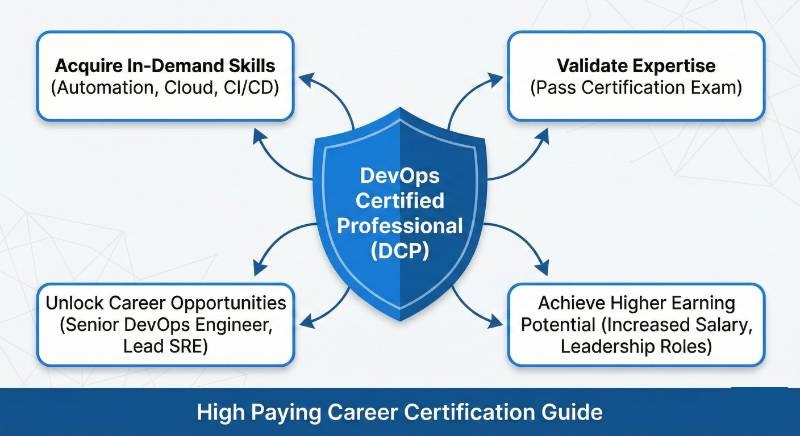
In today’s fast-moving tech market, the line between “writing code” and “running code” has disappeared. If you aren’t automating, you are falling behind. The DevOps Certified Professional (DCP) program is the industry’s answer to this shift. It isn’t just about learning a few tools—it is about mastering the “Engineering Ownership” that top-tier companies in India and across the globe are desperate to find. This guide is your roadmap to becoming a high-value architect in a world that no longer accepts manual work.
The Certification Landscape
Below is a list of the key certification tracks available through the program. Each one is built to help you master a specific area of the modern software lifecycle.
| Track | Level | Who it’s for | Prerequisites | Skills Covered | Recommended Order |
| DevOps | Professional | Engineers, Admins | Basic Linux, Scripting | CI/CD, Docker, K8s, IaC | Start here |
| DevSecOps | Professional | Security Engineers | DevOps Basics | Security Automation, Vault | Second |
| SRE | Professional | Ops Engineers | DevOps Basics | SLIs/SLOs, Error Budgets | Second |
| AIOps | Professional | Data/Ops Engineers | Python Basics | ML in Ops, Monitoring | Advanced |
| DataOps | Professional | Data Engineers | SQL, Data Basics | Data Pipelines, Quality | Advanced |
| FinOps | Professional | Managers, Leads | Cloud Basics | Cost Optimization | Leadership |
DevOps Certified Professional (DCP): Deep Dive
What it is
The DCP is a comprehensive program that teaches you how to automate the entire software development lifecycle. It focuses on breaking down silos between developers and operations teams using a standard set of tools and cultural shifts.
Who should take it
This is perfect for Software Engineers, System Administrators, and Quality Assurance professionals. It also adds great value for Project Managers who want to understand the technical side of modern delivery.
Skills you’ll gain
- Mastering Linux administration and shell scripting.
- Building automated CI/CD pipelines with Jenkins and GitHub Actions.
- Managing containerized apps with Docker and Kubernetes.
- Writing Infrastructure as Code (IaC) using Terraform and Ansible.
- Setting up full-stack monitoring and observability.
Real-world projects you should be able to do
- Automated Delivery: Build a fully automated pipeline that deploys a web app from code to a cloud cluster.
- Self-Healing Systems: Create a self-healing infrastructure that restarts services if they fail.
- Log Management: Set up a centralized logging system to track errors across multiple servers.
Preparation Plan
- 7-14 Days: Focus on the basics. Review Linux commands, Git branching, and the core philosophy of DevOps.
- 30 Days: Dive into automation. Practice building pipelines and managing small Docker environments every day.
- 60 Days: Master the “at scale” tools. Work on Kubernetes clusters, advanced Terraform modules, and disaster recovery scenarios.
Common Mistakes
- Ignoring the Basics: Many jump to Kubernetes without understanding Linux or Networking.
- Tool Obsession: Focusing only on learning a tool rather than understanding the “why” behind a process.
- No Hands-on Practice: Reading the theory is easy; fixing a broken pipeline is where the real learning happens.
Best next certification after this
Once you complete the DCP, the best next step is either the DevSecOps Professional to focus on security or the SRE Professional to focus on large-scale reliability.
Choose Your Path
Every engineer has a different interest. You can choose a path that fits your long-term goals:
- DevOps Path: Focuses on the core flow of code from a laptop to the production environment.
- DevSecOps Path: Teaches you how to put security checks inside every step of the automation.
- SRE Path: Focuses on keeping systems running and ensuring they are always available for users.
- AIOps/MLOps Path: Uses artificial intelligence to manage complex systems and automate model deployments.
- DataOps Path: Focuses on making data pipelines reliable and fast for data science teams.
- FinOps Path: Helps you manage cloud costs so that the business stays profitable as it grows.
Role → Recommended Certifications
| Role | Recommended Certifications |
| DevOps Engineer | DCP (DevOps), DevSecOps Professional |
| SRE | DCP (DevOps), SRE Professional |
| Platform Engineer | DCP (DevOps), Infrastructure Automation |
| Cloud Engineer | DCP (DevOps), Cloud Architecture |
| Security Engineer | DevSecOps Professional, Security Automation |
| Data Engineer | DataOps Professional, Big Data Mastery |
| FinOps Practitioner | FinOps Professional, Cloud Governance |
| Engineering Manager | DCP (DevOps), FinOps, DevOps Leader |
Top Institutions for DCP Training
If you are looking for help with training and certification, these institutions are well-known for their practical approach:
- DevOpsSchool: A leading provider that offers mentor-led training. They focus on real-world labs and provide deep technical support for students.
- Cotocus: Known for its corporate training programs. They help teams adopt DevOps practices by providing hands-on sessions tailored to business needs.
- Scmgalaxy: A great community-driven platform. They offer a wealth of resources and certifications focused on configuration management and automation.
- BestDevOps: Focuses on the latest trends in the DevOps world. Their training is designed to keep engineers updated with the most recent tools and practices.
- Specialized Schools: For niche tracks, you can look into devsecopsschool, sreschool, aiopsschool, dataopsschool, and finopsschool. These are dedicated to their respective domains.
Frequently Asked Questions (FAQs)
1. Is the DCP certification hard for beginners?
It is designed to start from the basics. If you have some knowledge of how software is built, you can follow the course. However, it requires a lot of practical practice to pass.
2. How much time do I need to study every day?
A dedicated hour or two daily is usually enough. For the 30-day plan, consistent hands-on work is more important than long hours of reading.
3. What are the prerequisites?
A basic understanding of how computers work and a little bit of coding or scripting knowledge will help you move faster.
4. Can I take these certifications in any order?
While you can, I highly recommend starting with the DevOps Certified Professional (DCP). It provides the foundation for all other tracks like SRE or DevSecOps.
5. How long does the certification stay valid?
Usually, these certifications are valid for 2 to 3 years. This ensures that you stay updated with the latest changes in the tech industry.
6. Will this help me get a salary hike?
Yes. Certified professionals often see a significant increase in salary because they can handle more complex tasks and manage systems more efficiently.
7. Is there an exam for the DCP?
Yes, there is an assessment that tests both your theoretical knowledge and your ability to solve practical problems.
8. Can I do this while working a full-time job?
Absolutely. The program is built for working professionals with flexible learning modes and weekend batches.
9. Does the program cover cloud providers like AWS or Azure?
Yes, the DCP includes working with major cloud platforms as they are the home for most DevOps tools today.
10. What if I fail the exam?
Most providers offer a second attempt or a review session to help you understand where you went wrong before you try again.
11. Is this certification recognized globally?
Yes, the skills and the certificate are recognized by many top tech companies around the world, from India to the USA.
12. What is the biggest benefit of the DCP?
The biggest benefit is the shift in mindset. You stop seeing “ops” as a separate job and start seeing it as a part of the engineering excellence you bring to your team.
DCP Certification Specific FAQs
1. What is the pass percentage of the DCP exam?
Most candidates who complete the hands-on labs pass successfully. The focus is on demonstrating skill rather than just memorizing facts.
2. Is the training live or recorded?
Providers like DevOpsSchool offer both live sessions and recorded libraries to accommodate different learning styles.
3. Do I get help with job placement?
Many of the listed institutions provide career guidance, resume building, and interview preparation as part of the program.
4. What tools are prioritized in the DCP?
The program focuses on industry standards: Git, Jenkins, Docker, Kubernetes, Terraform, and Ansible.
5. Is there a community for DCP students?
Yes, platforms like Scmgalaxy provide forums and community groups where you can ask questions and share knowledge.
6. Can I switch from a non-tech background to DCP?
It is possible, but we recommend starting with basic Linux and networking courses before attempting the DCP.
7. Are the exams proctored?
Yes, to maintain the value of the certification, exams are typically proctored online.
8. Is there a project required for certification?
Yes, you must complete a real-world project to show you can integrate multiple tools into a single pipeline.
Next Steps: Where to Go After DCP
Once you have mastered the basics and earned your DCP, you have three main directions to grow:
- Same Track (Advanced): Focus on advanced Kubernetes or cloud architecture to become a Master Architect.
- Cross-Track (Specialization): Move into DevSecOps to master security or SRE to master site reliability.
- Leadership Track: Pursue a DevOps Leader or Engineering Management certification to lead teams and strategy.
Conclusion
In the modern world of software development, standing still is the same as moving backward. The DevOps Certified Professional (DCP) is more than just a piece of paper; it is a roadmap for your career growth. By mastering the tools of automation and adopting a culture of collaboration, you make yourself indispensable to any organization.
Whether you are just starting your journey or looking to move into a leadership role, the paths outlined in this guide provide a clear way forward. My advice after many years in this industry is simple: do not just read about these tools. Build things. Break them. Fix them. That is how you become a true professional.