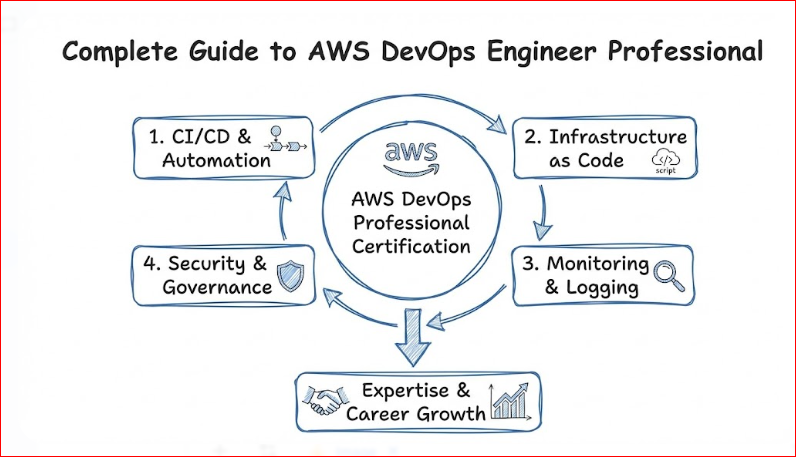
Introduction
AWS DevOps Engineer – Professional is an advanced certification for engineers and managers who build, deploy, and run applications on AWS in real production environments, and it focuses on creating reliable delivery systems through automation rather than manual processes. It validates your ability to design and manage CI/CD pipelines, implement safe deployment strategies, automate governance and security controls, and build strong monitoring and incident response workflows so releases stay fast and stable. Instead of testing only AWS services, it checks end-to-end ownership—how you plan for failures, improve availability, reduce operational effort, and keep systems scalable and compliant. This guide will help you understand what the certification covers, who it is for, what skills and projects it enables, how to prepare with clear timelines, and what to learn next to grow your career.
What is AWS DevOps Engineer – Professional?
This certification checks whether you can build and operate a complete DevOps workflow on AWS. It focuses on automation, continuous delivery, monitoring, incident response, governance, and reliability.
Instead of testing only tools, it tests how you design systems that can deploy often without causing outages.
If you work with production releases, scaling, and operational stability, this is a strong professional-level proof of capability.
Who should take this certification?
You should take this if your work includes building pipelines, managing production deployments, or improving system reliability. It suits engineers who own release processes, automate operations, and support services in real-time.
It’s also valuable for managers who want to understand what good DevOps practices look like in AWS environments.
If you want to move from “supporting DevOps” to “owning DevOps outcomes,” this certification fits well.
Why this certification is valuable for engineers and managers
For engineers
This certification helps you connect CI/CD, monitoring, and automation into one reliable workflow. You learn how to reduce manual work and deploy with fewer mistakes.
You also build stronger confidence in release safety, rollbacks, and incident handling.
Most importantly, you start thinking in systems, not just scripts or tools.
For managers
It gives you a structured view of how teams can deliver faster with less risk. You’ll understand what to measure, what to automate, and where failures usually happen.
This helps improve predictability, reduce firefighting, and support better planning.
It also improves how managers evaluate DevOps maturity across teams.
Certification prerequisites (what you should know before starting)
A strong starting point is hands-on AWS exposure and comfort with automation concepts. You should understand how releases move from code to production and how failures are detected and fixed.
Basic Linux administration and one scripting language are helpful because real DevOps work is automation-heavy.
If you are weaker in one area (like IAM or networking), you can still start—just use the 60-day plan.
Certification table: tracks, levels, and recommended order
| Track | Certification | Level | Who it’s for | Prerequisites | Skills covered | Recommended order |
|---|---|---|---|---|---|---|
| AWS DevOps | AWS DevOps Engineer – Professional | Professional | DevOps / Platform / Cloud engineers running workloads on AWS | AWS experience, automation, CI/CD basics | CI/CD, governance, security automation, monitoring, HA/DR | 1 (target) |
| DevOps | DevOps Certified Professional | Professional | Engineers moving from dev or ops to DevOps | SDLC basics | CI/CD, DevOps practices, automation mindset | 0 (prep, optional) |
| DevSecOps | DevSecOps Certified Professional | Professional | Engineers adding security to pipelines | DevOps basics | policy-as-code, scanning, compliance automation | 2 (cross-track) |
| SRE | Site Reliability Engineering Courses | Professional | Reliability-focused engineers & platform teams | production ops exposure | SLOs, error budgets, incident response | 2 (cross-track) |
| Cloud | AWS Solution Architect Associate | Associate | Cloud builders | cloud fundamentals | architecture, core services | prep (recommended) |
| IaC | Terraform Training | Intermediate | IaC users | cloud basics | IaC patterns, modules, state management | prep (optional) |
| Containers | Docker Training | Intermediate | Container users | basic Linux | images, containers, registries | prep (optional) |
| Containers | Kubernetes Training | Intermediate/Pro | Platform teams | containers + networking | deployments, ops, reliability | cross-track |
AWS DevOps Engineer – Professional
What it is
AWS DevOps Engineer – Professional validates your ability to design and manage CI/CD systems on AWS. It checks your skills in automation, monitoring, governance, and reliability.
It focuses on operating real-world distributed workloads with safe release patterns and strong operational discipline.
Who should take it
- DevOps Engineers who build pipelines, deployments, and automation for teams and services. You likely manage release safety, approvals, rollbacks, and daily operations.
- Platform Engineers who create shared platforms, templates, and “golden paths.” You need consistent delivery, observability, and governance at scale.
- Cloud Engineers who manage production environments and scaling on AWS. You work close to infrastructure and reliability decisions.
- SRE-minded engineers who reduce incidents by better monitoring and automation. You focus on stability, response, and service health.
Skills you’ll gain
- CI/CD implementation on AWS
You learn how to build a pipeline that moves code from commit to deployment safely. This includes automated builds, tests, approvals, and controlled releases.
You also understand how to design pipelines that remain reliable as teams and services grow. - Security controls, governance, and compliance automation
You learn how to embed security checks into delivery so it is not a last-minute gate. This includes policy-like thinking: approvals, controls, traceability, and compliance validation.
The goal is to ship fast while still meeting enterprise expectations. - Monitoring, logging, and alerting architecture
You learn how to build observability that actually helps during incidents, not just dashboards. This includes meaningful metrics, actionable alerts, and structured logs.
You also learn how to reduce noise and detect problems early. - Scalability, high availability, and self-healing patterns
You learn how to plan for failure and build systems that can recover automatically. This includes multi-AZ thinking, resilience patterns, and safe recovery strategies.
You also learn how to design releases so failures do not cause full outages. - Operational automation and continuous improvement
You learn how to remove manual repetitive work using automation and standard processes. This improves speed, reduces mistakes, and gives teams predictable outcomes.
You also learn how to create feedback loops that improve the system over time.
Real-world projects you should be able to do
- Build an end-to-end CI/CD pipeline
Create a pipeline that automates builds, testing, packaging, and deployment. Add quality checks so weak changes don’t reach production.
Design it in a way that multiple teams can reuse and maintain with minimal manual steps. - Implement blue/green and canary deployments with rollback
Create controlled rollouts where only part of traffic receives the change first. Monitor health signals and rollback quickly if issues appear.
This reduces release risk and makes deployments safer even during busy business hours. - Automate governance with approvals and compliance checks
Add rules and approvals to protect production environments from risky changes. Ensure releases have traceability, ownership, and audit-friendly records.
This helps in regulated and enterprise environments where accountability matters. - Build monitoring + alerting + incident response workflows
Create alerts that trigger only when action is needed, not for every small event. Design escalation paths, runbooks, and on-call readiness.
The result is faster incident detection, clearer ownership, and reduced downtime. - Design a practical HA/DR plan with RTO/RPO thinking
Build multi-AZ strategies and plan disaster recovery steps that are testable. Understand what must be restored first and what can wait.
This avoids “paper DR” and supports real recovery during outages. - Automate self-healing and event-driven response
Build automation that responds to failures by restarting services, scaling, or alerting teams. Use events to trigger actions that reduce manual firefighting.
This makes the system more stable and reduces response time.
Preparation plan
7–14 days (fast-track for experienced AWS DevOps engineers)
This plan is for people already doing AWS DevOps daily in production. You revise key concepts, close weak areas, and focus on decision-making patterns.
Spend time on deployment strategies, governance automation, monitoring design, and HA/DR tradeoffs.
Use practice sessions to identify gaps quickly and fix them with targeted revision.
30 days (balanced plan for most engineers)
This is the best plan for working professionals with some AWS experience. You learn in weekly themes: pipelines, automation/IaC, observability, and reliability.
You also build exam confidence through structured revision and mock practice.
This plan keeps learning consistent without burnout.
60 days (foundation + depth)
This plan is best if you are strong in DevOps but still building AWS fundamentals. It starts with core AWS concepts and gradually moves into advanced DevOps systems.
You get enough time to practice real workflow thinking: deploy, observe, respond, improve.
This reduces exam stress and improves real job readiness.
Common mistakes
- Studying services instead of workflows
Many learners memorize service names but cannot explain the delivery flow. The exam expects end-to-end thinking: code → deploy → monitor → recover.
Always learn by scenarios, not by lists. - Ignoring deployment strategy details
Blue/green and canary deployments look simple but require careful health checks and rollback logic. Missing these details reduces your ability to answer scenario questions.
Practice how and why each strategy is used. - Treating monitoring as dashboards only
Dashboards are useful, but incidents need alerts, escalation, and response workflows. The exam focuses on practical operations and reliability improvements.
Learn what “actionable monitoring” means. - Weak HA/DR decision-making
Learners often confuse multi-AZ, multi-region, and DR recovery approaches. You must understand tradeoffs, cost impact, and recovery expectations.
Build clarity around RTO/RPO style thinking. - Skipping governance and compliance automation
Governance is a core part of professional-level DevOps. The exam expects you to understand controlled releases, approvals, traceability, and security checks.
Treat governance as part of delivery, not an extra step. - Not doing timed practice
Many people know concepts but struggle under time pressure. Practice helps you learn how questions are framed and how to eliminate wrong options quickly.
Use timed revision to improve accuracy.
Best next certification after this
- SRE next
If your main focus is uptime, incident reduction, and reliability ownership, SRE is the best next step. It strengthens your ability to measure service health and manage operations at scale.
This path suits platform teams and production-heavy environments. - DevSecOps next
If your org needs stronger security controls, compliance readiness, and secure delivery, choose DevSecOps. It helps you embed security into CI/CD without slowing releases.
This path suits regulated industries and enterprise systems. - Leadership path next
If you want to lead delivery across multiple teams, focus on governance models, standard platforms, and operational excellence patterns. You’ll learn how to build consistency and predictability across the organization.
This suits engineering managers and technical leads.
Choose your path (6 learning paths)
DevOps Path
This path focuses on building reliable delivery systems that scale across teams. You learn CI/CD, release strategies, automation habits, and stable production practices.
It works best if your goal is faster releases with fewer incidents.
The certification fits naturally as a strong proof of professional DevOps capability.
DevSecOps Path
This path focuses on building security into delivery from day one. You learn secure pipeline practices, compliance checks, and governance automation.
It reduces late-stage security blockers and improves audit readiness.
It’s ideal for teams working in enterprise or regulated environments.
SRE Path
This path focuses on reliability and measurable service health. You strengthen monitoring, incident response, capacity planning, and failure-handling skills.
You also learn how to reduce firefighting through better automation and operational discipline.
It’s ideal if you enjoy stability work and large-scale systems.
AIOps / MLOps Path
This path builds on observability and uses data-driven operations to reduce noise. You focus on better detection, faster triage, and automated runbooks.
It’s best after you already understand monitoring and incident workflows clearly.
It suits organizations dealing with many alerts and complex services.
DataOps Path
This path applies DevOps thinking to data pipelines and analytics platforms. You learn reliable data delivery, governance, testing, and monitoring for pipelines.
It’s ideal for data engineering teams that struggle with broken pipelines or unclear ownership.
You first build delivery fundamentals, then apply them to data systems.
FinOps Path
This path adds cost discipline and accountability to cloud engineering. You learn tagging discipline, budget controls, and guardrails through automation.
It helps engineering teams reduce waste without slowing releases.
This path suits cloud-heavy companies that want cost visibility and better control.
Role → Recommended certifications
| Role | Recommended certifications (order) |
|---|---|
| DevOps Engineer | AWS Cloud fundamentals (via DevOpsSchool) → AWS DevOps Engineer – Professional → DevSecOps (optional for security automation) |
| SRE | AWS DevOps Engineer – Professional → SRE track (SRESchool) → Kubernetes training (optional for platform reliability) |
| Platform Engineer | Terraform/IaC training → Kubernetes training → AWS DevOps Engineer – Professional → SRE (optional for reliability depth) |
| Cloud Engineer | AWS Solution Architecture fundamentals → AWS DevOps Engineer – Professional → Terraform/IaC (if not strong already) |
| Security Engineer | DevSecOps track (devsecopsschool) → AWS DevOps Engineer – Professional → Cloud governance & compliance automation practice |
| Data Engineer | DataOps track (dataopsschool) → DevOps fundamentals → AWS DevOps Engineer – Professional (optional if owning AWS pipelines) |
| FinOps Practitioner | FinOps track (finopsschool) → Cloud cost governance + tagging standards → AWS DevOps Engineer – Professional (optional for automation depth) |
| Engineering Manager | DevOps fundamentals → AWS DevOps Engineer – Professional (concept mastery) → Leadership/operational excellence focus |
Next certifications to take (3 options )
Same track
After this certification, deepen your AWS DevOps mastery by strengthening release automation, reliability design, governance, and operational excellence.
Focus on repeatability: reusable pipelines, stable monitoring patterns, and safer deployments.
This improves both exam-ready thinking and real workplace performance.
Cross-track
Choose DevSecOps to strengthen security automation and compliance readiness. Choose SRE to strengthen reliability, incident response, and service health practices.
Cross-track learning makes your profile stronger and more future-proof.
It also helps you take ownership across more parts of the delivery lifecycle.
Leadership
If you want to scale DevOps across teams, leadership learning is the next step. Focus on standard platforms, guardrails, governance, and organizational reliability habits.
This is where you build systems that multiple teams can follow without confusion.
It fits technical leads and managers who want consistent outcomes.
Top institutions for Training + Certification support
DevOpsSchool
DevOpsSchool provides structured training focused on practical delivery systems, automation patterns, and real project thinking. It is useful for learners who want a clear roadmap and hands-on practice.
The training is aligned to real DevOps job tasks like CI/CD, monitoring, and operational automation.
Cotocus
Cotocus supports guided learning with a practical approach for professionals. It helps learners who want structured mentoring and step-by-step skill building.
It can be useful when you need a study plan plus support for labs and real workflows.
This works well for engineers transitioning into DevOps ownership roles.
Scmgalaxy
Scmgalaxy is useful for building a strong foundation in DevOps practices and tools. It suits learners who prefer structured training and consistent practice.
It can help bridge gaps before attempting professional-level certification learning.
It is also helpful for teams that want standard skill-building.
BestDevOps
BestDevOps is typically chosen for job-focused practice and practical learning. It supports hands-on preparation where learners practice tools and workflows.
It fits learners who want structured learning with a training-to-career focus.
It can be used as support for interview readiness and practical work.
devsecopsschool
devsecopsschool supports learners focusing on secure delivery and compliance automation. It fits people building security controls into pipelines and governance workflows.
It is useful when your role needs audit readiness and secure SDLC thinking.
It complements AWS DevOps learning with stronger security depth.
sreschool
sreschool focuses on reliability engineering practices like monitoring strategy, incident response, and stability improvements. It suits engineers who want to reduce firefighting and improve uptime.
This path is excellent after you build DevOps delivery foundations.
It also helps platform teams improve production maturity.
aiopsschool
aiopsschool supports teams dealing with high alert volume and complex monitoring. It focuses on correlation, noise reduction, and better triage workflows.
This is useful when your systems produce too many alerts and slow incident resolution.
It works best when observability basics are already strong.
dataopsschool
dataopsschool supports data pipeline reliability and governance learning. It helps teams apply DevOps discipline to data systems and analytics workflows.
This is valuable when data delivery breaks often or ownership is unclear.
It improves stability and delivery speed for data engineering teams.
finopsschool
finopsschool supports cloud cost discipline through engineering-friendly practices. It helps teams build guardrails, tagging discipline, and cost accountability workflows.
This is important for cloud-first teams trying to reduce waste.
It also supports better decision-making around cost vs performance tradeoffs.
Testimonials
- Amit
“The preparation plan helped me stay consistent without confusion. The biggest improvement was learning deployment strategies and rollback thinking clearly.
I also became more confident in monitoring and incident response workflows, not just pipeline steps.” - Neha
“I used to understand tools but not the full release system. This guide helped me connect CI/CD, governance, and observability into one flow.
It improved how I explain real production decisions in interviews and team discussions.” - Rahul
“Governance and security automation was my weak area, but the structure made it practical. I learned how to think about controls and traceability without slowing down delivery.
Now I can design pipelines with guardrails that enterprise teams expect.”
FAQs
- Is this certification difficult?
Yes, it is professional-level and scenario-driven. It expects you to think end-to-end: pipeline design, security/governance, monitoring, and reliability.
If you only memorize services, it feels hard. If you learn workflows, it becomes manageable. - How long does preparation take?
If you already run AWS DevOps in production, 7–14 days can work as a revision sprint. Most professionals need 30 days for balanced learning.
If AWS fundamentals are still building, 60 days is safer. - Do I need coding skills?
You don’t need advanced coding, but you must be comfortable with automation scripts and pipeline logic.
Real DevOps work involves scripting and configuration patterns. Understanding how automation behaves is important. - Do I need real AWS experience?
Strongly yes, because the exam expects practical decision-making. Real experience makes topics like deployment safety and monitoring easier to understand.
If you are new, you can still prepare with a longer plan and consistent labs. - What topics matter the most?
CI/CD workflows, deployment strategies, monitoring/logging, incident response, governance, and HA/DR decisions are core.
These are the areas where scenario questions often focus. Learn them with real examples. - Will it help in getting a DevOps job?
Yes, because it maps closely to real responsibilities like release automation and production operations.
It also improves how you explain system design choices and tradeoffs in interviews.
It is a strong signal for AWS-heavy DevOps roles. - Is it useful for Engineering Managers?
Yes, because it helps you understand what good delivery systems look like. You can evaluate whether teams have repeatable processes or rely on manual hero work.
This improves planning, stability, and delivery confidence across teams. - What should I learn first if I’m not ready yet?
Start with AWS fundamentals, basic networking/IAM, then IaC basics, then CI/CD basics.
After that, professional-level topics like governance automation and HA/DR become easier.
This prevents gaps and reduces stress. - How can I remember topics better?
Study by workflow: build → test → deploy → observe → respond → improve. This creates a clear mental model.
Avoid learning by service lists. Use scenarios and real project thinking. - What are common reasons people fail?
Skipping governance and compliance automation, weak monitoring/incident response understanding, and confusion around HA/DR tradeoffs are common.
Many learners also avoid timed practice, which hurts performance under exam pressure. - Is this certification useful globally (outside India)?
Yes, because the skills are universal: automation, safe delivery, reliability, and operational discipline.
AWS is widely used globally, and these job responsibilities are common across regions. - What career outcomes can this unlock?
It strengthens your fit for DevOps Engineer, Platform Engineer, and AWS Cloud DevOps roles.
It also supports SRE movement because reliability and monitoring are key parts.
Overall, it pushes you toward ownership roles, not support-only roles. - Should I choose DevSecOps or SRE next?
Choose DevSecOps if security controls and compliance are major needs in your org. Choose SRE if incidents, uptime, and reliability are major pain points.
Both paths work well after strong DevOps foundations.
AWS DevOps Engineer – Professional
What does this exam validate?
It validates your ability to design CI/CD systems, automate operations, implement monitoring/logging, and apply governance and security controls.
It also checks your understanding of reliability choices like HA and DR planning.
It is aimed at real production ownership thinking.
- What is the fastest preparation approach?
Use a 7–14 day sprint only if you already work on AWS DevOps daily. Focus on revision, weak area patching, and timed practice.
If you are learning new topics, move to the 30-day plan. - What should I practice daily?
Practice a full release scenario: change → pipeline → deployment → monitoring signals → rollback decision.
This builds real workflow thinking and improves scenario question accuracy.
It also improves job-ready confidence. - Which areas are most underestimated?
Governance and compliance automation is often underestimated because people focus only on CI/CD steps.
HA/DR decision-making is also tricky because it involves tradeoffs, not one correct answer.
Monitoring design is another area where “details matter.” - Do I need architecture depth?
You need practical architecture understanding around availability, fault tolerance, and recovery planning.
You should know how systems behave under failure and how to design safer deployments.
You don’t need theory-only architecture; you need decision-based thinking. - How do I know I’m ready?
You can explain why you pick canary vs blue/green, how you detect issues early, and how you rollback safely.
You can also explain how governance controls protect production without blocking delivery.
That’s a strong sign you are exam-ready. - What mindset shift helps most?
Stop thinking only about tools and start thinking about the delivery system. A DevOps engineer builds systems that teams rely on daily.
When you think in workflows and outcomes, your answers become clearer and faster. - What should I do after passing?
Pick one direction: reliability (SRE), security automation (DevSecOps), or scaling delivery across teams (leadership).
Then build projects that prove those skills in real scenarios.
This creates strong career growth after the certification.
Conclusion
AWS DevOps Engineer – Professional is a strong certification because it validates real, job-ready skills for building and running delivery systems on AWS. It helps you connect CI/CD, automation, monitoring, governance, and reliability into one complete workflow that works in production, not just in theory. When you prepare using real scenarios—like safe deployments, rollbacks, incident response, and HA/DR decisions—you gain confidence that directly improves your work performance and interview readiness. After completing this certification, you can choose a clear growth direction: go deeper in AWS DevOps, expand into DevSecOps or SRE, or move toward leadership by standardizing delivery across teams. In short, this certification is not only about passing an exam—it’s about becoming the person teams trust to ship changes safely and keep systems stable at scale.