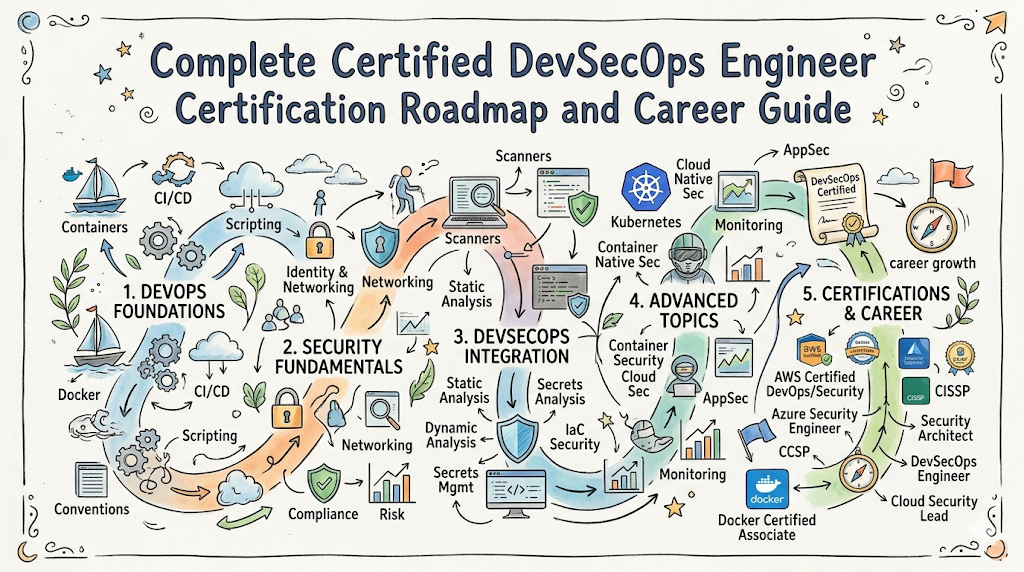
Software teams are releasing faster than ever, but security incidents are also growing. Traditional security models, where checks happen only at the end, no longer work for modern, cloud‑native systems. DevSecOps gives a better way: bring security into every stage of the software lifecycle, from planning and coding to deployment and operations. Certified DevSecOps Engineer is a focused certification designed for working engineers and managers who want to prove they can build and run secure systems in real environments. This guide is for software engineers, DevOps and SRE professionals, platform and cloud engineers, security engineers, data engineers, FinOps practitioners, and engineering managers in India and across the globe.
Certified DevSecOps Engineer – Detailed View
What it is
Certified DevSecOps Engineer is a practitioner‑level certification that proves you can integrate security into modern DevOps workflows. It covers secure SDLC practices, CI/CD security, container and cloud security basics, and security automation in real environments. The content is geared toward real projects and team scenarios.
Who should take it
- DevOps engineers who want strong security skills
- Software engineers building backend, frontend, or microservices
- Security engineers who want to work closely with delivery teams
- SREs and platform engineers running production systems
- Cloud engineers responsible for infrastructure and services
- Engineering managers and leads guiding delivery and risk
Skills you’ll gain
- Core DevSecOps principles, culture, and terminology
- Secure SDLC practices across plan, code, build, test, and release
- CI/CD security: static and dynamic scanning, dependency checks
- Container and Kubernetes security fundamentals
- Secrets management and secure configuration patterns
- Infrastructure as Code (IaC) security and policy enforcement
- Cloud security basics for common platforms and services
- Security monitoring, alerting, and simple incident response patterns
Real‑world projects you should be able to do after it
After completing this certification, you should be able to:
- Design a CI/CD pipeline with integrated code, dependency, and container scans
- Connect a secrets manager to your applications and pipelines safely
- Apply security policies to IaC templates and Kubernetes manifests
- Implement a secure release process for microservices in cloud or Kubernetes
- Harden core services and infrastructure with secure defaults
- Collaborate with developers, operations, and security to roll out checks in phases
Preparation plan (7–14 days / 30 days / 60 days)
You can choose a plan that fits your schedule.
7–14 days (intense plan):
- Daily 3–4 hours of focused learning and labs
- Days 1–3: DevSecOps fundamentals, SDLC security, basic threat understanding
- Days 4–7: CI/CD security, scanning tools, secrets management; build 1 mini project
- Days 8–14: Container and IaC security, cloud basics, review and practice questions
30 days (balanced plan):
- Daily 1–2 hours of study and hands‑on work
- Week 1: DevSecOps mindset, SDLC security, culture, and patterns
- Week 2: CI/CD security, code and dependency scanning, secure pipeline design
- Week 3: Container, Kubernetes, and IaC security foundations
- Week 4: Cloud security basics, monitoring, end‑to‑end project, mock questions
60 days (steady plan with full‑time job):
- 3–5 hours per week, more time on weekends
- Weeks 1–4: Concepts, reading, small labs, and basic pipeline exercises
- Weeks 5–8: Larger projects, pipeline designs, cloud integration, and exam‑style practice
- Use this if you want more time to absorb and experiment.
Common mistakes
Many learners and teams make similar mistakes:
- Treating DevSecOps as only adding tools, not improving process and culture
- Adding too many checks at once and slowing developers without clear benefits
- Ignoring developer experience and making security feel like friction
- Only focusing on application security and forgetting infrastructure and cloud risks
- Reading theory but skipping hands‑on practice with real repositories and pipelines
- Treating DevSecOps as a one‑time project instead of an ongoing practice
Best next certification after this
Once you are Certified DevSecOps Engineer, you can move in three main directions:
- Same track: Advanced DevSecOps or cloud‑native security certifications, focusing on containers, Kubernetes, and cloud security.
- Cross track: SRE, platform engineering, or cloud architect certifications to expand your view of reliability and system design.
- Leadership: Security leadership, governance, or technical management programs that help you lead secure delivery at scale.
Certification Table
| Track | Level | Who it’s for | Prerequisites | Skills covered | Recommended order |
|---|---|---|---|---|---|
| DevSecOps | Core / Practitioner | DevOps, cloud, platform, security engineers; managers | Basic Linux, Git, CI/CD, one language, cloud basics | DevSecOps principles, SDLC security, CI/CD security, container and IaC security, cloud security, monitoring | After basic DevOps/cloud experience, before advanced security specializations |
Choose Your Path – 6 Learning Paths
DevOps path
In the DevOps path, Certified DevSecOps Engineer turns a good DevOps engineer into a secure DevOps engineer. You learn to build pipelines that detect issues early, handle secrets safely, and reduce security surprises in production. This makes you valuable in product companies and service organizations.
DevSecOps path
In the DevSecOps path itself, this certification gives you a strong base. You understand how to apply security across repositories, builds, deployments, and environments. From here, you can go deeper into application security, cloud‑native security, or governance.
SRE path
SREs care about reliability, availability, and performance. Many reliability issues are caused by insecure or misconfigured systems. DevSecOps skills help you design systems that are not only highly available, but also protected against common threats and misuses.
AIOps/MLOps path
In AIOps and MLOps, automation and data pipelines run continuously. DevSecOps helps you protect these pipelines, secure access to models and data, and control how changes reach production. This is important when automation has direct impact on business decisions.
DataOps path
DataOps professionals manage data pipelines, storage, and transformations. With DevSecOps knowledge, you can add security policies, access controls, and checks to your data workflows. This supports privacy, compliance, and protection of sensitive information.
FinOps path
FinOps focuses on cloud cost, optimization, and business value. DevSecOps adds the security lens to that picture. Together, you can design cloud environments that are safe, cost‑efficient, and aligned with business rules and regulations.
Role → Recommended Certifications Mapping
| Role | How DevSecOps fits | Recommended certification sequence |
|---|---|---|
| DevOps Engineer | Adds security depth to CI/CD and automation | DevOps foundation → Certified DevSecOps Engineer → Cloud or container security specialization |
| SRE | Links reliability, performance, and security | SRE basics → Certified DevSecOps Engineer → Advanced reliability/resilience certifications |
| Platform Engineer | Strengthens platform guardrails and secure default configurations | Cloud/platform basics → Certified DevSecOps Engineer → Kubernetes and IaC security |
| Cloud Engineer | Helps secure cloud workloads and deployment workflows | Cloud associate level → Certified DevSecOps Engineer → Cloud security specialist |
| Security Engineer | Brings security closer to pipelines and engineering practice | Security foundation → Certified DevSecOps Engineer → Application or cloud‑native security programs |
| Data Engineer | Secures data pipelines and platforms | Data engineering basics → Certified DevSecOps Engineer → Data security and governance certifications |
| FinOps Practitioner | Aligns secure guardrails with cost‑efficient cloud usage | Cloud and FinOps basics → Certified DevSecOps Engineer → Governance and policy‑focused programs |
| Engineering Manager | Guides teams to deliver fast and safe | Engineering leadership basics → Certified DevSecOps Engineer → Security and risk leadership tracks |
How Certified DevSecOps Engineer Helps Your Career
For working engineers in India and global markets, DevSecOps is a clear differentiator. When employers look for talent, they want people who can handle both delivery and security. This certification shows that you understand how to protect pipelines, infrastructure, and applications in real environments.
For managers and leaders, it provides a practical understanding of how to include security in roadmaps and team processes. You can review architectures more confidently, support security initiatives, and explain trade‑offs between speed, cost, and risk in simple terms.
Top Institutions for Certified DevSecOps Engineer Training
Here are institutions that can support your training and certification journey.
DevOpsSchool
DevOpsSchool offers hands‑on training in DevOps and DevSecOps with a strong focus on practical labs. Their programs usually include real pipelines, cloud platforms, and security tools. This helps working professionals apply what they learn directly in their projects.
Cotocus
Cotocus designs structured learning paths aimed at role‑based outcomes. Their DevSecOps‑related training connects concepts with real use cases and assignments. This is useful if you want clear guidance from fundamentals to advanced topics.
ScmGalaxy
ScmGalaxy provides training around version control, build systems, and CI/CD pipelines. With DevSecOps topics, they show how to integrate scanning and security checks into existing workflows. Teams that already have pipelines often find this approach helpful.
BestDevOps
BestDevOps curates training content across the DevOps ecosystem with a focus on simplifying complex ideas. DevSecOps courses here aim to make security patterns easy to understand for busy engineers. This is suitable if you want clear explanations and structured modules.
devsecopsschool.com
devsecopsschool.com focuses directly on DevSecOps and secure delivery practices. Their programs cover secure SDLC, CI/CD security, infrastructure security, and practical labs. This is a strong choice if DevSecOps is your main specialization area.
sreschool.com
sreschool.com specializes in Site Reliability Engineering. When combined with DevSecOps knowledge, learners can design systems that are reliable and secure. This is ideal for engineers working on production systems and on‑call responsibilities.
aiopsschool.com
aiopsschool.com focuses on AIOps, observability, and automation. Adding DevSecOps skills to this background helps you build intelligent systems that detect issues and risks early. This is useful in large, dynamic environments with many services.
dataopsschool.com
dataopsschool.com centers its programs around DataOps and data engineering. With DevSecOps skills, you can apply strong security practices to data pipelines and platforms. This becomes important in organizations that handle large volumes of business‑critical data.
finopsschool.com
finopsschool.com provides training in FinOps and cloud cost management. Combined with DevSecOps, it enables you to design cloud architectures that balance cost, performance, and security. This is valuable for teams managing big cloud budgets and compliance needs.
FAQs on Certified DevSecOps Engineer
1. How difficult is Certified DevSecOps Engineer?
The certification is moderate to challenging. The main challenge is the wide range of topics, from SDLC and pipelines to containers and cloud. With a clear plan and regular practice, it is very achievable.
2. How much time do I need to prepare?
Most working professionals need 30–60 days with consistent effort. If you already have strong DevOps and cloud skills, you may complete preparation in 2–3 focused weeks. The key is to practice, not just read.
3. Do I need a security background before starting?
You do not need deep security experience. Basic knowledge of common vulnerabilities, authentication, authorization, and networking is enough to begin. The certification will help you build more structured security skills.
4. What are the main prerequisites?
You should be comfortable with Git, basic CI/CD concepts, one programming or scripting language, and core cloud ideas. Familiarity with containers and Kubernetes is helpful. A willingness to learn new tools is essential.
5. How does this certification help my career?
It shows employers that you can secure modern delivery systems, not just build them. This opens doors to roles such as DevSecOps engineer, secure DevOps engineer, platform engineer, and cloud security‑focused roles. It can also support promotions and role upgrades.
6. Is this certification useful for managers?
Yes. Managers gain enough technical understanding to design secure processes, review proposals, and support security‑aligned roadmaps. It helps them talk with both engineers and security teams in practical terms.
7. Can beginners attempt this certification?
Complete beginners will likely struggle. It is better to start with a basic DevOps or cloud foundation course first. Once you are comfortable with pipelines, repos, and cloud, DevSecOps becomes much easier.
8. What tools should I know before taking the exam?
You should know at least one CI/CD tool, one code scanning tool, one dependency scanner, and basic container tools. Knowledge of secrets management, IaC scanning, and cloud security tooling is also helpful. Focus on patterns and workflows, not just tool menus.
9. How should I structure my study plan?
Divide your study into three parts: concepts, tools, and projects. Start with DevSecOps principles, then learn common tools, and finally build one or two end‑to‑end projects. Keep notes and refine your understanding as you go.
10. What projects should I build while preparing?
Build a simple application with a pipeline that includes static analysis, dependency scanning, container scanning, and IaC checks. Deploy it to a cloud or Kubernetes environment and apply basic security controls. Treat this project as your personal case study.
11. Is DevSecOps knowledge useful outside core DevOps roles?
Yes, it is valuable for SREs, platform engineers, cloud engineers, data engineers, and FinOps practitioners. Any role working with production systems and cloud resources benefits from DevSecOps patterns.
12. What should I do after finishing this certification?
You can specialize further in application security, cloud security, Kubernetes security, SRE, or platform engineering. Alternatively, you can move toward leadership roles focused on security governance and technical strategy.
FAQs
1. What is a Certified DevSecOps Engineer?
A Certified DevSecOps Engineer is a professional who knows how to bring security into every stage of the software lifecycle. They work with developers, operations, and security teams to build secure pipelines, infrastructure, and applications. The certification confirms that you can apply DevSecOps practices in real projects.
2. Who should take the Certified DevSecOps Engineer certification?
This certification is ideal for DevOps engineers, software engineers, SREs, cloud and platform engineers, and security engineers. It is also useful for engineering managers who want to understand how security should fit into delivery processes. Anyone involved in building or running modern applications and platforms can benefit.
3. What are the main skills I will gain?
You will learn how to integrate security into CI/CD pipelines, code, and infrastructure. You will understand secure SDLC, scanning tools, secrets management, container and cloud security basics, and simple incident response. Overall, you gain the ability to design and operate secure delivery workflows.
4. What are the prerequisites for this certification?
You should know basic Git, CI/CD concepts, and at least one programming or scripting language. Understanding cloud basics and containers is very helpful but not mandatory. Most importantly, you should be comfortable working with command‑line tools and learning new platforms.
5. How much time do I need to prepare?
Most working professionals need around 30–60 days with consistent study and practice. If you already have strong DevOps and cloud experience, you may be ready in 2–3 focused weeks. The more hands‑on work you do with pipelines and security tools, the easier it becomes.
6. What kind of projects should I do while preparing?
You should build at least one small application with a CI/CD pipeline that includes code scanning, dependency scanning, and basic container or IaC checks. Deploy it to a cloud or Kubernetes environment and apply simple security controls. Treat this project as your personal DevSecOps lab.
7. How does this certification help my career?
It shows employers that you can handle both delivery and security, which is rare and valuable. This can help you move into roles like DevSecOps engineer, secure DevOps engineer, platform or cloud security‑focused roles, or senior DevOps/SRE positions. It also strengthens your profile for internal promotions.
8. What should I do after becoming a Certified DevSecOps Engineer?
After completing this certification, you can go deeper into application security, cloud security, or Kubernetes security. You can also move toward SRE or platform engineering to broaden your system design skills. If you are interested in leadership, you can explore programs focused on security governance and engineering management.
Next Certifications to Take (Three Directions)
After Certified DevSecOps Engineer, you can move in three natural directions:
- Same track: Advanced DevSecOps or cloud‑native security certifications to deepen your security expertise in containers, Kubernetes, and cloud.
- Cross track: SRE, cloud architect, or platform engineering certifications to broaden your system design and reliability skills.
- Leadership: Security leadership, governance, or engineering management programs to lead secure delivery in larger teams.
Choose based on where you want to be in the next few years.
Conclusion
Certified DevSecOps Engineer gives you a structured path to bring security into modern software delivery. It helps engineers and managers understand how to design pipelines, infrastructure, and processes that are both fast and safe. Whether you work in DevOps, SRE, security, cloud, data, or FinOps, this certification can become a central part of your growth journey.
By following a realistic preparation plan, building real projects, and connecting this certification with your current role, you can turn DevSecOps into a long‑term advantage. It allows you to speak to engineering, security, and business stakeholders in one clear, practical language.