Introduction
In my years working across the entire spectrum of software engineering and infrastructure management, I have witnessed seismic shifts in how we build and deploy software. We moved from racks of physical servers to virtual machines, and now, we are firmly rooted in the era of containerization and orchestration. Kubernetes has emerged as the operating system of the cloud. It is no longer a niche tool for infrastructure specialists; it is a foundational technology that every modern software engineer must understand. I often speak with engineers and managers who are trying to navigate this landscape. A question I get asked daily is: “Which certification actually holds value for a developer?” My answer is almost always the same: The Certified Kubernetes Application Developer (CKAD). This guide is designed to provide you with a comprehensive, no-nonsense roadmap to understanding and achieving the CKAD certification. Whether you are an engineer in Bengaluru looking to upskill, a manager in London planning your team’s development, or a software engineer anywhere in the world aiming for the next level in your career, this guide is for you.
Why Kubernetes Certifications Matter
Before we dive into the specifics of the CKAD, let’s look at the broader Kubernetes certification landscape. In my experience, certifications serves two purposes: they provide a structured learning path, and they offer a validated stamp of approval on your skills. In the Kubernetes world, there are several key certifications. I have compiled them in the table below to show you how CKAD fits into the larger picture.
Kubernetes Certification Landscape
| Track | Certification | Level | Who it’s for | Prerequisites | Skills Covered | Recommended Order |
| Development | Certified Kubernetes Application Developer (CKAD) | Associate/Professional | Software Engineers, DevOps Engineers | Basic Linux and Docker knowledge | Designing, building, configuring, and exposing cloud-native applications on Kubernetes. | First (for Developers) |
| Administration | Certified Kubernetes Administrator (CKA) | Professional | SREs, System Administrators, DevOps Engineers | CKAD knowledge is helpful but not mandatory | Kubernetes installation, configuration, cluster maintenance, networking, and security. | Second (after CKAD) |
| Security | Certified Kubernetes Security Specialist (CKS) | Specialist | Security Engineers, SREs, DevSecOps Engineers | Must hold active CKA certification | Cluster setup, hardening, system hardening, microservice security, supply chain security, monitoring. | Third (after CKA) |
| Associate | Kubernetes and Cloud Native Associate (KCNA) | Entry | Managers, Sales, New Graduates | None | High-level conceptual knowledge of the Kubernetes ecosystem and cloud-native architecture. | Optional (entry level) |
Spotlight on: Certified Kubernetes Application Developer (CKAD)
What it is
The Certified Kubernetes Application Developer (CKAD) program is designed to provide assurance that CKADs have the skills, knowledge, and competency to perform the responsibilities of a Kubernetes application developer. It proves you can design, build, configure, and expose cloud-native applications using Kubernetes.
Who should take it
This certification is tailor-made for:
- Software Engineers: Specifically backend developers who build microservices.
- DevOps Engineers: Those focusing on CI/CD pipelines and application deployment strategies.
- Platform Engineers: Engineers building internal developer platforms who need a deep understanding of the developer experience on Kubernetes.
- Engineering Managers: Managers who want to understand the modern deployment landscape to better support their teams (though they might not take the exam, understanding the content is crucial).
Skills you’ll gain
Preparing for and passing the CKAD exam equips you with a robust set of skills:
- Core Concepts: Master Pods, Namespaces, Nodes, and Labels.
- Configuration: Understand how to use ConfigMaps, Secrets, and ServiceAccounts.
- Multi-Container Pods: Learn design patterns like Sidecar, Adapter, and Ambassador.
- Observability: Implement Liveness and Readiness Probes, and understand logging and monitoring.
- Pod Design: Work with Deployments, Jobs, CronJobs, and Rolling Updates.
- Services & Networking: Configure Services, Ingress rules, and understand NetworkPolicies.
- State Persistence: Understand and configure PersistentVolumes (PV) and PersistentVolumeClaims (PVC).
Real-world projects you should be able to do after it
Once you are CKAD certified, you will have the confidence and skills to tackle complex real-world tasks, such as:
- Deploying a microservices application: Setting up multiple interconnected services with scaling and self-healing capabilities.
- Implementing Canary/Blue-Green Deployments: Managing traffic split and rolling updates for zero-downtime releases.
- Configuring application persistence: Setting up databases and stateful applications that can survive pod restarts.
- Securing application communication: Implementing NetworkPolicies to isolate namespaces and secure pod-to-pod traffic.
- Optimizing resource usage: Setting resource requests and limits to ensure efficient cluster utilization.
Common mistakes
Over the years, I’ve coached many engineers through this exam. Here are the most common pitfalls I see:
- Focusing too much on theory: The exam is 100% practical. Reading books won’t help if you can’t type the
kubectlcommands. - Inefficient use of
kubectl: Not using aliases (likekforkubectl) or relying too much onkubectl createinstead of editing YAML files can waste precious time. - Poor Time Management: Getting stuck on a single difficult question. In this exam, you must learn to skip hard questions and move on to accumulate points.
- Forgetting the Context: Not switching to the correct cluster or namespace context before solving a problem. This is a fatal mistake.
- Copying bad YAML: Blindly copying code snippets from the Kubernetes documentation without understanding how to adapt them to the problem at hand.
Best next certification after this
If you are on the engineering track, the natural next step is the Certified Kubernetes Administrator (CKA). While CKAD teaches you how to use the cluster, CKA teaches you how to build and manage it. If you are focused on security, your path is CKAD -> CKA -> CKS.
Preparation Plans for CKAD
Option 1: The 7–14 Day Sprint (The ‘I have experience’ path)
This plan is for you if you already use Docker and basic Kubernetes in your daily work. You are comfortable with YAML and the command line.
- Focus: Bridging the gaps in your knowledge and mastering exam time management.
- Strategy: Spend 2 hours daily.
- Week 1: Go through the CKAD syllabus and identify areas you don’t use daily (perhaps NetworkPolicies or Jobs). Spend one evening on each weak area.
- Week 2: Practice, practice, practice. Use platforms that offer mock exams in a real cluster environment. Focus on completing labs quickly and accurately. Learn the
kubectldocumentation navigation.
Option 2: The 30-Day Accelerated Path (The ‘I understand Docker but not K8s’ path)
This plan is best for software engineers comfortable with containers (Docker) but new to Kubernetes orchestration.
- Focus: Learning Kubernetes concepts deeply and translating them into hands-on skills.
- Strategy: Spend 1-2 hours daily.
- Days 1-7: Master the core concepts (Pods, Deployments, Services). Do basic labs.
- Days 8-21: Cover the rest of the syllabus topics (Networking, Storage, Configuration, Security). Practice focused labs for each topic.
- Days 22-30: Intensive mock exam practice. Review mistakes and speed up your workflow.
Option 3: The 60-Day Foundation Path (The ‘I’m starting from scratch’ path)
This plan is for junior engineers or those with no prior container experience.
- Focus: Building foundational knowledge of Linux, Docker, and then Kubernetes.
- Strategy: Spend 1 hour daily or a concentrated 5-7 hours on weekends.
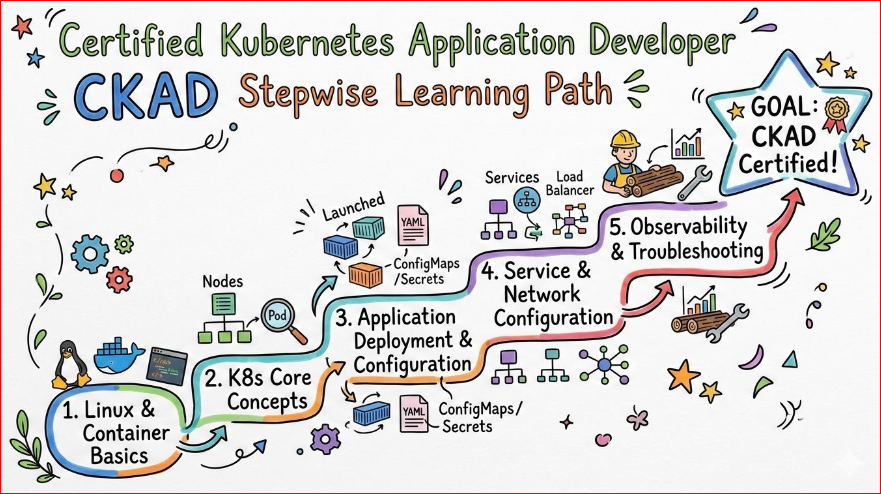
- Month 1: Focus entirely on Linux basics (command line, basic networking) and Docker (building images, running containers, networking).
- Month 2: Follow the 30-Day Accelerated Path for Kubernetes. Do not rush the core concepts. Build strong conceptual models before moving to complex topics like Networking.
Choose your path: Kubernetes Across the Domains
1. The DevOps Path
In DevOps, the goal is to bridge development and operations. CKAD is fundamental here. A DevOps engineer uses CKAD skills to build efficient CI/CD pipelines that deploy applications seamlessly. They need to understand how to configure Deployments, Rolling Updates, and Service exposing mechanisms to automate the delivery lifecycle.
2. The DevSecOps Path
DevSecOps is security integrated into DevOps. You cannot secure an application you don’t understand how to deploy. CKAD gives you the base layer. You learn about ServiceAccounts, ConfigMaps, and NetworkPolicies. This foundation is essential before you can progress to advanced security certifications like CKS, where you will focus on cluster hardening and advanced threat mitigation.
3. The SRE Path
Site Reliability Engineering (SRE) is about applying software engineering discipline to operations. SREs care deeply about reliability, scalability, and performance. CKAD teaches you how to implement Liveness and Readiness probes, manage resources (requests and limits), and configure autoscaling. These are the building blocks of a reliable system. A great SRE must first be a great application developer on the platform.
4. The AIOps/MLOps Path
Running Machine Learning workloads (MLOps) or AI-driven operational tools (AIOps) requires massive scale. Kubernetes is the preferred platform for training and serving ML models. CKAD skills are crucial for packaging ML applications as containers, managing complex stateful datasets using PVCs, and orchestrating batch training jobs using Kubernetes Jobs and CronJobs.
5. The DataOps Path
DataOps focuses on the delivery of data to business users. Modern data pipelines often rely on containerized tools (like Apache Spark or Airflow) running on Kubernetes. A Data Engineer needs CKAD skills to manage the deployment of these tools, configure their networking, and ensure data persistence, treating data infrastructure with the same rigor as software applications.
6. The FinOps Path
FinOps is about cloud financial accountability. While it seems separate, CKAD is directly relevant. An engineer with CKAD knowledge understands the concept of resource limits and requests. They can write efficient YAML configurations that prevent resource waste (over-provisioning), leading to direct cost savings. You must understand how an application consumes resources to optimize its cost.
Role → Recommended Certifications
| Current Role | Primary Certification | Secondary Certification | Advanced/Leadership Path |
| DevOps Engineer | CKAD | CKA (Administrator) | CKS (Security Specialist) |
| SRE (Site Reliability) | CKA (Administrator) | CKAD | Prometheus Certified (PCA) |
| Platform Engineer | CKA | CKAD | HashiCorp Terraform Associate |
| Cloud Engineer | AWS/Azure/GCP Architect | CKA | CKAD |
| Security Engineer | CKS (Security) | CKA | Certified Cloud Security (CCSP) |
| Software Engineer | CKAD | Cloud Developer Associate | Professional Cloud Architect |
| Data Engineer | CKAD | Data Engineering Professional | CKA |
| FinOps Practitioner | FinOps Certified (FOCP) | CKAD | Cloud Digital Leader |
| Engineering Manager | KCNA (Associate) | CKAD (Foundational) | PMP / Management Certs |
Next Certifications to Take
Option A: Stay in the Same Track (Infrastructure) -> Certified Kubernetes Administrator (CKA)
If you are an engineer or DevOps specialist, this is the most logical next step. While CKAD teaches you how to run apps on the platform, CKA teaches you how to manage the platform itself. It covers installation, networking, and cluster maintenance. This combination makes you a powerful asset to any team.
Option B: Cross-Track (Security) -> Certified Kubernetes Security Specialist (CKS)
This is the specialist track. If you are passionate about security, this is your path. It is perhaps the most challenging and respected Kubernetes certification. You must hold an active CKA before you can take the CKS exam, making it a longer journey, but highly rewarding in today’s security-conscious environment.
Option C: Leadership Track (Broad View) -> Kubernetes and Cloud Native Associate (KCNA)
This is for managers, team leads, or those moving into strategic roles. If you don’t need to be hands-on every day, but need to understand the big picture of the cloud-native landscape (including tools like Prometheus, Envoy, and Helm), the KCNA provides that validated conceptual overview.
Top Institutions Providing CKAD Training
DevOpsSchool
DevOpsSchool is a well-established name in the training industry, focusing heavily on all aspects of DevOps, including Kubernetes. They offer structured courses designed to take you from a beginner to exam-ready. Their approach typically combines expert-led instruction with practical, real-world scenarios, which is crucial for a hands-on exam like the CKAD.
Cotocus
Cotocus is known for its focus on emerging technologies and practical skills development. They offer comprehensive Kubernetes training programs that align well with the CKAD curriculum. In my experience, their courses are designed by practitioners, which often means the content is relevant to current industry problems and focuses heavily on the hands-on aspects that are required to pass performance-based exams.
Scmgalaxy
Scmgalaxy has a strong reputation in the Software Configuration Management and DevOps space. Their training programs are often very comprehensive, covering the entire software delivery lifecycle. For CKAD, they provide detailed courses that cover the necessary Kubernetes concepts and, importantly, the essential kubectl skills you will need to succeed in the exam environment.
Other Niche Training Providers
I also recommend checking out these niche providers, which often have highly specialized curriculum:
- devsecopsschool.com: Excellent if you want to approach Kubernetes with a strong security mindset from day one.
- sreschool.com: Focuses on the Site Reliability Engineering aspects of Kubernetes, perfect for aspiring SREs.
- aiopsschool.com: Best if you plan to run AI and Machine Learning workloads on Kubernetes.
- dataopsschool.com: Tailored for Data Engineers and those managing data pipelines on Kubernetes.
- finopsschool.com: Focuses on the cost management aspect, relevant for understanding cloud economics of Kubernetes.
Testimonials
Don’t just take my word for it. Here are stories from engineers I’ve seen succeed.
“I am a Senior Software Engineer in Bengaluru. My company started moving our microservices to Kubernetes, and I felt lost. The CKAD exam preparation gave me the structure I needed. It wasn’t just about the certificate; it was about the confidence to deploy and debug in production. I highly recommend it for any backend developer.”
— Priya Sharma, Senior Engineer
“Coming from a management background in the UK, I needed to understand what my team was talking about. I didn’t take the exam, but studying the CKAD curriculum helped me understand the developer workflow on Kubernetes. It completely changed how I plan our sprint goals and support my engineers.”
— David Chen, Engineering Manager
“The CKAD was the hardest and most rewarding exam I’ve ever taken. The focus on hands-on problem solving is what makes it valuable. As a DevOps engineer in Berlin, this certification was the key to unlocking my current role. It proves you can do the job under pressure.”
— Stefan Müller, DevOps Engineer
General FAQs
As a mentor, I hear these questions constantly. Let’s clear up some common doubts.
1. How difficult is the CKAD exam?
On a scale of 1-10, I would rate it an 8. It is not difficult because of complex theoretical questions; it is difficult because it is 100% hands-on and has a tight time limit. You must be fast and accurate with kubectl.
2. Is CKAD worth it in 2024 and beyond?
Absolutely. Kubernetes is now the industry standard for container orchestration. Every modern organization is either on Kubernetes or moving to it. CKAD is one of the most respected and high-ROI certifications for software engineers.
3. How much time do I need to prepare for CKAD?
If you are already familiar with Docker and Linux, 30-60 days of consistent, hands-on practice (1-2 hours daily) is usually sufficient. If you are a beginner, it might take 3-4 months.
4. What are the prerequisites for the CKAD exam?
There are no official prerequisites, but in my experience, you must have a strong foundation in Linux command line and basic networking concepts. You also need to understand Docker fundamentals (images, containers, volumes).
5. What is the format of the CKAD exam?
The exam is performance-based, not multiple-choice. You are given a series of tasks to solve in a live Kubernetes cluster environment via a terminal in your browser. You have 2 hours to complete approximately 15-20 tasks.
6. What score is needed to pass CKAD?
Currently, the passing score is 66%. However, do not aim for the minimum. Aim for 80% to give yourself a buffer for time management and simple mistakes.
7. Does the CKAD certificate expire?
Yes, the certification is valid for 3 years from the date you pass.
8. Is CKA required before CKAD?
No, it is not required. For software engineers, I highly recommend taking CKAD before CKA. CKAD focuses on the application level, which is closer to a developer’s daily work. CKA focuses on cluster administration.
9. Which is better, CKA or CKAD?
Neither is “better.” They serve different purposes. CKA is for administrators and operators. CKAD is for developers and application focused engineers. If you build apps, take CKAD. If you build the platform, take CKA.
10. Can I take the CKAD exam from home?
Yes, the exam is proctored online. You can take it from your home or office, provided you meet the room and technical requirements.
11. Does having CKAD help increase my salary?
While no certification guarantees a salary hike, the skills you gain are in extremely high demand. In the current market, Kubernetes-skilled engineers often command significantly higher salaries than those without such skills.
12. How does CKAD help in my career growth?
CKAD validates that you can design, build, and deploy cloud-native applications. This opens doors to roles in Platform Engineering, DevOps, SRE, and more senior development positions. It transitions you from being just a coder to being a modern cloud-native engineer.
FAQs on Certified Kubernetes Application Developer (CKAD)
Here are the specific questions I get regarding the CKAD training and exam itself.
1. What version of Kubernetes is used in the CKAD exam?
The exam typically tracks within one or two minor versions of the current stable Kubernetes release. You should check the official syllabus just before your exam.
2. Can I use external resources during the CKAD exam?
You are allowed to have one tab open to the official Kubernetes documentation (kubernetes.io/docs). You must become proficient at searching and navigating this documentation, as it is your only resource.
3. Is the CKAD exam available in different languages?
Yes, the exam is currently available in English, Simplified Chinese, and Japanese.
4. What is the current cost of the CKAD exam?
The standard price is approximately $395 USD, but this often changes and may vary by region. It’s always best to check the official provider for the latest pricing. The cost usually includes one free retake.
5. What is the cancellation/reschedule policy for CKAD?
You can generally reschedule the exam up to 24 hours before your scheduled time slot. Again, this is a policy you should verify directly on the official registration page.
6. How do I get my CKAD results?
Your results will be emailed to you within 24 hours of completing the exam. If you passed, you will also receive your digital badge and certificate.
7. What is the “notepad” in the CKAD exam?
The exam interface includes a built-in “scratchpad” or notepad. I recommend using this to paste YAML templates, store context-switching commands, or list questions you have skipped to come back to later.
8. What’s the best tip you give your mentees for exam day?
Practice context switching. The very first thing you must do for EVERY question is run the command to switch to the correct cluster and namespace specified at the top of the question. I have seen talented engineers fail simply because they solved the right problem in the wrong namespace.
Conclusion
I have spent two decades in this industry, and I have seen many technologies come and go. Kubernetes is not one of them. It is now foundational. For any software engineer aiming to be relevant and impactful in the cloud-native era, mastering Kubernetes is not optional; it is essential. The CKAD is more than just a certificate. It is a rigorous, practical, and highly respected validation of your ability to build and deploy software on the platform that now powers the modern world.