Intorduction
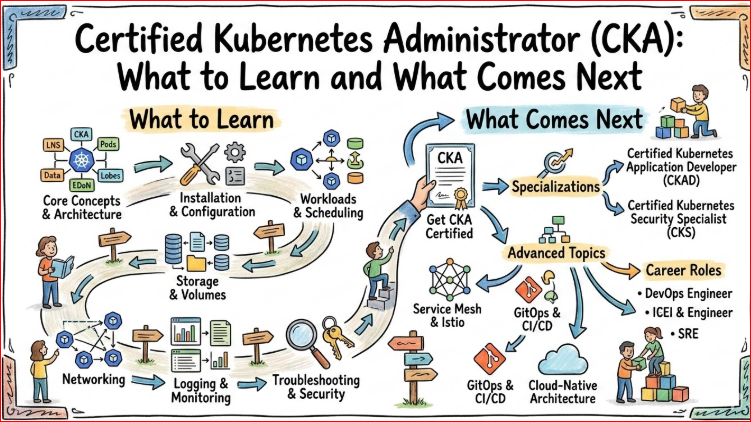
If you are working in modern software engineering or IT infrastructure today, you already know that Kubernetes has fundamentally changed how we deploy, scale, and manage applications across the globe. However, knowing about Kubernetes and proving you know how to tame it are two entirely different things, which is exactly why the Certified Kubernetes Administrator (CKA) has become the industry gold standard. Unlike standard multiple-choice tests, the CKA is a brutal, two-hour, purely hands-on practical exam where you must configure, deploy, and troubleshoot live clusters from a command-line interface under a ticking clock. Because it tests actual muscle memory rather than memorization, holding this badge instantly tells hiring managers that you have the technical grit to handle production-grade infrastructure. Whether your goal is to transition from legacy IT into modern DevOps, break into high-paying Site Reliability Engineering (SRE), or simply gain total confidence in how your microservices operate, this master guide will give you the exact, battle-tested blueprint you need to prepare for the exam and leverage it to accelerate your career.
Certification Overview
Before we dive into the deep end, let us look at exactly where the CKA fits into your professional portfolio.
| Feature | Details |
|---|---|
| Track | Container Orchestration / Cloud-Native Infrastructure |
| Level | Intermediate to Advanced |
| Who it’s for | DevOps Engineers, SREs, Platform Engineers, and Software Engineers |
| Prerequisites | Strong Linux command-line skills, basic networking knowledge, and Docker basics |
| Skills covered | Cluster Architecture, Installation, Workloads, Networking, Storage, Troubleshooting |
| Recommended order | Linux Basics → Docker Fundamentals → CKA → CKS (Security) |
| Certification Name | Certified Kubernetes Administrator (CKA) |
Certified Kubernetes Administrator (CKA)
What it is
The CKA is a 100% practical, performance-based exam that tests your ability to configure, manage, and troubleshoot live Kubernetes clusters from the command line. You must solve complex, real-world operational tasks within a strict two-hour time limit.
Who should take it
This certification is built for active practitioners. Site Reliability Engineers (SREs), DevOps professionals, and Cloud Architects should consider this mandatory. It is also highly valuable for Software Engineers who want to understand how their microservices operate in production, and for Engineering Managers who need to technically guide their teams.
Skills you’ll gain
- Provisioning highly available clusters from scratch using
kubeadm. - Controlling exactly where pods run using node affinity, taints, and tolerations.
- Managing cluster DNS, Ingress controllers, and secure Network Policies.
- Attaching persistent data to stateless pods via Persistent Volumes (PVs) and Claims (PVCs).
- Diagnosing crashed worker nodes, fixing broken control planes, and analyzing application logs.
Real-world projects you should be able to do after it
- Bootstrap a production-grade Kubernetes cluster on bare-metal servers or cloud virtual machines.
- Perform zero-downtime rolling updates and rollbacks for mission-critical enterprise applications.
- Implement a complete disaster recovery plan, including backing up and restoring the
etcddatabase. - Secure a multi-tenant cluster by writing strict Role-Based Access Control (RBAC) policies.
- Debug a failing microservice by tracing network traffic through services, endpoints, and pod logs.
Preparation plan
Everyone learns at a different pace. Here are three battle-tested study plans based on your current experience level.
7–14 Days Path (The Sprint)
This is for seasoned engineers who manage Kubernetes clusters daily. Focus entirely on exam mechanics and time management. Spend your days mastering imperative commands (kubectl run, kubectl expose) so you never have to write YAML from scratch. Practice upgrading a cluster with kubeadm and restoring etcd from a backup. Take timed mock exams to get used to the pressure.
30 Days Path (The Focused Grind)
This is for professionals with strong Linux/Docker skills but limited cluster administration experience. Dedicate your first week to core primitives like Pods, Deployments, and Namespaces. In week two, tackle configuration management (ConfigMaps, Secrets, Resource Limits). Use week three to master cluster architecture, installations, and storage. Your final week must be dedicated purely to troubleshooting broken clusters and mastering the official Kubernetes documentation search feature.
60 Days Path (The Deep Foundation)
This is for beginners transitioning from traditional IT or junior software engineering roles. Spend the first two weeks strengthening your Linux basics, networking fundamentals, and container runtimes. Over the next month, slowly build your knowledge of Kubernetes components. Set up a local cluster using Minikube or kind. Deploy simple apps, expose them to the internet, and attach storage. Spend the last two weeks intensely practicing troubleshooting scenarios and taking full-length mock exams.
Common mistakes
- Typing YAML manually: This wastes precious time. Always generate manifests using the
--dry-run=client -o yamlflag. - Ignoring the context switch: The exam uses multiple clusters. If you forget to run the provided context command before starting a question, you get zero points.
- Getting stuck on hard questions: Questions are weighted. Do not spend 20 minutes on a 4% troubleshooting question while ignoring an easy 8% pod creation task.
- Over-relying on memory: You have access to the official docs. Memorizing YAML syntax is a trap; learn how to search the documentation efficiently instead.
Best next certification after this
The Certified Kubernetes Security Specialist (CKS). Once you know how to build and manage a cluster, the CKS teaches you how to lock it down against real-world threats and vulnerabilities.
Choose your path
Kubernetes is a massive ecosystem, and it serves different engineering domains in unique ways. Here is how mastering the CKA aligns with your specific career track.
DevOps
For a DevOps engineer, Kubernetes is the ultimate deployment target. The CKA gives you the knowledge to write robust deployment manifests, integrate Helm charts, and build seamless CI/CD pipelines. You will learn to push code into production without downtime. You become the critical bridge between the development team’s code and the infrastructure it runs on.
DevSecOps
Security is useless if it is bolted on as an afterthought. DevSecOps professionals use the CKA as a foundation to understand deep system architecture. Once you know how the API server authenticates requests and how nodes communicate, you can implement strict Network Policies, Pod Security Standards, and RBAC rules. This allows you to secure the cluster organically from the inside out.
SRE (Site Reliability Engineering)
SREs are judged by system uptime, latency, and incident response times. The CKA is heavily focused on troubleshooting broken systems. It teaches you how to dive into worker nodes, read kubelet logs, and recover a cluster when the control plane fails. This is exactly the technical skill set you need when a major outage happens at 3:00 AM.
AIOps / MLOps
Machine learning models require immense, scalable compute power. Today, these massive workloads are heavily containerized. The CKA empowers AIOps and MLOps engineers to manage heavy, GPU-enabled worker nodes. You will learn how to schedule massive data-processing pods efficiently, ensuring that AI workloads have the resources they need without crashing the rest of the cluster.
DataOps
Running stateful data applications in a stateless container environment is incredibly complex. DataOps engineers rely on Kubernetes to run tools like Apache Kafka, Spark, and Airflow. The CKA teaches you the intricacies of StatefulSets, storage classes, and Persistent Volumes. This knowledge ensures your databases and streaming platforms remain highly available and do not lose data during pod restarts.
FinOps
Cloud computing bills can spiral out of control if Kubernetes is mismanaged and over-provisioned. A FinOps practitioner with CKA knowledge is a massive asset to any enterprise. You will understand how to implement namespace resource quotas, pod limit ranges, and autoscaling. This technical depth allows you to aggressively right-size infrastructure and save millions in cloud waste.
Role → Recommended certifications mapping
| Job Role | Step 1 (Foundation) | Step 2 (Core Competency) | Step 3 (Advanced/Specialization) |
|---|---|---|---|
| DevOps Engineer | Linux Foundation Certified System Administrator (LFCS) | Certified Kubernetes Administrator (CKA) | HashiCorp Certified: Terraform Associate |
| SRE (Site Reliability Engineer) | Certified Kubernetes Administrator (CKA) | Certified Kubernetes Security Specialist (CKS) | AWS Certified DevOps Engineer – Professional |
| Platform Engineer | Certified Kubernetes Application Developer (CKAD) | Certified Kubernetes Administrator (CKA) | Certified Kubernetes Security Specialist (CKS) |
| Cloud Engineer | AWS Certified Solutions Architect – Associate | Certified Kubernetes Administrator (CKA) | Azure Solutions Architect Expert (or AWS Pro) |
| Security Engineer | CompTIA Security+ | Certified Kubernetes Administrator (CKA) | Certified Kubernetes Security Specialist (CKS) |
| Data Engineer | AWS Certified Data Analytics | Certified Kubernetes Administrator (CKA) | Confluent Certified Developer for Apache Kafka |
| FinOps Practitioner | FinOps Certified Practitioner (FOCP) | AWS Certified Cloud Practitioner | Certified Kubernetes Administrator (CKA) |
| Engineering Manager | Certified Kubernetes Administrator (CKA) (For technical depth) | Certified ScrumMaster (CSM) | ITIL 4 Foundation |
Next certifications to take
Once you have the CKA badge on your profile, the learning journey continues. Depending on your career aspirations, choose one of these three paths:
1. Same Track (Deep Specialization)
Certified Kubernetes Security Specialist (CKS). This is the ultimate proof of container mastery. It focuses heavily on hardening clusters, securing the software supply chain, and implementing runtime threat detection. You must hold an active CKA to take this exam.
2. Cross-Track (Broad Architecture)
AWS Certified Solutions Architect – Professional. Kubernetes does not live in a vacuum. By combining your deep container knowledge with a broad understanding of cloud networking, managed databases, and global load balancing, you transition from a cluster administrator to an elite Cloud Architect.
3. Leadership (Strategic Management)
FinOps Certified Professional. If your goal is to move up the corporate ladder, you must understand business value. This certification teaches you how to align infrastructure decisions with financial goals, manage large-scale enterprise budgets, and lead high-performing technical departments.
Top Institutions for CKA Training and Certification
To pass a performance-based exam, you need rigorous, hands-on training. Based on industry reputation and curriculum depth, these are the top institutions globally for CKA preparation.
- DevOpsSchool
DevOpsSchool is a globally recognized leader in IT training, known for its rigorous and highly practical curriculum. Their instructors bring heavy production experience, offering deep-dive lab sessions that perfectly simulate the pressure of the actual CKA exam. - Cotocus
Cotocus excels in corporate training and enterprise-level upskilling. They focus heavily on aligning Kubernetes concepts with broader business goals, making their training ideal for teams looking to migrate legacy monolithic applications to modern microservices safely. - Scmgalaxy
Scmgalaxy is a highly community-driven platform packed with open-source knowledge. Their training approach is deeply hands-on, focusing on practical automation scripts, live troubleshooting scenarios, and a highly supportive peer-learning environment. - BestDevOps
BestDevOps focuses entirely on modern infrastructure and cloud-native practices. Their CKA modules emphasize rapid problem-solving, imperative command mastery, and automation, ensuring students are heavily prepared for the strict time limits of the exam. - devsecopsschool.com
While covering all standard CKA requirements, this institution uniquely injects security best practices into every single module. This makes them an excellent choice for engineers who plan to pursue the CKS certification immediately after passing their CKA. - sreschool.com
Tailored specifically for reliability engineers, sreschool.com approaches the CKA from an uptime and resilience perspective. Their intensive labs focus heavily on disaster recovery,etcdrestoration, and fixing intensely broken clusters under simulated pressure. - aiopsschool.com
This institution bridges the critical gap between infrastructure and artificial intelligence. Their CKA training highlights how to optimize and scale Kubernetes clusters specifically for heavy, automated, and AI-driven workloads. - dataopsschool.com
dataopsschool.com teaches Kubernetes with a massive emphasis on stateful applications. Students learn to master persistent volumes, stateful sets, and complex data pipeline integrations alongside all the standard CKA requirements. - finopsschool.com
finopsschool.com brings a unique and highly valuable cost-management angle to container orchestration. Their CKA prep teaches you how to spin up clusters while aggressively right-sizing them using resource limits and quotas to save enterprise budgets.
Frequently Asked Questions (FAQs) on CKA
1. How difficult is the CKA exam?
It is widely considered one of the most challenging IT certifications available. Because it is 100% practical, you cannot guess your way to a passing score. You must have actual muscle memory of the command line.
2. How much time do I need to prepare?
If you use Kubernetes daily, 2 to 4 weeks of focused exam prep is usually enough. If you are relatively new to container orchestration, plan for 8 to 12 weeks of consistent study and heavy lab work.
3. Are there any strict prerequisites to take the exam?
Officially, the Linux Foundation does not require any prior certifications. Unofficially, you absolutely must have a strong foundation in Linux administration, YAML formatting, and basic container concepts like Docker.
4. Should I take CKAD before CKA?
It is not mandatory. The CKAD focuses on the developer side (deploying applications), while the CKA focuses on the infrastructure side (managing the cluster itself). Many engineers take the CKA first for a broader architectural understanding.
5. What is the actual career value of passing the CKA?
The value is massive. Because the exam cannot be cheated via multiple-choice “brain dumps,” hiring managers deeply trust the CKA. It proves you can be trusted with production access.
6. Will this certification help me get a job globally?
Absolutely. Cloud-native infrastructure is a global standard and inherently remote-friendly. Companies worldwide are desperately seeking engineers who can reliably manage distributed systems.
7. Is the exam multiple-choice or practical?
It is 100% practical. You are given a browser-based terminal connected to live Kubernetes clusters and asked to solve 15 to 20 real-world tasks within two hours.
8. What happens if I fail the CKA exam?
Your exam purchase typically includes one free retake, provided you schedule and take it within 12 months of the original purchase. Use your score report to identify your weak domains.
9. How long is the CKA certification valid?
The CKA certification is valid for two years. To maintain your active status, you must either retake and pass the CKA exam or pass the higher-level CKS exam before your current certification expires.
10. Do I need to know programming to pass?
No programming experience (like Python or Go) is required. However, you must be extremely comfortable reading and writing YAML files, executing shell scripts, and using Linux text editors.
11. Can I use the internet during the exam?
You cannot use Google, StackOverflow, or AI tools. However, you are permitted to keep one browser tab open to access the official Kubernetes documentation to look up syntax and examples.
12. How does CKA compare to cloud-specific certs like AWS EKS?
The CKA tests “vanilla,” vendor-neutral Kubernetes. You will learn how the system works at its core. Cloud-specific certifications focus on how a vendor manages the infrastructure. CKA knowledge makes managing EKS or AKS significantly easier.
FAQs on Certified Kubernetes Administrator (CKA)
1. Should I learn a cloud platform like AWS or Azure before attempting the CKA?
Not necessarily. Kubernetes is platform-agnostic. While knowing a cloud provider is highly beneficial for your overall DevOps career, you can learn and pass the CKA entirely using local virtual machines or bare-metal servers. Master the core Kubernetes engine first, then learn how it integrates with specific cloud providers later.
2. What is generally considered the hardest topic on the CKA exam?
Troubleshooting cluster components consistently trips people up. When a worker node enters a NotReady state during the exam, you must quickly diagnose kubelet logs, check Linux systemd services, or fix broken network plugins (CNI) under strict time pressure. It tests your raw operational grit.
3. How much time do I actually have to complete the exam, and is it enough?
You are given exactly 2 hours to complete 15 to 20 complex, performance-based tasks. Time is your absolute biggest enemy. If you rely on writing YAML manifests manually or find yourself constantly reading the official documentation to remember basic syntax, you will run out of time.
4. How does the CKA compare to vendor-specific Kubernetes certifications like Red Hat OpenShift?
The CKA tests you on upstream, vanilla Kubernetes. It is the universal gold standard. Vendor-specific certifications are excellent but narrow in scope. Earning your CKA proves you understand the core underlying engine, which makes adapting to any vendor’s specific K8s flavor (like OpenShift, EKS, or GKE) incredibly easy.
5. Will the CKA help me transition from a traditional Linux SysAdmin role into DevOps?
Absolutely. It is arguably the best “bridge” certification available today. It takes your existing deep-level Linux troubleshooting skills and directly applies them to modern, distributed container orchestration. It signals to hiring managers that your operational skills are modernized for cloud-native environments.
6. What specific Docker or container fundamentals do I need before starting CKA prep?
You do not need to be a containerization master, but you must understand how to build images, run containers, map ports, and inspect container logs. You should also understand the difference between container engines like Docker and containerd, as modern Kubernetes relies heavily on the latter.
7. Does the CKA hold value for Engineering Managers, or is it only for individual contributors?
It is incredibly valuable for managers leading Platform, SRE, or DevOps teams. While you may not use kubectl daily, understanding the architecture, failure modes, and security constraints of Kubernetes allows you to make superior architectural decisions and accurately estimate technical timelines.
8. If I already have the CKAD, how much extra effort is required to pass the CKA?
You already have a massive head start. The CKAD covers about 30% to 40% of the CKA syllabus (focusing on Pods, Deployments, and Services). You can skip those basics and dedicate your preparation entirely to cluster administration: etcd backup and restore, control plane troubleshooting, advanced RBAC, and cluster upgrades.
Testimonials
“I thought I was a Kubernetes expert because I deployed Helm charts every day. Studying for the CKA completely humbled me. It forced me to understand the control plane, which directly helped me diagnose a major production outage just weeks after passing. This cert is the real deal.”
— Senior Cloud Engineer, Global E-Commerce Firm
“As an Engineering Manager, I was tired of treating our infrastructure like a black box. Taking the CKA alongside my team not only gave me massive technical credibility, but it completely changed how we architect our internal developer platforms to scale.”
— Director of Platform Engineering
“The time pressure of the CKA is intense. The labs and rigorous mock exams from top training institutions were the only reason I survived the clock. Now, whenever a deployment fails, I immediately know which logs to check and which imperative commands to run to fix it fast.”
— Lead Site Reliability Engineer
Conclusion
The Certified Kubernetes Administrator (CKA) is much more than a line item on your resume. It is a rigorous rite of passage. By committing to this certification, you are transitioning from someone who simply uses deployment tools to someone who deeply understands system architecture, networking, and fault tolerance at scale. Whether your future lies in leading DevSecOps initiatives, building massive data pipelines, or optimizing enterprise cloud costs, the hands-on skills validated by the CKA will serve as the bedrock of your technical career. Spin up a lab, open the terminal, and start building. The cloud-native world is waiting for you.