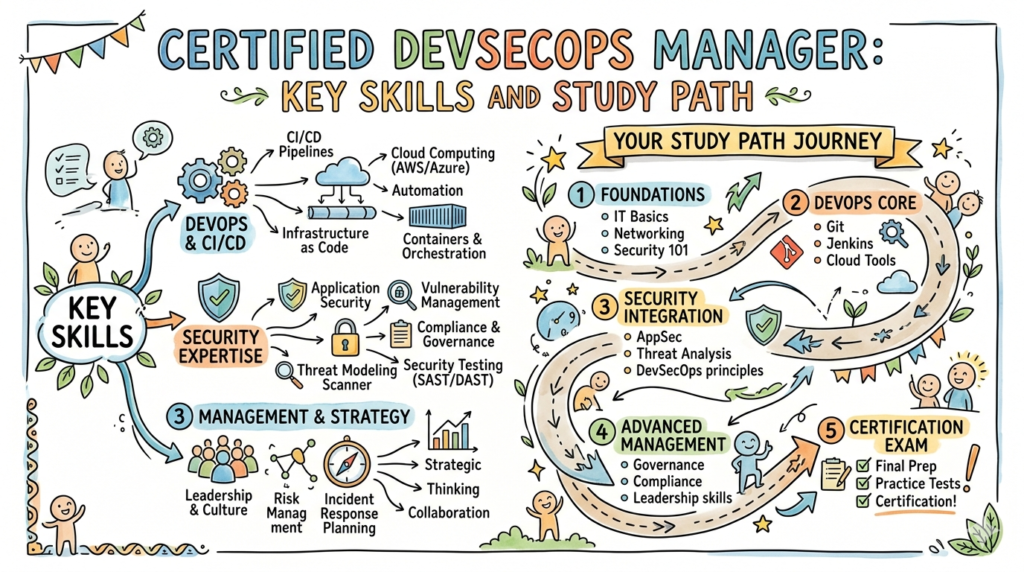
Security can no longer sit at the end of the software lifecycle. It must be designed into every stage of planning, coding, testing, deployment, and operations. This is exactly where the Certified DevSecOps Manager program becomes important for modern software and cloud teams. This guide is for working engineers, team leads, and managers in India and across the globe who want to lead secure DevOps at scale and build a strong career in DevSecOps and security leadership.
Certification overview table
| Track | Level | Who it’s for | Prerequisites | Skills covered | Recommended order |
|---|---|---|---|---|---|
| DevSecOps | Manager / Master | DevOps/SRE/Platform/Security Engineers, Tech Leads, Managers | 3+ years in DevOps/SRE/Security/Cloud, CI/CD experience, basic security & compliance awareness | DevSecOps leadership, governance, compliance mapping, policy-as-code, cross-team collaboration, KPIs, incident response, cloud risk | After core DevOps/Cloud/Security engineer-level certifications |
| DevOps | Associate | New or early-career engineers learning modern delivery | Basic IT knowledge, scripting or programming fundamentals | CI/CD basics, source control, scripting, containers, build and release pipelines | 1st DevOps step before any specialization |
| DevOps | Professional / Expert | Experienced DevOps and platform engineers | 2+ years in DevOps or system administration, CI/CD and cloud exposure | Advanced CI/CD, infrastructure as code, cloud strategy, observability, scaling delivery pipelines | After DevOps Associate, before DevSecOps Manager or SRE/Architect tracks |
| DevSecOps | Engineer / Professional | Security-minded DevOps/SRE/Cloud engineers | DevOps foundation, basic AppSec knowledge, exposure to security tools | Integrating SAST/DAST/SCA, secrets management, container security, secure SDLC, pipeline security automation | After DevOps Professional, before or alongside DevSecOps Manager |
| SRE | Specialist / Professional | Reliability engineers, SREs, Ops/DevOps moving into reliability roles | Programming skills, Linux, networking, CI/CD familiarity | SLIs/SLOs, error budgets, incident response, capacity planning, production readiness, observability | After DevOps foundation; can precede or run parallel to DevSecOps Manager |
| AIOps/MLOps | Specialist | ML/Data leads, platform engineers working with ML and intelligent ops | Python, cloud ML services, CI/CD knowledge | Model lifecycle, ML deployment, monitoring & drift, AIOps signals, automation of operations using AI/ML | After DevOps/DataOps fundamentals; before or after DevSecOps Manager for AI/ML-heavy environments |
| DataOps | Specialist | Data engineers, data architects, analytics platform owners | SQL, data engineering basics, ETL/ELT familiarity | Data pipeline design, data quality, lineage, collaboration, DataOps practices | After data engineering or BI experience; complements DevSecOps Manager for data platforms |
| FinOps | Specialist | Cloud managers, FinOps practitioners, cost-focused platform leaders | Cloud usage experience, basic finance/cost concepts | Cloud cost allocation, optimization, budgeting, chargeback/showback, governance | After cloud fundamentals; pairs well with DevSecOps Manager for cost + security governance |
Certified DevSecOps Manager – Detailed view
What it is
Certified DevSecOps Manager is a leadership-focused certification that teaches you how to embed security into DevOps at scale, across teams, tools, and cloud environments. It is not only about tools; it is about governance, culture, and measurable security outcomes.
Who should take it
This certification is ideal for:
- DevOps managers and engineering leads
- Security program managers and AppSec leads
- Cloud transformation leaders and platform owners
- Product and delivery managers who must ensure secure releases
- CTO/CIO/CISO staff driving DevSecOps transformation
If you are already responsible for secure delivery, or you are the “DevSecOps champion” in your team, this program fits you well.
Skills you’ll gain
After completing the Certified DevSecOps Manager program, you should be able to:
- Design and lead DevSecOps governance frameworks for an organization
- Build and manage DevSecOps adoption plans across multiple teams and products
- Map and align DevSecOps with compliance frameworks like ISO 27001, SOC 2, PCI-DSS, HIPAA, and GDPR
- Define and enforce secure SDLC and policy-as-code in CI/CD pipelines
- Collaborate with development, operations, and security teams using clear processes and roles
- Set up and monitor security KPIs and metrics (MTTR, vulnerability closure rate, policy compliance, maturity)
- Structure and lead incident response and crisis management with post-mortem learning
- Build and manage DevSecOps maturity roadmaps for continuous improvement
Real-world projects you should be able to do after it
Once you complete this certification, you should be confident leading projects such as:
- Designing an organization-wide DevSecOps operating model (roles, processes, tools, metrics)
- Building and rolling out a secure SDLC framework with clear checkpoints and automated controls
- Creating a DevSecOps maturity assessment and 12–24 month improvement roadmap
- Implementing security in CI/CD: SAST, DAST, SCA, container scanning, secrets management, compliance checks
- Leading cross-team incident response with structured workflows and blameless post-incident reviews
- Reporting security posture and risk to leadership in a language they can act on
Preparation plan (7–14 / 30 / 60 days)
You can adapt your preparation based on your background and available time.
7–14 days: Intensive leadership sprint
Best for: experienced DevOps / security leaders already working on DevSecOps.
- 3–4 hours per day
- Focus heavily on: governance models, compliance mapping, leadership and culture topics, metrics and maturity models
- Review agenda modules one by one and summarise key patterns in your own words
- Use mock scenarios: “If I were the DevSecOps Manager here, what would I do?”
30 days: Balanced working-professional plan
Best for: DevOps engineers, security engineers, or managers with partial DevSecOps exposure.
- 1–2 hours per day, 5–6 days a week
- Week 1–2: learn DevSecOps leadership basics, secure SDLC, policy enforcement, cloud and infra risk
- Week 3: dive into compliance alignment, metrics, and maturity models
- Week 4: practice scenario-based questions and design mini roadmaps for your own projects
60 days: Foundation + leadership
Best for: engineers moving into DevSecOps leadership for the first time.
- First 30 days: strengthen DevOps and security fundamentals, CI/CD security, basic compliance concepts
- Next 30 days: focus on leadership modules: governance, culture, metrics, incident response, cloud risk
- Build one “capstone” document: a full DevSecOps adoption plan for a sample or real organization
Common mistakes to avoid
Candidates often underestimate the leadership and governance depth of this certification. Common mistakes include:
- Studying only tools and technical details, ignoring governance and culture
- Ignoring compliance frameworks and audit readiness concepts
- Focusing only on “one team” instead of thinking at multi-team / enterprise scale
- Not practicing metrics, KPIs, and maturity models
- Treating DevSecOps as a security project instead of a shared responsibility across Dev, Sec, Ops, and business
Best next certification after this
After Certified DevSecOps Manager, you can grow in three broad directions (same track, cross-track, leadership). Drawing from common software engineering certification trends:
- Same track (DevSecOps / Security):
- A hands-on DevSecOps Engineer / cloud security specialization to deepen implementation skills
- Cross-track (SRE / Cloud / Platform):
- An SRE, reliability, or cloud architect certification to connect security with reliability and large-scale systems
- Leadership (Architecture / Governance):
- An enterprise architecture, cloud governance, or security leadership certification to move into director or head-of roles
Choose your path – 6 learning paths
Certified DevSecOps Manager fits into different career journeys. Here are six practical paths you can follow.
DevOps path
- Start with core DevOps: Linux, Git, CI/CD, containers, configuration management, infrastructure as code
- Work 2–4 years building and operating pipelines and platforms
- Learn basic security: secrets, vulnerability scanning, access control
- Then add Certified DevSecOps Manager to move into secure delivery leadership and platform security roles
DevSecOps path
- Begin as a developer, DevOps engineer, or security engineer with strong interest in application and pipeline security
- Take a foundational DevSecOps or secure coding course
- Get hands-on with SAST, DAST, SCA, secrets management, and container security
- Use Certified DevSecOps Manager to step up into organization-wide DevSecOps strategy, governance, and metrics
SRE path
- Start in operations, reliability, or infrastructure engineering
- Learn SRE concepts: SLIs, SLOs, error budgets, incident response, and reliability patterns
- Extend your responsibility to include security constraints and secure operations during incidents
- Add Certified DevSecOps Manager to align security with reliability and to lead secure SRE practices at scale
AIOps/MLOps path
- Work on AI/ML platforms, model deployment, and data pipelines for ML
- Learn MLOps: versioning, reproducibility, model monitoring, CI/CD for ML
- Add security around data access, model integrity, and ML pipelines
- With Certified DevSecOps Manager, you can design secure, governed AI and ML delivery including compliance and risk across the ML lifecycle
DataOps path
- Start as a data engineer or analytics engineer
- Focus on data pipelines, ETL/ELT, data quality, and observability
- Learn data security, masking, governance, and regulatory requirements
- Combine DataOps expertise with DevSecOps Manager skills to build secure, compliant, and observable data platforms
FinOps path
- Work on cloud cost management and financial operations
- Learn cloud usage patterns, billing, tagging, budgeting, and reporting
- Understand governance and access around cost data and tools
- Use Certified DevSecOps Manager principles to design cloud environments that are cost-efficient, secure, and compliant at the same time
Role → Recommended certifications
| Role | Where you usually start | Recommended certification direction (including DevSecOps Manager) |
|---|---|---|
| DevOps Engineer | DevOps / Cloud associate-level certs, CI/CD skills | DevOps → Cloud platform cert → Certified DevSecOps Manager for secure delivery leadership |
| SRE | SRE / Reliability / Cloud certs | SRE / Reliability → Cloud advanced cert → Certified DevSecOps Manager for secure SRE practices |
| Platform Engineer | DevOps + platform engineering skills | Platform / Kubernetes cert → Cloud security → Certified DevSecOps Manager |
| Cloud Engineer | Cloud associate/professional certs | Cloud Pro → DevOps / Infra-as-code cert → Certified DevSecOps Manager |
| Security Engineer | Security / AppSec / cloud security certs | AppSec / Cloud Security → DevSecOps-focused cert → Certified DevSecOps Manager |
| Data Engineer | Data engineering / analytics certs | Data Engineering → Data security / governance → Certified DevSecOps Manager |
| FinOps Practitioner | FinOps / cloud cost management certs | FinOps → Cloud governance → Certified DevSecOps Manager |
| Engineering Manager | General engineering / project / agile leadership | DevOps/Cloud fundamentals → Certified DevSecOps Manager → advanced leadership / governance |
General FAQs
1. How difficult is the Certified DevSecOps Manager certification?
It is a professional / leadership-level certification. The content is not deeply mathematical, but it is broad and strategic, so it feels challenging if you only know tools and not governance or culture topics.
2. How much time do I need to prepare?
Most working professionals need 30–60 days with 1–2 hours of focused study per day. Very experienced DevSecOps or security leaders can compress preparation into 7–14 intensive days.
3. What are the official prerequisites?
The program recommends at least 3+ years of experience in DevOps, Security, or IT Operations, plus exposure to CI/CD workflows and basic security/compliance frameworks. Some leadership or project management exposure is preferred but not mandatory.
4. Do I need hands-on coding skills?
You should understand DevOps tools, pipelines, and cloud architectures, but this certification focuses more on leadership, governance, and decision-making than on writing code every day.
5. Is this certification only for managers?
No. Senior engineers, staff engineers, and architects who act as technical leaders will benefit a lot. The key is that you influence teams, pipelines, or platforms, even if your title is not “manager.”
6. How does this certification help my career?
It positions you as the person who can own secure delivery, not just run individual tools. This opens up roles like DevSecOps Manager, Platform Security Manager, Cloud Governance Lead, and Secure Delivery Program Manager.
7. How is it different from a technical DevSecOps or security engineer certification?
Technical DevSecOps certifications go deep into specific tools and configurations. Certified DevSecOps Manager focuses on leadership, governance, compliance alignment, metrics, and cross-team culture.
8. Does it cover compliance and regulations?
Yes. The agenda includes aligning DevSecOps with frameworks like ISO 27001, SOC 2, PCI-DSS, HIPAA, GDPR, and NIST guidelines. You learn how to build policies and processes that make audits easier and more predictable.
9. What kind of exam scenarios should I expect?
Expect scenario-based questions about designing DevSecOps programs, choosing security controls, handling incidents, and prioritizing risk. You will often need to pick the most appropriate governance or rollout approach, not just a tool.
10. Is this certification relevant outside India?
Yes. DevSecOps leadership, cloud risk, and compliance mapping are global topics, and the frameworks covered are used worldwide. This makes the certification valuable for roles in any region.
11. Can I prepare while working full-time?
Yes. The 30-day and 60-day plans are designed for working professionals with limited daily study time. The key is consistency and applying concepts directly to your current projects.
12. What is the best way to start if I feel weak in security?
Begin with fundamentals: basic security concepts, common vulnerabilities, and CI/CD security patterns. Then move into governance, compliance, and leadership topics once you are comfortable with the basics.
Certified DevSecOps Manager – Specific FAQs
1. What is the main objective of the Certified DevSecOps Manager program?
The main objective is to prepare you to lead DevSecOps transformation, not just support it. You learn to design governance, enforce policies, drive culture, and align secure delivery with business outcomes.
2. Who is the ideal candidate for this program?
Ideal candidates include DevOps managers, engineering leads, security program managers, and cloud transformation leaders who already influence or own secure delivery.
3. Does the program include incident response and crisis management?
Yes. The agenda has a dedicated section on incident response, escalation workflows, post-mortem analysis, and building resilience and response automation.
4. Will it help me communicate better with CISO/CTO leadership?
Definitely. The program emphasizes KPIs, metrics, risk language, and governance models that leadership understands. This helps you explain why DevSecOps investments matter in business terms.
5. Is cloud security part of the syllabus?
Yes. You will learn about managing risks in cloud-native architectures, IAM governance, and ensuring security compliance in AWS, Azure, and GCP environments.
6. Do I need to know specific tools before joining?
You should be familiar with general DevOps tools (CI/CD, version control, collaboration tools) and have some exposure to security tools and frameworks. The program focuses more on patterns and frameworks than on one specific product.
7. What kind of learning resources will I get?
The program offers instructor-led training, leadership templates, governance playbooks, Q&A, and lifetime access to materials, along with a certification and digital badge on completion.
8. What roles can I target after this certification?
You can target roles like DevSecOps Transformation Manager, Platform Security Manager, Cloud Governance Lead, Secure Delivery Program Manager, or DevSecOps Consultant.
Top institutions for training and certification support
These institutions can help you with training, guidance, and roadmaps related to DevSecOps and leadership, including preparation for Certified DevSecOps Manager.
DevOpsSchool
DevOpsSchool is a well-known training provider for DevOps and related domains. It offers structured courses, hands-on labs, and mentoring for topics like CI/CD, cloud, DevSecOps, and SRE. Their programs are designed for working professionals and teams, with practical use cases and career-focused roadmaps.
Cotocus
Cotocus focuses on enterprise-grade DevOps, cloud, and security education. It provides customized training for organizations and individuals, covering DevSecOps practices, automation, and governance models that are directly relevant for aspirants of leadership roles.
Scmgalaxy
Scmgalaxy has long experience in SCM, build, release, and DevOps training. It supports both individual learners and corporate groups with programs that span DevOps fundamentals to advanced pipeline and security practices.
BestDevOps
BestDevOps works as a learning hub focusing on modern DevOps, SRE, and platform engineering ecosystems. Its content and guidance help engineers connect trends in DevOps and reliability with DevSecOps and security leadership.
devsecopsschool.com
DevSecOpsSchool, the provider of the Certified DevSecOps Manager program, specializes in DevSecOps strategy, tools, and culture. Its training is aligned directly with the certification, with emphasis on governance, compliance, and cross-team security collaboration.
sreschool.com
SRESchool focuses on Site Reliability Engineering, observability, and operational excellence. Its courses complement DevSecOps Manager by strengthening your understanding of incident management, SLIs/SLOs, and resilient operations.
aiopsschool.com
AIOpsSchool provides training at the intersection of operations, monitoring, and AI/ML. If you manage large, complex systems with intelligent automation, its programs help you integrate DevSecOps thinking into AIOps workflows.
dataopsschool.com
DataOpsSchool targets data engineering, analytics pipelines, and data governance practices. It is especially useful for professionals who want to apply DevSecOps ideas to sensitive data, regulatory needs, and data platforms.
finopsschool.com
FinOpsSchool focuses on cloud financial operations, cost visibility, and optimization. When you combine FinOps knowledge with DevSecOps Manager skills, you can design cloud landscapes that are secure, compliant, and cost-efficient.
Conclusion
Certified DevSecOps Manager is designed for professionals who want to lead, not just participate, in secure software delivery. It helps you move from “knowing security tools” to owning governance, culture, metrics, and strategy for DevSecOps across teams and platforms. If you are a working engineer, lead, or manager in DevOps, cloud, security, data, or platform teams, this certification can significantly accelerate your journey into impactful security leadership roles. Choose a preparation timeline that fits your schedule, apply what you learn to your current projects, and use this guide as your roadmap to becoming a trusted DevSecOps Manager in your organization.