Introduction
If you already work in DevOps, cloud, or platform teams, you know this truth: tools change fast, but architecture choices stay for years. A small design mistake can create slow releases, weak security, high cloud costs, and constant incidents.That is why Certified DevOps Architect matters. It helps you think like an architect who designs delivery systems that scale, stay secure, and support business goals—not just pipelines and scripts.This guide is written for working engineers and engineering managers in India and global teams. It uses simple English, short paragraphs, and practical examples.
What is Certified DevOps Architect
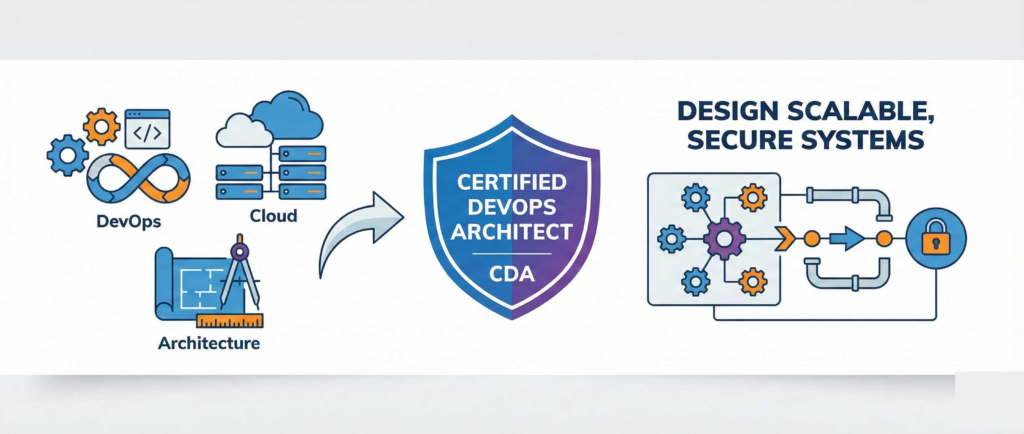
Certified DevOps Architect (CDA) is a certification focused on designing large-scale DevOps solutions. The official program description highlights Infrastructure as Code (IaC), cloud architecture, microservices design, advanced deployment strategies, multi-cloud, scalable infrastructure, and DevOps transformation frameworks.
Why Certified DevOps Architect matters in real jobs
It shifts you from “doer” to “designer”
A DevOps engineer builds pipelines. A DevOps architect designs the whole system: environments, pipelines, security, observability, and change management.
It helps you avoid costly architecture traps
Common traps include:
- CI/CD that works for one team but breaks at scale
- Kubernetes used without clear platform patterns
- Security added late, causing delays and rework
- Monitoring without SLOs, leading to alert fatigue
Certification summary at a glance
- Name: Certified DevOps Architect (CDA)
- Provider: DevOpsSchool
- What the certification covers: IaC, cloud architecture, microservices, advanced deployment strategies, multi-cloud, scalable infrastructure, DevOps transformation frameworks.
- Exam style (as listed): exam-only with multiple choice / multiple select; online proctored delivery is mentioned.
- Suggested prerequisite (as listed): after attending Master in DevOps Engineering (MDE) training.
Table of certifications you can combine with CDA
This table lists the core DevOpsSchool certification programs and the foundation/professional tracks that map directly to the learning paths in this guide (DevOps, DevSecOps, SRE, AIOps/MLOps, DataOps, FinOps).
| Certification | Track | Level | Who it’s for | Prerequisites | Skills covered | Recommended order |
|---|---|---|---|---|---|---|
| Certified DevOps Engineer (CDE) | DevOps | Core | DevOps/Cloud/SRE engineers | DevOps basics + tooling | CI/CD, automation, containers, monitoring | 2 |
| Certified DevOps Professional (CDP) | DevOps | Core | Engineers moving to full DevOps role | CI/CD + scripting basics | end-to-end DevOps practices | 3 |
| Certified DevOps Architect (CDA) | DevOps | Advanced | Architects, senior DevOps/Cloud | Strong cloud + CI/CD experience | IaC, cloud architecture, microservices, advanced deployments | 4 |
| Certified DevOps Manager (CDM) | DevOps | Leadership | Managers/Leads | Delivery + team leadership basics | DevOps leadership, transformation | 5 |
| DevOps Certified Professional (DCP) | DevOps | Professional | Job-focused DevOps engineers | DevOps basics | real-world DevOps workflows | 3 |
| Master in DevOps Engineering (MDE) | DevOps | Master program | Engineers targeting deep hands-on | Basic Linux + scripting | DevOps + DevSecOps + SRE foundations in one program | 1 |
| DevSecOps Certified Professional (DSOCP) | DevSecOps | Professional | Security + DevOps engineers | DevOps basics + security basics | secure SDLC, security automation | 4 |
| SRE Certified Professional (SRECP) | SRE | Professional | SRE/Platform/Operations | Monitoring basics | SLOs, reliability, incident response | 4 |
| AiOps Certified Professional (AIOCP) | AIOps | Professional | Ops + automation engineers | Monitoring + data basics | AIOps concepts, automation, analytics | 4 |
| MLOps Certified Professional (MLOCP) | MLOps | Professional | ML/Platform engineers | ML basics + DevOps basics | ML pipelines, model delivery | 4 |
| DataOps Certified Professional (DOCP) | DataOps | Professional | Data engineers + platform | Data pipeline basics | DataOps pipelines, automation | 4 |
| DevOps Foundation Certification | DevOps | Foundation | Beginners, switchers | None (helpful: Linux basics) | DevOps basics, culture, flow | 1 |
| SRE Foundation Certification | SRE | Foundation | New SREs | None (helpful: monitoring basics) | SRE basics | 1 |
| DevSecOps Foundation Certification | DevSecOps | Foundation | Beginners in security + DevOps | None | DevSecOps basics | 1 |
| CloudOps Foundation Certification | CloudOps | Foundation | Cloud operations | None | Cloud operations basics | 1 |
| DataOps Foundation Certification | DataOps | Foundation | Entry-level data + ops | None | DataOps basics | 1 |
| NoOps Foundation Certification | NoOps | Foundation | Automation-focused engineers | None | automation-first delivery thinking | 2 |
| MLOps Foundation Certification | MLOps | Foundation | Entry ML delivery roles | None | MLOps basics | 1 |
| FinOps Foundation Certification | FinOps | Foundation | Cloud cost + platform owners | None | cloud cost control, FinOps basics | 1 |
Certified DevOps Architect mini-sections
What it is
Certified DevOps Architect validates your ability to architect large-scale DevOps systems. It focuses on IaC, cloud architecture, microservices design, advanced deployment strategies, and multi-cloud scalability.
Who should take it
- Senior DevOps engineers aiming for architect roles
- Cloud architects working on delivery platforms
- Platform engineers designing self-service infrastructure
- Engineering leads who review architecture decisions
The official “Who should take this exam” list includes DevOps Architects, Cloud Architects, and Infrastructure Engineers.
Skills you’ll gain
- Design CI/CD for multiple teams and services
- Build IaC standards and reusable modules
- Create multi-cloud and hybrid deployment patterns
- Choose microservices and platform patterns that scale
- Improve security, reliability, and governance by design
Real-world projects you should be able to do after it
- Build a reference DevOps platform blueprint for an organization
- Design a multi-environment release strategy (dev/test/stage/prod) with clear promotion rules
- Create IaC modules for networks, clusters, and shared services
- Plan microservices deployment with safe rollout strategies (blue/green, canary, progressive delivery)
- Design observability + incident workflows that match business goals
Preparation plan (7–14 days / 30 days / 60 days)
7–14 days plan (fast revision)
- Review IaC patterns (modules, state, drift control)
- Revise CI/CD architecture patterns (pipeline templates, approvals, security gates)
- Refresh cloud architecture basics (networking, IAM, scaling, resilience)
- Practice microservices and deployment strategies (canary, blue/green, rollback)
30 days plan (balanced)
- Week 1: IaC + cloud fundamentals (network, IAM, compute, storage)
- Week 2: CI/CD architecture + artifact strategy + release governance
- Week 3: Microservices patterns + container orchestration + deployment strategies
- Week 4: Reliability + security-by-design + reference architecture practice
60 days plan (strong, job-ready)
- Month 1: Build deep foundation + weekly mini-projects
- Month 2: Build one end-to-end “platform design” case study (architecture doc + decision records + rollout plan)
- Add review sessions with mock scenario questions and trade-off discussions
Common mistakes
- Building “tool architecture” instead of “system architecture”
- Ignoring identity and access design until late
- Designing pipelines without environment strategy and governance
- Treating observability as only dashboards (not SLOs + action)
- Over-complicating microservices without clear boundaries
Best next certification after this
Pick one based on your career direction:
- Same track (DevOps depth): Master in DevOps Engineering (MDE) or DevOps Certified Professional (DCP)
- Cross-track (security/reliability): DevSecOps Certified Professional (DSOCP) or SRE Certified Professional (SRECP)
- Leadership path: Certified DevOps Manager (CDM)
Choose your path
Each path below gives you a clean order. Use it as a practical roadmap.
1) DevOps path
- DevOps Foundation Certification
- Master in DevOps Engineering (MDE)
- Certified DevOps Engineer (CDE)
- Certified DevOps Professional (CDP)
- Certified DevOps Architect (CDA)
2) DevSecOps path
- DevSecOps Foundation Certification
- Master in DevOps Engineering (MDE)
- DevSecOps Certified Professional (DSOCP)
- Certified DevOps Architect (CDA) (security-by-design focus)
3) SRE path
- SRE Foundation Certification
- Master in DevOps Engineering (MDE)
- SRE Certified Professional (SRECP)
- Certified DevOps Architect (CDA) (reliability architecture focus)
4) AIOps / MLOps path
- MLOps Foundation Certification (or start with DevOps Foundation if you are new)
- AiOps Certified Professional (AIOCP) and/or MLOps Certified Professional (MLOCP)
- Certified DevOps Architect (CDA) (platform + automation at scale)
5) DataOps path
- DataOps Foundation Certification
- DataOps Certified Professional (DOCP)
- Certified DevOps Architect (CDA) (data platform + delivery patterns)
6) FinOps path
- FinOps Foundation Certification
- Build cost controls into pipelines and platform policies
- Certified DevOps Architect (CDA) (architecture that reduces waste and improves governance)
Role → recommended certifications mapping
| Role | Recommended certifications |
|---|---|
| DevOps Engineer | DevOps Foundation → CDE → CDP |
| SRE | SRE Foundation → SRECP → CDA |
| Platform Engineer | MDE → CDE → CDA |
| Cloud Engineer | CloudOps Foundation → CDE → CDA |
| Security Engineer | DevSecOps Foundation → DSOCP → CDA |
| Data Engineer | DataOps Foundation → DOCP → CDA |
| FinOps Practitioner | FinOps Foundation → CDA (cost-aware architecture) |
| Engineering Manager | CDP or MDE → CDM (then CDA if you do architecture reviews) |
Next certifications to take after Certified DevOps Architect
Option A: Same track (go deeper in DevOps architecture)
- Master in DevOps Engineering (MDE) (strong structured program)
- DevOps Certified Professional (DCP) (job-ready practice)
Option B: Cross-track (add a second “superpower”)
- DevSecOps Certified Professional (DSOCP) for secure platform design
- SRE Certified Professional (SRECP) for reliability and incident architecture
Option C: Leadership path (run transformation)
- Certified DevOps Manager (CDM) for process, governance, and program-level adoption
Top institutions that help with training + certification preparation
Below are well-known training brands in the same ecosystem that support structured learning and hands-on preparation for Certified DevOps Architect:
DevOpsSchool
DevOpsSchool runs structured programs with hands-on learning and mentor guidance. It is a common starting place for engineers who want a clear roadmap. It also offers a broad certification catalog that supports different career paths.
Cotocus
Cotocus is often referenced in the mentor ecosystem around DevOps training. It is useful for learners who want practical exposure to real engineering problems and solution thinking.
ScmGalaxy
ScmGalaxy focuses on skill building and structured learning paths. It works well for learners who want step-by-step progression from basics to advanced topics.
BestDevOps
BestDevOps supports learning with practical DevOps skill tracks. It is helpful when you want focused learning around delivery pipelines and tool-based implementation.
DevSecOpsSchool
DevSecOpsSchool supports secure delivery learning. It is useful for adding security thinking to CI/CD, IaC, and runtime operations.
SRESchool
SRESchool supports reliability and operational excellence learning. It fits engineers who want stronger incident response, SLO thinking, and reliability patterns.
AIOpsSchool
AIOpsSchool supports automation and analytics-driven operations learning. It fits teams dealing with noise, alerts, and large-scale monitoring data.
DataOpsSchool
DataOpsSchool supports data delivery and pipeline automation learning. It fits learners working with data platforms, governance, and repeatable releases.
FinOpsSchool
FinOpsSchool supports cost-aware cloud operations learning. It helps engineers and managers reduce waste and build sustainable cloud usage patterns.
FAQs on difficulty, time, prerequisites, sequence, value, outcomes
1) Is Certified DevOps Architect hard?
It feels hard if you only worked on tools. It becomes manageable when you think in systems: architecture, trade-offs, scale, security, and reliability.
2) How much time do I need to prepare?
If you already work on cloud and CI/CD, you can prepare with a focused plan in weeks. If you are still new to architecture topics, take a longer plan and build one full platform case study.
3) Do I need coding skills?
You should understand scripts and automation logic. You do not need to become an application developer, but you must design systems that developers can use.
4) Do I need Kubernetes experience?
It helps a lot because modern platforms use containers. Even if you do not run Kubernetes daily, understand deployment patterns and rollout strategies.
5) What is the best order before CDA?
A common order is Foundation → MDE → CDE/CDP → CDA. The catalog also lists MDE as a prerequisite for CDA on the official page.
6) Is CDA useful for engineering managers?
Yes, especially if you review platform designs, release governance, and reliability decisions. Pair it with CDM if you lead transformation programs.
7) What job titles benefit most from CDA?
DevOps Architect, Platform Engineer, Cloud Architect, Infrastructure Architect, and senior DevOps roles. The official page also lists DevOps Architects, Cloud Architects, and Infrastructure Engineers.
8) Does CDA help with salary growth?
Usually, architecture skills connect directly to higher responsibility roles. The bigger value is that you can lead platform decisions and reduce failures.
9) What should I focus on the most?
Focus on system design: IaC patterns, cloud architecture, microservices patterns, and safe deployment strategies—because the official scope mentions these clearly.
10) What common mistake slows people down?
They memorize tools. Instead, learn why patterns work and when they fail.
11) Can I switch to architecture from operations?
Yes. Start by owning one platform area (CI/CD, IaC, observability) and then expand to end-to-end design.
12) What portfolio proof should I build?
Create a platform blueprint document: environments, pipeline strategy, IAM model, observability plan, and rollout strategy. This shows real architect thinking.
Certified DevOps Architect FAQs
1) What exactly does Certified DevOps Architect validate?
It validates your ability to design large-scale DevOps solutions, including IaC, cloud architecture, microservices design, advanced deployment strategies, and scalable infrastructure.
2) Is CDA only about AWS?
No. The official description mentions experience with major cloud providers and focuses on architecture patterns that work across environments.
3) What is the exam style?
The official page mentions an online proctored format with multiple choice and multiple select questions.
4) What prerequisites are expected?
The official page lists a prerequisite: after attending Master in DevOps Engineering (MDE) training.
5) What are the most important skills for CDA success?
Strong cloud basics, IaC thinking, CI/CD architecture, microservices patterns, and deployment strategies—because those areas appear directly in the official scope.
6) What type of real work matches CDA learning?
Designing resilient and secure DevOps systems that align with business goals—this is stated as the aim of CDA.
7) What should I do right after I complete CDA?
Choose your next step: deepen DevOps (MDE/DCP), cross-skill in DevSecOps or SRE, or move into leadership with CDM.
8) Is CDA a good choice for platform engineering?
Yes. Platform engineering is mainly architecture plus enablement. CDA strengthens your platform design thinking and helps you standardize reusable components.