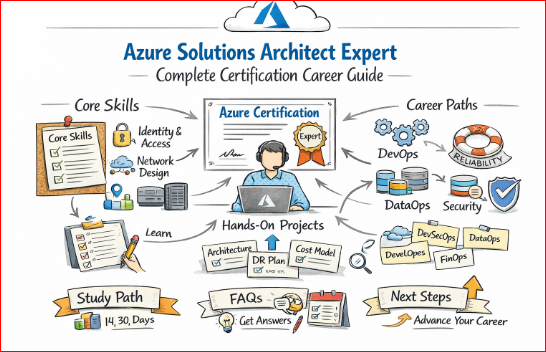
Introduction
Azure Solutions Architect Expert is Microsoft’s expert‑level, role‑based certification for professionals who design complete solutions on Azure, not just isolated components. It proves that you can take business requirements and turn them into secure, scalable, and reliable cloud architectures. You are expected to think end‑to‑end: identity, network, apps, data, security, and operations together. This makes it highly valuable for senior technical roles in modern cloud‑first organizations. Azure Solutions Architect focuses heavily on the Azure Well‑Architected Framework and design patterns that work in real life. You learn to balance trade‑offs between performance, reliability, cost, and security instead of blindly enabling features. This perspective is what separates architects from regular implementers. It also prepares you to work closely with multiple teams—developers, operations, security, and business.
Why this certification matters now
Most organizations across India and globally are either migrating to Azure or already running critical workloads there. They are not just looking for people who can “create resources” but for architects who can design systems that scale, stay secure, and stay up. That is where Azure Solutions Architect Expert comes in. It gives you a structured way to prove those skills.
For engineers, this certification helps you move from task‑level work to decision‑level work. You become the person who decides how solutions are shaped, not just how they are deployed. For managers, it strengthens your ability to review architectures, question assumptions, and align technical designs with business goals. It also improves your credibility in discussions with clients, vendors, and leadership.
Overview of the certification path
The certification path is designed for people who already understand Azure basics and want to move into architecture. Typically, you first build a strong foundation with Azure administration and core services. Once that is in place, you move into advanced design topics like hybrid networking, security models, and disaster recovery. This step‑by‑step journey makes the expert‑level content much easier to digest. Training programs usually package this into a guided roadmap. You learn concepts, apply them in labs, and then practice with case‑study style scenarios. Over time, you learn how to read a vague business requirement and turn it into a clear architecture diagram and plan. That is the real value of this path: learning to think and talk like an architect, not just pass an exam.
Core skills Azure Solutions Architect must have
An Azure Solutions Architect needs a mix of breadth and depth across infrastructure, applications, security, and operations. You do not have to be the absolute best in each area, but you must know how they fit together. For example, when you design a web application, you consider networking, identity, storage, backups, and monitoring together—not one by one. This holistic view is what organizations pay for. You also need strong communication skills. Architects spend a lot of time explaining designs to engineers, managers, and non‑technical stakeholders. You may need to defend decisions around cost, performance, or security. So, the role is both technical and consultative. Over time, this combination of skills can move you into lead architect, platform owner, or even cloud strategy roles.
Azure Solutions Architect Expert – certification table
| Track | Level | Who it’s for | Prerequisites | Skills covered | Recommended order |
|---|---|---|---|---|---|
| Azure Solutions Architect Expert | Expert | Working DevOps/Cloud/SRE/Platform engineers, Security/Data engineers, tech leads, and managers who design or review Azure solutions for real projects. | Strong Azure fundamentals, basic experience with deploying workloads to Azure, understanding of networking, identity, security, and general infra/DevOps concepts. | Designing secure and scalable architectures, identity and access, networking and connectivity, compute and containers, storage and data, governance and cost management, monitoring and observability, backup and disaster recovery, hybrid and migration scenarios. | 1) Build Azure fundamentals and admin skills, 2) Study core architect domains one by one, 3) Do hands‑on labs and 2–3 end‑to‑end projects, 4) Practice case studies and mock questions, 5) Attempt the expert‑level exam. |
Deep dive: Azure Solutions Architect Expert program
What it is
DevOpsSchool’s Azure Solutions Architect program is built to make you productive in real projects, not just exams. The sessions combine theory, whiteboard design, and hands‑on labs in a structured way. You work on real‑looking scenarios such as multi‑tier apps, hybrid networks, and secure environments. This makes it easier to apply your learning back at work. The curriculum is mapped to the major Azure architect domains like identity, networking, compute, security, and business continuity. Each module ends with practical exercises and design reviews. Over time, you build a small portfolio of architectures that you can talk about in interviews and internal discussions. This is extremely useful for career growth.
Who should take it
This program is ideal for working professionals who are already in DevOps, cloud, SRE, or system administration roles. If you are the person who gets pulled into discussions about “how should we design this on Azure,” this training fits you. It also suits team leads and managers who want to understand architecture deeply enough to guide technical decisions. You do not need to be a full‑time architect before joining, but you should have some hands‑on experience with Azure or cloud. For mid‑career professionals, this is a strong way to reposition yourself in the market. Instead of competing as one more engineer, you start positioning yourself as an architect or lead. This difference shows clearly in interviews and internal promotion discussions. The program gives you both language and structure to present your experience as architecture work.
Skills you’ll gain
- Ability to design secure, scalable, and reliable Azure architectures across compute, network, storage, identity, and security.
- Confidence to translate business and non‑functional requirements (availability, performance, RPO/RTO, cost) into concrete cloud designs.
- Hands‑on experience with Azure landing zones, governance, policies, and cost management for multi‑subscription environments.
- Skill to choose the right Azure services (VMs, App Service, AKS, databases, storage) for different application and data patterns.
- Capability to embed monitoring, logging, and observability into every design using Azure Monitor, Log Analytics, and Application Insights.
- Strong understanding of backup, disaster recovery, and high‑availability patterns for critical workloads.
- Improved documentation and diagramming skills for presenting architectures to engineers, managers, and stakeholders.
- Better collaboration with DevOps, SRE, Security, Data, and FinOps teams by speaking a common architecture language.
Real‑world projects you should be able to do
- Design a multi‑tier e‑commerce or SaaS application on Azure with load balancers, autoscaling, secure VNets, managed databases, and monitoring.
- Build a secure hybrid network connecting on‑premises data centers to Azure using VPN/ExpressRoute, with proper routing, NSGs, and identity integration.
- Architect a highly available web API platform using App Service or AKS, Azure SQL/Cosmos DB, Key Vault, and Azure AD‑based authentication.
- Implement a full monitoring and observability setup with Azure Monitor, Log Analytics, Application Insights, dashboards, and alert rules mapped to SLOs.
- Design and test a backup and disaster recovery strategy with region‑to‑region failover, defined RPO/RTO targets, and regular DR drills.
- Plan and execute a migration of an existing on‑prem application to Azure, including assessment, target architecture, cut‑over strategy, and rollback plan.
Preparation plan (7–14 days / 30 days / 60 days)
7–14 days (fast‑track, full‑time focus)
- Reserve 6–8 hours daily for study, labs, and revision.
- Day 1–3: Identity, governance, subscriptions, RBAC, and basic cost management.
- Day 4–6: Networking (VNets, VPN, ExpressRoute, Application Gateway, Front Door), plus hybrid connectivity.
- Day 7–10: Compute (VMs, scale sets, App Service, AKS), storage, and data services; build 1–2 small end‑to‑end architectures.
- Day 11–14: Monitoring, security, backup/DR, practice case studies and mock exams, and revise weak domains.
30 days (balanced for working professionals)
- Time: 1–2 focused hours on weekdays, 3–4 hours on weekends.
- Week 1:
- Learn identity, access management, governance, and management groups.
- Set up a small lab with multiple subscriptions and basic cost controls.
- Week 2:
- Deep dive into networking (VNets, subnets, NSGs, VPN, hybrid connectivity).
- Design and implement at least one hub‑and‑spoke or hybrid network scenario.
- Week 3:
- Study compute options (VMs, scale sets, App Service, containers, AKS) and storage/data services.
- Build a sample multi‑tier application architecture with monitoring and backup.
- Week 4:
- Focus on security, monitoring, logging, business continuity, and DR patterns.
- Solve case‑study style questions, take practice tests, and revise notes and diagrams.
60 days (deep practice with projects)
- Time: 1–2 hours on weekdays, 4–5 hours on weekends, plus project work.
- Phase 1 (Weeks 1–2):
- Strengthen fundamentals in identity, networking, storage, and compute.
- Do guided labs for each domain and maintain a personal “architecture notebook.”
- Phase 2 (Weeks 3–4):
- Build 2–3 complete reference architectures (web app, hybrid setup, data‑heavy workload).
- Add security layers, monitoring, and basic backup/DR to every design.
- Phase 3 (Weeks 5–6):
- Focus on optimization: cost, reliability, performance, and security trade‑offs.
- Practice full case studies, mock exams, and “whiteboard” sessions where you explain designs aloud.
Common mistakes
- Focusing only on exam dumps and question banks instead of learning real Azure architecture concepts.
- Skipping hands‑on labs and not building or breaking things in a real Azure environment.
- Ignoring core fundamentals like networking, identity, and security, and jumping straight into complex scenarios.
- Treating cost, governance, and compliance as “non‑technical” and leaving them out of designs.
- Memorizing services and features without understanding when and why to use them in real solutions.
- Not practicing with end‑to‑end case studies or reference architectures similar to real projects.
- Avoiding documentation and diagrams, which makes it hard to explain and defend design decisions.
- Preparing in isolation without discussing designs with peers, mentors, or in mock review sessions.
Best next certification after this
After you complete an architect‑level program, it is smart to add depth in one direction. If you enjoy pipelines and delivery, a DevOps or DevSecOps path is natural. If you like reliability and production work, SRE training fits very well. If you are pulled toward data or analytics, a data engineering or analytics certification is ideal.
For people moving toward leadership, you can also explore architecture leadership or consulting‑style programs. These focus more on communication, stakeholder management, and decision‑making frameworks. Combined with your architecture certification, this can set you up for roles like Principal Architect or Head of Cloud. It is a smooth next step once your technical base is strong.
Choose your path – 6 learning paths
1. DevOps path
In the DevOps path, you focus on how your Azure architectures support fast, reliable delivery. You design systems where infrastructure is automated, deployments are repeatable, and rollbacks are safe. This means working closely with CI/CD tools, infrastructure as code, and release strategies. Your architecture decisions impact how easily teams can ship features.
You also learn to break down monoliths into more manageable services over time. Pipelines, environments, and testing strategies become part of your design. This path is excellent if you already enjoy automation, scripting, and tooling. It positions you as someone who can both design and enable modern delivery practices on Azure.
2. DevSecOps path
DevSecOps is about building security into the design and delivery process from day one. In this path, your Azure architectures must follow strong security patterns by default. You think about identity, network segmentation, secrets management, and compliance early. You also consider how security checks run automatically in pipelines.
Over time, you become comfortable with concepts like zero‑trust, policy‑as‑code, and continuous compliance. This makes you valuable for companies in regulated industries or with strict audit requirements. Your profile becomes “Azure Architect who designs secure systems and integrates security into DevOps.” That combination is in high demand.
3. SRE path
The SRE path is for people who love reliability, performance, and incident management. Here, your Azure architecture work is guided by SLOs, error budgets, and observability. You design for graceful degradation, fast recovery, and clear monitoring from the start. Instead of only asking “will it work,” you ask “how will it behave under failure.”
You also learn practices around capacity planning, load testing, and chaos experiments. Over time, you can design systems that are both resilient and measurable. In organizations with strict uptime targets, this combination of Azure architecture plus SRE thinking is extremely powerful. You become the bridge between design and operations.
4. AIOps/MLOps path
AIOps/MLOps path fits people who sit at the intersection of operations and AI/ML. With your Azure architecture foundation, you design environments that support data collection, model training, and intelligent automation. You think about pipelines for data, models, and deployments. You also design how monitoring and alerts can be enhanced with AI.
Over time, you can help organizations move from basic dashboards to smarter, self‑healing systems. This path is useful in large, complex environments where manual monitoring is not enough. Your profile becomes “Azure Architect who understands intelligent operations and ML workflows.” That is still relatively rare in the market.
5. DataOps path
DataOps is for those who are drawn to data platforms and analytics. As an Azure architect on this path, you design data lakes, warehouses, and streaming solutions. You think about how data moves, how it is transformed, and how it is served to analytics tools. Quality, lineage, and governance become part of your architecture.
This path is ideal if you often work with BI teams, data engineers, or analytics stakeholders. You become the person who ensures the data platform is robust, scalable, and compliant. Combined with Azure Solutions Architect skills, this makes you suitable for roles like Data Platform Architect or Analytics Architect.
6. FinOps path
FinOps is about making cloud cost a first‑class design factor, not an afterthought. On this path, you use your architecture skills to design cost‑efficient systems. You think about right‑sizing, reserved capacity, autoscaling policies, and usage patterns. Tagging, budgets, and reports become part of your standard design templates.
This makes you a key partner for finance and leadership. You can explain why certain designs cost more and how to optimize without breaking reliability or performance. For organizations under cost pressure, an “Azure Architect + FinOps mindset” is extremely attractive. It helps them save money while still moving forward with cloud adoption.
Role → Recommended certifications mapping
| Role | How Azure Solutions Architect Expert helps | Recommended certifications mix (next steps) |
|---|---|---|
| DevOps Engineer | Designs Azure environments that support CI/CD, IaC, and fast, safe releases. | Azure Solutions Architect Expert + Azure DevOps Engineer (AZ‑400–oriented) + a Kubernetes/container certification + a DevSecOps/security fundamentals program. |
| SRE | Ensures reliability, scalability, and performance of Azure workloads in production. | Azure Solutions Architect Expert + SRE/Observability training (SLOs, incidents, monitoring) + performance and capacity planning course. |
| Platform Engineer | Builds internal platforms and self‑service infrastructure for developers on Azure. | Azure Solutions Architect Expert + Kubernetes/Platform Engineering training (GitOps, IaC) + Azure DevOps/automation‑focused certification. |
| Cloud Engineer | Implements and operates Azure infrastructure based on architecture designs. | Azure Solutions Architect Expert + Azure Administrator–level training + networking and security deep‑dive course. |
| Security Engineer | Designs and enforces security controls across Azure environments. | Azure Solutions Architect Expert + Azure Security/DevSecOps‑oriented certification + identity and zero‑trust architecture training. |
| Data Engineer | Designs data platforms and pipelines on Azure. | Azure Solutions Architect Expert + Azure data engineering/analytics certification + DataOps‑focused training. |
| FinOps Practitioner | Optimizes cloud spend and shapes cost‑efficient architectures. | Azure Solutions Architect Expert + FinOps/cloud cost management certification + governance and cost optimization training. |
| Engineering Manager | Guides teams and signs off on cloud architecture decisions. | Azure Solutions Architect Expert + architecture/leadership or “DevOps/Cloud Manager” program + one specialization (DevOps/SRE/Data/Security) based on team focus. |
Next certifications to take after Azure Solutions Architect Expert
1. Same track – go deeper in Azure architecture
If you want to stay close to Azure architecture and cloud platform depth:
- Strengthen Azure DevOps and automation skills with an Azure DevOps Engineer Expert–oriented program (AZ‑400 level), which focuses on CI/CD, IaC, and release strategies on Azure.
- Add Azure security specialization (like AZ‑500‑oriented training) to design secure, compliant architectures end‑to‑end.
- Explore advanced networking, hybrid, or multi‑cloud architecture trainings for complex enterprise environments.
This keeps you positioned as a senior or principal Azure Architect with strong delivery and security depth.
2. Cross‑track – DevOps, SRE, DevSecOps, Data, AIOps, FinOps
If you want to combine architecture with an operations or specialization track:
- DevOps / Azure DevOps path: Add a DevOps Engineer Expert–focused program (AZ‑400 level) or “Master in Azure DevOps” style course to build pipelines, IaC, and automation skills around your designs.
- SRE path: Take SRE‑focused training (SRESchool, etc.) that covers SLOs, error budgets, reliability patterns, and advanced monitoring on top of your Azure architectures.
- DevSecOps path: Add DevSecOpsSchool’s security automation and secure‑by‑design programs so your architectures embed security controls and compliance from day one.
- Data / DataOps path: If you often design analytics, data lakes, or pipelines, pick DataOps or Azure data engineering–oriented certifications next.
- AIOps/MLOps path: For AI‑driven operations or ML workloads, add AIOps/MLOps programs that teach monitoring with AI, model lifecycle, and intelligent remediation.
- FinOps path: If you work closely with cost and budgeting, a FinOps certification or FinOpsSchool program helps you become the cost‑optimization and cloud economics expert.
This makes your profile “Azure Architect + X” (DevOps, SRE, DevSecOps, DataOps, AIOps, or FinOps), which is very attractive in modern teams.
3. Leadership and manager‑oriented next steps
If your goal is to move into lead, manager, or architect‑manager roles:
- Choose architecture leadership or “Certified Cloud Architect / DevOps Manager”–style programs that focus on governance, roadmaps, and multi‑team decision‑making.
- Combine Azure Solutions Architect Expert with a FinOps‑oriented certification to become the person who balances technology, reliability, and cost at a portfolio level.
- Look for training that includes stakeholder communication, proposal writing, and review boards, so you can operate as a trusted architecture leader.
Top institutions for Azure Solutions Architect Expert training
DevOpsSchool
DevOpsSchool is a well‑known training platform for DevOps, Cloud, SRE, and Azure architecture programs, including Azure Solutions Architect–focused courses. It emphasizes hands‑on labs, real‑world case studies, and project‑based learning so that professionals can apply concepts directly in their jobs. Many courses are aligned with certification objectives and include interview, resume, and career support.
Cotocus
Cotocus is a consulting and corporate training company that helps organizations adopt DevOps, Cloud, DataOps, AIOps, MLOps, DevSecOps, FinOps, SRE, and related practices. It offers customized training for teams that want both practical implementation guidance and structured learning on modern cloud and operations topics. For professionals targeting Azure Solutions Architect Expert, Cotocus can provide organization‑wide upskilling around cloud architecture, governance, and operations.
ScmGalaxy
ScmGalaxy is positioned as an IT training and community platform focused on DevOps, configuration management, CI/CD, and related tooling. It provides instructor‑led courses, workshops, and mentoring that help engineers build strong foundations in automation and modern software delivery practices. For Azure architects, ScmGalaxy’s DevOps‑oriented content is useful to complement architecture skills with delivery and tooling depth.
BestDevOps
BestDevOps is typically described as a skill‑building and enablement brand in the broader DevOps learning ecosystem. It highlights training and content that align with modern DevOps practices such as CI/CD, automation, and cloud‑native delivery. Professionals preparing for Azure Solutions Architect Expert can use BestDevOps resources to strengthen their delivery and DevOps side along with architecture knowledge.
devsecopsschool.com (DevSecOpsSchool)
DevSecOpsSchool focuses on secure engineering and DevSecOps practices, combining security with DevOps pipelines and cloud environments. It offers training that covers topics like security automation, compliance, and integrating security tools into CI/CD workflows. For Azure Solutions Architects, this platform helps in learning how to embed strong security controls and processes into Azure solution designs.
sreschool.com (SRESchool)
SRESchool is dedicated to Site Reliability Engineering skills such as SLOs, incident management, observability, and production ownership. Its training and content are aimed at helping engineers and teams design and operate highly reliable systems. When combined with Azure architecture learning, SRESchool’s focus on reliability gives architects a strong SRE‑driven perspective on production‑grade designs.
aiopsschool.com (AIOpsSchool)
AIOpsSchool provides learning around AIOps, intelligent monitoring, and automated IT operations. It focuses on using AI and machine learning techniques to enhance incident detection, analysis, and remediation in complex environments. Azure architects who deal with large‑scale or dynamic systems can use AIOpsSchool content to design smarter, more automated operations on top of their core Azure architectures.
dataopsschool.com (DataOpsSchool)
DataOpsSchool centers on DataOps practices—improving the quality, speed, and reliability of data pipelines and analytics platforms. It offers guidance and training on building robust data workflows, integrating data tools, and aligning data teams with DevOps‑style practices. For Azure Solutions Architects working on data‑heavy solutions, DataOpsSchool helps in designing better data platforms and operations on Azure.
finopsschool.com (FinOpsSchool)
FinOpsSchool focuses on FinOps and cloud financial management, helping teams understand and optimize cloud cost. Training covers concepts like cost visibility, budgeting, chargeback/showback, and cost‑efficient architecture patterns across cloud platforms. Azure architects can leverage FinOpsSchool content to design solutions that balance performance and reliability with smart, well‑managed cloud spending.
FAQs on Azure Solutions Architect Expert
1. What is Azure Solutions Architect Expert?
Azure Solutions Architect Expert is an advanced Azure certification that proves you can design complete cloud solutions, not just deploy individual services. It focuses on secure, scalable, and reliable architectures that solve real business problems. You are tested on how you combine identity, networking, compute, storage, security, and monitoring into one working design.
2. Who should go for Azure Solutions Architect Expert?
This certification is ideal for DevOps engineers, cloud engineers, SREs, platform engineers, security engineers, data engineers, architects, and tech leads or managers. It is also useful for system administrators who are moving into cloud architecture roles. If you are already involved in designing or reviewing Azure solutions, this path fits you very well.
3. What skills do I need before starting this journey?
You should be comfortable with basic Azure services like VMs, storage, networking, and identity. Some experience with deploying applications, working with resource groups, and troubleshooting in Azure will help a lot. General knowledge of networking, security concepts, and Linux/Windows administration is also very useful.
4. How difficult is Azure Solutions Architect Expert?
It is challenging, but not impossible if you prepare with a proper plan and hands‑on labs. The difficulty mainly comes from scenario‑based questions and case studies that test your design thinking. If you only memorize features without understanding architecture patterns, it will feel very hard.
5. How long does it take to prepare while working full‑time?
Most working professionals need around 30–60 days of focused preparation. If you can give 1–2 hours daily on weekdays and extra time on weekends, that is usually enough. A shorter 7–14 day plan is possible only if you already have strong Azure experience and can study full‑time or in long daily blocks.
6. Do I need coding experience for this certification?
You do not need to be a full‑time developer, but basic scripting and automation skills are important. It helps if you understand ARM/Bicep templates, CI/CD pipelines, and how applications talk to Azure services. Your main job is to design and guide implementation, not to write all the code yourself.
7. Is on‑premises experience required?
On‑premises experience is not mandatory, but it is definitely helpful. Many real‑world architectures are hybrid, with some workloads on‑prem and some in Azure. If you understand data centers, networks, firewalls, and traditional infrastructure, you will find it easier to design migration and hybrid scenarios.
8. Is Azure Solutions Architect Expert valuable in India and globally?
Yes, this certification is well‑recognized in India as well as global markets like the US, Europe, and the Middle East. Many enterprises, consulting firms, and product companies use Azure and look for certified architects. It can give you an advantage in interviews, salary discussions, and client meetings.
9. Can I prepare for this exam if my company doesn’t use Azure?
Yes, you can still prepare using your own Azure subscription, free tiers, trials, and lab environments from training providers. The key is to do real hands‑on work: deploy resources, break things, and fix them. Even if your company is on another cloud, the architecture thinking you learn here will still be useful.
10. Will this certification help me move into DevOps or SRE roles?
It will help, but you also need DevOps/SRE‑specific skills. Azure Solutions Architect Expert gives you a strong base in design, reliability, security, and cost. To fully move into DevOps or SRE, you should add skills like CI/CD, observability, incident response, and automation tools. Together, they create a very strong profile.
11. Is Azure Solutions Architect Expert enough to become a cloud architect?
The certification is a strong foundation, but it is not enough by itself. You also need real project experience, architecture documents, design reviews, and practice explaining your decisions to others. Think of the certification as proof of knowledge; your day‑to‑day work, projects, and communication complete the cloud architect role.
12. How should I practice for real‑world scenarios, not just the exam?
Focus on building small end‑to‑end projects in a lab subscription. For example, design a secure web application with a database, VNet, monitoring, and backup. Write down non‑functional requirements like availability and RPO/RTO, then design around them. This habit trains you to think like an architect, not just an exam candidate.
FAQs specific to Azure Solutions Architect Expert
1. What is Azure Solutions Architect Expert in simple words?
Azure Solutions Architect Expert is an advanced Azure certification that proves you can design complete, secure, and scalable cloud solutions. It focuses on real architectures, not just individual services. You are tested on how well you combine identity, networking, compute, storage, security, and monitoring into one working solution.
2. Who should target Azure Solutions Architect Expert?
This certification is ideal for DevOps engineers, cloud engineers, SREs, platform engineers, security engineers, data engineers, and tech leads or managers. You should already have some hands‑on experience with Azure or cloud infrastructure. It’s best suited for people who want to move from “doing tasks” to “owning architecture and design decisions.”
3. What are the main topics covered in Azure Solutions Architect Expert?
You will learn to design identity and access, networks, compute platforms, storage, databases, security, monitoring, governance, and business continuity on Azure. The focus is always on end‑to‑end solutions, not just single resources. You also work with hybrid scenarios, cost optimization, and compliance requirements.
4. Do I need strong coding skills to become an Azure Solutions Architect Expert?
You do not need to be a full‑time developer, but basic scripting and template skills help a lot. You should be comfortable with concepts like ARM/Bicep templates, CI/CD, and how applications interact with Azure services. Your main job is to design and guide implementation, not to write every line of code yourself.
5. How much real‑world experience do I need before attempting this certification?
It is best if you have at least some real or lab experience deploying and managing workloads on Azure. You should have seen common patterns like web apps, APIs, databases, VPNs, and monitoring in practice. The exam and the role both assume that you can think in real scenarios, not only theory.
6. Is Azure Solutions Architect Expert useful in India and global markets?
Yes, it is recognized by companies in India as well as global markets like the US, Europe, and the Middle East. Many enterprises and consulting firms use Azure as a core platform and value certified architects. Having this certification on your profile makes conversations with recruiters and clients much easier.
7. Can I prepare for Azure Solutions Architect Expert while working full‑time?
Yes, most professionals do this while working. A realistic plan is 30–60 days with 1–2 focused hours daily plus deeper practice on weekends. If you follow a structured roadmap with labs, case studies, and revision, you can reach exam‑ready stage without leaving your job.
8. Will Azure Solutions Architect Expert alone make me a cloud architect?
The certification is a strong signal, but it is not enough by itself. You also need real project experience, design discussions, documentation practice, and the ability to explain trade‑offs to others. Think of the certification as a solid foundation and proof of knowledge; your projects and communication skills complete the profile of a true cloud architect.
Testimonials
Senior DevOps Engineer
“Before this Azure Solutions Architect Expert program, I was just ‘deploying resources’ without a clear design mindset. After the training, I finally understood how identity, networking, security, and cost all connect in a real architecture. I was able to redesign our production environment on Azure with cleaner patterns and better reliability, and my discussions with architects and managers became much more confident.”
Site Reliability Engineer (SRE)
“As an SRE, I always cared about uptime and performance, but I did not always see the bigger architecture view. This program helped me think in terms of end‑to‑end design, SLOs, and failure scenarios on Azure. Now I can participate in architecture reviews, suggest changes to improve reliability, and back my points with solid design principles.”
Cloud / Platform Engineer
“I was already working as a Cloud Engineer on Azure, but most of my work was ticket‑based and reactive. The Azure Solutions Architect Expert journey shifted my mindset from ‘how to fix this’ to ‘how should we design this properly from the start’. I now create reference architectures, document patterns, and help my team standardize deployments across environments.”
Security‑focused Engineer
“I come from a security background, and I used to look at Azure only from a control and compliance angle. Through this architect‑level training, I learned how to embed security into the overall solution design instead of bolting it on later. It became much easier to talk to DevOps and cloud teams, because we were finally working from the same architecture diagrams and goals.”
Conclusion
The conclusion brings everything together into one clear message. Azure Solutions Architect Expert is a strategic certification for those who want to move from execution to design and decision‑making. It sits at the center of many modern roles—DevOps, SRE, security, data, and platform—and opens doors to senior positions. The key is to combine the certification with real projects and continuous learning. If you are serious about becoming the “go‑to person” for Azure architecture in your team or organization, this path is worth your time. Combine thoughtful preparation, hands‑on labs, and a clear learning path like DevOps, SRE, or FinOps. Over time, you will see a clear difference in how you think, design, and communicate. That is the real power of this certification.