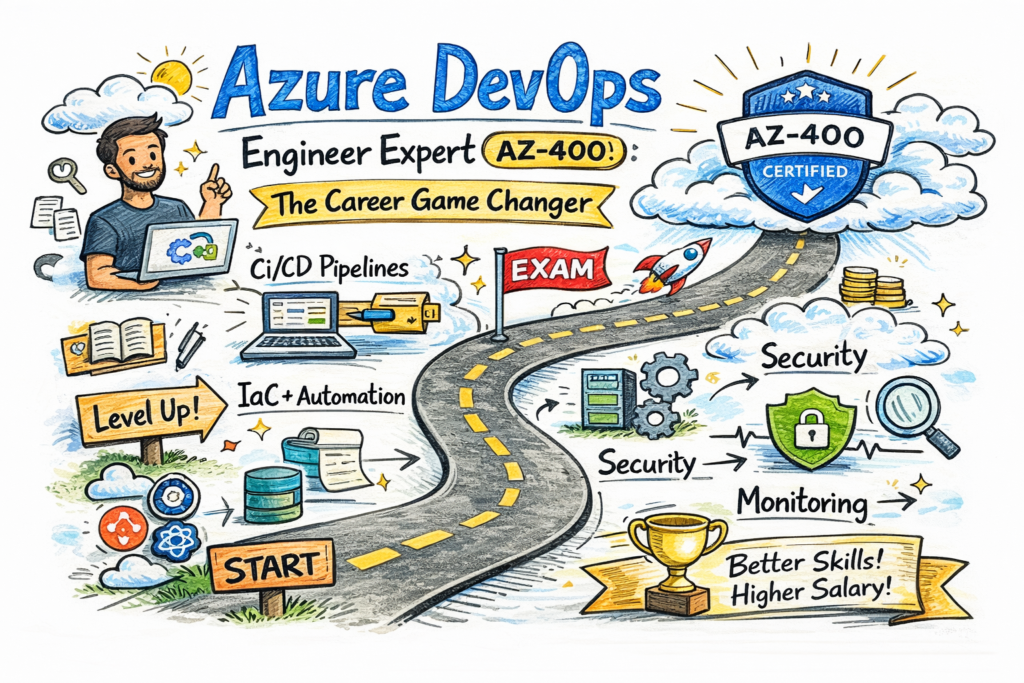
Introduction
Azure DevOps Engineer Expert (AZ‑400) is a certification that shows you can handle real DevOps work on Microsoft Azure. It covers how to plan, build, test, deploy, and monitor applications using automation and modern tools. For software engineers and managers, it proves that you know how to make releases faster, safer, and more reliable. If you want to grow as a DevOps Engineer, SRE, Platform Engineer, or tech‑savvy manager in an Azure‑based company, AZ‑400 is a very strong next step.
What is Azure DevOps Engineer Expert (AZ-400)?
Azure DevOps Engineer Expert validates your ability to design and implement DevOps processes that cover planning, coding, building, testing, releasing, monitoring, and feedback on Azure. It is centered around the AZ‑400 exam: Designing and Implementing Microsoft DevOps Solutions. The certification expects you to understand both tools and practices, from Git strategies to deployment patterns and observability. In short, it measures how well you can design a complete DevOps ecosystem on Azure.
Why this certification matters
This certification shows that you are not just writing scripts or pipelines, but designing end‑to‑end DevOps solutions for teams and organizations. It gives you a strong position for roles like DevOps Engineer, SRE, Platform Engineer, Cloud Engineer, and Tech Lead in Azure‑centric environments. Companies prefer AZ‑400‑certified professionals because they bring structure to releases, improve reliability, and reduce deployment risk. For managers, it also builds credibility when leading DevOps transformations and coaching teams.
AZ-400: Skills measured (high level)
AZ‑400 covers how you design DevOps processes, communication channels, and collaboration models across development and operations. It checks your ability to define Git branching strategies, implement CI pipelines, and build secure, repeatable release workflows. You must also understand infrastructure as code, artifact management, security integration, and monitoring. The exam is scenario‑oriented, so you are tested on how you would solve real problems, not just definitions.
AZ-400 Certification Snapshot
What it is
Azure DevOps Engineer Expert (AZ‑400) is an expert‑level certification focused on building and running DevOps solutions on Microsoft Azure. It combines process thinking with hands‑on skills in Azure DevOps, GitHub, CI/CD, and cloud automation. The certification is ideal if you want to be seen as the go‑to person for DevOps on Azure in your team or organization.
Who should take it
This certification is a strong fit for DevOps Engineers, SREs, Platform Engineers, Cloud Engineers, and senior Developers who work with Azure-based systems. It is also relevant for Engineering Managers and Tech Leads who want a deep understanding of DevOps so they can make better technical and process decisions. If you already manage builds, deployments, or automation, AZ‑400 helps formalize and validate your expertise. It suits both individual contributors and leaders who want to scale DevOps practices.
Skills you’ll gain (bullets → expanded)
- Design DevOps strategies and processes that align with business goals, team structures, and release cadences.
- Implement Git‑based source control strategies with branching, pull requests, policies, and governance for multiple teams.
- Build robust CI pipelines that automate builds, tests, code quality checks, and security scans across different application types.
- Design release strategies such as blue‑green, canary, and ring deployments that reduce risk and enable frequent releases.
- Implement infrastructure as code and integrate it into pipelines so that environments are consistent, repeatable, and versioned.
- Integrate security and compliance controls into your pipelines so that checks happen automatically and early in the lifecycle.
- Set up monitoring, logging, and feedback loops so teams can see how deployments affect performance, reliability, and user experience.
Real-world projects you should be able to do after it
- Build an end‑to‑end CI/CD pipeline for a microservices application hosted on AKS or App Service, with approvals and staged rollouts.
- Migrate a legacy, manual deployment process into a modern pipeline‑based workflow using Azure Pipelines with YAML.
- Implement a secure release pipeline with security scanning, code quality gates, and policy checks for a regulated industry project.
- Standardize infrastructure and deployment processes using templates and reusable pipeline components across multiple environments.
- Design dashboards and alerts so teams can track key metrics like errors, latency, deployments, and feature usage after each release.
Prerequisites for Azure DevOps Engineer Expert (AZ‑400)
Officially, you must hold either Azure Administrator Associate (AZ‑104) or Azure Developer Associate (AZ‑204) to earn the DevOps Engineer Expert certification. This ensures you already understand core Azure services and how applications run on the platform. Beyond formal prerequisites, it is important to have practical experience with Git, CI/CD concepts, and at least one real project using Azure. Familiarity with Agile or Scrum processes will also make many exam scenarios easier to understand.
Certification Path Table (Azure + DevOps Focus)
You can keep the table as is and support it in text like this:
Start with Azure Fundamentals (AZ‑900) if you are new to cloud or need a structured introduction to Azure concepts. Then move to AZ‑104 if you come from a sysadmin or infrastructure background, or AZ‑204 if you are more of an application developer. Once you earn one associate‑level certification, target AZ‑400 to build expert‑level DevOps skills on top. This sequence gives you a solid foundation in Azure and then layers DevOps practice on top of it.
Preparation Plan for AZ‑400
7–14 days (intensive)
This plan is best if you already design pipelines and work daily with Azure DevOps or GitHub. In the first few days, focus on understanding the current skills outline and mapping it to what you already know. Then spend several days doing targeted deep dives and hands‑on labs in your weaker areas. In the final days, revise using scenario‑style questions and practice exams, and refine your exam strategy and timing.
30 days (balanced plan)
A 30‑day plan is practical for working professionals who can study 1–2 hours per day. Each week, focus on a theme: first get comfortable with the tools and exam objectives, then go deeper into CI/CD and source control, followed by IaC and security, and finally monitoring and practice questions. Mix reading, videos, and documentation with real labs in Azure DevOps to make the concepts stick. By the end of the month, you should be comfortable with both theory and practical tasks.
60 days (paced for beginners to DevOps)
If you are newer to DevOps or Azure, a 60‑day plan gives you enough time to build the right foundations. Use the first month to strengthen your Azure basics and complete an associate‑level certification if needed. In parallel, learn Git, branches, pull requests, and simple CI concepts. In the second month, move into more advanced pipelines, infrastructure as code, security integration, and full scenarios. Finish with multiple practice exams and revisiting any weak topics you identify.
Common Mistakes Aspirants Make
Many candidates focus only on clicking through the Azure DevOps portal and ignore the bigger design and process questions. Others attempt AZ‑400 without real Azure project experience, which makes scenario questions hard to interpret. A common trap is ignoring YAML and relying only on classic pipelines, even though YAML is heavily used in real projects. Some people also overlook observability, feedback loops, and collaboration topics, which are a core part of DevOps and do appear in the exam. Avoid cramming; aim for understanding patterns and trade‑offs.
Best Next Certification After Azure DevOps Engineer Expert
1. Same track – go deeper into architecture
Recommended: Azure Solutions Architect Expert (AZ‑305).
- Ideal if you want to design end‑to‑end Azure solutions, not just pipelines.
- Complements AZ‑400 by adding strong skills in networking, identity, storage, continuity, and cost optimization.
2. Cross‑track – strengthen security / DevSecOps
Recommended: Azure Security Engineer Associate (AZ‑500).
- Great if you are moving toward DevSecOps or security‑heavy environments.
- Pairs naturally with AZ‑400 to cover identity, threat protection, and cloud security posture in depth.
3. Leadership / strategy direction
Recommended: Keep AZ‑400 as your technical core and add:
Security (AZ‑500) if you aim for security lead, compliance, or governance‑oriented leadership.
Architecture (AZ‑305) for solution/enterprise architect or platform lead roles.
Choose Your Path: 6 Learning Paths
1. DevOps Path
This path is for professionals who want to own CI/CD, automation, and release processes for applications on Azure. You build a strong base in Azure fundamentals and administration or development, then specialize with AZ‑400. Along the way, you add knowledge of containers, Kubernetes, and infrastructure as code. This makes you the central person for deployment and platform automation in your team.
2. DevSecOps Path
The DevSecOps path is ideal if you want to integrate security into every stage of the software lifecycle. You combine Azure fundamentals and administration with security‑focused learning and eventually AZ‑400. Your role is to make sure security checks are automated and embedded into pipelines, not bolted on at the end. This path is in high demand in regulated industries and organizations with strong compliance needs.
3. SRE Path
The SRE path focuses on reliability, performance, and incident management in production systems. You start with Azure fundamentals and administration, then specialize with AZ‑400 and strong monitoring and observability skills. You will work with SLIs, SLOs, error budgets, and automation to keep systems healthy. This path suits people who like debugging, performance tuning, and building resilient systems.
4. AIOps / MLOps Path
This path is for engineers who want to blend DevOps with AI and machine learning operations. You build your Azure and DevOps foundation, then extend into Azure AI/ML services and MLOps practices. Your job is to design pipelines that not only deploy applications but also train, validate, and deploy models. Over time, you may also implement intelligent monitoring and anomaly detection using AI techniques.
5. DataOps Path
The DataOps path focuses on bringing DevOps principles to data engineering and analytics workloads. You combine Azure fundamentals with data‑focused certifications and then layer AZ‑400 on top. The goal is to automate data pipelines, testing, and deployment of data platforms. This path is ideal if you like working with data engineers, analytics teams, and BI platforms.
6. FinOps Path
The FinOps path adds a cost and value perspective to DevOps and cloud operations. You use Azure and DevOps knowledge to design pipelines and environments that are not only reliable but also cost‑efficient. Over time, you learn practices like tagging, budgeting, showback/chargeback, and cost optimization patterns. This path is useful if you work closely with finance or leadership and want to connect engineering work to business value.
Role → Recommended Certifications Mapping
| Role | Primary Certifications (Azure / DevOps View) | Notes |
|---|---|---|
| DevOps Engineer | AZ‑900 → AZ‑104 or AZ‑204 → AZ‑400 | Core path for owning CI/CD, automation, and releases on Azure. |
| SRE | AZ‑900 → AZ‑104 → AZ‑400 | Add strong focus on monitoring, incident response, SLOs, and reliability practices. |
| Platform Engineer | AZ‑900 → AZ‑104 → AZ‑400 | Emphasize IaC, Kubernetes (AKS), and platform automation for shared services. |
| Cloud Engineer | AZ‑900 → AZ‑104 → AZ‑400 | Focus on infrastructure, networking, security, and operational excellence with DevOps skills. |
| Security Engineer | AZ‑900 → AZ‑104 → AZ‑500 → AZ‑400 | Combine Azure security depth with DevSecOps and pipeline‑level security automation. |
| Data Engineer | AZ‑900 → data‑oriented Azure cert (e.g., DP‑203) → AZ‑400 | Apply DevOps and CI/CD practices to data pipelines and analytics platforms. |
| FinOps Practitioner | AZ‑900 → AZ‑104 → AZ‑400 | Use DevOps automation plus governance and tagging to support cloud cost optimization. |
| Engineering Manager | AZ‑900 → AZ‑104 or AZ‑204 → AZ‑400 | Gain enough technical depth to lead DevOps teams and make informed architecture decisions. |
Top Institutions for AZ‑400 Training and Certification Support
DevOpsSchool
DevOpsSchool offers structured training programs for Azure DevOps and AZ‑400, combining theory with hands‑on labs and real project scenarios. Their courses are suitable for working professionals who want guided learning and exam preparation. They also cover broader DevOps topics, which helps you apply AZ‑400 skills in real environments.
Cotocus
Cotocus provides focused training on DevOps, cloud, and automation, including programs aligned to Azure DevOps Engineer Expert. Their approach is typically project‑oriented, helping learners build real pipelines and automation solutions. This is useful if you prefer learning through practical implementation rather than just slide‑based teaching.
ScmGalaxy
ScmGalaxy specializes in SCM and DevOps training, including Azure DevOps and related tools. Their courses often emphasize version control strategies, build automation, and continuous delivery pipelines. This can be a good fit if your current challenge is moving from basic Git usage to structured enterprise‑grade workflows.
BestDevOps
BestDevOps works as a platform bringing together DevOps training resources and programs, including Azure‑focused certifications. It is useful for discovering different training options and content around DevOps, CI/CD, and cloud practices. You can explore it to complement your AZ‑400 preparation with broader DevOps knowledge.
devsecopsschool.com
devsecopsschool.com focuses on the intersection of DevOps and security, making it a strong choice if you are following the DevSecOps path. Courses are oriented towards integrating security tools and processes inside CI/CD pipelines. This adds an important dimension to your AZ‑400 preparation, especially for security‑sensitive industries.
sreschool.com
sreschool.com is centered on Site Reliability Engineering, reliability practices, and observability. It helps bridge AZ‑400 DevOps skills with practical SRE concepts like SLIs, SLOs, error budgets, and incident response. This is a natural complement if your role combines DevOps automation with production reliability.
aiopsschool.com
aiopsschool.com teaches how AI and automation can enhance IT operations, which aligns well with the AIOps/MLOps path. It focuses on using telemetry, automation, and machine learning to improve reliability and reduce manual work. Pairing this with AZ‑400 gives you a strong combination of DevOps and intelligent operations skills.
dataopsschool.com
dataopsschool.com targets DataOps practices that bring DevOps principles to data pipelines and analytics platforms. It is useful if you want to apply AZ‑400 skills to data engineering and BI environments. You learn how to handle versioning, testing, and deployment of data workflows more systematically.
finopsschool.com
finopsschool.com focuses on financial operations in cloud environments and how to align engineering with cost and value. When combined with AZ‑400, it helps you design DevOps processes that are both technically sound and cost‑efficient. This is highly relevant for organizations that want to control cloud spend while scaling DevOps.
Focused FAQs on Azure DevOps Engineer Expert (AZ-400)
You can keep the same questions and expand each answer to 3–4 lines:
- What is the main focus of AZ‑400?
AZ‑400 focuses on how to design and implement DevOps processes on Azure using tools like Azure DevOps and GitHub. It covers the entire lifecycle: planning, coding, building, testing, releasing, monitoring, and feedback. The main goal is to see if you can create a consistent, automated, and secure flow from code to production. - Who is the ideal candidate for AZ‑400?
The ideal candidate is someone already working with Azure as a developer, administrator, or DevOps engineer. You should be responsible for, or interested in, CI/CD, automation, and release management. It is also suitable for SREs, Platform Engineers, and Tech Leads who want to formalize their DevOps expertise. - What are the official prerequisites for AZ‑400?
To earn the DevOps Engineer Expert certification, you must first hold either Azure Administrator Associate (AZ‑104) or Azure Developer Associate (AZ‑204). You can technically study AZ‑400 content in parallel, but your badge will only be awarded after you meet this requirement. This ensures you have solid Azure fundamentals before claiming expert‑level DevOps skills. - How much hands‑on experience should I have before attempting AZ‑400?
While there is no strict rule, it is wise to have several months of real experience with Azure, Git, and CI/CD pipelines. You should have built or maintained at least a few pipelines and deployments in real or lab projects. This makes the scenario‑based questions more natural and less theoretical. - How long should I prepare if I am a working professional?
If you already work with Azure and DevOps, 30–45 days of focused study is usually enough alongside your job. If you are newer to these topics, plan for 60 days or more, including time for associate‑level certification. The key is consistent daily progress rather than last‑minute cramming. - Can AZ‑400 boost my salary and role?
Yes, expert‑level certifications like AZ‑400 often help you move into higher‑responsibility roles such as senior DevOps Engineer, SRE, or Tech Lead. They make it easier to demonstrate your value to current and future employers. Combined with strong projects, AZ‑400 can support both promotions and better offers. - Is AZ‑400 more about tools or mindset?
AZ‑400 is a mix of both; you must know Azure DevOps and related tools, but you are also tested on DevOps principles and design decisions. Many questions focus on “how would you design this” rather than “where do you click”. So you need a strong mindset around automation, collaboration, and continuous improvement, not just tool familiarity. - What should I study last week before the exam?
In the last week, focus on the official skills outline and your weakest topics first. Revisit complex pipeline scenarios, IaC, and security integration, and ensure you can read and reason about YAML. Do at least one or two sets of practice questions to tune your timing and exam strategy.
FAQs on Azure DevOps Engineer Expert (AZ‑400)
Q1. What is Azure DevOps Engineer Expert (AZ‑400)?
Azure DevOps Engineer Expert is an expert‑level Microsoft certification that validates your ability to design and implement DevOps solutions on Azure. It covers CI/CD pipelines, source control, infrastructure as code, security, and monitoring. It is one of the most recognized certifications for professionals who want to lead DevOps work on the Azure platform.
Q2. Who should take the AZ‑400 certification?
AZ‑400 is best suited for DevOps Engineers, SREs, Platform Engineers, Cloud Engineers, and senior Developers who work with Azure. It is also useful for Engineering Managers and Tech Leads who want strong technical knowledge to guide their teams. If your daily work involves builds, deployments, automation, or releases on Azure, this certification is a perfect fit.
Q3. What are the official prerequisites for AZ‑400?
Microsoft requires you to hold either Azure Administrator Associate (AZ‑104) or Azure Developer Associate (AZ‑204) before earning the DevOps Engineer Expert badge. This ensures you already have solid Azure fundamentals. You can study for AZ‑400 in parallel, but your certification will only be awarded once you meet this requirement.
Q4. Is AZ‑400 a difficult exam?
AZ‑400 is considered moderate to difficult because it is scenario‑based and expects real hands‑on experience. You are not asked to memorize definitions; you are asked how you would solve real DevOps problems on Azure. Candidates with actual project experience tend to find it much more manageable than those relying only on study material.
Q5. How long does it take to prepare for AZ‑400?
If you already work with Azure DevOps and CI/CD regularly, 2–4 weeks of focused preparation is usually enough. For professionals newer to Azure or DevOps, a 30–60 day plan works better. The key is combining study material with hands‑on practice in real or lab Azure DevOps environments.
Q6. Can I attempt AZ‑400 without hands‑on experience?
Technically yes, but your chances of passing are low without real project experience. The exam is heavily scenario‑based, so you need to have actually built or managed pipelines, handled deployments, and worked with Azure services. Even setting up personal lab projects makes a significant difference in preparation.
Q7. What topics are most heavily tested in AZ‑400?
Designing and implementing build and release pipelines is one of the most heavily weighted areas. Source control strategies, infrastructure as code, security integration, and monitoring also carry significant weight. Many questions are case‑study style, asking you to choose the best design approach for a given situation.
Q8. Do I need to know YAML for AZ‑400?
Yes, YAML pipeline knowledge is very important for AZ‑400. Most modern Azure DevOps projects use YAML‑based pipelines, and exam questions often expect you to read, reason about, and design them. If you are only familiar with classic pipelines, spend extra time learning YAML before the exam.
Q9. Is AZ‑400 worth it for non‑Azure companies?
Yes, the DevOps concepts and design patterns in AZ‑400 transfer well even to non‑Azure or multi‑cloud environments. Topics like Git strategies, CI/CD design, security in pipelines, and observability are universal. The certification gives you a structured way to think about DevOps, regardless of the underlying cloud platform.
Q10. What job roles can AZ‑400 help me get?
AZ‑400 opens doors to roles like DevOps Engineer, Cloud Engineer, SRE, Platform Engineer, and Technical Lead in Azure‑focused organizations. It is also highly regarded for senior IC and architecture roles where you need to own or guide the delivery process. For managers, it builds the credibility needed to lead DevOps teams and make technical decisions.
Q11. Does AZ‑400 certification expire?
Microsoft certifications need periodic renewal to stay active. You can renew online for free through Microsoft’s renewal assessment, which you take before your certification expires. Staying current is important as Azure tools and DevOps practices evolve regularly.
Q12. What is the best next certification after AZ‑400?
If you want to go deeper into architecture, Azure Solutions Architect Expert (AZ‑305) is the best next step. If you want to strengthen security and move toward DevSecOps, Azure Security Engineer Associate (AZ‑500) is a strong choice. Your next move should align with the role you are targeting in the next 2–3 years.
Testimonials (Sample Content)
You can expand each testimonial slightly for more human feel:
- “After completing AZ‑400, I redesigned our entire delivery pipeline on Azure DevOps. Deployments that earlier took hours and frequent rollbacks now finish in minutes with far fewer incidents. The certification gave me the confidence and structure to lead this change.”
- “Preparing for AZ‑400 forced me to think beyond just builds and releases. I now look at how requirements flow through planning, coding, testing, deployments, and monitoring. This holistic view has made me far more effective as a DevOps Engineer.”
- “For our globally distributed team, aligning around the practices covered in AZ‑400 gave us a common language. We now use consistent branching, pipelines, and monitoring patterns, which has improved collaboration and reduced confusion across time zones.”
Conclusion
Azure DevOps Engineer Expert (AZ‑400) is one of the best ways to prove that you can design real, production‑ready DevOps solutions on Azure. It combines hands‑on pipelines and automation with process, collaboration, and observability thinking. For engineers and managers in India and globally, this certification can be a strong differentiator in a crowded market. With a structured preparation plan and real projects, AZ‑400 becomes more than a badge—it becomes a turning point in your DevOps career.