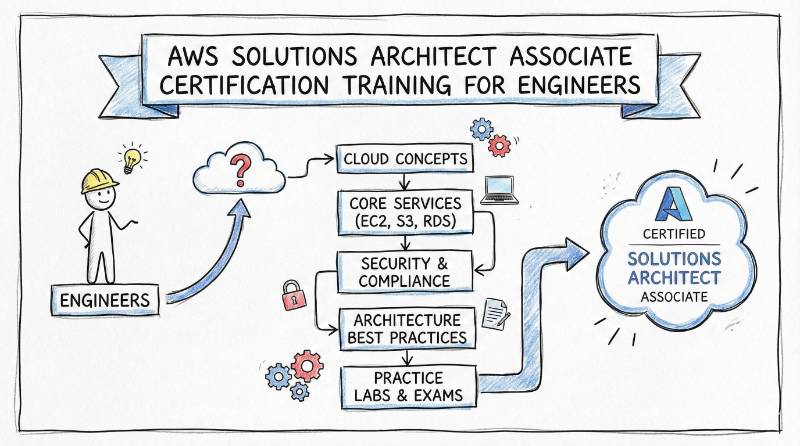
Introdcution
In the evolving landscape of distributed systems—from physical server racks to today’s serverless ecosystems—one truth remains constant: Technology changes, but architectural patterns endure. The AWS Certified Solutions Architect – Associate is not just a certification; it is the industry’s baseline for “Cloud Fluency.” It verifies that you don’t just know the names of AWS services, but that you possess the judgment to stitch them together into systems that are secure, resilient, and cost-effective. This guide is designed for working engineers, managers, and software developers (in India and globally) who want to move beyond “making it work” to “architecting it right.”
At a Glance: The Certification Profile
| Feature | Details |
|---|---|
| Track | Architecture |
| Level | Associate (Intermediate) |
| Who it’s for | Solutions Architects, DevOps Engineers, Developers, Systems Administrators |
| Prerequisites | None officially, but 1 year of hands-on AWS experience is strongly recommended |
| Skills Covered | IAM/Security, Networking (VPC), Compute (EC2/Lambda), Storage (S3/EBS), Databases (RDS/DynamoDB), Cost Optimization |
| Recommended Order | Take AWS Cloud Practitioner first if you are non-technical; otherwise, start here. |
What This Certification Actually Is
The SAA-C03 exam is a scenario-based test. It presents you with a business problem (e.g., “A company needs a highly available database that can survive a regional failure…”) and asks you to choose the best solution from four technically valid options. It forces you to make trade-offs. You will learn that in architecture, the answer is almost always “It depends.” This certification teaches you what it depends on: Cost, Performance, Security, or Reliability.
Who Should Take It (and Why)
- Software Engineers: To stop writing code that breaks the infrastructure. You will learn to write “cloud-native” applications that leverage queues (SQS) and serverless triggers (Lambda).
- System Administrators: To transition from “keeping the lights on” to “automating the lights.” This is your bridge to DevOps.
- Technical Managers: To sniff out bad designs. When your team proposes a solution, you need to know if it’s overkill or under-engineered.
- Freshers: To prove you have professional-grade knowledge. In India’s competitive market, this badge is often the resume filter.
Deep Dive: Skills You Will Gain
We aren’t just memorizing definitions. Here is the architectural depth you will develop:
1. Designing Resilient Architectures
- Multi-AZ vs. Multi-Region: You will learn when to replicate data across data centers (Availability Zones) for high availability versus across the world (Regions) for disaster recovery.
- Decoupling: You will master the art of breaking monolithic apps into microservices using SQS (Simple Queue Service) and SNS (Simple Notification Service) so that if one component fails, the whole system doesn’t crash.
2. High-Performance Networking
- The VPC (Virtual Private Cloud): This is the hardest part for most. You will learn to carve out your own slice of the cloud, creating public subnets for web servers and private subnets for databases, secured by NACLs and Security Groups.
- Hybrid Connectivity: How to connect a corporate office in Bangalore to a VPC in Virginia using Direct Connect or Site-to-Site VPN.
3. Secure Applications & Architectures
- Identity Management (IAM): You will move beyond “root access” to creating granular Roles and Policies. You’ll learn the principle of Least Privilege.
- Encryption: Understanding implementation of KMS (Key Management Service) for data at rest and TLS for data in transit.
4. Cost Optimization
- Storage Tiering: You will learn to automate data movement from expensive S3 Standard storage to cheaper tiers like S3 Glacier using Lifecycle Policies.
- Compute Strategies: Knowing when to use Spot Instances (for 90% savings) versus Reserved Instances (for predictable workloads).
Real-World Architectural Blueprints (Projects)
After this certification, you shouldn’t just pass an exam; you should be able to build these three core systems from scratch.
Project 1: The “Unbreakable” Web Application
Scenario: A high-traffic e-commerce site needs to handle flash sales without crashing.
- Architecture:
- Frontend: CloudFront (CDN) to cache content globally.
- Compute: An Auto Scaling Group of EC2 instances behind an Application Load Balancer (ALB).
- Database: Amazon Aurora with Read Replicas to handle heavy traffic.
- Storage: S3 for product images, offloading load from the web servers.
Project 2: The Serverless Data Processor
Scenario: A startup needs to process user-uploaded images (resize, watermark) without managing servers.
- Architecture:
- Trigger: User uploads image to S3 bucket.
- Compute: S3 event triggers an AWS Lambda function.
- Processing: Lambda processes the image and stores metadata in DynamoDB (NoSQL).
- Notification: SNS sends an email to the user when done.
Project 3: The Secure Hybrid Network
Scenario: A bank needs to extend its on-premise data center to AWS securely.
- Architecture:
- Connectivity: AWS Site-to-Site VPN as a backup, Direct Connect for primary traffic.
- Routing: Transit Gateway to manage connections across 10+ VPCs.
- Security: Network Firewall to inspect all traffic entering and leaving the VPCs.
Exam Strategy: How to Think Like an Architect
The exam is tricky. Here is the strategy I use:
- Spot the Keywords:
- If you see “Global Reach” or “Low Latency” → Think CloudFront or Global Accelerator.
- If you see “Decouple” → Think SQS.
- If you see “Real-time data” → Think Kinesis.
- If you see “Cost-effective archival” → Think S3 Glacier.
- Eliminate the “Distractors”:
- AWS often includes answer choices that are valid services but wrong for the specific requirement (e.g., using Snowball to migrate 10GB of data—technically possible, but overkill. The right answer is likely S3 Transfer Acceleration).
- The “Least Privilege” Rule:
- In security questions, the correct answer is almost always the one that grants the minimum permissions necessary. Never choose “Full Admin Access.”
Preparation Plan
Phase 1: The Foundation (Days 1–14)
- Goal: Understand the “Language of AWS.”
- Action:
- Sign up for the AWS Free Tier. Do not just read; do.
- Launch an EC2 instance (Linux). SSH into it. Install a web server.
- Create an S3 bucket and make a file public (then realize why that’s dangerous and make it private).
- Study: IAM Roles vs. Users vs. Groups.
Phase 2: The Network Deep Dive (Days 15–30)
- Goal: Master the VPC. This is where 40% of students fail.
- Action:
- Build a custom VPC without using the wizard.
- Manually create Subnets, Route Tables, Internet Gateways, and NAT Gateways.
- If you can’t draw the packet flow from a user to your private database on a whiteboard, you aren’t ready.
Phase 3: Services & Solutions (Days 31–45)
- Goal: Connect the dots.
- Action:
- Study RDS vs. Aurora vs. DynamoDB. When do you use which?
- Learn the “Glue” services: SNS, SQS, Lambda, Step Functions.
- Read the AWS Well-Architected Framework whitepaper. This is the bible of the exam.
Phase 4: Practice & Polish (Days 46–60)
- Goal: Exam Simulation.
- Action:
- Take full-length timed practice exams.
- Crucial Step: For every question you get wrong, read the documentation for why the right answer is right and why the wrong answers are wrong.
- Focus on your weak areas (usually Networking or Hybrid setups).
Common Mistakes to Avoid
- Memorizing Dumps: Dumps might help you pass, but they won’t help you survive a job interview. Understand the concepts.
- Ignoring “Ephemereal Ports”: In NACLs, forgetting that return traffic needs to be explicitly allowed.
- Confusing S3 Classes: Mixing up Standard-IA (Infrequent Access) with One Zone-IA. The difference is durability and cost.
- Over-Engineering: Choosing a complex solution (like Kubernetes/EKS) when a simple one (like Elastic Beanstalk or Lambda) was asked for.
Choose Your Path
The SAA-C03 is the trunk of the tree. Here is how the branches grow:
1. DevOps Path
- Focus: Automation, CI/CD, Infrastructure as Code.
- Next Cert: AWS Certified DevOps Engineer – Professional.
- Why: You want to build the factory that builds the software.
2. DevSecOps Path
- Focus: Compliance, Threat Detection, Automated Security.
- Next Cert: AWS Certified Security – Specialty.
- Why: You want to be the guardian of the cloud infrastructure.
3. SRE (Site Reliability Engineering) Path
- Focus: Observability, Incident Response, Performance Tuning.
- Next Cert: AWS Certified SysOps Administrator – Associate.
- Why: You care about “99.999%” availability.
4. AIOps/MLOps Path
- Focus: Machine Learning pipelines, SageMaker, Model deployment.
- Next Cert: AWS Certified Machine Learning – Specialty.
- Why: You want to operationalize AI models at scale.
5. DataOps Path
- Focus: Data Lakes, ETL, Warehousing.
- Next Cert: AWS Certified Data Engineer – Associate.
- Why: Data is the new oil, and you want to build the pipelines.
6. FinOps Path
- Focus: Cost Management, Budgeting, Reserved Instance Strategy.
- Next Cert: No specific cert, but deep focus on Cost Explorer and AWS Budgets.
- Why: You want to save the company millions.
Role → Recommended Certifications Map
| Role | Recommended Certifications |
|---|---|
| DevOps Engineer | SAA-C03 → AWS Certified DevOps Engineer – Professional |
| SRE | SAA-C03 → AWS Certified SysOps Administrator – Associate |
| Platform Engineer | SAA-C03 → CKA (Kubernetes) → AWS Certified Advanced Networking – Specialty |
| Cloud Engineer | SAA-C03 → AWS Certified SysOps Administrator – Associate |
| Security Engineer | SAA-C03 → AWS Certified Security – Specialty |
| Data Engineer | SAA-C03 → AWS Certified Data Engineer – Associate |
| FinOps Practitioner | SAA-C03 → AWS Cloud Financial Management (Specialty Training) |
| Engineering Manager | AWS Cloud Practitioner → SAA-C03 (for technical credibility) |
FAQs
1. Is the AWS Solutions Architect Associate exam difficult?
It is challenging but fair. It requires scenario-based thinking. If you only memorize definitions, you will fail. You need to understand how services interact.
2. How long does it take to prepare?
For a complete beginner, plan for 2-3 months (10-15 hours/week). If you have some IT background, 4-6 weeks is standard.
3. Do I need to know coding?
No. You need to understand scripts (like JSON for policies or YAML for CloudFormation), but you do not need to be a developer.
4. What is the passing score?
720 out of 1000. However, the questions are weighted differently based on difficulty.
5. Should I take the Cloud Practitioner (CLF-C02) first?
If you are non-technical (Sales, Marketing, HR), yes. If you are a developer or admin, skip it and go straight to Solutions Architect Associate.
6. Does this certification expire?
Yes, it is valid for 3 years. You must recertify or pass the Professional level exam to renew it.
7. Is this good for a career in India?
Absolutely. India is a major hub for cloud services. This certification is often a mandatory filter for resumes in MNCs (TCS, Infosys, Wipro) and product startups.
8. Can I get a job with just this certification?
The certification gets you the interview; your skills get you the job. You must combine this with hands-on labs and projects to succeed.
9. What are the prerequisites?
There are no official prerequisites. However, understanding basic networking (IP addresses, DNS) and virtualization concepts is crucial.
10. Which is better: Solutions Architect or SysOps Administrator?
Solutions Architect is about designing systems. SysOps is about operating and troubleshooting them. Architect is generally the better starting point for most people.
11. How much does the exam cost?
The standard cost is $150 USD.
12. Is the exam proctored?
Yes. You can take it online from home (via Pearson VUE) or at a testing center.
FAQs on AWS Certified Solutions Architect – Associate
1. Is the AWS Solutions Architect – Associate exam difficult?
It is challenging because it is scenario-based, not memory-based. You won’t be asked “What is EC2?”, but rather “Which EC2 instance type is most cost-effective for a spiky workload?” You need to understand how different services interact to solve business problems, which requires practical understanding over rote memorization.
2. Do I need to know how to code to pass?
No, you do not need to be a programmer. However, you should be comfortable reading JSON (for IAM policies) and YAML (for CloudFormation templates). You won’t be asked to write application code, but you must understand how code gets deployed to infrastructure.
3. How long should I study before taking the exam?
For a complete beginner, plan for 2–3 months (spending 10-15 hours per week). If you already have some IT background or hands-on AWS experience, 4–6 weeks of focused study is usually sufficient. Consistency is more important than cramming.
4. What is the value of this certification in the job market?
It is one of the most in-demand IT certifications globally. In India and abroad, it often serves as a mandatory “resume filter” for Cloud Engineer and DevOps roles at major MNCs. While the certification gets you the interview, your ability to explain the concepts on a whiteboard gets you the job.
5. How much does the exam cost?
The standard exam fee is $150 USD. If you have previously passed another AWS exam (like the Cloud Practitioner), you likely have a 50% discount voucher in your AWS Certification account that you can apply.
6. What is the exam format?
The exam consists of 65 questions to be completed in 130 minutes. The questions are a mix of Multiple Choice (one correct answer) and Multiple Response (two or three correct answers). There are no hands-on labs in the Associate-level exam.
7. Does the certification expire?
Yes, it is valid for 3 years. To maintain your status, you must either retake the Associate exam or, ideally, pass the AWS Certified Solutions Architect – Professional exam, which automatically renews your Associate credential.
8. Should I take “SysOps Administrator” or “Solutions Architect” first?
Start with Solutions Architect. It gives you a broad understanding of how AWS services fit together to form a system. The SysOps Administrator exam is more operational and specific to troubleshooting, which is much harder if you don’t first understand the architectural “big picture.”
Top Training & Certification Institutions
- DevOpsSchool
A premier destination for instructor-led training, offering a “learning by doing” approach with real-time AWS projects. They go beyond the exam syllabus by including interview preparation kits and lifetime access to resources, making them ideal for candidates seeking job-readiness alongside their certification. - Cotocus
Specializing in corporate consulting and team upskilling, Cotocus is excellent for professionals looking to understand AWS within an enterprise context. Their training emphasizes industry-standard architectural patterns and collaborative cloud workflows, helping you understand how AWS fits into large-scale business operations. - Scmgalaxy
A robust community-driven platform that offers extensive tutorials, reference guides, and troubleshooting forums for AWS tools. It is a fantastic resource for finding practical configuration examples and scripts, which helps demystify the “hidden details” often tested in the Associate exam. - BestDevOps
Focuses on providing clear, structured career roadmaps and curated study guides for cloud aspirants. They help break down the overwhelming AWS ecosystem into manageable learning paths, ensuring you study the right topics in the right order for the Solutions Architect exam. - devsecopsschool
The ideal choice for architects who want to specialize in the “Security” pillar of the AWS Well-Architected Framework. Their training dives deep into IAM policies, encryption, and VPC security, ensuring you are prepared to answer the toughest security-related questions on the exam. - sreschool
Tailored for those interested in the reliability and operational excellence aspects of AWS. Their curriculum focuses heavily on monitoring, auto-scaling, and disaster recovery strategies, helping you master the high-availability concepts that are central to the Solutions Architect certification. - aiopsschool
Perfect for forward-thinking architects who want to understand how AI and Machine Learning integrate with standard AWS infrastructure. While covering core concepts, they also provide unique insights into designing architectures that support predictive analytics and automated operations. - dataopsschool
Focuses intensively on the data storage and management domains, such as RDS, DynamoDB, and S3 strategies. Their training is highly beneficial for mastering the “Data” portion of the exam, teaching you exactly when to choose one database type over another based on specific use cases. - finopsschool
Dedicated to the “Cost Optimization” pillar, which is a critical component of the AWS Associate exam. They teach practical strategies for managing cloud spend, utilizing Spot Instances, and analyzing billing, ensuring you can design architectures that are as cost-efficient as they are technical.
Testimonials
“The training was very useful and interactive. It helped develop the confidence of all participants.”
— Abhinav Gupta, Pune
“Very well organized training, helped a lot to understand the DevOps concept and detailed related to various tools. Very helpful.”
— Sumit Kulkarni, Software Engineer
“Rajesh is a very good trainer. He was able to resolve our queries and questions effectively. We really liked the hands-on examples covered during this training program.”
— Indrayani, India
Conclusion
The AWS Certified Solutions Architect – Associate is more than a badge; it is a framework for thinking about modern IT. In my experience, the engineers who excel aren’t the ones who know every single service limit by heart, but the ones who can look at a business problem and sketch out a solution that is secure, resilient, and cost-efficient. The cloud is no longer the future; it is the present. Start your journey today. Build things, break things, and fix them. That is the only way to truly learn.