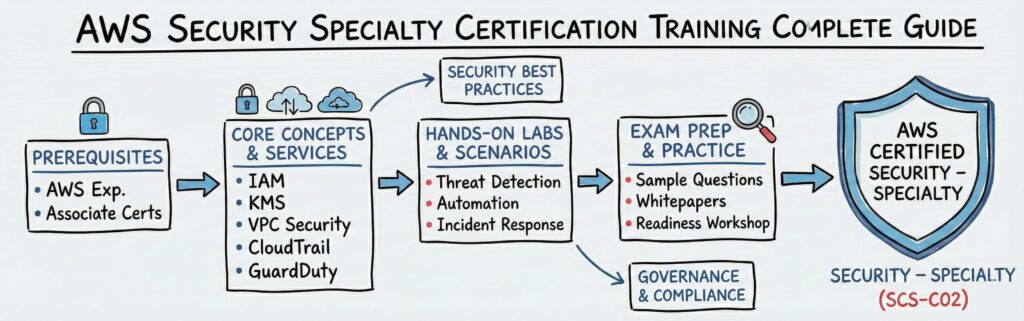
Introduction
In today’s cloud-first world, security is no longer a separate team’s responsibility—it is the foundation of every architectural decision. As organizations face increasingly sophisticated threats, the industry has shifted its focus toward engineers who can prove they possess deep, specialized knowledge in protecting data and infrastructure. The AWS Certified Security – Specialty certification is the definitive benchmark for this expertise, signaling to employers that you can navigate complex threat landscapes and implement defense-in-depth strategies at scale. This guide is designed to cut through the noise. Drawing on decades of industry experience, we move beyond generic exam tips to provide a strategic roadmap. Whether you are looking to pivot into DevSecOps or validate your existing skills, this post covers the essential preparation paths, real-world applications, and career outcomes you need to master the art of AWS security.
What is AWS Certified Security – Specialty?
The AWS Certified Security – Specialty (exam code: SCS-C02, with SCS-C03 released in December 2025) is a specialist-level certification that demonstrates your ability to create and implement comprehensive security solutions in AWS environments. Unlike foundational or associate-level certifications that cover broad AWS concepts, this specialist certification goes deep into threat detection, incident response, data protection, access management, and compliance frameworks specific to securing cloud workloads. It validates that you can not only understand AWS security services but also architect multi-layered security solutions, respond to security events, automate compliance checks, and implement defense-in-depth strategies across complex AWS infrastructures. It’s designed for security engineers, DevSecOps practitioners, and cloud architects who work hands-on with AWS security tools and want to prove their expertise to employers and clients. This certification is respected globally and often required for roles involving sensitive data, regulated industries (healthcare, finance, government), and enterprise-scale cloud migrations. The exam tests your ability to make security decisions under realistic constraints—balancing security requirements with performance, cost, and operational complexity—making it one of the most practical and valuable AWS certifications you can earn.
Who Should Take This Certification?
This certification is ideal for professionals who work directly with AWS security services and need to demonstrate specialized expertise in protecting cloud environments:
- Security Engineers: Responsible for protecting AWS workloads, implementing compliance controls, and responding to security incidents. They will find this certification validates their daily work and opens doors to senior positions by proving they can handle complex threat landscapes.
- DevSecOps Engineers: Those who embed security into CI/CD pipelines, implement infrastructure-as-code security scanning, and automate security testing. They benefit immensely from the deep knowledge of AWS security automation and integration patterns covered in this certification.
- Cloud Security Architects: Professionals designing multi-layer security architectures for enterprise applications, defining security standards, and conducting security reviews. They gain the structured knowledge and AWS best practices needed to architect securely at scale.
- SREs and Platform Engineers: Teams needing to harden infrastructure, implement monitoring and alerting for security events, and maintain secure production environments. This certification complements their reliability focus with essential security skills needed for production readiness.
- Compliance and Audit Professionals: Those working with AWS environments subject to regulatory requirements (HIPAA, PCI-DSS, GDPR, SOC 2). They use this certification to understand technical controls and how to practically implement compliance frameworks in AWS.
- DevOps Engineers: Engineers transitioning into security-focused roles. They discover this certification provides the specialized security knowledge needed to make that career pivot successfully while leveraging their existing AWS and automation experience.
If you already work with AWS security services like IAM, KMS, GuardDuty, Security Hub, CloudTrail, or WAF—and want to formalize and deepen your knowledge—this certification is for you. Even experienced engineers find that preparing for this certification exposes knowledge gaps and teaches advanced security patterns they can immediately apply at work.
Skills You’ll Gain
Earning this certification equips you with a comprehensive security skill set that spans identity, data protection, infrastructure security, threat detection, and incident response:
- Advanced Identity & Access Management: Master designing and implementing IAM policies, roles, permission boundaries, service control policies (SCPs), and federated access patterns. This includes understanding policy evaluation logic, cross-account access, resource-based policies, and implementing least-privilege access at scale.
- Data Encryption Mastery: Gain expertise in implementing data encryption at rest and in transit using AWS KMS, CloudHSM, and certificate management. You’ll understand key rotation, key policies, grant mechanisms, and how to manage the full lifecycle of cryptographic keys.
- Threat Detection & Incident Response: Learn to configure and tune GuardDuty, Security Hub, Detective, and Macie for your specific environment. You will then be able to automate responses using Lambda, EventBridge, and Systems Manager to react to threats in near real-time.
- Secure Network Architecture: Develop the ability to build secure VPCs with proper network segmentation, NACLs, security groups, PrivateLink, VPN, and Direct Connect. You will understand traffic flow, inspection points, and network-based attack prevention.
- Logging & Monitoring: Implement robust logging, monitoring, and auditing with CloudTrail, Config, CloudWatch, and VPC Flow Logs. This ensures you can handle compliance and forensics, including performing complex log analysis with Athena and CloudWatch Insights.
- Forensics & Remediation: Learn proven methodologies for responding to security incidents, isolating compromised resources, preserving forensic artifacts, and conducting post-incident analysis. You will know how to effectively contain breaches without destroying evidence.
- Compute & Application Security: Secure compute workloads (EC2, Lambda, ECS, EKS) and application layers (API Gateway, WAF, Shield) with appropriate controls. This includes implementing compliance frameworks and understanding the AWS shared responsibility model.
Real-World Projects You Should Be Able to Do After This
After earning the certification, you should confidently handle complex security engineering projects that directly impact your organization’s security posture:
- Multi-Account Security Strategy: Build a strategy using AWS Organizations, service control policies (SCPs), Control Tower, and Security Hub aggregation across dozens or hundreds of accounts. This ensures consistent security baselines across the entire organization.
- Centralized SIEM Pipeline: Implement centralized logging pipelines using CloudTrail, Config, VPC Flow Logs, and integration with third-party security tools (Splunk, Sumo Logic, Datadog). This allows you to lead projects from design to deployment for organization-wide visibility.
- Automated Incident Response: Design and deploy workflows with Lambda, EventBridge, and Systems Manager that can detect, contain, and remediate security events within minutes. This reduces reliance on manual intervention and speeds up reaction times.
- Hardened Compute & Containers: Harden EC2 AMIs and container images using EC2 Image Builder, vulnerability scanning tools, and secure build pipelines. This ensures your compute resources are secure by default before they ever reach production.
- Comprehensive Data Protection: Set up protection for S3 buckets with encryption, bucket policies, MFA delete, Object Lock, versioning, and cross-region replication. This protects your organization’s most valuable asset—its data—from deletion or theft.
- Least-Privilege Implementation: Confidently configure complex IAM roles, service control policies, permission boundaries, and session policies. You will be able to implement least-privilege access across applications and teams without blocking legitimate work.
- DDoS & Web Protection: Implement AWS WAF rules to block OWASP Top 10 attacks, rate limiting, geo-blocking, and DDoS mitigation with Shield Advanced. This protects your public-facing applications from both common and sophisticated attacks.
- Forensic Investigation: Conduct investigations using VPC Flow Logs, CloudWatch Logs Insights, Amazon Detective, and EC2 memory dumps. This enables you to understand exactly what happened during security incidents and prevents recurrence.
- DevSecOps Pipeline Integration: Secure CI/CD pipelines with CodeGuru Security, Secrets Manager, pipeline vulnerability scanning, and infrastructure-as-code security validation. This implements true DevSecOps practices, shifting security left.
Exam Details and Structure
The AWS Certified Security – Specialty exam (SCS-C02, with SCS-C03 available since December 2025) consists of 65 multiple-choice and multiple-response questions that you must complete within 170 minutes. The exam format challenges you with realistic scenarios where you must choose the best security solution from several plausible options, testing not just your knowledge but your judgment and decision-making under security constraints. Questions frequently present complex multi-service scenarios where you must understand how different AWS security services work together to create comprehensive solutions.
The passing score is 750 out of 1000 on a scaled scoring system, meaning the difficulty of questions varies and harder questions carry more weight. The exam costs $300 USD and is available in English, Japanese, Korean, and Simplified Chinese, with an additional 30 minutes available for non-native English speakers through the ESL accommodation. While there are no formal prerequisites, AWS recommends at least 2 years of hands-on experience securing AWS workloads and 5 years of general IT security experience. The certification remains valid for 3 years, after which you must recertify by retaking the exam or earning a higher-level AWS certification. You can take the exam at any Pearson VUE test center worldwide or online via remote proctoring from your home or office.
Exam Domains (SCS-C02)
The exam is divided into five domains that reflect the key responsibilities of AWS security professionals. Understanding the weight of each domain helps you allocate your study time effectively and focus on areas that matter most.
1. Threat Detection and Incident Response (14%)
This domain tests your ability to design and implement incident response plans, analyze security events from multiple sources, capture and preserve forensic data, and automate security alerting and response workflows. You’ll need to demonstrate proficiency with GuardDuty for threat detection, Detective for investigation, Security Hub for aggregation, and EventBridge/Lambda for automated response. Questions often present security incidents and ask you to identify the best investigation approach, data sources to examine, containment strategies, and post-incident improvements to prevent recurrence.
2. Security Logging and Monitoring (18%)
This domain focuses on implementing comprehensive logging with CloudTrail (API activity), Config (configuration changes), CloudWatch (metrics and logs), and VPC Flow Logs (network traffic). You must know how to centralize logs across accounts, analyze logs using Athena and CloudWatch Logs Insights, set up meaningful alerts, implement log retention and lifecycle policies, and protect log integrity. Questions test your understanding of what each logging service captures, how to query logs for security investigations, and how to detect anomalous patterns that might indicate security issues.
3. Infrastructure Security (20%)
This domain covers designing secure VPCs with proper network segmentation, implementing Network ACLs and security groups, deploying edge security with CloudFront and AWS WAF, and establishing secure remote access through VPN and Direct Connect. You need to understand network traffic flow, how to implement network inspection using Gateway Load Balancer and third-party appliances, host-based firewalls, and securing compute resources (EC2, ECS, EKS, Lambda). Questions often present network architectures and ask you to identify security weaknesses, implement segmentation, or choose appropriate controls for specific threat scenarios.
4. Identity and Access Management (22%)
As the largest single domain, this tests your deep knowledge of IAM policies, roles, resource-based policies, permission boundaries, service control policies (SCPs), and federated access patterns. You must understand policy evaluation logic, how different policy types interact, troubleshooting access denied issues, implementing least-privilege access, and managing credentials securely. Questions present complex access scenarios involving multiple accounts, services, and policy types, requiring you to determine the effective permissions and choose the most secure access pattern while maintaining operational flexibility.
5. Data Protection (26%)
The heaviest-weighted domain focuses on encrypting data at rest using KMS, CloudHSM, and S3 encryption options; encrypting data in transit using TLS/SSL and VPNs; managing KMS keys and policies; implementing S3 security with bucket policies, ACLs, Object Lock, and versioning; and classifying sensitive data using Macie. You need to understand key rotation, cross-region key usage, grant mechanisms, and envelope encryption. Questions test your ability to choose appropriate encryption methods for different data types, implement proper key management practices, secure data throughout its lifecycle, and meet compliance requirements like FIPS 140-2.
Preparation Plan
7–14 Day Plan (Crash Mode)
- Day 1–2: Review AWS security whitepapers including AWS Security Best Practices, the Well-Architected Security Pillar, and the AWS Security Incident Response Guide to ensure your practical knowledge aligns with AWS recommended practices.
- Day 3–4: Deep-dive the core services you use most—IAM policies and policy evaluation, KMS key policies and grants, CloudTrail event analysis, Config rule creation, GuardDuty findings, and Security Hub standards—filling any knowledge gaps in advanced features you haven’t used.
- Day 5–6: Focus on VPC security architecture including PrivateLink, Network Firewall, WAF rule creation, Shield Advanced protections, and network segmentation patterns for multi-tier applications.
- Day 7–9: Practice incident response scenarios using Detective for investigation, automate containment with Lambda and Systems Manager, analyze Macie findings, and practice forensic data collection and analysis workflows.
- Day 10–12: Take 3–4 full-length practice exams under timed conditions, review every incorrect answer in detail, and revisit the documentation for services where you’re weak.
- Day 13–14: Conduct final revision focusing on your weakest domains, review key service FAQs, practice IAM policy evaluation, and ensure you understand the subtle differences between similar security approaches.
30-Day Plan (Standard)
- Week 1: Complete a comprehensive AWS security foundations course covering IAM in depth, encryption concepts, KMS fundamentals, CloudTrail and Config basics, and the AWS shared responsibility model; simultaneously build hands-on lab experience with each service.
- Week 2: Dedicate this week to hands-on labs focusing on CloudTrail log analysis with Athena, Config rule creation and remediation, GuardDuty setup and tuning, Security Hub standard implementation, and Macie data classification.
- Week 3: Focus on network and infrastructure security by designing and implementing secure VPC architectures, creating sophisticated WAF rules that block real attacks, configuring Shield Advanced, implementing automated incident response with Lambda, and securing container workloads in ECS and EKS.
- Week 4: Take your first practice exam early in the week to identify weak areas, then spend targeted time revisiting those domains through AWS documentation and hands-on practice, complete 3–4 additional practice exams, and thoroughly review all incorrect answers.
60-Day Plan (Thorough)
- Week 1–2: Complete the AWS Security Fundamentals digital training course, then dive deep into IAM by creating users, groups, roles, and policies in a lab environment; practice with KMS by encrypting data in S3, EBS, and RDS.
- Week 3–4: Build secure VPC architectures from scratch including public and private subnets, NAT gateways, internet gateways, Network ACLs, security groups, VPC Flow Logs, and VPC endpoints; practice implementing network segmentation.
- Week 5–6: Implement comprehensive logging and monitoring by setting up CloudTrail organization trails, Config aggregators, CloudWatch dashboards, and log analysis pipelines; create CloudWatch alarms for security events.
- Week 7–8: Learn threat detection and response by deploying GuardDuty, investigating findings with Detective, aggregating security data in Security Hub, implementing automated response workflows with EventBridge and Lambda, and running through simulated security scenarios.
- Week 9–10: Take practice exams starting in week 9 to gauge readiness, identify your weakest domains, and use the final two weeks for targeted study using AWS whitepapers, FAQs, and additional hands-on labs in weak areas.
Common Mistakes to Avoid
Learning from others’ mistakes accelerates your preparation. Here are the most common pitfalls candidates encounter:
- Skipping Hands-on Labs: Relying only on theory is the biggest mistake. This is fundamentally a practical exam that tests your ability to implement security solutions, not just memorize service features. You must build things to pass.
- Ignoring IAM Logic: Many candidates fail by not deeply understanding IAM policy syntax, policy evaluation logic, and permission boundaries. These concepts are heavily tested in scenarios involving multiple accounts and federated access.
- Overlooking Logging & Monitoring: Candidates frequently overlook services like CloudTrail, Config, and VPC Flow Logs, viewing them as boring. However, these services appear constantly in incident response, compliance, and troubleshooting scenarios.
- Underestimating KMS Depth: Failing to understand key policies, grants, envelope encryption, and cross-region key usage causes problems on the substantial data protection portion of the exam. You need to know exactly how KMS works.
- Neglecting Incident Response: Not practicing incident response scenarios and forensic workflows leaves you unprepared for questions asking you to investigate events, preserve evidence, and conduct post-incident analysis.
- Ignoring Whitepapers: Failing to read AWS security whitepapers means you miss the recommended approaches that AWS expects in exam answers. Even if an alternative works technically, the AWS best practice is the correct answer.
- Rushing Practice Reviews: Rushing through practice exams without thoroughly reviewing incorrect answers wastes valuable learning opportunities. You must understand why the wrong answers are wrong to learn the decision-making framework.
Best Next Certification After AWS Certified Security – Specialty
Once you’ve earned this certification, your next step should align with your career direction:
Same Track (Security Deepening)
- Certified Ethical Hacker (CEH) / OSCP: Adds offensive security skills that complement your defensive AWS knowledge. Understanding how attackers think makes you a better defender.
- CISSP: Provides broader enterprise security leadership, governance, risk management, and compliance knowledge. This positions you for security architect and management roles.
Cross-Track (Cloud and DevOps Skills)
- AWS Certified DevOps Engineer – Professional: Helps you integrate security into CI/CD pipelines at scale. You will learn to implement infrastructure-as-code with security validation and build automated deployment pipelines.
- AWS Certified Solutions Architect – Professional: Provides holistic cloud architecture design skills. This helps you balance security requirements with performance, cost, and operational concerns in complex multi-service architectures.
- Certified Kubernetes Security Specialist (CKS): Adds container and Kubernetes-specific security expertise. This is increasingly valuable as organizations containerize workloads and need to secure Kubernetes clusters.
Leadership and Governance
- AWS Certified Advanced Networking – Specialty: Provides deep network-level security knowledge including advanced VPC designs. This is essential for designing reliable, secure, high-performance architectures.
- Certified Information Security Manager (CISM): Focuses on security governance, risk management, and incident management programs. This is ideal for moving into security leadership roles.
- FinOps Certified Practitioner: Helps you understand cost implications of security controls like KMS encryption and GuardDuty. This enables you to balance security requirements with cloud cost optimization—a critical skill for senior roles.
Choose Your Path: Where Does This Certification Fit?
1. DevOps Path
Start with AWS Certified Solutions Architect – Associate to build foundational AWS knowledge across compute, storage, networking, and databases. Then earn AWS Certified Security – Specialty to add the security expertise DevOps engineers increasingly need for securing infrastructure-as-code and pipelines. Finally, complete AWS Certified DevOps Engineer – Professional to master advanced automation.
2. DevSecOps Path
Begin directly with AWS Certified Security – Specialty to build deep security foundations. Then progress to AWS Certified DevOps Engineer – Professional to understand CI/CD, automation, and deployment pipelines where you’ll embed security controls. Culminate with Certified Kubernetes Security Specialist (CKS) to secure containerized workloads and cloud-native applications.
3. SRE Path
Follow AWS Certified SysOps Administrator – Associate to gain operational expertise in monitoring, automation, and incident management. Then earn AWS Certified Security – Specialty because SREs must secure production infrastructure and respond to security incidents. Finally, add AWS Certified Advanced Networking – Specialty for deep networking knowledge essential for designing reliable, secure architectures.
4. AIOps/MLOps Path
Combine AWS Certified Machine Learning – Specialty with AWS Certified Security – Specialty. Securing ML pipelines, data lakes, training data, and model endpoints requires specialized security knowledge that standard ML training rarely covers. This combination is increasingly valuable as organizations deploy production ML systems.
5. DataOps Path
Start with AWS Certified Security – Specialty to deeply understand data encryption, access control, and compliance requirements. Then progress to AWS Certified Data Analytics – Specialty to master data lake architecture and analytics services. Data engineers must encrypt data and manage fine-grained access control to sensitive datasets.
6. FinOps Path
Progress from AWS Certified Cloud Practitioner for cloud fundamentals to AWS Certified Security – Specialty to understand security service costs. Then take FinOps Certified Practitioner for cloud financial management. Understanding security costs—like KMS per-request charges and GuardDuty volume pricing—is essential for balancing security with cost optimization.
Role → Recommended Certifications Mapping
| Role | Recommended Certifications | Rationale |
|---|---|---|
| DevOps Engineer | AWS Solutions Architect Associate → AWS Security Specialty → AWS DevOps Professional | Build foundational AWS knowledge, add critical security skills, then master automation and CI/CD with security embedded |
| SRE | AWS SysOps Administrator Associate → AWS Security Specialty → AWS Advanced Networking Specialty | Start with operational excellence, add security for production systems, deepen with networking for reliable architectures |
| Platform Engineer | AWS Security Specialty → AWS DevOps Professional → Kubernetes CKA/CKS | Security-first platform design, DevOps automation, container orchestration and security for modern platforms |
| Cloud Engineer | AWS Solutions Architect Associate → AWS Security Specialty → AWS Solutions Architect Professional | Foundational architecture, security specialization, advanced multi-service architecture design at enterprise scale |
| Security Engineer | AWS Security Specialty → CISSP → CEH or OSCP | Deep AWS security, enterprise security governance, offensive security to understand attack perspectives |
| Data Engineer | AWS Security Specialty → AWS Data Analytics Specialty → AWS Machine Learning Specialty | Security fundamentals for data, analytics architecture, ML engineering with security-aware design |
| FinOps Practitioner | AWS Cloud Practitioner → AWS Security Specialty → FinOps Certified Practitioner | Cloud fundamentals, security service costs and optimization, financial management and cost allocation |
| Engineering Manager | AWS Security Specialty → AWS Solutions Architect Professional → TOGAF or PMP | Technical security credibility, architecture leadership, enterprise architecture or project management frameworks |
Certification Summary Table
Top Institutions for AWS Certified Security – Specialty Training and Certification
DevOpsSchool
DevOpsSchool offers comprehensive instructor-led training for AWS Certified Security – Specialty with extensive hands-on labs, real-world security projects, and exam-focused practice tests designed to mirror actual exam scenarios. Their curriculum is designed by industry practitioners with deep AWS security experience and covers all exam domains in depth with practical examples from production environments. They provide flexible learning options including live online sessions, recorded content for review, weekend batches for working professionals, and dedicated doubt-clearing sessions.
Cotocus
Cotocus specializes in corporate training and individual certification programs for AWS Security with personalized learning paths based on your current skill level and career goals. Their courses include scenario-based learning that simulates real security challenges, live AWS environment access for hands-on practice, project-based assignments, and personalized mentoring from AWS-certified instructors. They focus on practical security implementation alongside exam preparation, ensuring you can both pass the certification and apply your knowledge to secure real AWS environments.
Scmgalaxy
Scmgalaxy delivers end-to-end AWS security training with a strong focus on DevSecOps integration, showing how to embed security into existing DevOps workflows without slowing down development velocity. Their programs include CI/CD security automation, infrastructure-as-code security validation with tools like Checkov and tfsec, automated compliance workflows, and container security for ECS and EKS. They offer boot camps for intensive preparation, flexible weekend batches, hands-on labs with real AWS accounts, and lifetime access to course materials.
BestDevOps
BestDevOps provides domain-expert-led AWS Certified Security – Specialty training with real-time projects, case studies from actual security incidents, and comprehensive coverage of all exam domains. Their approach combines foundational security concepts with advanced AWS service configurations, ensuring you understand not just how to configure services but why certain security patterns are recommended. They offer lifetime access to course materials, dedicated doubt-clearing sessions, interview preparation for security engineering roles, and resume building guidance.
devsecopsschool
Specializing in DevSecOps, devsecopsschool delivers AWS security training integrated with shift-left security practices, CI/CD pipeline security, container security, and security automation throughout the software development lifecycle. Their courses are ideal for DevOps engineers transitioning into security roles, showing exactly how to embed security gates, automated testing, vulnerability scanning, and compliance checks into existing pipelines. They emphasize practical automation using Python, Lambda, and infrastructure-as-code tools.
sreschool
sreschool focuses on SRE and cloud reliability with strong emphasis on security monitoring, incident response, observability, and maintaining security while maximizing availability and performance. Their AWS security courses are specifically tailored for SREs managing production workloads, covering topics like security incident detection without false positives, security automation that doesn’t impact reliability, forensic data collection without service disruption, and implementing defense-in-depth in highly available architectures.
aiopsschool
aiopsschool offers AI-driven operations training with specialized modules on AWS security automation, anomaly detection using machine learning, intelligent threat response, and predictive security analytics. Their programs are suited for engineers working at the intersection of AI and cloud security, showing how to leverage AWS ML services for security use cases like automated log analysis, behavior-based threat detection, and intelligent security orchestration. They cover GuardDuty’s ML-based threat detection and automating Security Hub responses.
dataopsschool
dataopsschool provides AWS security training specifically for data engineers, focusing on data encryption strategies, fine-grained access control with Lake Formation, Macie for sensitive data classification, data masking and tokenization, and compliance with data privacy regulations like GDPR and CCPA. Their curriculum addresses the unique security challenges of data lakes, analytics pipelines, and big data processing where traditional perimeter security is insufficient. They teach practical patterns for encrypting petabyte-scale data and auditing data access.
finopsschool
finopsschool covers AWS security cost optimization, helping FinOps practitioners understand the financial impact of security services like continuous GuardDuty monitoring, KMS per-request charges, WAF rule evaluation costs, and data transfer costs for encryption. Their training shows how to balance security requirements with cost efficiency without creating security gaps, implement cost-effective security architectures, rightsize security controls based on risk assessment, and make data-driven decisions about security investments.
FAQs on AWS Certified Security – Specialty
1. Is AWS Certified Security – Specialty difficult?
Yes, it’s considered one of the more challenging AWS certifications because it tests deep, hands-on knowledge of security services, requires understanding how multiple services work together, and presents complex scenarios where you must choose the best security approach from several plausible options. The questions are not simple recall of service features but realistic security challenges requiring judgment, trade-off analysis, and decision-making under constraints.
2. How long does it take to prepare?
For someone with 2+ years of hands-on AWS security experience who already works with security services daily, 30–45 days of focused study with hands-on labs is typical and sufficient. If you have general AWS experience but limited security-specific knowledge, plan for 60–90 days with substantial hands-on practice building secure architectures. Complete beginners to AWS should first earn an associate-level certification then spend 60–90 days on security-specific preparation.
3. What are the prerequisites?
There are no formal prerequisites or required prior certifications—you can technically take this as your first AWS certification. However, AWS strongly recommends at least 2 years of hands-on experience securing AWS workloads and 5 years of general IT security experience. In practice, most successful candidates first earn AWS Solutions Architect Associate or AWS SysOps Administrator Associate to build foundational AWS knowledge.
4. Can I take this as my first AWS certification?
Technically yes—there are no prerequisites—but it’s not recommended unless you have extensive hands-on AWS security experience from your job. Most candidates first earn AWS Certified Solutions Architect – Associate or AWS Certified SysOps Administrator – Associate to build foundational AWS knowledge before specializing. The Security Specialty exam assumes you’re already comfortable with AWS services and focuses on security-specific knowledge layered on top of that foundation.
5. What’s the difference between SCS-C02 and SCS-C03?
SCS-C03 (released December 2025) includes updated content reflecting the latest AWS security services and best practices, with new coverage of generative AI security, enhanced container security content for Amazon ECS and EKS, advanced incident response automation patterns, and updated exam questions reflecting current service features. The core domains and percentages remain similar, but SCS-C03 reflects the evolution of cloud security practices.
6. Do I need to know programming for this exam?
Basic scripting knowledge in Python or Bash is helpful for understanding Lambda-based automation, EventBridge response workflows, and CloudWatch Logs Insights queries, but you won’t write full programs during the exam. The exam may present Lambda code snippets or policy documents and ask you to evaluate them, but it tests your understanding of security logic and service integration rather than programming ability.
7. How much does the exam cost?
The AWS Certified Security – Specialty exam costs $300 USD globally. This fee includes one exam attempt, a detailed score report showing your performance by domain, and a digital badge upon passing. If you fail, you must pay the full fee again after the 14-day waiting period, so thorough preparation is a worthwhile investment.
8. Is this certification worth it for career growth?
Absolutely. Cloud security specialists are in exceptionally high demand worldwide, and this certification demonstrates specialized expertise that differentiates you from generalist cloud engineers in a crowded market. Many organizations now require this certification for senior security engineering, DevSecOps, and cloud security architect roles, making it effectively mandatory for career progression in those tracks.
Testimonials
“The AWS Certified Security – Specialty certification completely transformed my career trajectory. I moved from a generalist DevOps role to a senior DevSecOps engineer position at a fintech company with a 35% salary increase. The hands-on knowledge of GuardDuty, Security Hub, and IAM policy design is something I use literally every single day.”
— Rajesh K., DevSecOps Engineer, Bangalore
“I was genuinely nervous about the depth of this exam because I’d heard it was one of the hardest AWS certifications. The structured training from DevOpsSchool with their real-world incident response labs made all the difference—they didn’t just teach me to pass the exam, they taught me to actually respond to security incidents confidently.”
— Priya S., Cloud Security Architect, Pune
“As an SRE, I thought I knew AWS pretty well after managing production systems for three years. This certification completely exposed gaps in my security knowledge—especially around KMS key policies and forensic investigation techniques. It’s made me a fundamentally better engineer who considers security implications in every design decision.”
— Amit M., Site Reliability Engineer, Hyderabad
Conclusion
The AWS Certified Security – Specialty certification represents far more than a credential to list on your resume—it’s tangible proof that you possess the specialized knowledge, practical skills, and security judgment required to design, implement, and manage secure, compliant cloud environments at enterprise scale. In an era where cloud security breaches make headlines regularly and organizations face increasingly sophisticated threats, security-focused engineers who can architect defense-in-depth strategies, automate threat response, and balance security requirements with business needs are not just valuable—they’re absolutely critical to business success. Security isn’t a checkbox you complete once during deployment—it’s a mindset you adopt, a practice you refine continuously, and an ongoing commitment to protecting your organization’s most valuable assets from evolving threats. This certification pushes you to think like an attacker anticipating vulnerabilities, defend like an architect building multi-layered protection, and respond like an incident commander making high-pressure decisions with incomplete information. The investment in preparation—whether 30, 60, or 90 days of focused study—pays dividends not just on exam day when you pass, but every single day afterward when you secure production workloads and respond effectively to security events.