Introduction
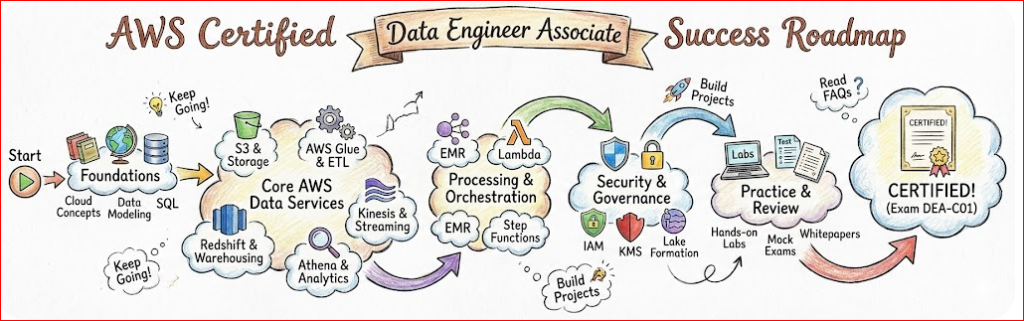
Data is not useful unless it is clean, trusted, and easy to use. In most companies, teams lose time because data arrives late, pipelines fail silently, or the same dataset has different meanings in different dashboards. That is why data engineering matters. A strong data engineer builds reliable pipelines, chooses the right storage, protects sensitive data, and keeps everything observable so teams can trust what they see. The AWS Certified Data Engineer – Associate certification is designed to validate these real job skills on AWS. It is a practical credential for engineers and managers who want confidence that they can design and run data pipelines on AWS in a production-like way.
Certification snapshot
This certification is an AWS Associate-level exam called DEA-C01.
Key exam facts (high level):
- Exam code: DEA-C01.
- Format: Multiple choice and multiple response.
- Length: 130 minutes.
- Number of questions: 65.
- Cost: USD 150.
Certification table
| Certification | Track | Level | Who it’s for | Prerequisites | Skills covered | Recommended order |
|---|---|---|---|---|---|---|
| AWS Certified Data Engineer – Associate | Data / Analytics | Associate | Data Engineers, Software Engineers, Cloud Engineers | AWS + data pipeline basics; hands-on practice recommended | Ingestion, transformation, storage, operations, security & governance | Cloud basics → AWS fundamentals → This certification |
What it is
AWS Certified Data Engineer – Associate validates your ability to build, operate, and secure data pipelines on AWS.
It focuses on end-to-end data work: ingestion (batch + streaming), transformation (ETL/ELT), storage choices, monitoring, and governance.
Who should take it
This certification is a good fit if you are:
- A Data Engineer working on data lakes, ETL, streaming, and warehouses on AWS.
- A Software Engineer who wants to move into data engineering and needs proof of cloud data skills.
- A Cloud/Platform Engineer supporting data platforms and wanting deeper knowledge of AWS data services and operations.
- An Engineering Manager who leads data teams and wants to assess designs and risks with more clarity.
You should skip it (for now) if you have never used AWS at all. Build basic AWS foundations first, then come back to this exam.
Skills you’ll gain
After preparing properly, you will be able to:
- Design batch ingestion using AWS-native patterns (files, CDC, scheduled loads).
- Design streaming ingestion patterns and know when real-time is truly needed.
- Build transformations using managed AWS data tools and understand trade-offs.
- Choose the right data store for a given workload (lake, warehouse, NoSQL, search).
- Operate pipelines: retries, alerts, monitoring, and failure handling.
- Apply data security and governance: least privilege access, encryption, and controlled sharing.
Real-world projects you should be able to do after it
Think of the certification as proof you can deliver projects like these:
- Build a simple data lake on Amazon S3, catalog it, and query it for analytics.
- Create an automated ETL pipeline with scheduling, incremental loads, and error notifications.
- Implement near real-time ingestion using a streaming approach for events and logs.
- Build a warehouse-style analytics flow where curated data feeds dashboards and ad-hoc queries.
- Apply data security controls so different teams see only what they should (governance first).
- Add operational monitoring so failures are visible and recoverable, not hidden.
Exam domains (what to focus on)
AWS organizes the exam into four domains with these weights.
- Data Ingestion and Transformation (34%).
- Data Store Management (26%).
- Data Operations and Support (22%).
- Data Security and Governance (18%).
Domain 1: Ingestion and transformation (34%)
This is the biggest part of the exam.
You must be comfortable with questions like:
- “We ingest daily batches + occasional backfills. What is the simplest, most reliable design?”
- “We need streaming events with ordering and scaling. How should we ingest and land them?”
- “We need to transform raw data into curated layers. Where should the logic run and how do we trigger it?”
What to practice:
- Build one batch pipeline and one streaming pipeline end-to-end.
- Practice incremental processing and idempotent writes (so re-runs do not corrupt data).
- Learn how to handle schema changes in a controlled way.
Domain 2: Data store management (26%)
This domain tests if you can pick and manage the right storage.
Expect scenarios around:
- Data lake vs warehouse decisions.
- Partitioning strategies, file formats, and performance trade-offs.
- Cataloging and discoverability so teams can actually find datasets.
What to practice:
- A basic lake layout (raw/clean/curated).
- How you would organize partitions for cost + speed.
- How you would support both BI queries and data science exploration.
Domain 3: Data operations and support (22%)
This is the “production reality” domain.
It covers:
- Observability: metrics, logs, alerts.
- Failure patterns: retries, dead-letter patterns, fallback approaches.
- Operational runbooks: how to respond when a pipeline breaks.
What to practice:
- Add monitoring to your pipelines.
- Create alert rules for lag, errors, and unexpected drops in data volume.
- Practice debugging a pipeline failure with logs and metrics.
Domain 4: Data security and governance (18%)
Many candidates under-prepare here because it feels “policy heavy”. But it is very practical in real teams.
It covers:
- Least-privilege access and safe sharing.
- Encryption at rest and in transit.
- Auditability and traceability for compliance.
What to practice:
- A clean permission model for producers vs consumers.
- Encryption basics and access logging.
- A simple governance story: who can read what, and why.
Preparation plan (7–14 / 30 / 60 days)
Below are three plans. Pick one based on your current AWS comfort.
7–14 days (Fast track)
Choose this only if you already work with AWS data pipelines.
Day-by-day approach:
- Days 1–2: Read the exam guide and list every service and concept you do not use daily.
- Days 3–6: Hands-on labs focused on Domain 1 (the highest weight). Build one batch and one streaming pipeline.
- Days 7–9: Hands-on focus for Domain 2 and Domain 4 (storage + governance).
- Days 10–12: Practice exams + deep review of wrong answers, not just scores.
- Days 13–14: Final revision using your notes: “When to use what” and “common traps”.
30 days (Standard plan for working professionals)
This is the best plan for most working engineers.
Week 1 (Domain 1):
- Learn ingestion patterns (batch vs streaming).
- Build one ETL pipeline and document decisions (why this service, why this format).
Week 2 (Domain 2):
- Focus on storage decisions, partitioning, and performance basics.
- Build a small lake and run queries against it.
Week 3 (Domain 3 + Domain 4):
Week 4 (Exam readiness):
- Take multiple practice exams.
- Turn every mistake into a short rule (example: “If the question says near real-time + managed ingestion, consider streaming ingestion first”).
60 days (Deep learning plan)
Use this if you are new to AWS data services or you want strong confidence.
Month 1:
- Focus on fundamentals: core AWS, IAM basics, and why each data service exists.
- Do guided labs weekly and take notes on trade-offs.
Month 2:
- Build 2–3 mini projects (lake, streaming, warehouse-style reporting).
- Start practice exams, then go back to labs for weak areas.
- In the final two weeks, revise using diagrams and service selection rules.
Common mistakes
Avoid these mistakes because they are common and costly:
- Studying services by name instead of learning “when to use what” through scenarios.
- Skipping hands-on work and relying only on reading (the exam is scenario-driven).
- Ignoring governance and security until the last week.
- Not learning operational patterns (monitoring, retry logic, pipeline failure handling).
- Spending too little time on Domain 1 even though it has the highest weight.
Choose your path (6 learning paths)
Use this section to place the certification into a bigger career plan.
1) DevOps path
If your work is CI/CD + infra + platform support, data pipelines become another production system you operate. Add data engineering skills so you can build reliable ingestion and reporting pipelines that do not break in production.
Suggested sequence:
- Cloud fundamentals → AWS architecture basics → AWS Certified Data Engineer – Associate
2) DevSecOps path
If you work on compliance, security reviews, or secure platforms, this certification helps you secure data movement and access.
Suggested sequence:
- Cloud fundamentals → Security fundamentals → AWS Certified Data Engineer – Associate (with deep focus on governance)
3) SRE path
SREs are expected to improve reliability. Data pipelines need SLO thinking too: freshness, completeness, and failure recovery.
Suggested sequence:
- AWS fundamentals → Observability and reliability patterns → AWS Certified Data Engineer – Associate
4) AIOps / MLOps path
ML systems fail when data is weak. If you want to work in MLOps, strong data engineering is a must.
Suggested sequence:
- AWS Certified Data Engineer – Associate → MLOps concepts → ML-focused work (pipelines + features + monitoring)
5) DataOps path
DataOps is about making data pipelines repeatable, testable, and fast to change.
Suggested sequence:
- AWS Certified Data Engineer – Associate → Data quality + orchestration mindset → advanced automation
6) FinOps path
Data platforms can become expensive due to storage growth and inefficient queries. FinOps-minded engineers design for cost control.
Suggested sequence:
- AWS fundamentals → cost basics → AWS Certified Data Engineer – Associate (cost-aware storage, processing, and query patterns)
Role → Recommended Certifications Mapping
| Role | Primary Certification | Next Step | Advanced / Leadership |
|---|---|---|---|
| DevOps Engineer | AWS Cloud Practitioner → AWS Solutions Architect Associate | AWS Certified Data Engineer – Associate | AWS DevOps Engineer Professional |
| SRE (Site Reliability Engineer) | AWS Solutions Architect Associate | AWS Certified Data Engineer – Associate | AWS DevOps Engineer Professional |
| Platform Engineer | AWS Cloud Practitioner → AWS Solutions Architect Associate | AWS Certified Data Engineer – Associate | AWS Certified Machine Learning Specialty |
| Cloud Engineer | AWS Cloud Practitioner → AWS Solutions Architect Associate | AWS Certified Data Engineer – Associate | AWS Solutions Architect Professional |
| Security Engineer | AWS Security Specialty | AWS Certified Data Engineer – Associate (Domain 4 focus) | AWS Solutions Architect Professional |
| Data Engineer | AWS Certified Data Engineer – Associate (Core / Start here) | AWS Certified Machine Learning Specialty | AWS Solutions Architect Professional |
| FinOps Practitioner | AWS Cloud Practitioner → FinOps Certified Practitioner | AWS Certified Data Engineer – Associate | AWS Solutions Architect Professional |
| Engineering Manager | AWS Solutions Architect Associate | AWS Certified Data Engineer – Associate | AWS DevOps Engineer Professional |
Best next certification after this
You asked for “best next certification”, and also “next certifications to take (3 options)”. Here are the three clean options.
Option 1: Same track (go deeper)
Pick an advanced data/ML direction if you want to work closer to AI, forecasting, and model-driven systems.
Option 2: Cross-track (go broader)
Pick a broader architecture certification if you want to design full systems, not only data pipelines.
Option 3: Leadership (move up)
Pick a professional-level certification that strengthens delivery, operations, and cross-team ownership (great for tech leads and managers).
Top institutions for training
DevOpsSchool
DevOpsSchool provides structured training aligned with the AWS Certified Data Engineer – Associate goal, with hands-on learning focus and guidance designed for working professionals. Their programs are typically practical and oriented toward real pipeline work, not only theory.
Cotocus
Cotocus is known for industry-focused training programs and can be a good fit if you want guided learning with real project thinking. It is especially useful if you prefer instructor-led structure over self-study.
Scmgalaxy
Scmgalaxy supports cloud and DevOps learning paths and often works well for learners who want step-by-step coverage plus practice. It can be useful if you want consistent weekly learning momentum.
BestDevOps
BestDevOps is typically chosen by learners who prefer bootcamp-style preparation with a practical angle. If your goal is to move fast and build confidence through projects, this style can help.
devsecopsschool
devsecopsschool is a good fit if you want a stronger security mindset along with cloud and data skills. It supports learners working in compliance-heavy or security-first environments.
sreschool
sreschool is a good option if you care about reliability, monitoring, and production-grade operations. Data pipelines are production systems, and this mindset helps you in Domain 3.
aiopsschool
aiopsschool can be helpful if your long-term plan includes AIOps/MLOps and automation. Data engineering is a foundation layer for many AI operations workflows.
dataopsschool
dataopsschool fits learners who want DataOps discipline: repeatable pipelines, data quality, and automation habits. This aligns strongly with the “operations + support” part of the exam.
finopsschool
finopsschool is useful if you want to link technical choices to cost outcomes. This matters in real life because storage and queries can silently become expensive at scale.
FAQs
1) Is the AWS Certified Data Engineer – Associate exam hard?
It is moderate if you have hands-on AWS exposure, and difficult if you only study theory. The exam is scenario-based and expects practical decision-making.
2) How long is the exam?
3) How many questions are there?
4) What question types are included?
It includes multiple-choice and multiple-response questions.
5) What is the exam code?
6) What is the exam fee?
7) What background do I need?
AWS recommends real data engineering experience plus hands-on AWS practice. You do not need a formal degree, but you do need practical skills.
8) Can a software engineer switch to data engineering using this certification?
Yes, if you combine it with hands-on projects. Use the certification as proof, and use projects as evidence in interviews.
9) Is it useful for managers?
Yes. It helps managers review architecture decisions, ask better questions, and estimate effort and risk more accurately.
10) What should I study the most?
Spend the most time on Data Ingestion and Transformation because it has the highest exam weight.
11) What is the biggest reason people fail?
Lack of hands-on practice and weak service selection judgment. The exam rewards correct choices in realistic scenarios.
12) Do I need to take another AWS certification before this?
It is not mandatory, but many engineers benefit from building AWS fundamentals first. This makes the data engineering topics easier to learn.
FAQs
Q1. Is this certification good for India + global jobs?
Yes. AWS certifications are recognized globally, and data engineering demand is strong across regions.
Q2. Is it only for Data Engineers?
No. It also fits cloud engineers, software engineers, and platform teams working around data workloads.
Q3. What is the fastest safe prep plan?
If you already work on AWS data pipelines, the 7–14 day plan can work.
Q4. What is the safest prep plan for a busy professional?
30 days with steady daily practice is the most practical approach for most working engineers.
Q5. Which domain is most ignored?
Security and governance is often under-prepared, even though it appears in real work and in the exam.
Q6. Will practice tests alone be enough?
No. Use practice tests to find weak areas, then fix them with hands-on labs.
Q7. How should I present this on a resume?
Add the certification plus 2–3 short bullet projects (lake, streaming, warehouse-style pipeline) to show proof of skill.
Q8. What should I do right after passing?
Immediately build one portfolio-quality project and write a short case study. This turns your certification into interview-ready proof.
Conclusion
The role of a Data Engineer is the most critical link in the AI and Analytics chain. Without clean, reliable, and secure data pipelines, even the most advanced ML models are useless. The AWS Certified Data Engineer – Associate is more than just a badge; it’s a rigorous validation that you have the skills to build the future of data-driven business.