Introduction
Modern IT systems are no longer simple server-based applications. Today, applications run across cloud platforms, containers, APIs, distributed databases, and microservices. A single user request may travel through dozens of services before returning a response.Every layer generates logs, metrics, events, and traces. When an issue occurs, hundreds of alerts can fire at the same time. Engineers often spend hours identifying the real cause.Traditional monitoring shows what is broken. It does not always explain why.This is where AIOps changes the game.The AiOps Certified Professional (AIOCP) certification prepares engineers and managers to work in this new intelligent operations world.
What is AIOps?
AIOps stands for Artificial Intelligence for IT Operations. It is the practice of using machine learning and data analytics to improve IT operations.Instead of manually analyzing logs and dashboards, AIOps systems collect operational data and use algorithms to identify patterns. These systems can correlate related alerts, detect anomalies, predict failures, and even trigger automated remediation.In simple terms, AIOps transforms operations from reactive to proactive.For example, in a large production environment, CPU usage may spike, memory usage may increase, and application latency may grow at the same time. Traditional systems generate multiple alerts. AIOps analyzes these signals together and identifies the root cause, such as a database bottleneck or configuration issue.This reduces downtime and speeds up recovery.
Why AIOps is Critical Today
Organizations are under pressure to deliver high availability and excellent user experience. At the same time, infrastructure complexity keeps increasing.Cloud-native systems, Kubernetes clusters, hybrid deployments, and real-time applications generate massive operational data. Human teams alone cannot process this volume effectively.AIOps addresses several major challenges:Alert fatigue is reduced because related events are intelligently grouped. Root cause analysis becomes faster because patterns are automatically identified. Predictive monitoring allows teams to act before customers are impacted. Automation reduces manual intervention and improves consistency.For managers, this means lower operational cost and improved reliability. For engineers, it means solving complex problems more efficiently.
Certification Overview
| Track | Level | Who it’s for | Prerequisites | Skills Covered | Recommended Order |
|---|---|---|---|---|---|
| AIOps | Professional | DevOps Engineers, SREs, Cloud Engineers, Software Engineers, Managers | DevOps basics, Linux, Monitoring fundamentals | AIOps architecture, ML basics, anomaly detection, event correlation, automation | After DevOps or SRE fundamentals |
What the AIOCP Certification Covers
1. Foundations of AIOps
The certification begins with strong conceptual clarity.
You learn what AIOps really means in enterprise environments. It explains how AIOps evolved from traditional monitoring and why static rule-based alerting is no longer sufficient in cloud-native systems.
You understand the relationship between:
- DevOps
- SRE
- Observability
- Automation
- Machine learning
This foundation ensures you do not treat AIOps as just another tool, but as an operational strategy.
2. AIOps Architecture and Components
AIOCP explains the architecture of an AIOps system in detail.
You learn how operational data flows through different layers:
- Data collection from logs, metrics, and traces
- Data normalization and enrichment
- Model training and analysis
- Event correlation
- Automation and remediation
Understanding architecture is critical because real enterprise systems integrate multiple tools and data sources. This section builds the ability to visualize and design intelligent operational systems.
3. Data Ingestion and Observability
AIOps is powered by data. Without quality data, intelligence fails.
The certification covers how logs, metrics, events, and traces are collected and structured. It explains observability concepts and how they support intelligent analysis.
You learn how different data types contribute to:
- Performance monitoring
- Failure detection
- Root cause analysis
- Trend identification
This section strengthens your monitoring foundation.
4. Machine Learning Basics for IT Operations
AIOCP introduces machine learning concepts in a practical way.
It does not require deep mathematical expertise. Instead, it focuses on how ML models are applied in operational environments.
You understand:
- Supervised vs. unsupervised learning
- Clustering concepts
- Anomaly detection techniques
- Pattern recognition
The emphasis is on how these models help detect unusual behavior in infrastructure and applications.
5. Event Correlation and Alert Noise Reduction
One of the most important parts of AIOps is reducing alert fatigue.
The certification explains how related alerts can be grouped into a single meaningful incident. Instead of reacting to dozens of separate alerts, engineers learn how intelligent systems correlate events across infrastructure layers.
This improves:
- Incident response speed
- Operational clarity
- Team productivity
Understanding correlation logic is essential for real-world impact.
6. Anomaly Detection and Predictive Monitoring
AIOCP covers how intelligent systems detect deviations from normal behavior.
Rather than waiting for thresholds to be crossed, anomaly detection models identify unusual patterns early.
You learn how predictive monitoring works and how historical data can help forecast failures or capacity issues.
This section shifts operations from reactive to proactive.
7. Root Cause Analysis Using Data Patterns
Traditional root cause analysis often depends on manual debugging.
AIOCP explains how AI-driven systems analyze data patterns across logs, metrics, and traces to suggest probable root causes.
This reduces Mean Time to Recovery (MTTR) and improves production stability.
8. Automation and Intelligent Remediation
AIOps is incomplete without automation.
The certification explains how intelligent insights can trigger automated workflows. For example, if an anomaly is detected, a script can automatically scale resources or restart services.
This integration between detection and action is what makes AIOps powerful.
You learn how to design automation strategies that are safe, scalable, and reliable.
9. Integration with DevOps and SRE Practices
AIOCP does not treat AIOps as separate from DevOps or SRE.
Instead, it shows how intelligent analytics enhances:
- CI/CD pipelines
- Deployment monitoring
- Reliability metrics
- Error budget analysis
This ensures AIOps becomes part of the engineering lifecycle rather than an isolated function.
10. Real-World Use Cases and Enterprise Scenarios
The certification includes practical scenarios such as:
- Handling production outages
- Reducing alert storms
- Detecting performance degradation
- Forecasting infrastructure capacity
- Improving service reliability
These scenarios prepare professionals to apply AIOps in real environments rather than just understanding concepts.
Skills You Gain After AIOCP
The AiOps Certified Professional (AIOCP) certification equips you with essential skills for implementing Artificial Intelligence-driven solutions in IT operations. Here’s what you will learn:
1. Understanding AIOps Architecture
- Learn how AIOps systems work, from data collection to automation and remediation.
- Understand the flow of data (logs, metrics, events) and the role of machine learning in IT operations.
2. Data Collection, Processing, and Normalization
- Gain expertise in collecting and processing logs, metrics, and traces from different systems.
- Learn how to normalize data to ensure consistency across diverse systems.
3. Machine Learning for IT Operations
- Understand the basics of machine learning, including anomaly detection and pattern recognition.
- Learn how to apply ML models to operational data for better insights.
4. Event Correlation and Alert Noise Reduction
- Master techniques to correlate related alerts and reduce unnecessary notifications.
- Use intelligent event correlation to identify meaningful incidents from multiple alerts.
5. Anomaly Detection and Predictive Monitoring
- Learn to detect unusual behavior in real-time and predict potential issues before they affect users.
- Use historical data to forecast resource consumption and service failures.
6. Root Cause Analysis Using Data Patterns
- Understand how to identify root causes of incidents using data correlation and pattern recognition.
- Improve incident recovery time by quickly pinpointing the source of issues.
7. Designing Automation Workflows
- Gain skills in designing automation workflows to trigger actions like auto-scaling or service restarts.
- Integrate AIOps tools with automation platforms to streamline incident response.
8. Observability and Monitoring Strategy Design
- Learn to design observability strategies that combine logs, metrics, and traces for full system visibility.
- Build effective monitoring strategies to track system health and performance.
9. Reliability Engineering and Incident Response
- Learn how to measure and improve system reliability through SLAs, SLOs, and error budgets.
- Use AIOps data to automate incident response and prioritize critical issues.
Real-World Impact of AIOCP
The AiOps Certified Professional (AIOCP) certification empowers professionals to make a significant impact in real-world IT operations. Here’s how:
- Reduces Alert Noise:
AIOps uses event correlation to reduce alert fatigue by grouping related alerts into a single, actionable incident. - Improves Mean Time to Recovery (MTTR):
With AI-driven anomaly detection and root cause analysis, AIOCP-trained professionals can identify the source of issues faster, leading to quicker resolution times. - Enhances Predictive Monitoring:
By analyzing historical data, professionals can predict potential failures or performance degradation before it impacts users, enabling proactive intervention. - Optimizes Automation:
Automating remediation actions such as scaling resources or restarting services based on real-time data helps reduce manual intervention and increases efficiency. - Supports Continuous Reliability:
AIOCP professionals design observability systems that provide continuous, data-driven insights, helping to maintain high system availability and reliability. - Drives Cost Efficiency:
Predictive capacity planning and automated workflows help prevent resource wastage and reduce operational costs. - Improves Decision-Making:
By leveraging AI and machine learning for data-driven decision-making, AIOCP professionals contribute to more informed, strategic operational choices.
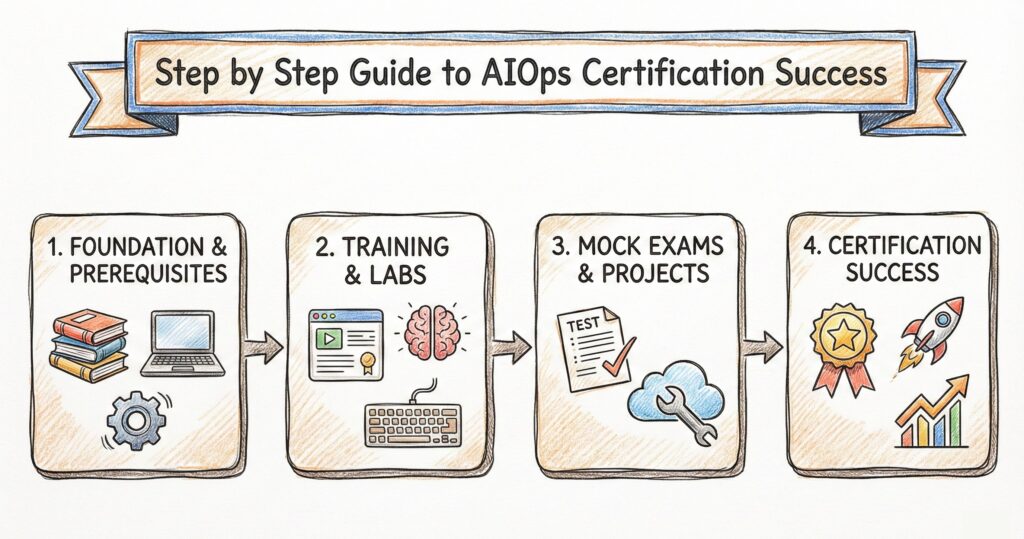
Preparation Plan
7–14 Days (Fast Track for Experienced Professionals)
- Day 1-3: Review DevOps fundamentals (CI/CD, automation, cloud basics)
- Day 4-6: Study monitoring and observability concepts (logs, metrics, traces)
- Day 7-9: Learn basic machine learning (anomaly detection, supervised vs unsupervised learning)
- Day 10-12: Understand AIOps architecture and data flow
- Day 13-14: Practice real-world scenarios, such as event correlation and automation workflows
30 Days (Balanced Plan)
- Week 1: Refresh DevOps, Linux, and cloud fundamentals
- Week 2: Dive into monitoring tools, observability techniques, and AIOps architecture
- Week 3: Focus on machine learning basics and anomaly detection models
- Week 4: Practice designing automation workflows, integrate AIOps tools, and revise concepts
60 Days (Beginner-Friendly Plan)
- Month 1: Strengthen DevOps, cloud, and monitoring foundations
- Month 2: Focus on AIOps architecture, machine learning for operations, and designing intelligent workflows
- Throughout: Regular hands-on practice, review case studies, and solve mock tests
Common Mistakes to Avoid
- Skipping DevOps Fundamentals:
A strong foundation in DevOps, cloud, and monitoring is essential before diving into AIOps concepts. Without it, understanding AIOps’ full impact is difficult. - Overlooking Data Quality:
AIOps relies heavily on clean, structured data. Skipping the importance of data normalization and collection can lead to ineffective analysis and inaccurate results. - Focusing Too Much on Theory:
AIOps is about practical implementation. Don’t just memorize concepts—ensure you understand how they apply in real-world scenarios and workflows. - Underestimating Machine Learning:
While deep ML knowledge isn’t necessary, understanding how anomaly detection and clustering work in AIOps is crucial. Avoid skipping this aspect. - Ignoring Automation Fundamentals:
Automation is at the heart of AIOps. Failing to understand how to integrate AI insights into automated workflows can limit the real-world benefits of AIOps. - Not Practicing with Tools:
Hands-on experience is key. Don’t just study concepts; actively work with monitoring and automation tools to gain practical, real-world experience.
Choose Your Career Path
1. DevOps Path
- Focus: Integration of AIOps within DevOps processes for continuous delivery, automation, and monitoring.
- Certifications:
- DevOps Foundation
- Kubernetes
- AIOCP
- SRE (Site Reliability Engineering)
- Goal: Add intelligence to DevOps workflows, improving automation and incident management.
2. DevSecOps Path
- Focus: Incorporating security into AIOps-driven workflows, ensuring that security measures are automated alongside operational tasks.
- Certifications:
- DevSecOps
- AIOCP
- Security Automation Certifications
- Goal: Design intelligent systems that secure applications while optimizing reliability and performance.
3. SRE Path
- Focus: Leveraging AIOps for enhancing reliability, reducing downtime, and improving system performance across distributed environments.
- Certifications:
- SRE Foundation
- AIOCP
- Advanced SRE Certifications
- Goal: Strengthen system reliability using AIOps-driven monitoring, predictive insights, and automation.
4. AIOps / MLOps Path
- Focus: Focus on applying machine learning models to IT operations for enhanced monitoring, failure prediction, and automation.
- Certifications:
- AIOCP
- MLOps
- Data Engineering
- Goal: Master AI/ML systems and their practical applications in IT environments.
5. DataOps Path
- Focus: Use AIOps to drive automation in data pipelines, ensuring that data quality, processing, and monitoring are streamlined.
- Certifications:
- DataOps
- AIOCP
- Data Engineering
- Goal: Apply AIOps in data management systems to automate and optimize data workflows.
6. FinOps Path
- Focus: Combine AIOps with financial operations, focusing on cost optimization and intelligent cost management for cloud resources.
- Certifications:
- FinOps
- AIOCP
- Cloud Certifications
- Goal: Leverage AIOps to monitor, forecast, and control cloud infrastructure costs intelligently.
Role to Certification Mapping
| Role | Recommended Certification Path |
|---|---|
| DevOps Engineer | DevOps → Kubernetes → AIOCP |
| SRE | Monitoring → SRE → AIOCP |
| Platform Engineer | Kubernetes → Automation → AIOCP |
| Cloud Engineer | Cloud → DevOps → AIOCP |
| Security Engineer | DevSecOps → AIOCP |
| Data Engineer | DataOps → AIOCP |
| FinOps Practitioner | FinOps → AIOCP |
| Engineering Manager | DevOps → AIOCP → Leadership |
Next Certifications After AIOCP
1. Same Track: Advanced AIOps / MLOps
- Why: Deepen your expertise in AIOps or expand into MLOps (Machine Learning Operations).
- Focus: Learn how to apply advanced machine learning models to optimize IT operations and infrastructure management.
- Goal: Strengthen your capabilities in AI-driven infrastructure automation, predictive monitoring, and data analysis.
2. Cross Track: SRE (Site Reliability Engineering)
- Why: If you want to focus on improving system reliability and scalability, SRE certifications build upon AIOps by emphasizing uptime, availability, and efficiency.
- Focus: Incorporating AIOps into SRE practices for predictive analysis, incident management, and performance monitoring.
- Goal: Become proficient in both reliability engineering and AIOps-driven automation to reduce downtime and improve system performance.
3. Cross Track: DevSecOps
- Why: AIOps plays a key role in integrating security into the DevOps lifecycle. DevSecOps certifications will help you focus on automating security measures alongside operational workflows.
- Focus: Learn to integrate security automation within AIOps systems, ensuring security measures are proactive and effective.
- Goal: Develop the ability to design and implement secure, automated systems using AIOps principles.
4. Leadership Track: Cloud Architect / Engineering Management
- Why: If you aim to move into a leadership or strategic role, these certifications will provide the skills to design and lead large-scale cloud infrastructure and engineering teams.
- Focus: Focus on designing cloud infrastructure with AIOps-driven automation and leading engineering teams for efficient operations.
- Goal: Manage large IT teams or cloud architecture projects that implement AIOps and drive strategic initiatives across the organization.
Institutions Supporting AIOCP
1. DevOpsSchool
- DevOpsSchool is a leading provider of industry-focused training programs, offering live instructor-led sessions and hands-on labs for AIOps. The institution emphasizes real-world application and practical exposure, helping candidates understand how AIOps integrates with DevOps workflows.
2. Cotocus
- Cotocus specializes in consulting-driven training and certification preparation. They offer tailored training sessions that focus on both the theoretical and practical aspects of AIOps, making it easier for professionals to apply their knowledge in real-world environments.
3. Scmgalaxy
- Scmgalaxy is renowned for its comprehensive DevOps and automation-focused certifications. Their AIOCP training programs offer in-depth knowledge of AIOps concepts, with a focus on practical implementation through hands-on labs and case studies.
4. BestDevOps
- BestDevOps offers global certification programs in AIOps and related fields. They provide structured learning paths and support to ensure professionals gain a strong understanding of AIOps principles, including machine learning models and intelligent monitoring strategies.
5. DevSecOpsSchool
- DevSecOpsSchool integrates security automation with DevOps, offering a unique perspective on AIOps. Their AIOCP courses emphasize security-focused automation in IT operations, preparing engineers to work in environments where security is integral to performance.
6. SREschool
- SREschool provides specialized training for Site Reliability Engineering and integrates AIOps into reliability practices. Their AIOCP programs are designed to help professionals enhance system reliability using AI and automation, improving incident management and uptime.
7. AIOpsSchool
- AIOpsSchool focuses entirely on AIOps certification and training. Their curriculum is specifically designed for professionals looking to specialize in AIOps, with deep dives into machine learning, anomaly detection, and operational automation.
8. DataOpsSchool
- DataOpsSchool offers a blend of data engineering and AIOps training. This institution focuses on applying AIOps concepts to data workflows, helping professionals streamline data pipelines and ensure smooth, automated data operations.
9. FinOpsSchool
- FinOpsSchool combines financial operations with AIOps, focusing on cloud cost optimization. Their training prepares professionals to apply AIOps techniques for monitoring and managing cloud infrastructure costs intelligently, ensuring financial efficiency and scalability.
Frequently Asked Questions (FAQs)
1. Is the AIOCP certification difficult?
- The AIOCP certification is moderately challenging. It requires foundational knowledge of DevOps, cloud computing, and monitoring systems. The difficulty increases with the machine learning and data analysis aspects, but with proper preparation, it’s manageable.
2. How long does it take to prepare for the AIOCP certification?
- The preparation time depends on your current skill level:
- 7–14 days for experienced DevOps/SRE professionals who are familiar with monitoring tools.
- 30 days for those with a solid DevOps foundation but less exposure to AIOps.
- 60 days if you are new to DevOps or cloud infrastructure, requiring more foundational learning.
3. What are the prerequisites for taking the AIOCP certification?
- You should have a basic understanding of:
- DevOps fundamentals (CI/CD, automation, cloud basics)
- Monitoring tools (e.g., Prometheus, Grafana, Nagios)
- Cloud platforms (AWS, Azure, GCP)
- Familiarity with Linux and scripting languages is helpful, but not mandatory.
4. What is the sequence of topics covered in AIOCP?
- DevOps Basics → Cloud/Monitoring Foundations → AIOps Architecture → Machine Learning Basics → Event Correlation → Anomaly Detection → Automation Workflows → Root Cause Analysis → Real-World Use Cases
5. How much value does the AIOCP certification add to my career?
- The AIOCP certification adds significant value, especially for roles in DevOps, SRE, and IT operations. As more companies adopt AI-driven solutions, this certification makes you a strong candidate for positions focused on intelligent automation, reliability engineering, and predictive monitoring.
6. What are the career outcomes after AIOCP?
- After AIOCP, professionals typically transition into roles such as:
- AIOps Engineer
- Site Reliability Engineer (SRE)
- Intelligent Automation Specialist
- Observability Architect
- Cloud Operations Lead
These roles are in high demand as organizations look to improve uptime, efficiency, and automation.
7. What are the real-world applications of the AIOCP certification?
- Professionals with AIOCP certification can:
- Build intelligent monitoring and alerting systems
- Implement anomaly detection and predictive monitoring
- Automate incident resolution processes
- Optimize cloud costs using AI-driven insights
- Enhance system reliability through automated root cause analysis
8. Do I need prior machine learning experience for AIOCP?
- While prior experience with machine learning (ML) is helpful, it’s not required. The certification introduces ML concepts in a practical way, focusing on how ML can be applied in IT operations for tasks like anomaly detection and root cause analysis.
9. How should I prepare if I have no prior experience with AIOps?
- Start by reviewing DevOps and cloud basics. Then, focus on understanding monitoring tools, logging systems, and observability. Once these foundations are solid, move on to AIOps-specific topics like event correlation, machine learning, and automation.
10. What tools or software do I need to learn for AIOCP?
- You will primarily work with:
- Monitoring tools like Prometheus, Grafana, and Nagios
- Log analysis tools such as Elasticsearch, Logstash, and Kibana (ELK stack)
- Automation tools like Ansible, Terraform, and Puppet
- AIOps platforms like Moogsoft, BigPanda, or Splunk (for practical understanding)
Hands-on experience with these tools will be essential for a thorough understanding.
11. Is the AIOCP certification recognized globally?
- Yes, AIOCP is recognized internationally. As AI-driven IT operations become a global trend, organizations across different industries—such as banking, telecom, and SaaS—are adopting AIOps. This makes the certification relevant no matter where you are located.
12. Can AIOCP help me transition into leadership roles?
- Yes, it provides a strong foundation for moving into engineering management or cloud architecture roles. The skills you gain can help you lead intelligent automation projects, manage AIOps teams, or guide organizations toward more resilient, data-driven operations.
FAQs on AiOps Certified Professional (AIOCP)
1. What is AIOCP, and why should I take it?
- AIOCP (AiOps Certified Professional) is a certification designed to validate your knowledge of Artificial Intelligence for IT Operations (AIOps). It teaches you how to use AI and machine learning to enhance monitoring, automation, and incident management within IT operations. You should take it to stay ahead in the rapidly evolving fields of DevOps, SRE, and AI-driven automation, which are key to improving system reliability and reducing downtime.
2. How long does it take to prepare for the AIOCP certification?
- The preparation time varies based on your background:
- If you have a solid DevOps and monitoring background, it may take around 2–4 weeks.
- For those less familiar with machine learning or AIOps, it may take 4–8 weeks.
- Consistent hands-on practice and understanding real-world scenarios will ensure better preparation.
3. Do I need prior experience in machine learning to take AIOCP?
- No, you do not need advanced machine learning experience. However, having a basic understanding of machine learning concepts like anomaly detection and clustering will be helpful. The certification focuses on practical applications of AI in IT operations, so the concepts are introduced in a way that is easy to apply in real-world environments.
4. What tools or platforms should I be familiar with for the AIOCP exam?
- While the AIOCP certification does not require deep familiarity with specific tools, understanding the following will be beneficial:
- Monitoring tools (e.g., Prometheus, Grafana)
- Log analysis platforms (e.g., ELK Stack, Splunk)
- Automation tools (e.g., Ansible, Terraform, Puppet)
- AIOps platforms like Moogsoft or BigPanda can also help in learning practical aspects.
5. Is the AIOCP certification valuable for career growth?
- Absolutely. The AIOCP certification demonstrates that you are equipped to handle complex IT systems, using AI and automation to improve system performance, reliability, and security. It opens up roles in AIOps, SRE, cloud operations, and reliability engineering. As organizations increasingly adopt intelligent automation, having AIOCP can give you a competitive edge in these high-demand fields.
6. What career opportunities are available after completing AIOCP?
- After completing the AIOCP certification, you can pursue roles such as:
- AIOps Engineer
- Site Reliability Engineer (SRE)
- Cloud Operations Lead
- Observability Architect
- Intelligent Automation Specialist
- Platform Engineer
- These roles focus on implementing AI and machine learning to optimize monitoring, incident resolution, and system reliability in real-time.
7. Can I take AIOCP if I am new to DevOps or IT operations?
- It is recommended to have some background knowledge in DevOps, cloud platforms, and monitoring systems before attempting AIOCP. If you’re new, you should first familiarize yourself with the basics of DevOps and cloud infrastructure. Consider starting with foundational certifications in these areas before diving into AIOCP.
8. What is the format of the AIOCP exam?
- The AIOCP exam typically includes multiple-choice questions and scenario-based queries to test your practical knowledge of AIOps principles. It focuses on:
- Understanding AIOps architecture and tools
- Application of machine learning in IT operations
- Event correlation and anomaly detection
- Designing automation workflows
- The exam tests both theoretical and practical understanding, so hands-on experience with tools and real-world scenarios is important.
Testimonials
Rahul S., DevOps Engineer
“AIOCP helped me rethink how we handle alerts in production. Instead of reacting to dozens of noisy alerts, I can now focus on meaningful incidents. This changed how our team approaches monitoring.”
Priya M., Site Reliability Engineer (Global SaaS Company)
“Before AIOCP, troubleshooting performance issues was largely manual and time-consuming. The certification taught me how to use intelligent data analysis and automation workflows to solve problems faster. I now reduce downtime with confidence.”
Arjun K., Cloud Operations Lead
“Completing AIOCP gave me a clearer view of how machine learning can be applied practically in operations. It helped me design automation that actually works in real environments rather than being theoretical.”
Final Conclusion
The AiOps Certified Professional (AIOCP) certification equips professionals with the essential skills to harness the power of AI and machine learning in IT operations, enabling them to proactively manage complex, distributed systems. By combining intelligent monitoring, predictive analytics, and automation, AIOCP helps professionals drive greater reliability, reduce downtime, and optimize system performance. As businesses increasingly adopt AI-driven operations, this certification opens doors to advanced roles in AIOps, SRE, and cloud operations, ensuring career growth and positioning you at the forefront of modern IT management.