Introduction
Every ambitious organisation, government, and military institution faces a recurring challenge: turning broad aspirations into achievable reality. Decision-makers frequently articulate compelling goals—securing regional peace, modernising critical infrastructure, deterring external aggression, or expanding economic influence—yet struggle to translate those statements into coherent action. When an institution declares an objective without specifying how it will be pursued or what resources will sustain the effort, the result is not strategy; it is wishful thinking.
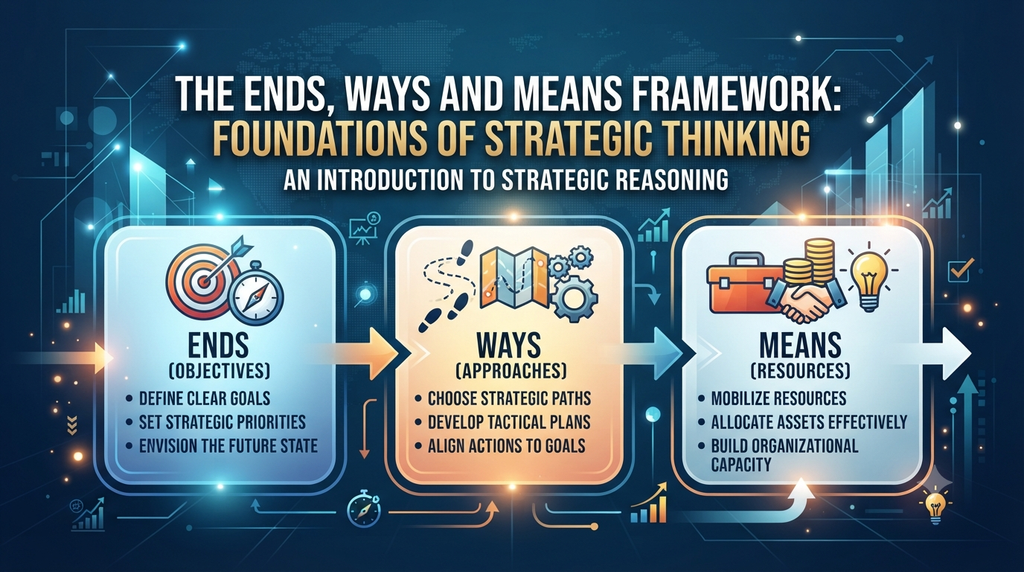
In strategic studies and national security planning, the Ends, Ways and Means framework provides a disciplined method for testing whether a proposed course of action makes logical sense. At its core, the framework breaks strategic reasoning down into three interrelated questions: What outcome is being sought (Ends)? What approach or concept of action will produce that outcome (Ways)? And what resources and capabilities are available or required to execute that approach (Means)?
Popularised in modern defence education through the work of American strategist Arthur F. Lykke Jr. at the U.S. Army War College during the 1980s, this formulation has become a foundational tool across military staff colleges, public policy institutions, and executive planning teams. Its enduring value lies in its simplicity and analytical rigour. A credible strategy requires continuous alignment between what an organisation wants to achieve, how it intends to achieve it, and what it can realistically commit. When these three elements are out of balance, strategic risk escalates, resources are wasted, and core objectives remain out of reach.
Section 1: Understanding the Fundamentals of Strategy
In international relations, national security, and institutional governance, strategy is the bridge between high-level political purpose and practical action on the ground. Unlike routine administration, which focuses on maintaining established processes, strategic reasoning deals with purposeful change in competitive, uncertain, or resource-constrained environments.
To understand how strategy operates, it is essential to distinguish it from adjacent concepts that are often used interchangeably in everyday conversation:
- Policy defines the overarching political goals, values, and priorities established by leadership. Policy answers the question of why an institution acts and what broad state of affairs it wishes to preserve or create.
- Strategy translates policy into a coherent plan of action, aligning objectives, methods, and resources across time and space to achieve desired political effects.
- Operations (or operational art in military doctrine) links strategy to tactical execution by designing, sequencing, and coordinating campaigns or major institutional programmes within a specific theatre or sector.
- Tactics involves the immediate, localised execution of specific actions, engagements, or tasks using assigned personnel and equipment.
Strategy is fundamentally shaped by political objectives. As the nineteenth-century Prussian theorist Carl von Clausewitz observed in On War, conflict and statecraft are extensions of politics by other means. Whether a government is negotiating a trade agreement, managing a public health emergency, or deploying naval forces, political priorities dictate which outcomes are acceptable, what costs can be borne, and what constraints must be respected.
Furthermore, strategic reasoning never occurs in a vacuum. Decision-makers must contend with incomplete information, finite budgets, domestic political pressures, alliance obligations, and active opposition from competitors or adversaries who possess their own strategies. Consequently, strategy cannot be treated as a static blueprint drafted once and filed away. It is an iterative, continuous process of evaluation and adjustment across multiple tiers—from grand national strategy and joint military strategy down to ministerial, corporate, and institutional planning.
Section 2: What Are Ends? Defining the Desired Outcome
Ends represent the specific objectives, conditions, or end-states that a strategy is designed to achieve. They define what success looks like once strategic action has taken effect. In national security and public policy, Ends are derived from core national interests, constitutional mandates, or institutional charters, and they reflect the priorities of political leadership.
Effective strategic reasoning requires careful differentiation among several types of objectives:
- Political versus Strategic Objectives: Political objectives express the ultimate policy purpose (for example, maintaining territorial sovereignty or regional stability). Strategic objectives translate those broad political aims into concrete conditions that instruments of power can realistically achieve (such as deterring armed incursion along a contested border).
- Short-Term versus Long-Term Outcomes: Immediate objectives focus on stabilising an urgent crisis or achieving an interim milestone, whereas long-term Ends aim to reshape structural conditions over years or decades.
- Limited versus Ambitious Objectives: Limited Ends seek modest adjustments—such as compelling a rival to return to negotiations—while ambitious or unlimited Ends aim for fundamental transformation, such as regime change or complete institutional overhaul.
For Ends to guide planning effectively, they must be clear, realistic, and measurable. Vague aspirations—such as “enhancing regional influence” or “improving national resilience”—offer little direction to planners because they provide no criteria for deciding which actions are relevant or when an objective has been met. Worse, poorly defined Ends invite “mission creep,” where organisations continually expand their commitments without a clear endpoint.
Consider a hypothetical scenario in which a coastal state seeks to protect a vital maritime trade corridor passing near a volatile region. A broad political aspiration to “secure maritime commerce” is too general to direct operational planning. Through strategic reasoning, policymakers refine that ambition into distinct, actionable Ends:
- Maintain uninterrupted commercial navigation through the primary shipping lanes.
- Reduce the frequency of maritime security incidents, including piracy and illegal interdiction, to negligible levels.
- Preserve regional diplomatic stability by preventing localized maritime friction from escalating into interstate conflict.
By articulating specific conditions rather than broad slogans, leaders establish clear benchmarks for selecting appropriate methods and allocating resources—while recognizing that Ends may still require recalibration if regional political realities shift.
Section 3: What Are Ways? Choosing the Approach
Ways refer to the methods, strategic concepts, and courses of action chosen to achieve the defined Ends. If Ends specify where an organisation wants to go, Ways explain how it intends to get there. In statecraft and institutional planning, Ways represent how leaders employ their available instruments of power—often categorised in strategic literature as diplomatic, informational, military, and economic (DIME) tools, alongside legal, intelligence, and development mechanisms.
Decision-makers rarely rely on a single method in isolation. Instead, effective strategies typically combine multiple Ways into a mutually reinforcing approach:
- Diplomacy and Negotiation: Bilateral talks, multilateral treaties, crisis mediation, and coalition-building aimed at shaping the behaviour of partners and rivals without coercion.
- Economic Measures and Trade Policy: Sanctions, tariffs, investment incentives, supply-chain diversification, and financial aid designed to alter an actor’s cost-benefit calculations.
- Military Deterrence and Defence Posture: Forward presence, readiness exercises, missile defence, and credible retaliatory capabilities intended to convince adversaries that aggression will fail or incur unacceptable costs.
- Defence Cooperation and Alliances: Security assistance, joint training, interoperability agreements, and intelligence sharing that strengthen partner capacity.
- Intelligence and Information Activities: Strategic communication, public diplomacy, counter-disinformation, and covert collection to shape perceptions and reduce uncertainty.
- Development Assistance and Institution-Building: Governance reform, infrastructure investment, and economic development aimed at addressing underlying sources of instability.
Selecting appropriate Ways requires rigorous comparative evaluation. Planners must assess candidate approaches against several criteria: likely effectiveness in producing the desired End, operational feasibility, domestic and international political consequences, time required to generate results, financial and human risk, and how adversaries or third parties might react.
Returning to the hypothetical maritime security example, the coastal state might conclude that relying solely on unilateral naval patrols would be prohibitively expensive and diplomatically provocative. Instead, policymakers design an integrated set of Ways: combining bilateral diplomatic agreements with neighbouring littoral states, regional maritime information-sharing protocols, coordinated coast guard patrols, and visible defensive naval deterrence. Selecting this multi-layered approach reflects a careful reading of the operating environment, balancing security requirements against regional political sensitivities.
Section 4: What Are Means? Understanding Resources and Capabilities
Means encompass the tangible and intangible resources, assets, and capabilities required to execute the chosen Ways. A strategic concept, however clever on paper, remains purely theoretical unless an institution possesses—or can reliably generate—the Means to carry it out.
In comprehensive strategic planning, Means extend far beyond weapons systems or financial accounts. They span eight interconnected categories:
- Financial Resources and Budgets: Fiscal allocations, contingency funds, credit access, and sustained multi-year funding streams.
- Military and Security Personnel and Equipment: Trained service members, specialised units, naval vessels, aircraft, vehicles, and munitions.
- Technology and Infrastructure: Satellite communications, cyber capabilities, sensor networks, ports, airfields, and transport corridors.
- Intelligence and Information Capabilities: Analytical agencies, reconnaissance platforms, linguistic expertise, and strategic communication channels.
- Diplomatic Networks and Institutional Capacity: Embassies, skilled negotiators, interagency coordination bodies, and legal frameworks.
- Industrial and Logistical Support: Defence manufacturing bases, supply chains, maintenance facilities, fuel reserves, and strategic lift.
- Public Support and Political Legitimacy: Domestic consensus, legislative backing, alliance trust, and adherence to international norms.
- Time, Expertise, and Organisational Coordination: Institutional knowledge, leadership bandwidth, and the administrative capacity to synchronise complex efforts.
A critical distinction in strategic analysis is the difference between existing Means (capabilities currently ready for deployment) and developmental Means (capabilities that must be funded, procured, trained, or built over time). A strategy that depends on capabilities still in research and development cannot be executed immediately without accepting substantial risk.
Furthermore, raw resource volume does not automatically translate into strategic capability. An agency may possess substantial budgets or advanced hardware, yet lack the trained operators, logistical sustainment, or interagency coordination needed to employ them effectively. When a strategy’s resource demands exceed an institution’s actual capacity—for instance, committing to simultaneous overseas contingencies without adequate strategic airlift or maintenance personnel—the resulting gap renders the strategy unsustainable.
Section 5: How Ends, Ways and Means Work Together
The analytical power of the Ends, Ways and Means framework lies not in treating its three components as separate checklists, but in examining how they interact as a dynamic system. Each element constrains and shapes the others.
| Element | Main Question | Strategic Function | Primary Focus |
| Ends | What do we want to achieve? | Defines the objective or desired end-state | Political purpose, policy priorities, and measurable outcomes |
| Ways | How will we achieve it? | Determines the strategic approach or concept | Methods, sequencing, and employment of instruments of power |
| Means | What resources do we need? | Establishes practical feasibility and sustainability | Budgets, personnel, capabilities, infrastructure, and legitimacy |
In a coherent strategy, Ends, Ways, and Means are aligned in equilibrium: the Means are sufficient to execute the Ways, and the Ways are logically capable of achieving the Ends within acceptable limits of time and risk. When one element shifts—due to budget cuts, political upheaval, or technological disruption—decision-makers must adjust the remaining two to restore balance.
When alignment breaks down, predictable strategic pathologies emerge:
| Alignment Mismatch | Core Strategic Problem | Typical Consequences |
| Clear Ends + Effective Ways, but Insufficient Means | Resource-Strategy Gap (Overreach): Ambitions and plans exceed available capacity. | Operational exhaustion, degraded readiness, broken commitments, and eventual forced retreat or mission failure. |
| Strong Means, but Poorly Defined Ends | Aimless Activism: Substantial capabilities are deployed without a clear political purpose. | Tactical activity without cumulative progress, wasted expenditure, drifting priorities, and inability to measure success. |
| Ambitious Ends + Sufficient Means, but Ineffective Ways | Flawed Theory of Success: Abundant resources are applied through an inappropriate or counterproductive approach. | High financial and human cost, unintended escalation, alienation of partners, and failure to achieve the desired political outcome. |
Understanding these interactions prevents planners from treating strategy as an exercise in pure ambition or pure logistics. If financial constraints reduce available Means, leaders cannot simply keep the same Ends and Ways and hope for better efficiency; they must either adopt more economical Ways or scale back their Ends to match reality.
Section 6: Applying the Framework Through a Practical Scenario
To see how Ends, Ways and Means interact in practice, consider the following hypothetical case study involving a mid-sized maritime nation—referred to here as State A—whose economy relies heavily on seaborne trade passing through a narrow, heavily trafficked international strait. Over an eighteen-month period, commercial vessels transiting the corridor face rising incidents of armed boarding, electronic navigation interference, and coercive inspections by non-state actors operating from nearby coastlines.
Structuring the Strategy
Confronted with rising shipping insurance premiums and supply-chain delays, State A’s National Security Council applies the Ends, Ways and Means framework to formulate a coherent response:
Ends:
- Protect commercial shipping transiting the corridor from boarding and harassment.
- Reduce security disruptions to pre-crisis baseline levels within twelve months.
- Support regional maritime stability without triggering interstate military confrontation.
- Maintain internationally recognised freedom of navigation through the strait.
Ways:
- Diplomatic engagement with neighbouring coastal states to establish shared security responsibilities and de-conflict maritime zones.
- Maritime information-sharing agreements linking regional vessel traffic services and coastal radar networks.
- Coordinated patrols combining State A’s coast guard vessels with partner maritime law enforcement units in high-risk sectors.
- Intelligence cooperation to identify shore-based smuggling networks and illicit financing supporting maritime disruptions.
- Defensive preparedness, keeping naval assets on standby outside the immediate choke point to deter escalation without militarising routine law enforcement.
Means:
- Trained naval, coast guard, intelligence, and diplomatic personnel.
- Maritime domain awareness systems, including coastal radar, patrol aircraft, and commercial transponder tracking.
- Offshore patrol vessels, interdiction boats, and defensive naval frigates.
- Dedicated operational funding for fuel, maintenance, and partner capacity-building grants.
- Diplomatic missions and legal advisors to draft bilateral maritime protocols.
Assessing Feasibility and Adapting to Constraints
During strategic review, State A’s planners test the alignment of the proposal against real-world constraints. Three major limitations emerge:
- Resource and Fleet Constraints: State A’s coast guard lacks enough long-endurance patrol vessels to maintain continuous presence across the entire corridor while simultaneously fulfilling domestic fisheries and search-and-rescue duties.
- Political Sensitivities: One neighbouring state is reluctant to sign a formal security pact due to domestic political opposition, fearing loss of sovereignty.
- Geographic and Operational Complexity: High-density commercial traffic complicates sensor tracking and increases the risk of miscalculation during night-time interdictions.
Rather than proceeding with an unworkable plan, decision-makers recalibrate the strategy across all three dimensions. First, they adjust the Ways: instead of seeking a formal multilateral security treaty, diplomats pursue narrower, technical coast guard search-and-rescue and anti-piracy information-sharing arrangements that avoid domestic political sensitivities. Second, they reallocate Means: rather than attempting continuous surface patrols everywhere, State A invests in unmanned aerial surveillance and satellite tracking to cue rapid-response patrol boats only toward verified anomalies. Finally, they refine the Ends: accepting that complete elimination of all illicit activity is unrealistic within a year, policymakers define success as reducing severe interdictions by 80 percent while keeping shipping lanes open.
Section 7: Strategic Balance, Feasibility and Risk
A strategy that looks persuasive in a briefing document can unravel rapidly during implementation if planners fail to account for strategic risk. In strategic studies, strategic risk is defined as the gap between what decision-makers intend to accomplish and what their chosen Ways and available Means can realistically deliver under real-world conditions.
Evaluating strategic feasibility requires examining several recurring sources of friction and vulnerability:
- Resource Limitations and Opportunity Costs: Every rupee, dollar, or battalion committed to one priority is unavailable for another. Strategies that ignore opportunity costs risk hollowing out core capabilities elsewhere.
- Strategic Overreach: Attempting to secure too many ambitious Ends simultaneously spreads Means too thinly, leaving critical vulnerabilities exposed.
- Political and Economic Costs: Prolonged deployments, trade sanctions, or austerity measures can erode domestic political support and strain alliances long before strategic objectives are achieved.
- Time Constraints: Some Ways—such as institutional reform or defence procurement—require years to mature, whereas political crises may demand visible stabilisation within weeks.
- Adversary Adaptation: Competitors are not passive targets. When faced with new countermeasures, adversaries routinely shift tactics, exploit legal grey zones, or target unprotected seams.
- Unintended Consequences: Actions intended to deter aggression can sometimes provoke fear and escalation, producing a security dilemma that leaves all parties worse off.
- Fragile Assumptions: Many failed strategies rest on unexamined assumptions—such as assuming that local partners share identical priorities, that economic pressure will rapidly alter political behaviour, or that technological superiority guarantees rapid victory.
Sound strategic judgement does not aim to eliminate risk entirely—which is impossible in competitive environments—but to identify where risk sits, determine whether it is acceptable, and build mitigation measures into the plan.
Section 8: Common Mistakes When Using Ends, Ways and Means
Even experienced planners frequently misuse the Ends, Ways and Means framework. Recognising these ten recurring errors helps prevent flawed strategic design:
- Defining Objectives That Are Too Broad or Unrealistic: Framing Ends in sweeping, utopian terms makes alignment impossible. Remedy: Translate broad political aspirations into specific, bounded, and verifiable conditions.
- Confusing Military or Organisational Activity with Strategic Success: Measuring success by sorties flown, budgets spent, or meetings held mistakes inputs for outcomes. Remedy: Tie every operational metric directly to the desired political or strategic End.
- Selecting Ways Before Clarifying Ends: Jumping straight to favourite tools—such as launching a naval deployment or imposing sanctions—before agreeing on the objective leads to incoherent action. Remedy: Enforce discipline by defining the End first and testing every proposed Way against it.
- Ignoring Resource Limitations: Treating budget and manpower constraints as minor administrative details guarantees strategic overreach. Remedy: Require rigorous cost, logistics, and personnel audits before approving strategic concepts.
- Assuming Additional Resources Automatically Solve Strategic Problems: Pouring more money or troops into a flawed Way merely increases the scale of failure. Remedy: Diagnose whether failure stems from insufficient Means or a defective theory of success.
- Neglecting Political and Economic Constraints: Designing technically sound plans that ignore domestic legitimacy, legal authorities, or economic blowback invites sudden collapse. Remedy: Integrate political, legal, and economic advisors throughout the planning cycle.
- Treating Strategy as a Fixed Blueprint: Assuming initial plans will survive contact with reality intact creates institutional rigidity. Remedy: Build formal review points and contingency branches into strategic directives.
- Ignoring Adversary Adaptation: Planning on the assumption that competitors will continue behaving predictably leads to strategic surprise. Remedy: Use red-teaming and wargaming to test how rivals might counter chosen Ways.
- Failing to Establish Measurable Indicators of Progress: Without clear benchmarks, institutions cannot tell whether a strategy is succeeding or drifting. Remedy: Define concrete indicators of both progress and warning signs of failure early.
- Disconnecting Short-Term Actions from Long-Term Ends: Allowing urgent tactical crises to dictate policy can undermine long-term strategic goals. Remedy: Continuously evaluate short-term expedients against their multi-year political impact.
Section 9: Monitoring, Evaluation and Strategic Adaptation
Strategic reasoning does not conclude when a policy paper is signed or an operation begins. Because political environments, resource levels, and competitor behaviours constantly evolve, strategy requires continuous monitoring, evaluation, and adaptation.
Effective strategic oversight rests on three parallel tracking mechanisms:
- Monitoring Progress Toward Ends: Planners assess whether conditions in the operational environment are actually moving toward the desired end-state, rather than merely tracking internal activity levels.
- Evaluating the Effectiveness of Ways: Decision-makers examine whether the chosen mechanisms—such as diplomatic pressure, deterrence patrols, or economic incentives—are producing the intended causal effects on target actors.
- Tracking Resource Consumption (Means): Financial managers and logisticians monitor expenditure rates, personnel fatigue, equipment readiness, and political capital to ensure the effort remains sustainable.
A crucial challenge in strategic evaluation is selecting meaningful indicators without falling into the trap of metric fixation. Quantitative indicators—such as reductions in shipping incidents, treaty ratifications, or trade volume recovery—are valuable, but they must be paired with qualitative intelligence assessments that capture shifts in adversary intent, partner morale, and regional perceptions.
When feedback mechanisms reveal that assumptions were flawed or circumstances have shifted, leaders must adapt purposefully. Adaptation does not mean abandoning core principles at the first sign of difficulty; rather, it means adjusting Ways, reallocating Means, or refining interim Ends so the strategy remains coherent and aligned with reality.
Section 10: Strengths and Limitations of the Ends, Ways and Means Framework
Like any analytical model, the Ends, Ways and Means framework offers distinct advantages alongside important limitations that practitioners must keep in mind.
Strengths
- Conceptual Clarity: It distils complex strategic problems into three intuitive, logical categories accessible to both senior policymakers and operational planners.
- Enforces Alignment: It compels institutions to connect high-level ambitions with concrete methods and real-world resource constraints.
- Exposes Gaps and Overreach: By testing feasibility early, it highlights mismatches between goals and capabilities before costly commitments are made.
- Facilitates Civil-Military and Interagency Dialogue: It provides a shared vocabulary enabling diplomats, military officers, economists, and political leaders to coordinate across institutional boundaries.
Limitations
- Ambiguity of Real-World Ends: In democratic politics and coalition diplomacy, objectives are often deliberately ambiguous to maintain consensus, making strict analytical precision difficult.
- Difficulty Measuring Intangible Means: Factors such as political will, institutional trust, morale, and cultural legitimacy are critical to success but resist neat quantification.
- Nonlinear Strategic Dynamics: Real-world conflicts and political systems rarely follow neat, linear cause-and-effect chains; small actions can trigger disproportionate, unpredictable reactions.
- Interactive Adversaries: Unlike engineering problems, strategy involves thinking opponents who actively work to disrupt your Ways and degrade your Means.
- Risk of Over-Simplification: Used mechanically, the framework can reduce subtle historical, cultural, and psychological dynamics into an overly technocratic checklist.
Ultimately, Ends, Ways and Means is a diagnostic tool and an analytical starting point—not a magic formula for victory. It structures thinking, disciplines debate, and exposes faulty logic, but it cannot substitute for deep contextual knowledge, political wisdom, and sound human judgement.
Strategic Coherence Checklist
Before endorsing or executing a strategic plan, policymakers and analysts can test its internal logic against six core questions:
- Clarity of Ends: Are the desired strategic objectives clearly defined, politically grounded, and distinguishable from mere operational activities?
- Suitability of Ways: Is there a plausible, evidence-based causal link explaining how the chosen approaches will achieve those specific objectives?
- Adequacy of Means: Are the financial, human, technological, diplomatic, and institutional resources required to sustain the approach currently available or realistically acquirable?
- Risk and Cost Assessment: Have the financial costs, opportunity costs, unintended consequences, and likely competitor responses been honestly evaluated?
- Measurability: Are there clear, meaningful indicators to assess whether the strategy is producing genuine strategic progress over time?
- Adaptability: Does the plan include formal review mechanisms and contingency options to adjust Ends, Ways, or Means if core assumptions change?
Frequently Asked Questions (FAQs)
1. What does Ends, Ways and Means mean in strategy?
In strategic planning, Ends are the specific objectives or desired outcomes a strategy aims to achieve; Ways are the methods, concepts, and courses of action used to pursue those objectives; and Means are the tangible and intangible resources—such as funding, personnel, technology, and political legitimacy—required to execute the chosen approach.
2. Why are Ends, Ways and Means important in strategic planning?
The framework prevents wishful thinking by requiring logical alignment between goals, methods, and resources. It helps decision-makers identify resource shortfalls, expose flawed assumptions, evaluate strategic risk, and communicate clearly across political, diplomatic, and operational teams.
3. What is the difference between Ends, Ways and Means?
Ends define what success looks like (the destination), Ways explain how the organisation intends to get there (the route and method), and Means identify with what resources the journey will be sustained (the fuel, vehicles, and personnel).
4. How does the framework apply to national security?
In national security, political leaders establish national interests and policy goals (Ends), interagency planners combine diplomatic, economic, informational, and military approaches (Ways), and governments allocate defence budgets, armed forces, intelligence assets, and diplomatic networks (Means) to protect the state and advance its interests.
5. Can a strategy succeed without sufficient Means?
Rarely. When Ends and Ways exceed available Means, an organisation faces a resource-strategy gap that typically leads to operational exhaustion, degraded capabilities, and mission failure. If additional Means cannot be generated, leaders must adopt more economical Ways or scale back their Ends.
6. How are strategic objectives different from tactical objectives?
Strategic objectives focus on achieving broad, enduring political or institutional conditions—such as deterring aggression or stabilising a trade corridor—across time and space. Tactical objectives focus on immediate, localised tasks—such as securing a specific harbour or completing a patrol—that contribute to larger operational and strategic goals.
7. Is Ends, Ways and Means used only in military strategy?
No. Although modern formulations were systematised in military war colleges, the framework is widely applied in foreign policy, public administration, corporate strategy, crisis management, infrastructure planning, and non-profit governance whenever organisations must align goals, methods, and finite resources.
8. What are the main limitations of the Ends, Ways and Means framework?
The framework can oversimplify complex, nonlinear political environments where objectives are ambiguous, intangible factors like morale or legitimacy are hard to measure, and intelligent adversaries actively adapt to disrupt plans. It works best when combined with historical awareness, regional expertise, and continuous evaluation.
Conclusion
Ambition is an essential starting point in statecraft and institutional leadership, but ambition alone is never a strategy. Across history, governments and organisations have repeatedly faltered not because they lacked bold visions, but because they failed to align their desired outcomes with credible approaches and sustainable capabilities.
The Ends, Ways and Means framework endures because it brings discipline to strategic reasoning. By forcing decision-makers to specify precisely what they seek to achieve, justify how their chosen methods will produce those results, and verify that they possess the necessary resources, the framework turns abstract aspirations into testable propositions. In an international environment defined by rapid technological change, economic interdependence, and persistent geopolitical competition, effective strategy depends on coherence, adaptability, and the intellectual honesty to match goals with reality.