Introduction
Consider a medium-sized maritime state facing a convergence of pressures. Beyond its borders, major powers are competing for influence over critical sea lanes, while regional instability threatens key trading partners. At home, rapid technological change is reshaping industrial competitiveness, foreign cyber actors are probing energy grids, and supply chains for vital semiconductors depend heavily on overseas manufacturers. To respond, senior leaders convene defense officials, diplomats, intelligence directors, and economic ministers to chart a coherent course.
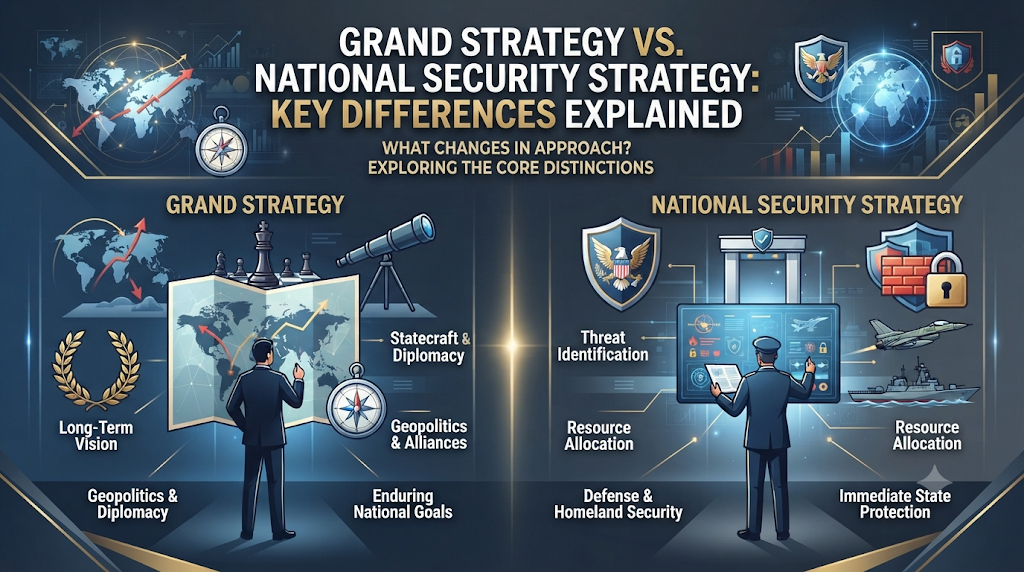
In the ensuing debates, two terms frequently surface: Grand Strategy and National Security Strategy. Policymakers, journalists, and commentators often use them interchangeably—treating a government’s latest security white paper as its complete vision for the future, or describing a multi-decade geopolitical posture as a routine security plan. Yet in strategic studies and statecraft, Grand Strategy vs National Security Strategy represents a meaningful analytical distinction.
Understanding what separates these two concepts is essential for students of international relations, defense researchers, and policy analysts. It clarifies how states align their vast national resources with their immediate security needs, and why a government’s public security doctrine does not always capture its deepest long-term ambitions. This raises a central question: What changes when a country moves from thinking about its overall long-term position in the world to defining its national security priorities and policy direction?
What Is Grand Strategy?
At its broadest level, Grand Strategy is the overarching, long-term framework through which a state organizes, develops, and employs all of its available resources and instruments of power to secure its fundamental national interests. Unlike military strategy, which focuses on the employment of armed forces to achieve campaign or wartime objectives, grand strategy operates continuously across both war and peace.
Writing in 1943, historian Edward Mead Earle observed that strategy is not merely a wartime concept, but “an inherent element of statecraft at all times,” integrating the policies and armaments of a nation so that war is either rendered unnecessary or undertaken with the greatest prospect of success. Similarly, British military theorist B. H. Liddell Hart emphasized that while traditional military strategy is bounded by the conduct of war, grand strategy looks beyond the conflict to the subsequent peace—regulating the use of all national instruments so as to preserve long-term security and prosperity. Contemporary scholar Colin S. Gray went further, defining grand strategy as the direction and use of any or all assets of a security community in support of its policy goals, arguing that in practice, grand strategy is virtually synonymous with statecraft itself.
Because grand strategy concerns the fate and standing of the state over decades or generations, it encompasses a wide spectrum of national life:
- Long-Term National Interests: Defining what the state values most—such as sovereignty, territorial integrity, political autonomy, economic prosperity, and a favorable international order.
- National Power and Resources: Assessing and cultivating demographic, financial, industrial, and natural resources over time.
- Political Objectives: Ensuring that every external commitment and domestic mobilization serves clear political ends, echoing Carl von Clausewitz’s enduring insight that strategy must remain subordinate to political purpose.
- Military Capabilities: Shaping the long-term size, technological sophistication, and posture of armed forces to deter aggression or project influence.
- Economic Strength and Technological Development: Fostering innovation, trade competitiveness, and industrial capacity as the foundational engines of national power.
- Diplomatic Relationships and Alliances: Building enduring coalitions, bilateral partnerships, and institutional frameworks that extend influence and share burdens.
- International Position and Strategic Adaptation: Determining the state’s desired role in the international system—whether primacy, regional leadership, non-alignment, or restraint—and adapting that posture as global power balances shift.
Crucially, a grand strategy is rarely contained within a single official document. Scholars such as Lukas Milevski and Hal Brands note that grand strategy can be understood variously as a deliberate intellectual blueprint, an ongoing bureaucratic process, or an observable pattern of behavior inferred by historians. In many states, grand strategy remains implicit, contested among domestic political factions, and distributed across economic policies, diplomatic traditions, alliance commitments, and defense postures rather than codified under a single title.
What Is National Security Strategy?
If grand strategy represents the overarching architecture of statecraft, a National Security Strategy (NSS) is a more focused policy framework designed to identify, prioritize, and address a country’s specific security interests, threats, risks, and operational policy directions. While grand strategy asks what kind of international position a nation wants to hold over the long run, a national security strategy concentrates on safeguarding the state and its citizens against concrete dangers and vulnerabilities.
In contemporary governance, a national security strategy typically brings together multiple arms of government to coordinate security policy across several core areas:
- National Security Objectives: Articulating the core security goals the government seeks to protect within a defined political or planning cycle.
- Threat and Risk Assessment: Evaluating state-based rivalries, regional conflicts, terrorism, proliferation, pandemics, and environmental hazards.
- Defence Policy and Military Readiness: Aligning defense spending, force posture, and deterrence requirements with identified threats.
- Intelligence and Counterintelligence: Directing early warning, threat detection, and covert or clandestine information gathering.
- Cybersecurity and Critical Infrastructure: Protecting digital networks, telecommunications, financial systems, and energy grids from disruption.
- Economic Security: Addressing vulnerabilities in supply chains, foreign investment screening, export controls, and strategic commodities.
- Diplomatic Partnerships: Leveraging security alliances, bilateral defense agreements, and multilateral diplomacy to manage shared risks.
- National Resilience and Crisis Preparedness: Enhancing civil defense, emergency response, and societal ability to withstand and recover from major shocks.
- Institutional Responsibilities: Clarifying how ministries of defense, foreign affairs, interior, finance, and intelligence agencies coordinate their efforts.
It is important to recognize that the exact meaning, legal status, and institutional format of a national security strategy vary significantly across countries. In the United States, Section 603 of the Goldwater-Nichols Department of Defense Reorganization Act of 1986 legally mandates that the President submit a formal written National Security Strategy report to Congress, outlining national interests, commitments, and required capabilities. The United Kingdom similarly publishes periodic Integrated Reviews and national security strategies combining defense, diplomacy, and resilience. Conversely, other nations do not issue a single public document under that exact title, instead distributing their national security priorities across defense white papers, foreign policy concepts, internal security doctrines, or executive directives.
Grand Strategy vs National Security Strategy: Core Differences
To clarify how these two concepts diverge in analytical scope and practical application, the table below summarizes their core dimensions. Note that this comparison represents a conceptual framework used in strategic studies rather than a universal legal standard across all governments.
| Dimension | Grand Strategy | National Security Strategy |
| Central Focus | Overall long-term national interests and international position | Protection and advancement of national security interests |
| Scope | Broad and whole-of-state (encompassing economy, society, diplomacy, and defense) | Security-focused, though increasingly cross-government in execution |
| Time Horizon | Usually long-term and generational (spanning decades) | Often medium- to long-term, typically tied to periodic policy reviews (4–10 years) |
| Main Concern | How national power and resources are built and used to support enduring objectives | How the state identifies, prioritizes, and mitigates security threats and risks |
| Policy Instruments | Military, economic, diplomatic, political, technological, cultural, and informational | Defence, diplomacy, intelligence, cybersecurity, economic security, and civil resilience |
| Main Questions | What international role does the country seek? How will it sustain that position over time? | What security interests must be defended? Which threats require immediate or medium-term action? |
| Outputs | Broad strategic orientation, national development priorities, and geopolitical posture | Formal security objectives, risk hierarchies, capability priorities, and interagency guidance |
| Adaptability | Evolves gradually with structural shifts in national power and global order | Revised more frequently as administrations change or acute threats emerge |
How Their Objectives Differ
When moving from grand strategy to national security strategy, the fundamental questions policymakers ask shift from systemic positioning to threat management and security governance.
Grand Strategy asks:
- What are the country’s enduring, foundational national interests across generations?
- What kind of international position or regional order does the state want to shape, maintain, or avoid?
- How should national wealth, demographics, education, and industrial capacity be cultivated over decades to generate sustainable power?
- How should economic growth and diplomatic engagement reinforce long-term political autonomy?
- What major structural trade-offs—such as balancing domestic welfare against external commitments, or prioritizing one geographic theater over another—must leaders manage?
National Security Strategy asks:
- What are the state’s vital security interests that must be protected against coercion, disruption, or attack?
- Which specific external and internal threats, hazards, and systemic risks pose the greatest danger over the next several years?
- What military, intelligence, cyber, and civil capabilities are required to deter or counter those risks?
- Which allies, security partners, and international institutions are necessary to achieve these security objectives?
- How should government institutions enhance national resilience to absorb crises without systemic failure?
While these questions overlap—particularly when long-term economic vitality is viewed as a prerequisite for national defense—their analytical center of gravity differs. Grand strategy is fundamentally concerned with the creation and orchestration of national power, whereas national security strategy focuses on the protection of the state and the management of security risks.
How Their Policy Instruments Differ
Both frameworks draw upon the instruments of statecraft, often categorized in defense studies through acronyms such as DIME (Diplomatic, Informational, Military, and Economic). However, the specific policy tools emphasized under each framework reflect their differing scopes.
Grand Strategy Instruments:
- Military Power: Long-term force structure, nuclear posture, power projection, and defense industrial capacity.
- Economic Development and Trade Policy: Macroeconomic growth models, trade agreements, development finance, and currency influence.
- Diplomacy and Alliances: Grand coalitions, treaty architectures, mediation, and long-term bilateral alignments.
- Technology, Innovation, and Industrial Policy: State investment in foundational research, higher education, manufacturing ecosystems, and emerging technologies.
- International Institutions: Shaping global governance norms, legal regimes, and multilateral organizations.
- Political Influence and Strategic Communications: Cultural diplomacy, ideological appeal, soft power, and long-term international narratives.
National Security Strategy Instruments:
- Defence Policy and Military Preparedness: Operational readiness, deterrence deployments, force modernization, and defense budgeting.
- Intelligence Capabilities: Strategic warning, espionage, counterintelligence, and threat assessment.
- Cybersecurity and Digital Defense: Securing government networks, defending critical infrastructure, and countering state-sponsored cyber operations.
- Border, Maritime, and Homeland Security: Coast guard patrols, airspace monitoring, customs enforcement, and territorial defense.
- Counterterrorism and Internal Security: Law enforcement coordination, counter-extremism, and disruption of illicit financing.
- Critical Infrastructure Protection: Hardening energy grids, transportation hubs, water systems, and telecommunications.
- Economic and Technological Security: Export controls, investment screening, sanctions enforcement, and supply-chain diversification.
- Civil Preparedness and Resilience: Disaster management, strategic stockpiles, public health emergency systems, and societal continuity.
In practice, these instruments frequently intersect. A semiconductor subsidy program or a bilateral trade pact, for instance, may serve a grand strategic objective of long-term economic leadership while simultaneously fulfilling a national security strategy goal of reducing supply-chain vulnerability.
How Grand Strategy and National Security Strategy Work Together
Rather than operating as isolated concepts, grand strategy and national security strategy function as interconnected layers of statecraft. However, scholars caution against viewing them as a rigid, universal legal hierarchy. As former U.S. National Security Council official Don M. Snider noted in his classic study of strategy formulation, writing national strategy is rarely a purely mechanical top-down exercise; it is an intensely political and institutional process shaped by bureaucratic bargaining, resource constraints, and leadership priorities.
Still, as an explanatory model, the interaction between broad strategic vision and specific security execution typically flows through several stages:
- Grand Strategic Thinking Establishes Long-Term Direction: Rooted in geography, history, political values, and economic capacity, broad grand strategic assumptions define what the nation seeks to achieve in the world over decades.
- National Security Strategy Defines Security Priorities: Within that wider context, the government identifies specific threats, ranks vital security interests, and sets cross-agency policy priorities for the near-to-medium term.
- Subordinate Sectoral Strategies Provide Functional Guidance: Documents such as a National Defense Strategy, National Military Strategy, Maritime Strategy, or National Cyber Strategy translate overarching security priorities into domain-specific objectives.
- Institutions Develop Operational and Resource Plans: Ministries, armed forces, intelligence agencies, and budget offices allocate funding, procure equipment, and design operational plans.
- Review and Adaptation Close the Loop: As international crises unfold, technologies evolve, or domestic politics shift, governments revise their security strategies—and, over longer cycles, adjust their grand strategic assumptions.
Because constitutional arrangements and strategic cultures vary widely, governments execute this flow differently. Parliamentary systems with strong cabinet traditions may integrate grand strategy and security policy through white papers and treasury reviews, whereas presidential systems may rely on formal statutory reports and interagency councils.
Historical Examples: Understanding the Difference in Practice
Examining historical and institutional cases illustrates how analysts distinguish between a state’s overarching grand strategy and its formal national security frameworks.
1. The United States During the Cold War
Historian John Lewis Gaddis, in his seminal study Strategies of Containment, demonstrated how successive U.S. administrations pursued an overarching grand strategy of containing Soviet power while preserving an open international economic order and avoiding catastrophic nuclear war. This grand strategy spanned four decades and integrated the Marshall Plan for European economic recovery, the creation of Bretton Woods financial institutions, permanent peacetime alliances such as NATO, technological innovation, and nuclear deterrence.
Within that broader grand strategic consensus, specific administrations issued formal national security policy directives to address immediate threats and allocate resources. For example, NSC-68 (1950), a landmark classified report by the National Security Council, translated the broad idea of containment into urgent national security policy—assessing Soviet military capabilities, warning of acute peril, and recommending a rapid expansion of U.S. conventional and nuclear defense spending. Later, following the Goldwater-Nichols Act of 1986, the White House began publishing unclassified National Security Strategy reports (starting in 1987) to communicate administration-specific security priorities to Congress and the public.
2. The United Kingdom During the Second World War
During the Second World War, British leadership under Prime Minister Winston Churchill operated within a clear grand strategic imperative: ensuring national survival and preserving the British Empire’s global position against Axis expansion, while recognizing Britain’s finite industrial and financial resources. As historians such as Alan Milward and Williamson Murray have documented, British grand strategy rested on sustaining economic mobilization, securing American financial and material support (through Lend-Lease), maintaining maritime control, and building the Grand Alliance with the United States and the Soviet Union.
Within this grand strategic framework, the British War Cabinet and Chiefs of Staff Committee managed concrete national security and wartime priorities—such as prioritizing the Battle of the Atlantic to protect vital food and supply convoys, defending the home islands from air assault, and coordinating theater priorities in the Mediterranean and Europe. The grand strategy determined how Britain would survive and shape the postwar coalition, while wartime security directives governed where scarce ships, aircraft, and industrial output were committed.
3. India’s Strategic Position
India offers an instructive example of why analysts must distinguish between an unwritten grand strategic tradition and a formal, published national security strategy document. Since independence, Indian statecraft has been guided by enduring grand strategic themes: safeguarding territorial sovereignty, maintaining strategic autonomy (avoiding binding military alliances that restrict independent decision-making), prioritizing domestic economic and technological development, and fostering a multipolar international order. Over the past two decades, this posture has evolved to include deeper security partnerships across the Indo-Pacific, maritime domain awareness in the Indian Ocean, and indigenous defense manufacturing.
However, as Indian defense scholars and official parliamentary discussions have frequently noted, India has not historically published a single, comprehensive, publicly titled National Security Strategy document comparable to the U.S. model. Instead, India’s national security priorities are articulated and implemented across multiple institutional channels—including annual Ministry of Defence reports, Ministry of External Affairs policy statements, maritime security doctrines issued by the Indian Navy, and coordination through the National Security Council Secretariat (NSCS). Treating the absence of a single titled document as an absence of strategy would be a serious analytical error.
4. NATO’s Strategic Concepts
It is also helpful to contrast national frameworks with alliance-level documents. The North Atlantic Treaty Organization (NATO) periodically publishes a Strategic Concept—most recently in 2022—which sets out the Alliance’s purpose, security environment assessment, and three core tasks: deterrence and defence; crisis prevention and management; and cooperative security.
While NATO’s Strategic Concept shares structural similarities with a national security strategy—identifying threats, cyber risks, resilience goals, and capability priorities—it is an intergovernmental alliance consensus document, not a sovereign state’s grand strategy. Each of NATO’s 32 member states retains its own national interests, domestic economic priorities, and grand strategic outlook, which it harmonizes with collective defense commitments through the Alliance.
Contemporary Challenges That Connect Both Frameworks
In the modern international environment, many policy challenges cut directly across the boundary between grand strategy and national security strategy. Understanding both lenses helps analysts see why certain issues receive urgent security attention while simultaneously reshaping long-term statecraft.
- Geopolitical Competition: Major-power rivalry affects both immediate deterrence postures (a national security concern) and decades-long efforts to shape trade networks, regional alignments, and international norms (a grand strategic concern).
- Cybersecurity and Digital Infrastructure: Defending government networks and power grids from intrusion is an immediate national security priority. At the same time, setting global technical standards for next-generation telecommunications, artificial intelligence, and undersea cables is a long-term grand strategic contest for technological leadership.
- Economic and Technological Security: Securing critical minerals, diversifying semiconductor supply chains, and enforcing export controls address acute vulnerabilities to coercion (national security), while domestic industrial revitalization and research investment build foundational national power (grand strategy).
- Climate and Resource Security: Preparing military bases and civil infrastructure for extreme weather and resource shocks falls under national resilience and crisis preparedness. Simultaneously, navigating the global energy transition and securing long-term water and food supplies alters a state’s economic geography and international leverage.
- Military Modernization: Maintaining ready forces to deter regional aggression is a core national security function, whereas investing in long-term defense R&D, autonomous systems, and space capabilities shapes the military balance decades into the future.
- Information Environments: Countering foreign disinformation and interference protects democratic institutions and crisis stability in the near term, while sustaining public trust, educational quality, and credible international narratives underpins long-term national cohesion.
Common Misconceptions
When students and commentators analyze statecraft, several recurring misconceptions tend to blur the distinction between these two concepts:
- Misconception 1: Grand strategy simply means military strategy.
- Correction: Military strategy concerns the employment of armed forces to achieve political objectives. Grand strategy coordinates military power alongside diplomacy, finance, trade, technology, and domestic policy. During the Cold War, U.S. economic aid to Western Europe was as central to its grand strategy as its military deployments.
- Misconception 2: A National Security Strategy is just a defense strategy.
- Correction: A defense strategy focuses on the armed forces and defense ministry. A national security strategy integrates defense with diplomacy, intelligence, homeland security, economic resilience, and public health.
- Misconception 3: Grand Strategy and National Security Strategy are interchangeable terms.
- Correction: While closely related, grand strategy has a broader scope and longer horizon, encompassing the overall trajectory of the state, whereas a national security strategy focuses specifically on security threats, risks, and policy direction.
- Misconception 4: A published National Security Strategy automatically reveals a country’s complete grand strategy.
- Correction: Official NSS documents are public political statements tailored for domestic legislatures, allies, and adversaries. They often omit sensitive trade-offs, covert intelligence priorities, or deeper economic assumptions.
- Misconception 5: Every country publishes a formal Grand Strategy document.
- Correction: Very few governments publish a document titled “Grand Strategy.” States like India, Japan, or Switzerland pursue clear long-term strategic interests through combinations of white papers, legislative acts, and diplomatic traditions rather than a single grand strategic manifesto.
- Misconception 6: Grand strategy must be written down in one place to exist.
- Correction: As historians of statecraft observe, coherent grand strategies frequently emerge from institutional habits, geographic imperatives, and cumulative policy decisions over generations.
- Misconception 7: National Security Strategy deals exclusively with external military threats.
- Correction: Modern national security strategies routinely address domestic resilience, pandemics, cyber vulnerabilities, supply-chain dependencies, and environmental risks.
- Misconception 8: Economic and technological policies are separate from national security.
- Correction: Industrial capacity, technological innovation, and economic resilience form both the material base of grand strategy and key instruments of modern national security.
- Misconception 9: One framework mechanically dictates the other without friction.
- Correction: Immediate security crises (such as a sudden regional war or financial shock) frequently force governments to alter their long-term grand strategic plans, creating constant two-way tension between immediate security needs and long-term ambitions.
How to Read and Evaluate a National Security Strategy Document
When governments release a formal National Security Strategy, Defense White Paper, or Integrated Review, analysts must read it critically—distinguishing aspirational rhetoric from actionable policy. Applying a structured ten-point framework helps prevent confusing high-level strategic vision with operational execution:
- Who published the document? Determine whether it was issued by the head of government (carrying whole-of-government authority) or a single ministry (such as defense or foreign affairs).
- What year and political context was it published in? Identify whether it marks the start of a new administration, a response to a major geopolitical crisis, or a routine statutory update.
- What core national interests does it identify? Look for how the document defines vital versus secondary interests—and whether it prioritizes homeland defense, economic prosperity, ideological values, or regional stability.
- How does it characterize the international security environment? Examine whether the world is framed around great-power competition, transnational threats, multilateral cooperation, or multipolar fragmentation.
- Which threats and risks are explicitly prioritized? True strategy requires prioritization. If a document lists every conceivable global problem as a “top priority,” it lacks strategic discipline.
- What capabilities and instruments does it emphasize? Note the balance between military modernization, intelligence, diplomatic engagement, economic statecraft, and domestic resilience.
- What role do alliances and partnerships play? Assess whether the state emphasizes collective defense, burden-sharing, flexible coalitions, or unilateral autonomy.
- How are economic and technological issues integrated? Check whether trade, industrial policy, and critical technologies are treated as core pillars of security rather than separate domestic matters.
- Which institutions are assigned responsibility for implementation? Look for clear governance mechanisms, interagency councils, or ministerial mandates.
- Are there measurable objectives, resource commitments, or review mechanisms? A strategy without budget alignment or legislative oversight often remains aspirational. Analysts must always compare a document’s stated priorities against subsequent defense budgets, diplomatic actions, and force deployments.
Practical Comparison Example: Energy Dependence in a Fictional State
To see how these two analytical lenses operate side by side, consider a hypothetical example. Suppose the fictional coastal republic of Valdoria imports 75 percent of its natural gas and refined petroleum from a single neighboring region prone to political instability, while its domestic manufacturing sector relies heavily on imported energy.
If Valdoria’s leadership examines this challenge through a Grand Strategy Perspective, the focus is on transforming the country’s long-term economic foundation and international leverage over the next 20 to 30 years:
- Long-Term Industrial and Economic Transformation: Investing in domestic renewable energy, nuclear power research, and high-efficiency industrial technologies to permanently reduce structural import dependence.
- Diversification of International Partnerships: Negotiating long-term trade and investment agreements with multiple energy-producing regions across different continents so no single supplier holds geopolitical leverage over Valdoria.
- Technological Leadership: Funding national universities and private enterprises to position Valdoria as a regional exporter of clean-energy technologies, turning a historical vulnerability into an engine of economic power.
- International Positioning: Enhancing Valdoria’s diplomatic autonomy so its foreign policy decisions are never constrained by fear of energy coercion.
If Valdoria’s government addresses the same issue through a National Security Strategy Perspective, the focus narrows to managing acute security risks, protecting critical systems, and ensuring continuity over the next 3 to 5 years:
- Threat and Risk Assessment: Modeling scenarios of sudden pipeline disruptions, maritime blockades, or cyberattacks on power distribution networks.
- Protection of Critical Infrastructure: Hardening liquefied natural gas (LNG) terminals, refineries, and electrical grids against physical sabotage and cyber intrusion.
- Emergency Preparedness and Strategic Reserves: Expanding strategic petroleum and gas reserves to guarantee 90 days of uninterrupted supply during a crisis, alongside rationing protocols for essential services.
- Security Partnerships and Maritime Patrols: Coordinating naval escorts with regional security partners to protect tanker routes and establishing emergency fuel-sharing agreements with neighboring allies.
Both approaches are essential, and neither replaces the other. The national security strategy keeps Valdoria’s lights on and its military fueled during a sudden crisis today, while the grand strategy ensures that two decades from now, Valdoria is no longer structurally vulnerable to energy coercion.
Frequently Asked Questions
1. What is the main difference between Grand Strategy and National Security Strategy? The main difference lies in breadth and time horizon. Grand Strategy is the overarching, long-term orchestration of all national resources—economic, diplomatic, technological, informational, and military—to achieve a state’s enduring geopolitical goals. National Security Strategy is a more focused policy framework that identifies specific security interests, assesses threats and risks, and coordinates government instruments to protect the state over a defined planning period.
2. Is Grand Strategy broader than National Security Strategy? Yes. Grand Strategy encompasses the totality of statecraft, including long-term economic growth models, educational and industrial capacity, cultural influence, and the state’s overarching role in the international system. National Security Strategy operates within that broader context, concentrating specifically on safeguarding security interests and managing threats and vulnerabilities.
3. Does every country have a formal Grand Strategy? No. While scholars argue that every state exhibits grand strategic behavior—or at least faces grand strategic trade-offs—very few countries publish an official document titled “Grand Strategy.” In most nations, grand strategy is inferred from long-term diplomatic traditions, economic policies, defense postures, and constitutional principles rather than a single written blueprint.
4. Is National Security Strategy the same as defence strategy? No. A defence strategy focuses specifically on the military instrument—how armed forces are structured, funded, equipped, and employed to deter or defeat adversaries. A National Security Strategy is broader, integrating defence policy with diplomacy, intelligence, cybersecurity, economic security, border management, and civil resilience.
5. How does foreign policy connect with Grand Strategy? Foreign policy is one of the primary instruments through which a state executes its grand strategy. Through diplomacy, alliances, trade negotiations, and participation in international institutions, foreign policy shapes the external environment to support the state’s long-term grand strategic objectives.
6. Can economic policy become part of national security? Yes. In contemporary strategic studies, economic statecraft—such as securing critical mineral supply chains, screening foreign investments in sensitive sectors, enforcing export controls, and protecting financial infrastructure—is widely recognized as a vital component of both national security strategy and grand strategy.
7. How do governments translate security strategies into action?Governments translate a National Security Strategy into action by cascading its priorities into subordinate departmental strategies (such as defence, cyber, or diplomatic plans), aligning national budgets with priority capabilities, assigning institutional mandates across ministries, and establishing interagency oversight mechanisms.
8. Can Grand Strategy and National Security Strategy change over time? Yes, though at different speeds. National Security Strategies are typically reviewed and updated every few years—often when a new government takes office or when acute security threats emerge. Grand Strategy tends to evolve more gradually, shifting primarily in response to major structural changes in domestic power, technological revolutions, or fundamental transformations in the international balance of power.