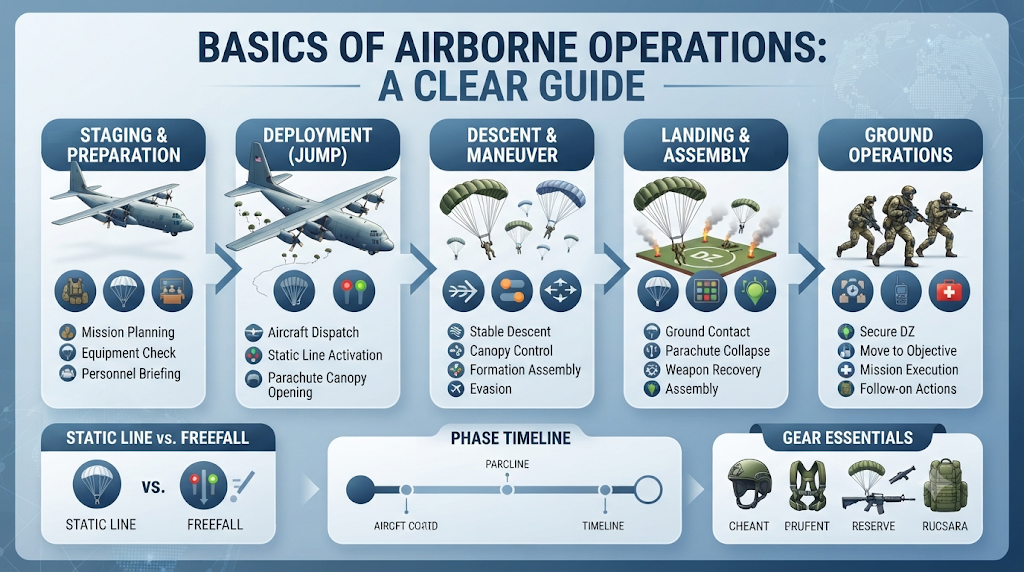
Airborne operations drop soldiers into a fight from the sky. No roads, no ports, and no warning for the enemy. This guide covers the basics of airborne operations in plain terms. You will learn the types, the phases, the risks, and how armies judge success.
Armies have used parachutes in war since the 1930s. Germany seized the island of Crete from the air in 1941. Allied paratroopers dropped into Normandy before the beach landings in 1944. The core idea has not changed since those days. Deliver a fighting force by air, land it on a chosen spot, and seize the objective before the enemy can react.
What Are Airborne Operations?
An airborne operation is a military move that delivers combat troops by air. The soldiers land by parachute or by aircraft, and they fight at once. The goal is simple enough. Place force where the enemy is weak, quickly, and with complete surprise.
Most airborne missions fit one of four shapes. A seizure takes a key point and holds it until help arrives. A raid hits a target and leaves before the enemy recovers. A show of force signals intent without firing a shot. A support mission drops aid, gear, or small teams deep behind the lines.
The key trade-off is weight. You can move troops across long distances very fast by air. But heavy tanks and large supply loads do not drop easily. Airborne units pack light and count on speed instead of armor.
A Short History Worth Knowing
The idea took shape between the world wars. Russia and Germany built the first serious parachute forces. Crete in 1941 was the first big island captured by air alone. The cost was so high that Germany never tried a drop that size again.
The Allies learned from those lessons. On D-Day in 1944, paratroopers landed behind the beaches to seal roads and bridges. Operation Market Garden that same year showed the limits. Dropped units that could not be relieved took heavy losses. Every airborne plan since balances two things: speed of arrival and certainty of relief.
The Main Types of Airborne Insertion
Static line parachuting
This is the classic paratrooper method. The chute is tied to a cable inside the plane. When you jump, the static line pulls the chute open for you. No skill is needed to open the chute, and that is the whole point. You jump from about 800 to 1,250 feet. You reach the ground in under a minute. Mass drops of hundreds of troops rely on this method.
Freefall: HALO and HAHO
HALO means High Altitude, Low Opening. You exit at about 25,000 feet, freefall, and open the chute low. HAHO means High Altitude, High Opening. You open the chute high and glide a long way, sometimes tens of miles. Both methods need oxygen above about 14,000 feet. Small, quiet teams use these jumps when stealth matters more than numbers.
Air assault
Air assault moves troops by helicopter instead of parachute. The aircraft lands or hovers low, and the troops step out fast. This method is flexible and precise, and it can be repeated all night. It also places expensive aircraft close to ground fire. The 101st Airborne Division made this approach famous.
Air landing
Here the planes land on a captured or friendly strip, and the troops simply step off. This method moves more gear than a drop can. But it needs a usable runway that the enemy has not blocked or wrecked.
| Method | Best for | Speed to fight | Main limit |
|---|---|---|---|
| Static line | Mass drops of troops | Very fast | Rough landings, wide spread |
| HALO/HAHO | Small stealth teams | Medium | Needs oxygen and deep skill |
| Air assault | Precision moves | Fast | Aircraft exposed to fire |
| Air landing | Heavy gear and vehicles | Fast | Needs a usable runway |
How an Airborne Operation Unfolds
Phase 1: Planning and briefing
Every drop starts with a target and a plan. The staff pick the drop zone, study the wind and weather, and set the timing to the minute. Then they brief the troops in full. A good brief covers the mission, the flight route, the assembly point, and the plan for things going wrong.
Phase 2: Marshalling
Troops draw their gear, rig their chutes, and load the planes. This stage is slow, quiet, and strict. Every strap and every bundle gets checked, then checked again by different hands. Marshalling ends with the troops seated, hooked to the cable, and ready to go.
Phase 3: Air movement
The aircraft fly to the drop zone in formation. The time over target is planned to the second. Enemy air defenses shape the route, and the pilots often fly low to stay under radar. A delay of one minute can push a whole drop off its zone.
Phase 4: The drop
Jumpmasters watch the green light and call the exit. Paratroopers leave the door in a steady stream. Each jumper waits a beat so the chute above clears the plane. A full plane can empty in well under a minute over the zone.
Phase 5: Assembly and ground action
This is the hardest part of the mission. Troops land spread across hundreds of yards of ground. Each soldier must shed the chute, recover the weapon, and move to the assembly point. Lights, sound, and runners guide them in the dark. Small units form first, then larger ones. Once assembled, the unit fights for the objective.
The People Who Make It Work
Pathfinders go in first and mark the drop zone with lights and radar beacons. Jumpmasters run the exit inside the aircraft. Drop zone support teams on the ground steer the pilots and flag problems live. Air dispatchers handle the heavy drops of vehicles and gear. Every role has one clear job: put the force on target, on time.
Equipment Basics
The main US Army parachute today is the T-11. It descends slower and steadier than the older T-10 model. A reserve chute backs up the main one on every jump. Troops carry their rifle in a kit bag lowered on a cord, so it does not slam into them at landing. Heavier gear, from ammunition to light vehicles, drops on cargo chutes rigged to pallets. Freefall teams add altimeters, oxygen masks, and navigation aids.
Strengths and Limits
The strength of airborne operations is reach plus surprise. You can strike far behind enemy lines with no need for roads or ports. A dropped force can seize a bridge, an airfield, or a choke point within hours.
The limits are just as real. Dropped troops land light, without tanks or heavy guns. Weather can cancel a drop with no notice. Strong wind can scatter a unit across whole miles of ground. Once the force has dropped, there is no recall button. Relief must arrive on schedule, or the force risks being cut off.
What Can Go Wrong
Weather is the top killer of airborne plans. High winds tear chutes and drag jumpers across the ground. Fog hides drop zone markers. Low cloud pushes entire sticks off target.
Dispersion is the next danger. A drop that lands wide splits a unit into weak fragments. History shows this happens even in famous, successful operations.
Rigging and maintenance errors claim lives every decade. A badly packed chute simply fails. A loose kit cord can break a wrist or worse.
Enemy fire adds risk at the door and on the ground. Transport planes are large, slow targets near a defended zone.
The answer to all of this is constant training. Strict checks at every step. A backup for every key task. And a plan that still works if the drop lands a mile wide.
When Armies Should Not Go Airborne
Skip the drop when the weather is poor or the forecast is thin. Skip it when the drop zone is strongly held by the enemy. Skip it when a ground force can reach the same goal faster. Never drop a unit you cannot resupply or relieve within the plan. Airborne operations trade armor for speed. If the mission truly needs armor, choose a different tool.
How Soldiers Qualify
The US Army runs a basic airborne course that lasts three weeks. Week one covers ground drills and exits from a mock door. Week two adds tower jumps and chute control training. Week three ends with five live jumps from real aircraft. Pass them all, and you earn your jump wings. Freefall schools add weeks more of training. Qualified jumpers keep their skills sharp with jumps spread through the year.
How Units Verify Success
Units grade every drop on hard facts. Did the force land on the correct zone? How long did the assembly take from the first jumper? How many troops or bundles were lost or damaged? How fast could the unit actually fight after landing? After the mission, a review asks what failed and why it failed. Good units track these numbers over time and attack their weak spots.
Common Mistakes to Avoid
- Skipping full kit checks. One bad rig can cost a life.
- Poor drop zone study. Wind and terrain decide the whole plan.
- No rally plan. Troops who cannot find each other cannot fight.
- Dropping troops you cannot resupply on schedule.
- Treating assembly as an afterthought. Assembly is the whole game.
Quick checklist before any drop:
- Drop zone studied and marked
- Weather checked at go/no-go time
- Chutes and kit rigged and double-checked
- Assembly points and signals set
- Relief or resupply plan in place
- Abort rules clear for every leader
Frequently Asked Questions
Q1. What does airborne mean in the military?
It means troops trained to fight after arriving by aircraft. Most people mean parachute troops. The term also covers helicopter moves and air landings.
Q2. What is the difference between airborne and air assault?
Airborne troops jump from planes by parachute. Air assault troops ride helicopters and step out low. Both units fight fast after they land.
Q3. How high do paratroopers jump from?
Static line jumps run from about 800 to 1,250 feet. Freefall teams exit near 25,000 feet. Each method serves a very different job.
Q4. How long does airborne school take?
The US Army basic course lasts three weeks. It ends with five live jumps. The wings come after the last one.
Q5. Do paratroopers steer their chutes?
Yes, but only a little. Modern chutes have risers for slight turns. The drop plan counts on drift, not steering skill.
Q6. What happens if a soldier lands off the drop zone?
They rally to the nearest assembly point on the map. Units drill this over and over. Leaders collect stray troops as they arrive.
Q7. Why do troops jump at night so often?
Night hides the planes, the drop, and the troops. It buys real surprise. Night jumps also raise the risk of wide dispersion.
Q8. Can vehicles be dropped by parachute?
Yes. Light vehicles and guns drop on cargo chutes and pallets. The weight limits are strict, and the rigging is checked twice.
Q9. Which units are famous for airborne work?
The US 82nd Airborne Division and the UK Parachute Regiment lead the list. Germany and Russia built the first large forces in the 1930s.
Q10. Where should I learn more?
Start with unit histories of the 1940s drops. Then read current field manuals on the subject. Both are open to the public.
Conclusion
Airborne operations trade weight for speed and surprise. Learn the four insertion types, the phases of a drop, and the hard limits of weather and relief. Then study real drops from history with a map at hand. That habit will teach you more than any summary can.
10 SEO-Friendly Titles
Awareness titles:
- What Are Airborne Operations? A Simple Guide
- How Paratroopers Really Land and Fight
- Airborne Operations: The Basics, Explained
- Inside a Military Parachute Drop
- Airborne Ops: What Everyone Gets Wrong
Google-ranking titles:
- Basics of Airborne Operations: Full Guide
- Types of Airborne Operations: A Comparison
- How Airborne Operations Work, Step by Step
- Static Line vs HALO vs Air Assault Jumps
- Airborne Operations: Phases, Risks, and Rules
Top 6 Hashtags
#AirborneOperations, #Paratroopers, #MilitaryHistory, #HALOJump, #AirAssault, #WarOpsX