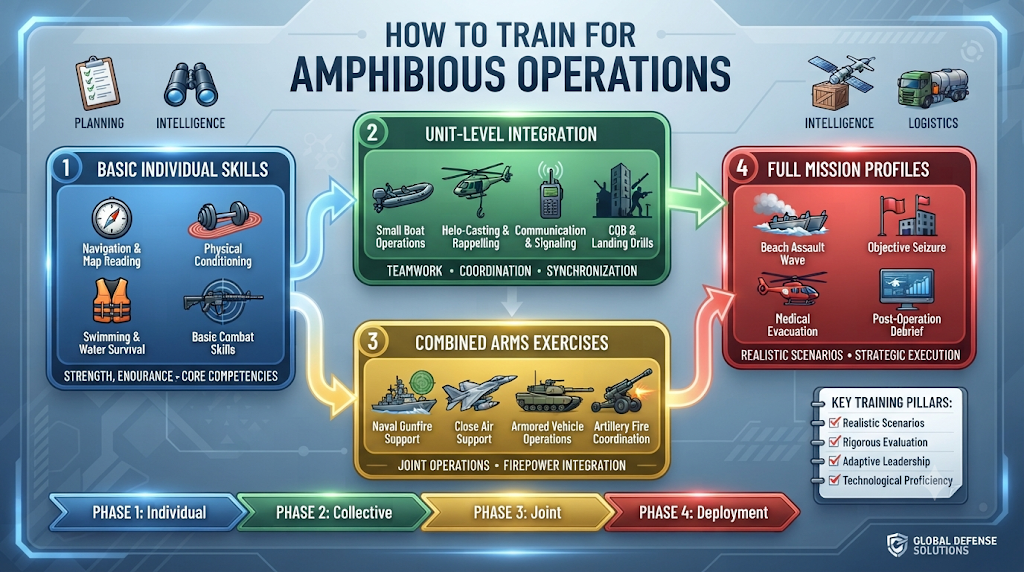
Amphibious operations remain among the most demanding military undertakings, requiring forces to transition seamlessly from ship to shore under contested conditions. The training challenge is not simply building swim fitness or boat-handling skills—it is forging the coordination between naval and ground elements that makes a landing possible at all. Units that treat amphibious training as an occasional add-on consistently fail at the ship-to-shore interface, where tides, surf, equipment weight, and communication gaps compound into mission-ending problems.
This guide examines the training sequence that actually prepares personnel for amphibious operations. It covers the foundational skills, the integration phases, the safety constraints that are not optional, and the failure modes that experienced planners watch for. The focus is on the training pipeline as practiced by units with established amphibious roles, with the assumption that readers are either building a program from scratch or auditing an existing one.
What Amphibious Training Actually Requires
Amphibious operations are not a single skill. They are a cluster of competencies that must function together under time pressure and environmental uncertainty. At minimum, a training program must develop water survival and confidence, small-boat handling and navigation, ship-to-shore movement procedures, equipment preparation and embarkation, and the command-and-control habits that keep a landing on schedule when the first three elements encounter friction.
The U.S. Marine Corps defines amphibious training tasks in granular terms. One formal performance step for over-the-horizon operations requires personnel to prepare for combat, assist in launching the boat, perform assigned duties in transit (navigation, coxswain, timekeeping), conduct immediate action drills, and recover the boat—all while operating as part of a team . This level of procedural specificity is instructive: amphibious competence is built from dozens of discrete tasks, each of which can fail independently.
The training setting matters as much as the content. The Marine Corps classifies surf passage and small-boat operations as high-risk training, requiring safety swimmers, signaling devices for night operations, and adherence to surf-safety instructions . Any program that treats water entry as a routine physical event rather than a controlled hazard is setting itself up for an avoidable casualty.
Phase 1: Water Competence and Confidence
Before tactical boat work begins, personnel need functional comfort in the water while carrying equipment. This is not competitive swimming. It is the ability to enter water unexpectedly, right oneself, and assist others without panic.
Marine Corps water survival training explicitly ties aquatic competence to mission readiness. The program notes that water provides 12–14 percent more resistance than air, making aquatic training an efficient way to build strength while reducing joint stress—but the operational rationale is more direct: Marines must be prepared to survive and function in aquatic environments with full combat gear . Minimum swim qualifications exist, but commanders are encouraged to exceed them because the baseline qualification does not replicate the fatigue and equipment burden of an actual water insertion .
For units without an established water survival pipeline, the practical starting point is a graduated pool or calm-water sequence: equipment ditch and recovery, treading water in boots and uniform, buddy-assisted towing, and night entries with signaling devices. These are prerequisite skills, not amphibious training proper, but skipping them produces predictable failures later.
Phase 2: Small-Boat Handling and Over-the-Horizon Movement
Once water competence is established, training moves to the boats themselves. The Republic of Korea Marine Corps’ basic amphibious raid training illustrates the progression: trainees first build physical fitness and practice paddling form on land, then move to waterborne paddling and maneuvering, and finally execute procedures under simulated operational conditions . The sequence is deliberately conservative—land rehearsal before water execution—because boat errors in surf are costly.
U.S. Marine Corps training for over-the-horizon operations includes a similar progression, with performance steps covering boat launch, in-transit duties (navigation, coxswain responsibilities), immediate action drills, and boat recovery . The inclusion of immediate action drills is significant: trainees must practice what to do when the engine fails, the surf swamps the boat, or the landing point is compromised. These contingencies are not edge cases in amphibious operations; they are expected friction.
For units operating inflatable boats, the physical handling of the craft is itself a training objective. Korean Marine Corps reports describe teams of six to eight personnel managing 140-kilogram inflatable boats, with repeated drills building both technical proficiency and the teamwork that comes from shared physical burden . This is not incidental. A crew that cannot carry its own boat to the waterline has a limited operational envelope.
Phase 3: Ship-to-Shore Integration
The transition from independent boat training to integrated amphibious operations is where most programs fail. Individual boat crews may be proficient, but the ship-to-shore movement requires synchronization with naval assets, landing plans, and supporting arms that no small-unit training can replicate.
U.S. Navy and Marine Corps pre-deployment training provides a model for this integration. The Amphibious Ready Group and Marine Expeditionary Unit complete a phased workup that includes embarkation (practicing flight deck qualifications, amphibious assaults, and ship-to-shore transport), integrated training (air defense, land air assaults, communications, and standard operating procedures), and debarkation . The integrated phase is the longest, reflecting the reality that coordination—not individual skill—is the binding constraint.
At the staff level, Marine Corps University’s expeditionary operations curriculum devotes multiple weeks to amphibious planning, including landing plan development, ship-to-shore movement execution, landing beach criteria, and the serial assignment tables that allocate craft and personnel to waves . This is the planning layer that boat crews rarely see but that determines whether their training translates into a coherent landing.
For units without access to amphibious shipping, synthetic training and tactical floor games can partially substitute. The Indonesian Navy uses tactical floor games to validate amphibious doctrine revisions, simulating embarkation, voyage, landing, and consolidation phases to build decision-making speed and cross-element collaboration . These tabletop exercises do not replace live ship-to-shore drills, but they surface planning errors before they become safety incidents.
Phase 4: Enabler Integration
Amphibious operations involve more than infantry and coxswains. Special operations enablers, intelligence personnel, and combat support elements increasingly receive maritime familiarization because they deploy with teams that operate from small craft.
The U.S. Army’s 1st Special Forces Group runs a Maritime Operations Familiarization Course for enablers that covers open-water swimming, small-boat helmsmanship, outboard engine troubleshooting, and boat assembly and launch . A signals analyst quoted in Army reporting described the boat assembly process as unforgiving: “Going back and having to disassemble a boat because one of the first few steps was done wrong is definitely strong encouragement to do it right the first time” . The cadre’s rationale is operational: “In the Pacific, our teams operate across isolated islands and contested coastlines—there are no passengers in a Zodiac” .
For training planners, the implication is that amphibious readiness is not confined to designated amphibious units. Any element that might deploy into a littoral environment needs at least familiarization-level water and boat training, or it becomes a liability rather than an asset to the team it supports.
Safety and Risk Management: Non-Negotiable Controls
Waterborne training injures and kills when safety controls are treated as paperwork. The U.S. Marine Corps’ training standards are explicit: surf training requires safety swimmers, day and night signaling devices for swimmers, illumination marking for night swims, and compliance with higher-level surf safety and high-risk training instructions . Korean Marine Corps amphibious training includes pre-, during-, and post-training risk assessments, with safety measures adjusted for weather and sea state, and heat illness prevention during summer training .
The most common failure in amphibious training safety is the assumption that calm-water competence transfers to surf. It does not. A training program that conducts all boat drills in flat water and then executes a surf passage on the final day is not a progressive program; it is a hazard. Surf conditions should be introduced incrementally, with go/no-go criteria based on wave height, period, and personnel experience level.
Common Failure Modes and How to Avoid Them
Failure mode 1: Boat skills without water survival. Crews that can handle a boat but cannot survive a swamping are not amphibious-ready. The fix is sequential training: water survival first, boat handling second, never the reverse.
Failure mode 2: Individual proficiency without crew synchronization. A coxswain who can navigate does not constitute a boat crew. Repeated crew drills—launch, transit, immediate action, recovery—build the muscle memory that holds under stress .
Failure mode 3: Live training without planning rehearsal. Units that go straight from pool to surf skip the planning layer that amphibious operations require. Tactical floor games, landing plan exercises, and serial assignment drills should precede live execution .
Failure mode 4: Treating amphibious training as an annual event. The Marine Corps sets a 12-month sustainment interval for over-the-horizon boat operations, but proficiency in surf and small-boat handling degrades faster than that if not rehearsed . Quarterly water time is a more realistic floor for units with an actual amphibious mission.
Failure mode 5: Ignoring the enablers. Intelligence analysts, communicators, and medics attached to amphibious teams need at least familiarization training. The 1st Special Forces Group’s approach—open maritime familiarization to all enablers—prevents the situation where a team’s technical expert becomes a passenger in the boat .
How to Validate That Training Worked
Amphibious training validation is not a written test. The meaningful metrics are behavioral and observable:
- Boat crew drills under time pressure: Can a crew launch, transit a specified distance, execute an immediate action drill, and recover the boat within a defined standard? If the standard is not written, write one before the next drill.
- Surf entry with equipment: Can personnel enter and exit surf with full load without assistance, in daylight and at night? This is a go/no-go event, not a graded one.
- Ship-to-shore serial execution: In a rehearsal, does the landing occur on the planned schedule, with the correct craft and personnel in the correct waves? Deviation rates above a threshold (set by the unit) indicate planning or communication gaps, not personnel failure.
- Enabler participation: Can attached personnel assemble, launch, and recover a boat with minimal supervision? If not, the familiarization training did not achieve its purpose.
Frequently Asked Questions
Q1. What is the first step in training for amphibious operations?
Water survival and confidence training, not boat handling. Personnel must be able to function in water with equipment before they can safely operate small craft. The sequence is deliberate: water competence, then boat skills, then integration.
Q2. How long does amphibious training take?
Basic water survival and boat familiarization can be achieved in one to two weeks of concentrated training. Full ship-to-shore integration at the unit level takes months and requires access to amphibious shipping or high-fidelity simulation. Korean Marine Corps basic amphibious raid training runs approximately ten days for initial skills .
Q3. Do all personnel in an amphibious unit need to swim?
Yes, at a functional level. Minimum swim qualifications exist, but commanders are encouraged to exceed them because baseline qualification does not replicate equipment burden and fatigue . Enablers attached to amphibious teams need at least water survival familiarization.
Q4. What is the most common mistake in amphibious training?
Skipping the planning and rehearsal layer. Units that train boat skills in isolation but never rehearse landing plans, serial assignments, and ship-to-shore timing produce crews that cannot function in an integrated landing .
Q5. Can amphibious training be done without access to naval ships?
Partially. Small-boat handling, water survival, and crew drills can be conducted from shore. Planning exercises and tactical floor games can build staff proficiency . But full ship-to-shore integration requires either amphibious shipping or high-fidelity simulation that most units do not have organic access to.
Q6. How often should amphibious skills be refreshed?
The Marine Corps sets a 12-month sustainment interval for over-the-horizon boat operations . For units with an actual amphibious mission, quarterly water time is more realistic because surf and small-boat proficiency degrades faster than annual training can arrest.
Q7. What safety controls are mandatory for waterborne training?
Safety swimmers, signaling devices for all swimmers (especially at night), illumination marking for night operations, and compliance with surf safety instructions. Training should be classified as high-risk and governed by the appropriate risk management directive .
Q8. How do enablers fit into amphibious training?
Enablers—intelligence, communications, medical, and support personnel—should receive at least maritime familiarization covering boat assembly, launch, and basic water survival. The operational rationale is that in small-craft operations, there are no passengers; everyone must contribute .
Q9. What distinguishes amphibious training from general water survival?
Amphibious training adds boat handling, navigation, ship-to-shore procedures, equipment embarkation, and integrated planning on top of water survival. Water survival is a prerequisite, not the objective.
Q10. How is amphibious training evaluated?
Through observed performance under realistic conditions: timed boat drills, surf entries with equipment, and integrated landing rehearsals with measured adherence to the landing plan. Written tests do not capture the coordination failures that matter.
Conclusion
Amphibious training succeeds or fails at the seams—between water and boat, between boat and ship, between planning and execution. Build the foundation first: water survival, then crew drills, then integration with naval and planning elements. Treat safety controls as operational requirements, not administrative overhead. The units that train this way are the ones that can still execute when the surf is higher than forecast and the schedule has already slipped.