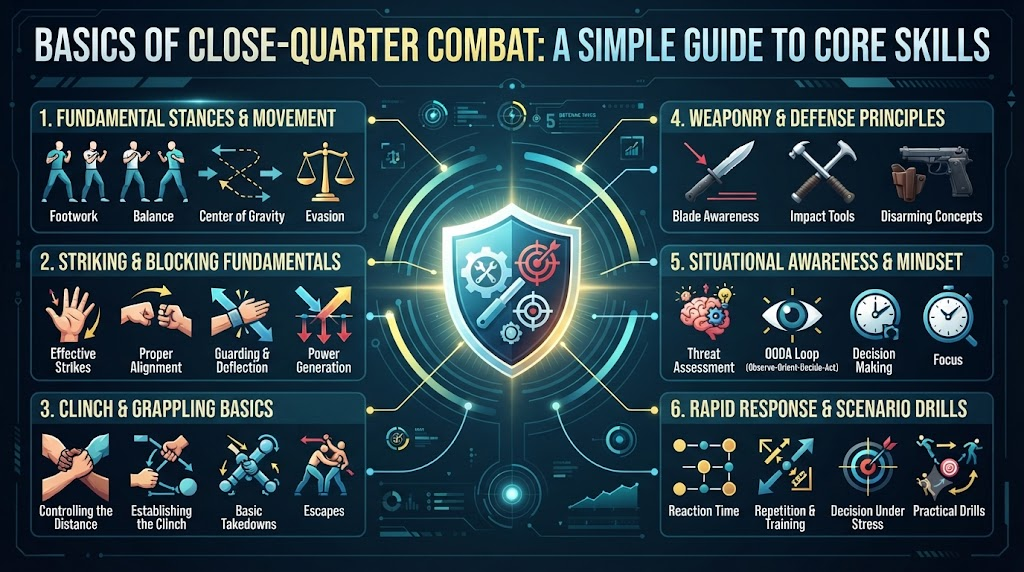
Picture a narrow hallway with a closed door at the end. You cannot see inside. Your team has only seconds to act. That moment is where close-quarter combat begins. Close-quarter combat means fighting at very short range. It happens inside buildings, trenches, vehicles, and tight streets. Space is small and time is short. One mistake can cost a life.
So skill, calm, and teamwork matter more than raw strength. Many beginners think this topic is all about action. It is not. It is about planning, safe habits, clear talk, and sound judgment. Good teams move slowly in training so they can move smoothly when it counts.
In this guide from WarOpsX, you will learn the core ideas in plain English. You will see lessons from history, common mistakes, a 10-step learning roadmap, and 10 clear answers to common questions. This guide covers ideas and training habits only. Real training must happen under qualified instructors.
What Close-Quarter Combat Really Means
Close-quarter combat is fighting at very short range, usually inside buildings or other tight spaces, where teams have little room and little time to react.
Armies, police units, and rescue teams all study it. The goal is not just to win a fight. The goal is to finish a mission, protect your team, and protect people who are not fighting.
Most close fights are short. Many last only seconds. That is why training matters so much. You cannot learn in the moment. You can only use what you already practiced.
The Three Words That Define It
Experts often boil the topic down to three ideas: surprise, speed, and control. Surprise gives you the first advantage. Speed keeps the other side from reacting. Control keeps your own team safe.
Notice that control comes last in the list but first in importance. Fast and sloppy teams make deadly errors. Fast and controlled teams finish the job.
Why Tight Spaces Change Everything
Fighting in a field is not like fighting in a hallway. Distances shrink. Walls block your view. Doors, corners, and stairs create blind spots. Noise echoes and confuses everyone.
Here is a simple comparison.
| Factor | Open-Area Fight | Close-Quarter Fight |
|---|---|---|
| Distance | Long | Very short |
| View | Wide and clear | Blocked by walls and corners |
| Reaction time | Several seconds or more | Often a fraction of a second |
| Communication | Radio and hand signals | Short voice calls and touch signals |
| Biggest risk | Being seen from far away | Surprise from a nearby corner |
| Key skill | Movement and cover | Awareness and teamwork |
The table shows one big truth. In tight spaces, the enemy can be one step away and still be invisible. So your habits must protect you before you see any threat.
Small Teams Beat Big Crowds
Large groups jam up in narrow spaces. People block each other’s view. People step into each other’s line of fire. That is why most close-quarter work uses small teams with clear roles.
Each person knows what to watch. Each person knows where to go. Nobody guesses.
The Core Principles Every Beginner Should Know
Think of these principles as the base of a house. Without them, advanced skills fall apart.
Surprise
Surprise means the other side is not ready when you arrive. You get it through quiet movement, good timing, and smart planning. A team that wastes its surprise gives up its best advantage.
Speed With Control
Speed does not mean running. It means moving without long pauses. Pauses give the other side time to think. But rushing causes mistakes. The best teams move at a pace where everyone can still see, think, and decide.
Clear Roles
Every team member has a job. One person leads. Others cover different directions. Someone watches the rear. When roles are clear, nobody freezes and nobody repeats the same task.
Safe Weapon Handling
Safety rules never take a day off. Keep your weapon pointed in a safe direction. Keep your finger off the trigger until you decide to act. Know what is beyond your target. These rules protect your teammates, and your teammates are the people closest to you.
Awareness: Seeing Danger Before It Sees You
Awareness is the quiet skill behind every good team. It means knowing what is around you at all times.
In a building, danger hides in predictable places. Doorways, corners, stairs, and windows are the big ones. A doorway is risky because it limits your movement and shows your shape to anyone inside. Trainers often call this area the “fatal funnel.” The name sounds scary, and it should. The lesson is simple: do not stand still in a doorway.
Angles and Sectors
Each person on a team watches one slice of space. This slice is called a sector. When every sector is covered, no gap remains. When two people watch the same slice, another slice goes unwatched.
Think of it like a group of friends watching a crowded street. If everyone looks left, nobody sees the right.
Reading the Room
Look for clues before you act. Sounds, light, smells, and signs of recent movement all tell a story. Good practitioners collect small clues and build a picture. This habit also connects to the intelligence work covered in WarOpsX’s military analysis guides.
Knowing Your Target: Judgment and Rules
Skill with movement means little without judgment. Every action must follow the law and the rules of the mission.
Close-quarter spaces often hold people who are not fighting. Families live in buildings. Workers hide in offices. Hostages sit in rooms. So teams must identify who is a threat and who is not before they act.
This takes a clear head. It also takes training that adds stress, so the brain learns to think under pressure. Under the laws of armed conflict, armies must protect civilians as much as they can. Police and rescue teams follow their own local laws.
Why Judgment Beats Speed
A fast wrong decision is worse than a slow right one. Teams that rush often hurt people they never meant to hurt. Strong teams practice stopping, checking, and choosing. That pause may last half a second, but it saves lives.
Fitness, Stress, and the Mind
Close-quarter work asks a lot from your body. You carry gear. You climb stairs. You crouch, turn, and move in cramped spaces. Strong legs, a strong core, and good breathing help every step.
But the mind matters even more. Stress shrinks your focus. Your heart pounds. Your hands shake. Time seems to change. Without training, you may freeze or fixate on one thing.
Simple Ways to Stay Calm
Slow, steady breathing lowers stress. Many trainers teach a basic pattern: breathe in for four counts, hold for four, breathe out for four. Practice it daily so it feels natural.
Also train with realistic pressure. Add time limits, noise, and surprise to drills. Over time, your body learns that pressure is normal. This is called stress inoculation, which simply means getting used to stress in a safe setting.
Training That Actually Works
Good training builds skill in layers. You start slow and safe. Then you add speed, stress, and realism.
| Training Type | What It Teaches | Risk Level |
|---|---|---|
| Walk-through drills | Movement, roles, and calls | Very low |
| Dry practice (no live ammunition) | Handling and safety habits | Low |
| Simulation and marking gear | Decision-making under pressure | Moderate, with safety gear |
| Full-team scenarios | Teamwork and timing | Moderate, with strict control |
Always train under qualified instructors in approved places. Never skip safety checks. A sloppy training day can cause a real injury.
Why Repetition Matters
Repetition turns actions into habits. Habits hold up under stress. A move you practiced 500 times needs almost no thinking. A move you saw once needs a lot, and you will not have the time.
Medical Readiness: The Skill Nobody Wants to Use
Every team must know basic first aid. In close fights, injuries happen fast, and help may take time to arrive.
The most important skill is stopping heavy bleeding. Teams train to apply a tourniquet, which is a strap that squeezes a limb to slow blood loss. They also learn to keep an injured person warm and calm until medics arrive.
This skill belongs in the core list, not the extras list. A team that cannot treat its own members is not ready. Many seasoned trainers say first aid training is the most valuable training of all.
Real-World Stories and Lessons
History offers plenty of lessons. Here are ten, some from real events and some from common training experiences.
- Iranian Embassy siege, London, 1980: A British special forces team ended a hostage crisis in a short, fast assault. Careful planning and rehearsal made that speed possible.
- Entebbe raid, 1976: Israeli forces rescued hostages from an airport terminal far from home. Surprise and tight teamwork let them finish in about an hour and a half.
- Mogadishu, 1993: A raid planned to be short turned into an overnight fight. The lesson is to plan for missions to run longer, with extra water, medical supplies, and radio batteries.
- Fallujah, 2004: Marines cleared buildings room by room. They learned to mark cleared areas clearly so no one walked into a space behind them.
- Grozny, 1994–95: Armored columns drove into narrow streets and took heavy losses. Vehicles alone cannot hold tight city spaces without foot soldiers beside them.
- Stalingrad, 1942: Both sides fought in ruined buildings, and small, flexible assault groups worked best. Big formations got stuck in the rubble.
- Hue, 1968: Thick stone walls and narrow streets slowed the fight for weeks. Patience and teamwork between units mattered more than speed.
- Mosul, 2016–17: Fighters hid among civilians for months. Teams had to separate threats from bystanders in nearly every street.
- A common training story, friendly crossfire: Two teams enter the same building from different sides without a shared plan. They nearly mistake each other for threats. Shared plans and clear calls prevent this.
- A common training story, the missed first-aid drill: A team trains hard on movement but skips medical practice. When a trainee “gets hurt” in a drill, nobody knows what to do. Medical practice belongs in every session.
Common Mistakes and Pitfalls
Beginners repeat the same errors. Learn them now and save yourself pain later.
- Rushing in: Speed without control causes accidents. Fix it by practicing slow, smooth movement first.
- Freezing in doorways: Standing still in a doorway makes you an easy target. Train to move through and clear the space.
- Weak communication: Silence leads to confusion. Use short, clear calls that every teammate knows.
- Poor weapon discipline: Pointing a weapon at a teammate, even for a second, can kill. Repeat safety rules until they are automatic.
- Tunnel vision: Stress narrows your focus to one thing. Train with distractions and scan your sector often.
- Overlapping sectors: Two people watching the same area leave another area open. Assign sectors before every drill.
- Skipping rehearsals: Teams that skip rehearsal improvise under stress. Walk the plan first, every time.
- Ignoring fitness: Tired people make bad choices. Build strength, balance, and breathing control.
- Trusting gear too much: Gear can fail, and it never replaces judgment. Train with and without your favorite tools.
- Forgetting people who are not fighting: Rushed teams may overlook bystanders. Practice identifying targets in every drill.
Step-by-Step Learning Roadmap
Follow these steps in order. Do not skip ahead.
- Learn the safety rules first. Study weapon safety, range rules, and local laws. Safety is the base of everything else.
- Find a qualified instructor. Pick a trainer with real experience and a clean safety record. Never learn this alone.
- Study the core principles. Learn surprise, speed, control, and clear roles until you can explain them in your own words.
- Build your fitness. Work on legs, core, balance, and breathing. A strong body makes every drill easier.
- Practice basic movement. Walk through rooms and hallways slowly with no gear. Focus on balance, angles, and quiet steps.
- Learn team calls and signals. Agree on short words and hand signs. Practice them until they feel natural.
- Train in pairs, then small teams. Start with two people. Add more only when the pair works smoothly.
- Add pressure step by step. Bring in time limits, noise, and surprise. Raise the stress slowly, never all at once.
- Learn first aid. Take a certified course in bleeding control and basic care. Review it often.
- Review and repeat. After every session, talk about what went well and what went wrong. Then train again.
FAQs
1. What is close-quarter combat in simple words?
Close-quarter combat is fighting at very short range, usually inside a building, trench, or vehicle. Space is tight and time is short. Teams use planning, teamwork, and clear communication to finish a mission safely.
2. Who studies close-quarter combat?
Soldiers, police tactical teams, and rescue units all study it. Each group has a different goal. Soldiers focus on missions, police focus on protecting the public, and rescue teams focus on saving lives.
3. Why is fighting indoors so dangerous?
Walls block your view, and corners hide threats. Distances are tiny, so reaction time shrinks to a blink. People who are not fighting may also be nearby, which raises the risk of tragic mistakes.
4. What does “fatal funnel” mean?
It is a trainer’s term for the area around a doorway. A doorway limits movement and shows your outline to anyone inside. The lesson is to avoid stopping there and to move through with control.
5. Why do teams train in small groups?
Small groups fit through narrow spaces and avoid blocking each other. Each person has a clear job and a clear sector. Large groups jam up, lose track of each other, and risk friendly mistakes.
6. How important is physical fitness?
Fitness matters a great deal. You carry gear, climb stairs, and move in cramped places. A fit body stays steady longer, which helps your mind think clearly when stress rises.
7. How do trainers teach calm under stress?
They add pressure little by little. Drills start easy and then include time limits, noise, and surprises. Breathing practice also helps. Over time, the body learns to stay steady when stress rises.
8. Can I learn this from videos alone?
Videos can teach ideas, but they cannot teach safe habits. You need a qualified instructor who can correct your mistakes in real time. Hands-on guidance is the only safe way to build real skills.
9. What role does first aid play?
First aid is a core skill, not an extra. Injuries happen fast, and heavy bleeding can become deadly within minutes. Teams train to stop bleeding and care for the injured until medics arrive.
10. How do teams protect people who are not fighting?
They practice identifying targets before they act. They use clear rules, short pauses, and strong communication. Training with realistic stress helps teams make careful choices when seconds feel like they are racing by.
Final Recommendation and Next Steps
Close-quarter combat looks simple from the outside. A door opens, a team moves, and it is over. But inside those few seconds sits months of careful training. The people who do this work well are the ones who respect that fact.
Start with safety. Every skill in this guide rests on safe habits. If you remember only one thing, remember that careful practice protects real people. Speed grows from control, never the other way around.
Next, build the base. Work on your fitness, your breathing, and your focus. A calm body supports a calm mind. A calm mind makes better choices when pressure hits.
Then find real teachers. A qualified instructor sees mistakes you cannot see. They also keep training safe, legal, and useful. Good teachers are worth far more than any piece of gear.
After that, practice as a team. Learn the calls, share the plan, and review every session honestly. Small teams that talk well and trust each other will beat bigger groups that do not.
Finally, keep learning. Read about history, study how past teams succeeded and failed, and explore related topics like military intelligence analysis on WarOpsX’s other guides. Strong close-quarter skills grow from steady habits, honest reviews, and respect for every life in the room.