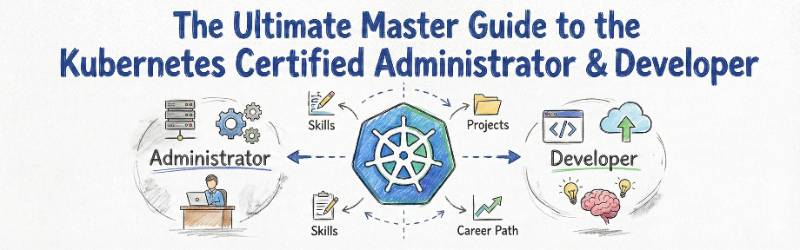
Through my long career in software engineering, I have watched the technology landscape completely transform. I saw teams struggle with physical servers, transition to virtual machines, and finally embrace the cloud. However, container orchestration has been the most massive shift of all. Kubernetes is no longer just a helpful tool. It is the core operating system of the modern digital world. If you work as an engineer in India or manage a tech team anywhere across the globe, you need solid proof of your cloud-native skills. The Kubernetes Certified Administrator & Developer (KCAD) program gives you exactly that. It forces you to prove your hands-on skills in a live, high-pressure environment. It separates the people who only read the manual from the experts who can actually fix a broken system.
The Complete Certification Landscape Table
Here is a simple look at the entire ecosystem. This table shows you the different tracks, who they are for, and in what order you should take them.
| Certification Track | Skill Level | Target Audience | Required Background | Key Skills Covered | Suggested Order |
| KCAD | Professional | Software Engineers & Managers | Basic Linux & Docker | Cluster Admin + App Deployment | 1st (Core Foundation) |
| DevSecOps | Specialist | Security Focused Engineers | KCAD / K8s Knowledge | RBAC, Vault, Security Policies | 2nd (Security Route) |
| SRE | Expert | Reliability Leads | KCAD + Strong Networking | SLOs, Deep Observability | 2nd (Reliability Route) |
| AIOps | Advanced | Data & ML Engineers | KCAD + Python | Machine Learning for Ops | 3rd (Future Tech) |
| DataOps | Specialist | Data Engineers | KCAD + SQL/Pipelines | Big Data on Containers | 3rd (Data Flow) |
| FinOps | Management | Managers & FinOps Leads | Cloud Basics | Cost Control, Quotas | 3rd (Business Logic) |
A Closer Look at the KCAD Certification
Let us dive deep into what makes the KCAD so important. This section breaks down the exact skills you will learn, the projects you will build, and how to study for the exam.
Exactly What It Is
The KCAD program is a hands-on test of your real-world abilities. It verifies that you can install, configure, and maintain a live Kubernetes cluster. It also proves you can write the code and design the architecture for applications running inside that cluster. You do not answer multiple-choice questions; you type commands into a real terminal to solve problems.
The Ideal Candidates for This Exam
Software Engineers, System Administrators, and DevOps practitioners get the most value from this exam. You must take this if you want to design cloud-native systems. Engineering Managers should also take it. When managers understand Kubernetes at a deep technical level, they make much better decisions for their engineering teams.
Core Skills You Will Master
- Building the Foundation: You will learn how to configure control plane nodes, worker nodes, and the ETCD database.
- Deploying Workloads: You will master the deployment of Pods, ReplicaSets, and StatefulSets so your applications never go offline.
- Managing Network Traffic: You will understand how to route internet traffic using Ingress controllers, LoadBalancers, and ClusterIP services.
- Controlling Storage: You will learn to save application data permanently by attaching Persistent Volumes and Persistent Volume Claims to your containers.
- Fixing Broken Systems: You will gain the ability to read container logs, find crashed components, and bring broken clusters back to life.
Real-World Projects You Can Complete Afterward
- Cloud Cluster Creation: You will easily build a highly available, multi-node Kubernetes cluster from scratch on providers like AWS, Azure, or Google Cloud.
- Application Migration: You will break down old, massive monolithic applications into small, fast microservices and deploy them safely on Kubernetes.
- Zero-Downtime Updates: You will create rolling update strategies that allow you to push new software versions to your customers without them ever seeing an error page.
- Automated Scaling: You will set up systems that automatically add more servers when your website gets busy and remove them when traffic slows down to save money.
Your Step-by-Step Preparation Plan
- The 7 to 14 Days Sprint: Do you already use Kubernetes at work every day? Focus totally on speed. Practice your
kubectlcommands and take timed mock exams to get faster. - The 30 Days Standard Path: This is the best path for most working engineers. Spend two solid hours every single day writing YAML files and practicing in a live lab environment.
- The 60 Days Beginner Journey: Are you totally new? Spend your first twenty days learning basic Linux commands and Docker. Once you understand containers, spend the next forty days learning Kubernetes.
The Most Common Mistakes to Avoid
- Spacing Errors in YAML: You will fail tasks if you put one extra space in your code. You must become a master of correct YAML formatting.
- Wasting Time on Hard Questions: You have a strict time limit. Do not spend twenty minutes on a question that only gives you two points. Move on and come back later.
- Writing Everything Manually: You will run out of time if you type every YAML file by hand. You must learn to use imperative commands like
kubectl createto generate files quickly. - Working in the Wrong Place: The exam uses multiple clusters. If you fix a problem in the wrong cluster, you get zero points. Always check your context.
The Best Next Step After KCAD
Once you pass the KCAD, you have a solid foundation. The very best next step is to specialize. Most engineers take the Certified Kubernetes Security Specialist (CKS) next. This teaches you how to lock down your cluster and stop hackers from stealing your data.
Picking Your Future Career Route
Kubernetes touches every part of modern software. After you earn your KCAD, you can move your career into one of these six exciting paths.
1. The DevOps Route
This path focuses on pure automation. You will learn how to build pipelines that take code from a developer’s laptop and push it straight into the Kubernetes cluster. You will use tools like Jenkins, Git, and ArgoCD to make software delivery fast and error-free.
2. The DevSecOps Route
Security cannot wait until the end of a project. In this path, you act as the protector. You will use the KCAD skills to enforce strict network policies. You will scan container images for viruses and manage secret passwords safely inside the cluster.
3. The SRE (Site Reliability Engineering) Route
This path is all about keeping the website online. You will use Kubernetes to track the health of your systems. You will master tools like Prometheus and Grafana. You will focus on building self-healing systems that fix themselves before the customer even notices a problem.
4. The AIOps and MLOps Route
Artificial Intelligence needs massive computing power. This path teaches you how to run heavy machine learning models inside Kubernetes. You will also use AI tools to predict when a server might crash so you can replace it ahead of time.
5. The DataOps Route
Companies run on data. In this path, you learn to manage huge databases inside containers. You will learn the advanced storage skills needed to keep data safe when pods restart or servers crash.
6. The FinOps Route
Cloud computing gets expensive very quickly. This path focuses on money. You will use Kubernetes features to set resource limits. You will stop developers from using too much CPU or memory, and you will help your company lower its monthly cloud bill.
Matching Your Job Title to the Right Certifications
This table will show you exactly which certifications match your current or future job title.
| Your Job Title | Recommended Certification Path |
| DevOps Engineer | KCAD + Jenkins Master + Terraform Specialist |
| SRE | KCAD + Prometheus Certified + Observability Expert |
| Platform Engineer | KCAD + Ansible Expert + Cloud Architect |
| Cloud Engineer | KCAD + AWS/Azure/GCP Solutions Architect |
| Security Engineer | KCAD + DevSecOps Certified Professional |
| Data Engineer | KCAD + DataOps Specialist + Big Data Architect |
| FinOps Practitioner | KCAD + FinOps Certified Professional |
| Engineering Manager | KCAD + Agile Leader + Certified DevOps Manager |
The Top Training and Certification Support Institutes
You cannot pass a performance exam just by watching videos. You need real labs and real mentors. Here is a list of the top institutes that provide exactly that.
- DevOpsSchool: They are the absolute global leader for Kubernetes education. They provide an incredible hands-on experience with labs that stay open 24 hours a day. Their teachers are actual industry professionals who share real stories of production failures, which makes the learning deeply practical.
- Cotocus: This institute is famous for its premium, highly focused consulting and training style. They keep their class sizes very small to ensure every student gets personal attention. This is a wonderful choice for senior engineers who want to ask deep, complex architectural questions.
- Scmgalaxy: This is a massive, community-powered learning platform. They focus heavily on the development side of the software lifecycle. They give you hundreds of practical scripts, Helm charts, and Git tutorials to help you master application deployment on Kubernetes.
- BestDevOps: They specialize in intense bootcamps designed to get you a job or a promotion fast. They update their study materials constantly to match whatever the tech industry is asking for right now. Their focus is completely on your career growth.
- devsecopsschool: This is the absolute best place to go if you want to learn cloud security. They teach you how hackers break into Kubernetes, and then they teach you how to block them. You will learn critical tools like Falco and Vault in a safe lab environment.
- sreschool: This school focuses purely on reliability and uptime. They teach you the science of keeping systems running under heavy stress. You will learn how to measure system health properly and how to respond to major outages calmly and effectively.
- aiopsschool: They bridge the gap between artificial intelligence and daily operations. They teach you how to build a smart cluster. You will learn how to make your Kubernetes environment predict its own failures and automatically fix itself using machine learning.
- dataopsschool: Managing data in containers is very hard, but this school makes it simple. They teach you how to run heavy databases and complex data pipelines on Kubernetes. You will learn the secrets of persistent storage and data backup.
- finopsschool: This unique school tackles the financial side of cloud engineering. They teach managers and engineers how to analyze their cloud usage. You will learn how to set strict resource quotas so your Kubernetes cluster never wastes the company’s money.
Why Choose DevOpsSchool?
You might wonder why DevOpsSchool stands out so clearly from the rest. The answer is their learning method. They do not rely on boring slide decks. They throw you into a live terminal from day one. Their mock exams are actually harder than the real certification test, which means you feel completely relaxed on exam day. Furthermore, their instructors do not just teach theory; they teach you how to survive a 3:00 AM server crash. If you want a certification that actually transforms your daily work, DevOpsSchool is the clear choice.
Success Stories from Real Professionals
Do not just take my word for it. Here are some thoughts from people who completely changed their careers.
“I spent weeks trying to learn Kubernetes from free videos and got nowhere. The structured labs at DevOpsSchool finally made everything click. I passed the KCAD easily and got a massive promotion.”
— Michael T., Senior Platform Engineer
“The mock exams were the secret weapon. They trained me to type fast and find my mistakes quickly. I actually finished the real exam with twenty minutes left on the clock.”
— Sneha R., Cloud Architect
“As a manager, I needed to understand what my team was actually doing. The KCAD training gave me the technical confidence to lead my engineers effectively. I highly recommend it.”
— Carlos M., Engineering Director
“The focus on imperative commands changed my life. I used to write everything by hand. Now I can deploy complete applications in seconds. Best career investment I ever made.”
— Aisha K., DevOps Lead
What to Learn Next
Learning never stops in the tech industry. Once you have your KCAD certificate, look at these three great options for your next step.
- Stay on the Same Track (Specialization): Go for the Certified Kubernetes Security Specialist (CKS). This makes you an expert at defending your cluster. It is tough, but it pays very well.
- Cross over to a New Track (Broadening): Look at the DevSecOps Certified Professional. This expands your mind. You will stop looking only at Kubernetes and start looking at securing the entire software pipeline from the developer’s laptop to production.
- Move into Leadership (Growth): Take the Certified DevOps Manager course. If you want to stop typing code and start leading big teams, this course teaches you the strategy and culture you need to succeed.
Frequently Asked Questions
Here are the most important questions people ask about this journey.
1. How hard is the actual exam?
It is quite challenging. You cannot pass by guessing. You must prove you can use the command line quickly and accurately to solve real problems.
2. How much time will I need to study?
If you have a full-time job, plan for about four to six weeks. You need to spend at least one to two hours every day practicing in a live terminal.
3. What do I need to know before I start?
You do not need an older certification, but you absolutely must know how to navigate a Linux server and how to build a basic Docker container.
4. What is the smartest order to take these exams?
Always start with the KCAD to build your core foundation. After that, move on to security with the CKS or reliability with SRE training.
5. Does this certification increase my salary?
Yes. Companies all over the world, especially in India, are begging for certified Kubernetes experts. It is common to see a big salary jump when you add this to your resume.
6. What kinds of jobs can I get after I pass?
You will easily qualify for roles like Senior DevOps Engineer, Cloud Architect, Site Reliability Engineer, and Platform Lead.
7. Does the certification expire?
Yes. Technology moves fast. Your certificate will expire after a few years, which forces you to take a new test and prove you know the latest features.
8. Can I search the internet while taking the test?
No. You are strictly limited. You can only open the official Kubernetes documentation website. You must know how to use their search bar efficiently.
9. Do I have to travel to a testing center?
No. The exam is fully online. A proctor will watch you through your webcam to make sure you do not cheat.
10. What happens if my internet connection breaks during the test?
The proctor will pause your exam. Once your internet comes back, you can usually resume right where you left off.
11. Is this certification good for AWS or Google Cloud?
Yes. The skills are completely neutral. The commands you learn will work perfectly on AWS (EKS), Google (GKE), Azure (AKS), or your own private servers.
12. Why should managers bother taking this technical exam?
It stops engineers from hiding behind technical jargon. When a manager understands the technology, they can set realistic deadlines and truly support their team.
13. What is the passing score I need to aim for?
You generally need to score around 66% or higher. Because it is a practical exam, you can earn partial points even if you only solve half of a problem.
14. How many tasks will I have to complete?
You will face between 15 and 20 different hands-on tasks. You have exactly two hours to finish them all.
15. Do I need to know how to write Java or Python code?
No. You do not write application code. You only write YAML configuration files and run Linux commands.
16. How important is the troubleshooting section?
It is extremely important. A massive part of your score depends on your ability to find out why a pod crashed or why a server stopped talking to the network.
17. What text editor should I use during the exam?
You must learn to use a terminal-based editor. Vim is the most popular and the fastest, but Nano is also perfectly fine if you prefer it.
18. What version of Kubernetes will I be tested on?
The exam always uses a very recent version of Kubernetes. It updates regularly, so you must practice on modern clusters.
19. Why do people fail this exam on their first try?
The number one reason is bad time management. People freeze on a hard question and waste twenty minutes. You must learn to skip hard questions and grab the easy points first.
20. Will DevOpsSchool help me if I fail?
Yes. They provide massive support, and exam vouchers often come with a free retake option so you have a safety net.
Final Thoughts
We are living in the container age. Every major company is moving their applications to Kubernetes. Gaining the KCAD certification proves that you are ready for this new world. It shows you have the dedication and the raw technical skill to build the future of software. Grab your terminal, start practicing, and take that next big step in your career.