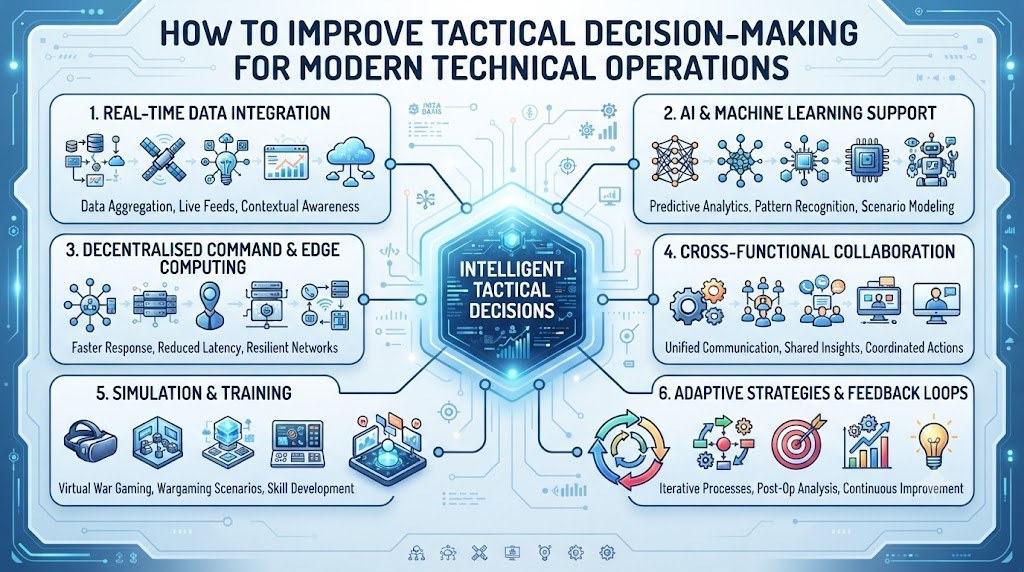
In that critical split second, bad calls do not happen because your team lacks technical skill. They happen because cognitive overload crushes judgment and turns clear thinking into guesswork. When your production systems catch fire, you need structured, repeatable ways to filter noise, pinpoint root causes, and take corrective steps. You can explore how modern operations teams automate situational clarity at WarOpsX.com to solve this problem permanently.
Tactical decision-making is the disciplined habit of choosing the right fix quickly during active incidents. It replaces frantic guessing with structured, rehearsed operational actions. When you master these skills, your mean time to recovery plunges, your team stays calm, and outages stop turning into disasters.
What Is Tactical Decision-Making in Live Operations?
Tactical decision-making is the real-time choice of actions during a live technical event. Unlike strategic planning, which spans quarters or years, tactical decisions take seconds or minutes. You do not have the luxury of endless data collection or long committee meetings.
Tactical choices focus strictly on the immediate reality in front of your screen. You ask what broke, what will fail next, and what stops the bleeding right now. The goal during a tactical phase is never root-cause perfection. The goal is rapid stabilization to buy time for deeper analysis.
Modern digital infrastructure runs on complex, tightly coupled microservices. When one component fails, dependent services often collapse like dominoes. Strong tactical decision-makers spot these cascade patterns early, isolate the blast radius, and protect core business transactions.
The Cognitive Traps That Ruin Incident Response
High-stress operations trigger evolutionary survival reflexes that work against technical problem-solving. Adrenaline narrows your field of view, causing what psychologists call tunnel vision. You fixate on a single broken database query while five upstream queues quietly overflow.
Another major pitfall is confirmation bias during high-stakes outages. An on-call engineer remembers last week’s memory leak and assumes tonight’s crash shares the identical cause. They spend forty precious minutes tweaking cache settings while network packet loss quietly chokes the cluster.
Fatigue also ruins analytical reasoning across on-call rotations. After working a twelve-hour shift, an engineer’s brain struggles to evaluate multi-variable trade-offs. Tactical frameworks eliminate this fatigue penalty by giving responders clear, step-by-step decision rules that work even when exhausted.
Why Fast Incident Triage Protects Business Revenue
Downtime costs modern digital businesses thousands of dollars for every passing minute. When payment gateways stall or streaming pipelines freeze, customers jump directly to competing platforms. Fast, accurate tactical choices protect revenue before customer trust erodes permanently.
Speed without accuracy produces reckless thrashing that worsens server outages. When engineers panic, they often restart servers blindly or roll back database migrations without checking compatibility. These clumsy moves corrupt state stores and turn brief five-minute blips into four-hour outages.
Structured decision frameworks give your on-call teams the confidence to act decisively. Instead of freezing in fear of making mistakes, responders follow tested containment workflows. They isolate failing nodes, shed non-critical background traffic, and preserve core platform availability.
Building Real-Time Situational Awareness
You cannot fix an operational issue that you do not understand. Situational awareness means knowing your system’s current state, its trajectory, and what threatens its survival. It forms the essential baseline for every good tactical choice.
Raw telemetry alone does not produce genuine operational awareness. Hundreds of colorful dashboards often drown on-call engineers in useless visual noise. True operational awareness requires curated signals that highlight service degradation, error spikes, and saturated dependencies instantly.
To achieve this clarity, modern teams combine logs, traces, and metrics into unified system perspectives. They define strict golden signals: latency, traffic, errors, and saturation. When an alert fires, responders check these four indicators first to understand system health immediately.
The OODA Loop Applied to Technical Outages
Military strategist John Boyd created the OODA Loop to explain rapid decision-making in dogfights. The acronym stands for Observe, Orient, Decide, and Act. Today, the world’s best reliability teams adapt this mental model to dominate high-pressure server crashes.
Observation begins the second your alerting system wakes your primary responder. You collect raw facts without forming rigid early conclusions. You check status pages, latency charts, external payment dependencies, and error logs across your delivery boundary.
Orientation is where elite engineers separate themselves from novices. You filter incoming observations through your mental model of the software architecture. You ask what recent changes occurred, what third-party vendors are struggling, and what components match the observed failure shape.
Deciding means picking the least risky, highest-yield containment action right now. You do not deliberate endlessly over the ideal fix. You pick an action, predict its measurable outcome, and execute it immediately in the Act phase.
       +---------------------------------------------+
       |                                             |
       v                                             |
+-------------+     +------------+     +----------+  |  +---------+
|   OBSERVE   | --> |   ORIENT   | --> |  DECIDE  | -+->|   ACT   |
| (Telemetry) |     |  (Context) |     | (Options)|     | (Execute|
+-------------+     +------------+     +----------+     +---------+
The Role of Psychological Safety in High-Pressure Decisions
Fear of blame paralyzes engineers during live production outages. If your team members fear firing or humiliation for taking risks, they will hesitate. They will wait for managerial approval while customers suffer through a crashing service.
Psychological safety means engineers know their team backs their thoughtful interventions. When responders feel safe, they communicate bad news immediately instead of hiding broken states. They attempt smart, safe rollbacks and share observations openly across the incident bridge.
Blameless culture is not just a nice slogan for progressive tech companies. It is an operational necessity for reliable high-availability architectures. When post-incident reviews focus on systemic flaws rather than personal blame, your operational decision quality climbs steadily over time.
10 Real-World Production Crash Case Studies
Here are ten concrete, real-world crash scenarios that show how tactical decision-making makes or breaks live operations:
- The Runaway Redis Connection Storm: A sudden marketing push tripled traffic to a retail web app. The application spun up two hundred worker pods, each opening fifty persistent Redis connections. Redis hit its maximum client limit, causing worker threads to hang and pool resources. The tactical lead immediately cut idle connection limits and enabled local in-memory caching. This quick action brought Redis CPU utilization down from 100% to 28% within ninety seconds.
- The Unindexed Database Migration Disaster: An engineer deployed a migration adding a column without an index during peak afternoon load. The database locked the entire customer table, causing thousands of read queries to queue up behind it. The replica nodes quickly fell thirty minutes behind primary replication streams. The incident commander tactically canceled the migration transaction and killed all locked background queries. The team stabilized database throughput before connection pools exhausted completely.
- The Cascading Microservice Circuit Failure: A third-party fraud verification API suffered severe intermittent latency spikes of eight seconds. The checkout service did not set strict timeout thresholds, so checkout worker threads clogged waiting for replies. Upstream cart services stalled next, triggering an outage across the entire storefront checkout flow. The on-call engineer made the tactical call to trip the fraud-check circuit breaker manually. Orders were routed to an offline asynchronous verification queue, restoring instant checkouts for shoppers.
- The Accidental DNS TTL Lockout: A networking engineer migrated DNS providers and accidentally set the record TTL to seven days instead of sixty seconds. When the primary load balancer IP shifted during maintenance, half of all global traffic hit a dead host. The team could not push a fast global DNS update because intermediate resolvers cached the dead address. The tactical response involved re-binding the old public IP to an edge proxy within twenty minutes. This proxy redirected traffic safely to the new cluster while the old TTL expired.
- The Kubernetes Node Memory Starvation Loop: An updated machine learning worker container had an unconstrained memory leak. The Linux kernel OOM killer started terminating critical cluster networking daemonsets on the worker node. Nodes began flapping between Ready and NotReady states, causing Kubernetes to reschedule workloads repeatedly across healthy machines. The responder quickly labeled the leaking deployment with a zero-replica count. Stopping the cascading eviction loop allowed the cluster control plane to stabilize node states immediately.
- The Border Gateway Protocol Route Leak: A regional internet provider mistakenly advertised internal private routes to the global BGP table. Global transit traffic for a SaaS platform suddenly routed through an overloaded, low-bandwidth regional router in Europe. Users experienced 80% packet drops and severe connection timeouts across European availability zones. The tactical network engineer updated route filtering to ignore advertisements from the rogue autonomous system. Latency dropped back to baseline within four minutes of the routing update.
- The Expired Intermediate SSL Certificate: A platform’s root certificate was valid, but an intermediate signing certificate expired silently at midnight. Automated monitoring tests passed because they cached older trust chains, but new client browsers threw severe security warnings. Mobile API requests failed instantly, halting in-app purchases globally. The incident lead bypassed regular release pipelines to hot-patch the edge ingress controllers with the updated certificate bundle. The service fully recovered within eight minutes of identifying the expired intermediate cert.
- The Storage Volume IOPS Exhaustion Trap: A background database backup script ran during an unexpected surge in user registrations. Both processes competed aggressively for write IOPS on the shared cloud storage volume. Disk latency spiked from three milliseconds to two thousand milliseconds, causing write queues to stall. The on-call responder spotted the IOPS saturation on storage metrics and paused the backup process. Disk queue depths dropped back to normal ranges, restoring responsive database writes.
- The Rogue Log Flooding Disk Outage: A buggy microservice encountered an unhandled exception and dumped three gigabytes of debug stack traces per minute. The root disk partition on three primary logging aggregators filled to 100% capacity within fifteen minutes. System daemons failed to write runtime state files, crashing the host monitoring agents across all three servers. The engineer used a lightweight remote rescue shell to truncate old log files and turned off debug logging. Freeing disk space instantly revived the crashed telemetry pipeline.
- The Malicious Distributed Denial of Service Inundation: An anonymous attacker hit an unprotected public search endpoint with four hundred thousand requests per second. The complex search database queries pushed backend Elasticsearch clusters to a sustained 100% CPU lock. Regular user traffic could not query inventory or load catalog landing pages. The tactical commander applied an edge rate-limiting rule targeting the specific search user-agent string. They activated managed edge caching for empty search terms, mitigating the attack in two minutes.
Comparing Tactical Decision Styles Under Pressure
Teams handle incidents differently based on their internal tooling, leadership styles, and operational maturity. The following table contrasts old-school reactive triage with modern tactical decision frameworks:
| Feature / Metric | Reactive Guesswork (Ad-Hoc) | Modern Tactical Decision Framework |
| Primary Goal | Find the permanent root cause immediately | Isolate blast radius and restore service availability |
| Communication Style | Noisy, fragmented messages across random chats | Single incident commander with structured status updates |
| Telemetry Focus | Digging randomly through gigabytes of raw logs | Checking golden signals: latency, traffic, errors, saturation |
| Response Time | 45 to 90 minutes to stabilize simple outages | 5 to 15 minutes through automated and rehearsed runbooks |
| Operational Stress | High panic, emotional shouting, and finger-pointing | Calm, methodical execution following clear checklists |
| Change Authorization | Waiting for executive management sign-offs | Delegated authority to act based on pre-approved safety limits |
| Post-Incident Action | Punitive reviews that blame individual engineers | Blameless retrospective focused on hardening systemic resilience |
Structured Frameworks: OODA vs. Cynefin for Live Incidents
Choosing the right mental model helps teams organize their thinking when technical systems fail unexpectedly. The Cynefin framework helps you identify the type of problem you are facing before choosing a response. It categorizes operational problems into clear, distinct domains: Clear, Complicated, Complex, and Chaotic.
Clear situations involve known issues with known fixes, such as replacing a broken hardware drive. Complicated situations require expert analysis and methodical investigation, like tuning a slow SQL execution plan. Complex situations feature unpredictable interactions between distributed microservices where you must probe, sense, and respond.
Chaotic environments, such as sudden multi-region cloud outages, demand immediate action above all else. You cannot analyze or probe because the system is actively bleeding out. You must act to establish order, sense where stability lies, and move the incident from chaos to complexity.
| Problem Domain | Environmental Characteristics | Best Immediate Tactical Approach |
| Clear | Well-understood, repeating, predictable issues | Follow standard operating procedures and runbooks |
| Complicated | Multi-layered issues requiring deep domain expertise | Bring in specialists to analyze metrics and traces |
| Complex | Emerging patterns with unknown cross-service causes | Probe with small safe changes, observe, and adapt |
| Chaotic | High-velocity cascades threatening total platform collapse | Act decisively to halt bleeding, establish order, and stabilize |
Establishing Clear Incident Command Roles
During a serious technical outage, standard engineering hierarchies must vanish immediately. The most senior engineering executive should rarely run the technical response bridge. Executives focus on business impacts, customer relationships, and board communication, not terminal commands.
An Incident Commander leads the tactical response with total operational authority. This person does not touch keyboards, run scripts, or analyze log files directly. The Commander maintains a high-level operational view, assigns tasks, and prevents engineers from duplicating efforts.
You also need an Operations Lead who directs engineers running diagnostic checks. A Communications Lead handles updates to internal stakeholders, customer-facing support teams, and external status pages. This role division keeps the technical responders completely focused on stabilizing the platform.
                  +----------------------+
                  |  INCIDENT COMMANDER  |
                  | (Strategy & Control) |
                  +----------+-----------+
                             |
         +-------------------+-------------------+
         |                                       |
         v                                       v
+------------------+                   +--------------------+
| OPERATIONS LEAD  |                   | COMMUNICATIONS LEAD|
| (Hands on Tech)  |                   | (Stakeholders & UX)|
+--------+---------+                   +--------------------+
         |
    +----+----+
    |         |
    v         v
[Triage]  [Mitigate]
Eliminating Toxic Communication on Incident Bridges
Nothing ruins tactical decision speed faster than noisy, unstructured communication. When twenty engineers talk over each other in an open video call, vital clues get lost. Clear communication rules keep everyone aligned and focused on solving the outage.
Teams should adopt clear military-style acknowledgment protocols on incident bridges. When the Incident Commander assigns an action, the engineer repeats the instruction clearly. Once the command finishes, the engineer reports the exact result and any observed side effects.
Keep chat channels clean by moving side conversations and speculative theories to separate threads. Use the main incident channel solely for verified timeline events, system state changes, and explicit commands. This discipline lets new responders joining the bridge catch up on the situation within seconds.
Managing Blast Radius Through Graceful Degradation
Smart tactical decision-makers protect critical platform features by sacrificing non-essential components. If your database CPU hits 98%, you do not need to let the whole website crash. You turn off expensive background features like recommendation engines, analytics trackers, and email notifications.
Graceful degradation preserves the core revenue paths while shedding secondary operational weight. A retail website can disable personalized product suggestions while keeping the “Buy Now” button functional. Customers might miss dynamic recommendations, but they can still complete their purchases.
Implement dynamic feature flags to make these tactical trade-offs easy during outages. An engineer can toggle a flag to stop heavy database queries across a distributed system instantly. This sheds load without requiring risky, time-consuming emergency code deployments.
Data-Driven Decision Thresholds
Tactical decisions should never depend on personal gut feelings or emotional arguments. Elite engineering teams establish clear numerical triggers for taking drastic operational actions. When a metric hits a predetermined safety threshold, responders execute the designated mitigation immediately.
For instance, your runbook might state: “If checkout error rates exceed 5% for three minutes, roll back the release.” There is no debate, no waiting for committee meetings, and no hesitation. Responders follow the rule, execute the rollback, and protect the customer experience.
Define these thresholds long before outages happen during calm architecture reviews. Involve product managers, security teams, and engineering leads in setting these operational limits. When everyone agrees on the rules beforehand, tactical execution during crises becomes fast and blameless.
10 Common Mistakes in Tactical Decision-Making
Avoid these ten frequent traps that derail technical response teams during critical production outages:
- Fixating on Root Cause Instead of Rapid Mitigation: Novice responders often spend hours trying to figure out why a bug exists while the system burns. Your first tactical priority is always restoring service availability to users, not debugging code. Roll back the release, restart the service, or shed traffic first. You can investigate the detailed code flaw safely after production stabilizes.
- Failing to Appoint a Single Clear Incident Commander: When nobody leads the incident bridge, engineers step on each other’s toes and duplicate work. Two different developers might change database settings simultaneously, making system behavior totally unpredictable. Designate one person as the Incident Commander for every Sev-1 outage. That leader coordinates all diagnostic actions and ensures absolute operational alignment.
- Making Multiple Infrastructure Changes Simultaneously: When panic sets in, engineers often restart servers, deploy patches, and change networking rules all at once. If the system suddenly recovers or gets worse, nobody knows which specific change caused the shift. Make one deliberate tactical change at a time whenever possible. Observe the operational metric impact before moving to your next action.
- Ignoring Upstream and Downstream Service Dependencies: Flipping a switch on a payment gateway can inadvertently trigger a huge backlog of webhook calls. Teams often fix one bottleneck only to cause a massive, catastrophic failure in a downstream component. Always map out service dependencies before applying drastic tactical fixes. Ensure downstream caches, queues, and databases can handle the shifted workload safely.
- Allowing Executive Micromanagement on Technical Bridges: Anxious executives often join incident calls asking for detailed technical explanations every two minutes. Answering these interruptions distracts technical responders from diagnosing and fixing the actual outage. Appoint a dedicated Communications Lead to give executives concise, periodic business-impact updates in a separate channel. Keep your technical responders shielded from political noise.
- Relying on Tribal Knowledge Instead of Written Runbooks: When critical operational steps live only in a senior architect’s head, response times crater when they are offline. Teams waste precious hours trying to reverse-engineer undocumented deployment scripts and database credentials. Document every critical mitigation step in clean, accessible, and version-controlled runbooks. Ensure any on-call engineer can execute recovery steps without special assistance.
- Skipping Triage Checklists Under Pressure: Engineers under severe cognitive stress skip simple, fundamental checks like disk space, DNS records, and SSL certificates. They jump straight into complex kernel tuning or deep distributed trace analyses while an empty disk partition causes the issue. Always follow a standardized baseline triage checklist during the first five minutes of any incident. Ruling out simple physical and environmental failures saves enormous amounts of time.
- Hesitating on Safe Rollbacks Due to Pride: Developers who spent all week building a new feature often resist rolling it back during an outage. They insist they can push a quick hotfix in five minutes, which usually takes an hour and introduces new bugs. Enforce a strict policy: if a new release shows high error rates, roll it back immediately. Debug the problem safely on a staging cluster, not on live customer traffic.
- Neglecting Physical Human Needs During Protracted Outages: Complex, stubborn outages can stretch across eight, twelve, or twenty hours of grueling technical labor. Fatigued, hungry, and dehydrated engineers make catastrophic typing and configuration mistakes. The Incident Commander must mandate shift rotations, forcing responders to rest after four hours of continuous high-stress triage. Fresh minds resolve complex technical puzzles much faster than exhausted teams.
- Failing to Document Tactical Actions in Real Time: During a frantic outage, responders often forget what commands they ran, when they ran them, and what flags they toggled. This missing context makes writing accurate post-incident retrospectives nearly impossible later. Assign a scribe to record every timeline event, command execution, and metric shift as it happens. Accurate timeline data helps teams identify systemic weaknesses and refine future decision-making frameworks.
10-Step Tactical Decision-Making Implementation Roadmap
Follow this step-by-step roadmap to build an elite, repeatable tactical decision-making program for your organization:
- Audit Your Current Telemetry and Define Four Golden Signals: Review your existing monitoring platforms to ensure you track latency, traffic, errors, and saturation across all critical paths. Eliminate redundant, noisy alerts that cause alert fatigue and desensitize on-call engineers. Build clean, curated dashboards that show overall system health at a single glance. Ensure these core metrics refresh every ten seconds to provide actionable, real-time feedback during incidents.
- Establish a Formal Incident Command System Structure: Define clear roles and responsibilities for Incident Commanders, Operations Leads, and Communications Leads. Write down explicit operational boundaries so every engineer knows exactly who commands authority during emergencies. Train at least five senior engineers across different rotations to serve as certified Incident Commanders. Distribute this operational leadership across time zones to maintain seamless twenty-four-seven coverage.
- Develop Standardized, Verifiable Runbooks for Common Incidents: Document step-by-step containment procedures for your top ten most frequent technical failure scenarios. Include precise rollback commands, traffic-shedding configurations, and cache-clearing instructions in every guide. Store these runbooks in a highly resilient, offline-accessible system that survives primary cloud infrastructure outages. Review and update every runbook at the end of each operational quarter.
- Implement Automated Circuit Breakers and Bulkheads: Architect your microservices to fail gracefully when downstream third-party dependencies slow down or crash. Configure strict request timeouts and automated circuit breakers that cut off failing dependencies before queues back up. Isolate critical customer transaction paths from secondary background processing jobs using architectural bulkheads. Test these isolation boundaries regularly by simulating upstream network partitions.
- Create Automated Rollback Gates in CI/CD Pipelines: Remove the human hesitation penalty from deployments by setting up automated canary analysis in your delivery pipelines. Configure your release systems to roll back newly deployed code automatically if error rates exceed 1% over five minutes. Require explicit operational approvals for overriding automated rollback triggers during high-traffic business windows. Keep rollbacks fast, automated, and completely routine.
- Conduct Monthly Chaos Engineering and Game Day Drills: Run controlled failure-injection drills in staging or production environments using chaos engineering tools. Kill database primaries, introduce artificial network latency, and fill disk partitions to test your team’s tactical reflexes. Evaluate how quickly responders notice alerts, form incident bridges, and execute the correct runbook mitigations. Use drill outcomes to patch operational holes before real crises strike.
- Deploy Dynamic Feature Flagging Across All Services: Decouple code deployment from feature activation by routing new business logic behind centralized feature flags. Train your on-call responders to use feature flags as primary tactical load-shedding tools during performance degradation events. Ensure that toggling a flag takes effect globally within five seconds without requiring pod restarts or software builds. Audit flag configurations weekly to clean up stale and unused triggers.
- Design Pre-Approved Emergency Access and Authorization Workflows: Eliminate operational delays caused by engineers lacking elevated permissions to run recovery tools during midnight outages. Implement automated just-in-time access tools that grant temporary break-glass permissions with complete audit logging. Pre-authorize emergency mitigation actions so responders do not waste time waiting for vice-president approvals. Review all emergency access logs in weekly security standups.
- Build a Standardized Incident Bridge and Communication Routine: Create automated scripts that spin up dedicated Slack channels, video bridges, and shared scratchpads when an incident triggers. Post automated templates that guide the scribe in recording timeline events, operational hypotheses, and completed actions. Establish a twenty-minute update cadence for broadcasting business-impact summaries to executive stakeholders. Keep technical discussion channels strictly separated from executive status channels.
- Institute Blameless Post-Incident Reviews and Action Trackers: Hold a blameless retrospective within seventy-two hours of resolving any high-severity operational outage. Focus on the systemic vulnerabilities, missing telemetry signals, and tooling failures that allowed the incident to occur. Turn every discovered weakness into a prioritized engineering ticket with clear ownership and a thirty-day completion deadline. Share lessons learned openly across your entire engineering organization to elevate collective tactical skills.
The Future of AI-Assisted Tactical Operations
Machine learning agents are beginning to reshape how engineering teams manage live production emergencies. Modern AI systems can parse millions of log lines across thousands of containers in fractions of a second. They spot subtle correlations between disparate error spikes that human engineers would miss entirely.
These AI platforms do not replace human Incident Commanders; they act as high-speed operational copilots. An AI copilot can suggest relevant runbooks, draft accurate timeline summaries, and surface recent Git commits that touched failing services. This contextual assistance slashes cognitive load, helping human responders make better tactical calls faster.
The winning formula pairs human judgment with automated system insights. Humans excel at strategic context, safety trade-offs, and cross-team communication during emergencies. Automated platforms handle massive data aggregation, anomaly detection, and rapid runbook execution. Together, they create an unbeatable operational engine.
Frequently Asked Questions
1. What is tactical decision-making in software and site reliability operations?
Tactical decision-making is the disciplined practice of choosing and executing fast, real-time mitigations during live system outages. It focuses on isolating the blast radius, stopping cascading failures, and restoring user-facing service availability immediately. Unlike strategic architectural planning, tactical decisions take seconds or minutes and emphasize pragmatic operational containment over finding perfect root causes.
2. How does tactical decision-making differ from strategic technical planning?
Tactical decision-making addresses immediate operational crises happening right now, while strategic planning shapes long-term architectural health over months or years. Tactical decisions prioritize short-term containment, such as shedding traffic, restarting pools, or rolling back releases. Strategic decisions address systemic redesigns, tech-debt retirement, platform migrations, and long-term organizational engineering investments.
3. What are the four golden signals used to guide tactical incident response?
The four golden signals are latency, traffic, errors, and saturation. Latency measures the time it takes to service a request, distinguishing fast successes from sluggish degradation. Traffic measures incoming demand across the network boundary. Errors track the rate of failed requests, while saturation measures how full your most constrained system resources (such as memory, disk IOPS, or CPU) currently are.
4. What is the role of an Incident Commander during a major outage?
The Incident Commander holds complete operational authority over the incident bridge and coordinates the technical response from start to finish. This leader does not write code, run commands, or analyze logs directly. Instead, the Incident Commander maintains a high-level operational perspective, delegates diagnostic tasks, resolves technical disagreements, and prevents engineers from duplicating efforts or thrashing the system.
5. Why should teams roll back releases before investigating root causes?
Rolling back releases immediately eliminates newly introduced code or configuration bugs, restoring healthy service availability for your users in minutes. Investigating the root cause while production is actively down wastes expensive time and damages customer trust. Once you roll back the change and the system stabilizes, you can safely analyze logs, replicate bugs in staging, and build permanent fixes without panic.
6. How does psychological safety improve decision speed during live incidents?
When engineers work in a blameless culture, they do not fear punishment or humiliation if a thoughtful mitigation attempt fails. This safety removes the hesitation and paralysis that often delay critical incident actions. Responders communicate bad news faster, execute pre-approved mitigations decisively, and share complete operational facts openly, which dramatically accelerates overall system recovery.
7. What is the OODA Loop, and how does it apply to system outages?
The OODA Loop is a four-step mental model created by military strategist John Boyd, consisting of Observe, Orient, Decide, and Act. During an outage, responders Observe raw telemetry signals, Orient those signals within their architectural mental model, Decide on the fastest low-risk containment step, and Act by executing the mitigation. The cycle repeats continuously until the platform stabilizes completely.
8. What is the fastest way to reduce cognitive overload for on-call engineers?
The fastest way to reduce cognitive overload is by silencing low-priority, non-actionable alerts and organizing dashboards around the four golden signals. Giving engineers simple, tested, and copy-paste runbooks eliminates the stress of figuring out complex commands in the middle of the night. Clear role assignments on the incident bridge also shield responders from distracting executive interruptions.
9. How do feature flags help during tactical load shedding?
Feature flags allow engineering teams to disable expensive, non-critical background features dynamically without deploying new code or restarting services. If a database struggles under an unexpected traffic surge, responders can toggle off recommendation engines, analytics scripts, or image processing pipelines instantly. This sheds processing load immediately, preserving critical database capacity for core transactions.
10. When should an on-call team decide to declare a major incident?
An on-call team should declare a major incident immediately when an event degrades core user workflows, breaches service level objectives, or threatens data integrity. If an incident cannot be diagnosed and contained within ten minutes, escalate it to a major incident immediately. It is always better to declare an incident early and downgrade it later than to let an uncoordinated response prolong downtime.
Final Recommendation and Next Steps
Improving tactical decision-making is not an overnight fix; it is a permanent organizational discipline. Begin by scheduling a blameless operational audit of your three most recent production outages. Identify the exact moments where your responders hesitated, lacked visibility, or stumbled over poor documentation.
Next, pick your single most critical customer-facing service and implement the first three steps of the roadmap. Clean up its alerts, appoint your initial group of Incident Commanders, and build a verified, copy-paste rollback runbook. Test that runbook next week during a calm, scheduled game day drill.
When your team swaps panic for prepared tactical mastery, outages lose their power to disrupt your business. You will protect your platform’s revenue, build deep trust with your customers, and give your on-call engineers the calm, confident work environment they deserve.