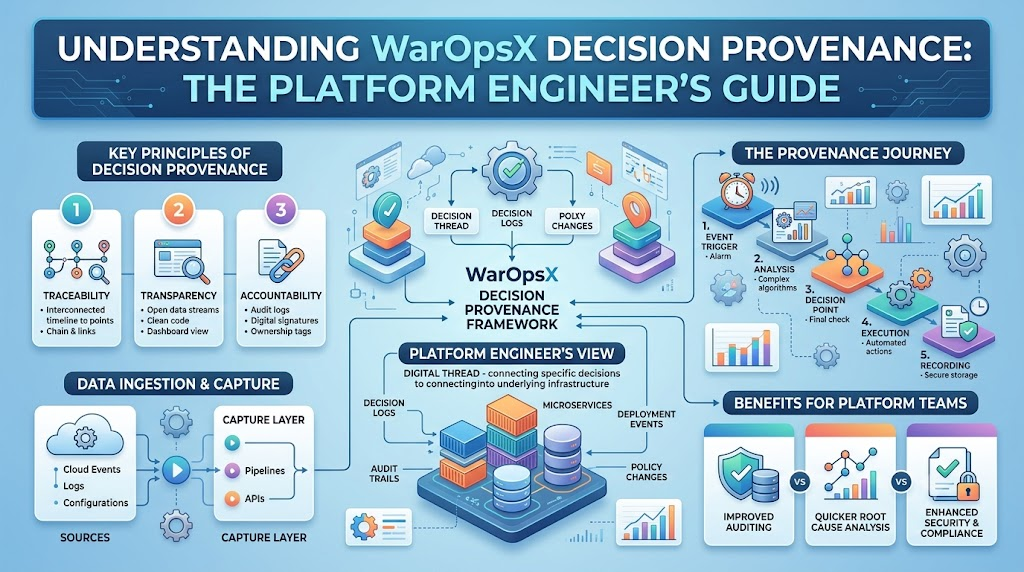
Autonomous infrastructure management and AI-assisted site reliability engineering (AIOps) have shifted operational incident management from manual triage to automated execution. In high-stakes production environments, a persistent challenge is not merely whether an automation platform can resolve an incident, but whether operators can trust its decisions. Platform engineers, security directors, and incident commanders need to inspect the operational logic of automated actions. They need clear insight into what happened, why an action was chosen over alternatives, and what system state justified the decision. For technical teams evaluating WarOpsX, understanding its decision-explanation architecture is essential for verifying safety, maintaining compliance, and integrating human operators into the command loop. When automated remediation platforms operate as black boxes, operational resistance grows. Incident commanders hesitate to grant write permissions, SREs spend hours reverse-engineering automated rollbacks, and compliance teams flag automated changes as unverified drift. WarOpsX addresses this gap by decoupling operational execution from decision explainability.
The Black Box Problem in Automated Incident Command
Automated remediation systems traditionally rely on static rule engines or opaque machine learning models. Both approaches create significant operational hurdles:
- Static heuristics and playbooks lack context. When system conditions deviate from pre-configured parameters, scripts execute rigidly, occasionally triggering cascading service degradation.
- Deep learning and unconstrained LLM agents provide adaptive responses but frequently obscure their reasoning, fail to preserve point-in-time system state, and hallucinate policy justifications under degraded network conditions.
When an incident commander faces a multi-region outage, reviewing raw logs, diff traces, or natural-language explanations after the fact is inadequate. Operators need deterministic evidence that:
- The telemetry ingestion was accurate at $T_0$.
- The blast radius was mathematically bounded before execution.
- System policies explicitly authorized the command.
- Specific alternative actions were evaluated and discarded for documented reasons.
Explainability in WarOpsX is not an aesthetic reporting layer added post-execution; it is an active constraint engine built into the control plane.
Architectural Breakdown: The WarOpsX Decision Pipeline
The platform uses a deterministic decision-pipeline model. Every autonomous or suggested action moves through four discrete operational phases, each producing immutable audit trails.
[ Telemetry & Topology ]
         │
         ▼
┌────────────────────────┐
│  State Reconciliation  │ ──► Snapshot Engine (eBPF, Metrics, Graphs)
└────────────────────────┘
         │
         ▼
┌────────────────────────┐
│  Causal Evaluation     │ ──► Graph Dependency & Counterfactual Check
└────────────────────────┘
         │
         ▼
┌────────────────────────┐
│  Policy & Risk Arbiter │ ──► Hard Constraints, RBAC, Blast Radius Limit
└────────────────────────┘
         │
         ▼
┌────────────────────────┐
│  Command Execution     │ ──► Cryptographically Signed Provenance Envelope
└────────────────────────┘
1. Point-in-Time State Snapshotting
Before computing any remediation plan, WarOpsX establishes a cryptographic capture of the system state. Using lightweight eBPF probes, cloud provider APIs, and OpenTelemetry streams, it records:
- Service mesh dependency topologies.
- Resource saturation metrics (CPU, memory, disk I/O, network queue depth).
- Active deployment manifests, running versions, and configuration flags.
- Recent changes (git commits, canary updates, secret rotations).
This state vector represents the system’s precise condition when triage began, isolating the decision engine from downstream drift.
2. Directed Acyclic Graph (DAG) Causality Mapping
WarOpsX avoids single-metric threshold triggers. A latency spike on an edge gateway does not directly trigger an edge scale-out command. Instead, the engine maps signals onto a dynamic service topology graph.
By analyzing causal sequences rather than simple metric correlations, WarOpsX traces edge latency through the proxy mesh down to connection pool starvation in a downstream payment database. The engine can then demonstrate to an operator that scaling the edge proxy would not resolve the issue, focusing remediation on database connection throttling instead.
3. Counterfactual and Alternative Action Modeling
For any proposed command, WarOpsX generates an internal decision tree that evaluates candidate actions against operational constraints:
- Candidate Action $A$: Isolate and restart the affected database read replicas.
- Candidate Action $B$: Apply global rate-limiting to non-critical read queries.
- Candidate Action $C$: Trigger a regional failover.
The engine calculates an expected blast radius, estimated time-to-recovery (TTR), and risk coefficient for each alternative. When explaining why Action $B$ was executed over Action $C$, WarOpsX points directly to the state snapshot: active replication lag in the secondary region exceeded the acceptable Recovery Point Objective (RPO) threshold, making regional failover unsafe.
4. Policy Arbitration and Blast-Radius Sandboxing
Every candidate action must pass an immutable policy layer based on the Open Policy Agent (OPA) framework. The platform evaluates whether the actor (the automated agent or human-in-the-loop operator) holds the required role-based privileges, verifies that the change budget has not been exhausted, and enforces blast-radius limits (e.g., “never mutate more than 15% of active worker nodes simultaneously”).
Structure of a Command Explanation Trace
When an SRE, security auditor, or incident lead inspects a WarOpsX command, the system does not return generic log outputs. Instead, it outputs a structured Decision Provenance Envelope.
JSON
{
  "decision_id": "cmd-8f92a4-b01c",
  "timestamp_utc": "2026-09-15T06:14:22.184Z",
  "trigger_incident": "INC-44021: Checkout Service P99 Latency Breach",
  "selected_command": {
    "action": "traffic_shed",
    "target": "service/checkout-api",
    "parameters": { "drop_percentage": 20, "target_tier": "unauthenticated" }
  },
  "rationale": {
    "primary_causal_node": "database/aurora-primary",
    "root_condition": "Lock contention on 'inventory_reservations' table exceeding 12000ms",
    "invalidation_of_alternatives": [
      {
        "action": "horizontal_pod_autoscaling",
        "discarded_reason": "Downstream saturation detected; scaling checkout pods increases lock contention risk by 4.2x"
      },
      {
        "action": "pod_restart",
        "discarded_reason": "Ephemeral restart violates P1 SLA; connection pool drain would drop active transaction contexts"
      }
    ]
  },
  "policy_verification": {
    "policy_hash": "e3b0c44298fc1c149afbf4c8996fb92427ae41e4649b934ca495991b7852b855",
    "constraints_passed": [
      "max_drop_threshold_under_25_percent",
      "authenticated_traffic_exempted",
      "change_freeze_window_override_authorized"
    ]
  },
  "blast_radius_estimate": {
    "impacted_traffic_percent": 18.4,
    "projected_ttr_seconds": 180,
    "confidence_interval": 0.94
  },
  "state_snapshot_ref": "s3://waropsx-telemetry-snapshots/2026/09/15/snap-9011a.parquet"
}
This provenance envelope provides concrete utility across operational tiers:
- Level 1 (SRE on-call): Quickly assesses why the system chose to drop unauthenticated traffic instead of autoscaling the pod fleet.
- Level 2 (Systems Architect): Verifies the causal modeling logic against system dynamics during post-incident reviews.
- Level 3 (Compliance and Security): Confirms that automated operational actions strictly complied with defined change policies and blast-radius thresholds.
Comparative Decision Paradigms
Understanding WarOpsX’s role within an enterprise stack requires comparing its explainability model to standard operations frameworks.
| Evaluation Metric | Traditional Scripting / Runbooks | Standard Observability Platforms | Black-Box AI Agents | WarOpsX Explainability Plane |
| Decision Driver | Hardcoded conditional branches (if-else) | Metric thresholds and alert triggers | Generative prompt tokens or weights | Causal inference graphs and constraints |
| State Retention | Ephemeral, relying on external log sinks | Time-series data points at variable resolution | Ephemeral prompt memory | Immutable cryptographic state vector snapshots |
| Rejection Context | Absent (unexecuted branches are dropped) | Absent (alerts evaluate conditions independently) | Unstructured or conversational rationale | Structured, deterministic counterfactual records |
| Blast Radius Check | Static script limits, prone to drift | Passive (triggers post-impact alerts) | Unverified without sandboxing | Pre-execution validation via policy engines |
| Audit Fidelity | Low; requires manual log correlation | Medium; reflects what happened, not why | Poor; non-deterministic outputs | High; structured, signed, machine-readable records |
| Operator Friction | High; manual triage and intervention | High; requires manual query construction | High; low trust during production outages | Low; exposes verifiable reasoning steps directly |
Operational Considerations, Risks, and Failure Modes
Deploying explainable decision automation into mission-critical infrastructure introduces distinct operational trade-offs that systems engineers must manage.
Telemetry Skew and Split-Brain States
If network degradation isolates an infrastructure partition, the state vector snapshot captured by WarOpsX may become skewed. In these scenarios, causal graph calculations run the risk of operating on partial topology data.
- Mitigation: WarOpsX enforces strict quorum rules on telemetry ingest. If the freshness or partition coverage of metric signals drops below acceptable thresholds, the decision engine defaults to Safe-Halt Mode, surfacing the decision to human operators while documenting the telemetry loss as the primary constraint.
Explanation Latency vs. Blast Radius Expansion
Generating full causal graphs, testing alternatives, and writing cryptographic provenance envelopes introduces micro-latencies (typically 200ms to 2s). For rapidly expanding failures—such as a runaway thread-pool exhaustion or internal DDoS conditions—deliberating to generate an explanation can allow the blast radius to widen.
- Mitigation: WarOpsX supports multi-tiered command policies. Critical safety protections (such as circuit-breaking on hard resource saturation) run on low-latency paths with lightweight rule explanations. Slower remediation workflows (such as node rescheduling or routing failovers) execute through the full, multi-layered explanation pipeline.
Storage and Cost Overhead
Maintaining state snapshots (including eBPF network maps, container statuses, and metrics) for every incident triage generates significant data volumes. Retaining full parquet snapshots indefinitely across large enterprise clusters can rapidly increase cloud storage costs.
- Mitigation: Implement automated retention policies: retain full state vector data for 30 to 90 days for audit and post-incident review requirements, then downsample snapshot metadata to high-level graph traces for long-term historical analysis.
Best Practices for Integrating WarOpsX
To deploy WarOpsX successfully within enterprise platform engineering teams, implement the following operational practices:
- Tune Policies in Shadow Mode First: Run WarOpsX in read-only observation mode for 30 days. Review its generated Decision Provenance Envelopes during weekly operations reviews to verify its causal reasoning before granting write permissions to production clusters.
- Treat Policy Configurations as Code: Manage all WarOpsX blast-radius constraints, remediation policies, and escalation paths in Git repositories via pull request workflows with automated linting and validation.
- Use Counterfactual Traces in Incident Post-Mortems: When conducting blameless post-mortems, use the discarded-actions log to examine why the system rejected alternative remediation steps. This helps engineers identify hidden operational dependencies or outdated architectural assumptions.
- Standardize on Minimum Scopes of Authority: Apply the principle of least privilege to WarOpsX service accounts. Authorize it to adjust traffic routes, scale workloads, or restart stateless pods, while requiring human-in-the-loop confirmation for stateful database mutations or unverified DNS changes.
Key Takeaways
- Explainability Is a Safety Boundary: Trustworthy remediation systems must do more than resolve outages; they must document their operational reasoning deterministically.
- Decoupled State Ingestion: WarOpsX prevents drift by capturing a point-in-time state vector using eBPF and telemetry data before evaluating changes.
- Causal Graphs Replace Metric Thresholds: By relying on topological dependencies instead of raw metric spikes, the platform identifies root causes and avoids ineffective remediation paths.
- Structured Counterfactual Context: WarOpsX explains not only the action it took, but also why alternative remediation plans were evaluated and discarded.
- Auditable Production Provenance: Generating signed, machine-readable decision envelopes allows platform teams to balance autonomous remediation with enterprise security and regulatory requirements.
Frequently Asked Questions
1. How does WarOpsX explain command decisions?
WarOpsX explains command decisions by producing a structured, cryptographically signed Decision Provenance Envelope for every action it executes or suggests. This envelope details the point-in-time system state, the causal dependency chain that isolated the root condition, the policy checks that authorized the action, and the specific reasons alternative candidate actions were evaluated and discarded.
2. Does WarOpsX rely on black-box large language models to decide remediation steps?
No. While modern natural-language interfaces may be used to summarize decisions for human consumption, the core decision-making and explainability engine relies on deterministic causal graph analysis, point-in-time telemetry snapshots, and declarative policy engines like Open Policy Agent (OPA). This design prevents hallucinations and ensures all remediation paths remain mathematically bounded.
3. What is a counterfactual explanation in the context of WarOpsX?
A counterfactual explanation documents why alternative remediation options were rejected. For example, if the platform decides to throttle non-critical incoming traffic instead of restarting an overloaded service, the counterfactual record explains why the restart was ruled out—such as demonstrating that a service restart would clear active connection pools and violate target availability SLAs.
4. How does the system capture the exact state of infrastructure during an outage?
WarOpsX continuously ingests infrastructure metadata, OpenTelemetry traces, and kernel-level networking data via eBPF probes. When an incident trigger fires, the engine captures a snapshot of this active topology and metric state into an immutable data record. All subsequent diagnostic evaluations reference this point-in-time snapshot, isolating the decision logic from downstream state changes.
5. Can WarOpsX explain decisions when operating in human-in-the-loop mode?
Yes. When operating in human-in-the-loop mode, WarOpsX presents its complete reasoning trace, causal path, projected blast radius, and discarded alternatives to the incident commander before any action is executed. This enables the human operator to validate the system’s operational logic within seconds, rather than manually gathering and correlating raw telemetry.
6. Does generating complex explanations introduce latency during critical incidents?
Yes, causal graph evaluation and provenance logging require computational time, typically ranging between 200 milliseconds and 2 seconds. To maintain system stability during fast-moving incidents, WarOpsX splits remediation paths: simple safety controls (like circuit breaking) execute on low-latency paths, while complex, state-altering workflows run through the complete explainability engine.
7. How does WarOpsX handle network partitions or missing telemetry signals?
When monitoring data becomes inconsistent or network partitions isolate clusters, WarOpsX detects the loss of telemetry integrity and enters an automated Safe-Halt Mode. It refuses to execute autonomous changes based on partial topology graphs, safely surfacing the decision to human operators while logging the missing telemetry nodes in the audit trace.
8. How do WarOpsX decision logs integrate with enterprise SIEM and compliance systems?
Decision Provenance Envelopes are emitted as structured JSON objects that can be streamed directly into SIEM and log aggregation platforms, including Splunk, Datadog, Elasticsearch, or long-term cloud object storage. Because each decision includes explicit policy hashes and cryptographic state references, they satisfy standard change-control auditing requirements.
9. Can teams customize the policies that govern WarOpsX command selections?
Yes. Teams define blast-radius limits, change-freeze windows, permitted action types, and escalation requirements using declarative policies managed as code. WarOpsX evaluates these policies before executing any action, ensuring that all autonomous operations conform strictly to organizational governance guidelines.
10. What prevents WarOpsX from making incorrect decisions during unprecedented failures?
By enforcing pre-execution constraints—including strict limits on blast radius, error budgets, and target-resource mutations—the platform bounds its actions even during novel system failures. If no candidate remediation path meets the required safety confidence interval, the engine halts automation and immediately routes the context-rich decision dossier to human engineers.
Conclusion
Automating modern infrastructure requires balancing operational velocity with explainability. When systems act autonomously without providing clear rationale, they introduce operational blind spots, complicate compliance, and erode the trust of engineering teams. WarOpsX addresses this challenge by shifting explainability from an afterthought to a core operational constraint. By combining point-in-time telemetry capture, causal graph validation, structured counterfactual analysis, and declarative policy guardrails, it provides the deterministic proof that site reliability engineers, architects, and compliance officers need. Organizations deploying WarOpsX can adopt automation responsibly: start in shadow mode, manage system boundaries using code-defined policies, and turn every autonomous decision into an auditable operational asset.