Introduction
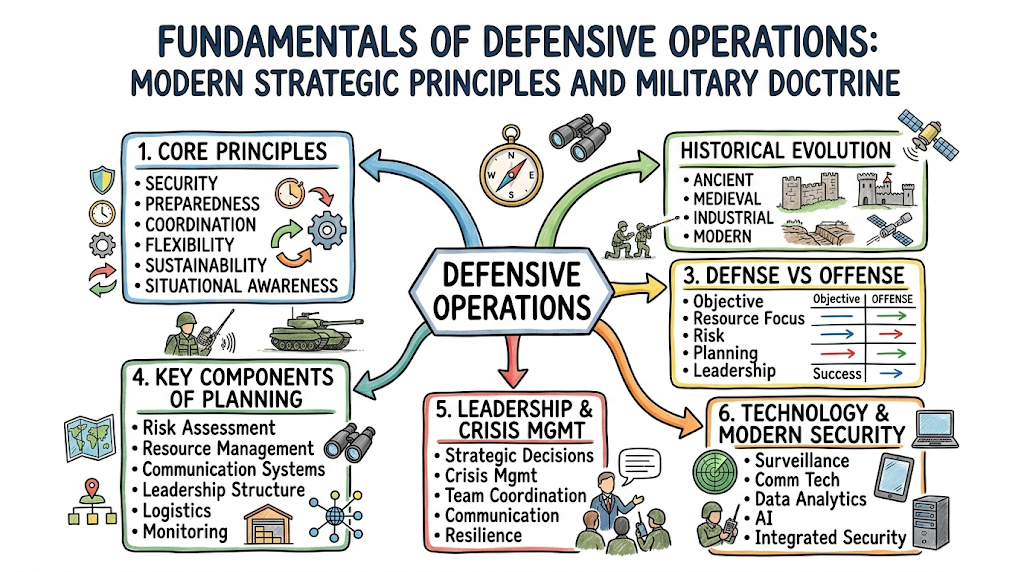
Strategic defense planning is the cornerstone of institutional survival and operational continuity. In an unpredictable world, the ability to anticipate, absorb, and neutralize threats determines whether an entity endures or collapses under pressure. Historically, organizations and nations that treated security as an active discipline thrived, while those relying on passive assumptions consistently faltered. True preparation goes far beyond building walls; it requires an active blueprint designed to manage risk, preserve resources, and maintain clear communication through crises.
Throughout history, defensive operations have shaped the borders of nations and the doctrines of global security. In the modern era, these concepts extend past conventional physical spaces into cyberspace, critical infrastructure protection, and organizational risk management. This guide explores the foundational structures of defense planning, drawing on historical evolution and strategic frameworks to show how these concepts foster long-term resilience. To explore deeper operational insights and security studies, visit WarOpsX, your premier educational hub for strategic defense analysis on the Official Website URL.
Featured Snippet
What Are Defensive Operations?
Defensive operations are coordinated military and security frameworks designed to resist, degrade, and defeat an adversary’s offensive actions. Their primary objective is to protect critical assets, preserve force capability, and retain vital territory, establishing the necessary conditions to regain the initiative and transition to offensive operations.
Understanding Defensive Operations
Defensive operations represent an active, highly structured endeavor to deny an opposing force its objectives. Far from being a static posture, modern defense involves complex maneuvering, resource optimization, and rapid decision-making designed to wear down an adversary’s momentum and resources.
Definition of Defensive Operations
At its core, defensive doctrine defines these operations as intentional actions taken to resist threat progression, safeguard specific geographic areas or assets, and buy time. Defense is rarely conducted as an end in itself; it serves as a critical phase within a broader strategy, creating a stable platform from which to pivot toward future initiatives.
Purpose of Defensive Strategies
The primary purposes of defensive planning include:
- Preserving critical infrastructure and valuable personnel assets.
- Fixing an adversary’s position to limit their operational choices.
- Conserving resources in one sector to enable concentration in another.
- Reducing risk when facing asymmetrical or superior forces.
Defensive Thinking in Military History
Historically, defensive structures shaped civil development. From ancient fortified settlements to modern integrated air defense networks, the architecture of the defense reflects a society’s technological capacity and strategic priorities. Those who mastered defensive systems understood that defense dictates where, when, and under what conditions an engagement occurs.
Why Defense Is a Core Military Function
Defense provides the stability required for any complex system to operate. Without a reliable defensive framework, offensive planning is inherently fragile, exposed to disruptive counter-actions. Defense ensures that an organization can absorb unexpected shocks without suffering catastrophic system failure.
+--------------------------------------------------------+
|             DEFENSIVE OPERATIONS CONCEPT MAP           |
+--------------------------------------------------------+
|                                                        |
|    +-------------------+      +-------------------+    |
|    |  PREPAREDNESS     |      |  SECURITY         |    |
|    | - Risk Assessment | ---> | - Asset Shielding |    |
|    | - Resource Spares |      | - Intelligence    |    |
|    +-------------------+      +-------------------+    |
|              |                          |              |
|              v                          v              |
|    +-------------------+      +-------------------+    |
|    |  COORDINATION     |      |  FLEXIBILITY      |    |
|    | - Shared Systems  | ---> | - Rapid Maneuver  |    |
|    | - Unified Command |      | - Backup Plans    |    |
|    +-------------------+      +-------------------+    |
|              |                          |              |
|              v                          v              |
|    +----------------------------------------------+    |
|    |            SITUATIONAL AWARENESS             |    |
|    |      Continuous Monitoring & Data Streams     |    |
|    +----------------------------------------------+    |
|                                                        |
+--------------------------------------------------------+
Section Engagement Elements
In Simple Terms
Imagine defensive operations as a world-class goalie in hockey. The goalie doesn’t just stand still waiting for the puck; they actively track the play, adjust their angles, coordinate with defenders, and position themselves to block shots, all to flip the momentum back to their team’s offense.
Historical Example
During the Battle of Britain in 1940, the Royal Air Force established an integrated defensive system combining radar technology, spotter networks, and centralized command hubs. This framework allowed them to allocate limited fighter aircraft efficiently, successfully repelling a larger offensive force.
Common Misunderstanding
People often assume that choosing a defensive posture implies weakness or a lack of ambition. In reality, defense is a conscious, strategic choice used to preserve resources, gather vital intelligence, and wait for the optimal moment to act from a position of security.
Key Takeaways
- Defense is an active, dynamic discipline focused on controlling the environment.
- The ultimate goal of a defense is to neutralize threats and regain long-term initiative.
- Effective defensive systems require a mix of physical protection, technology, and clear organization.
Historical Evolution of Defensive Operations
The methods used to implement defensive operations evolved alongside technological innovation and changes in social organization. Tracking this evolution reveals how core principles remain steady even as tools change completely.
Ancient Defensive Strategies
In antiquity, defense centered on natural topography and physical mass. Cities leveraged high ground, rivers, and stone masonry to create defensive bastions. Operations relied on deep perimeters that forced adversaries into lengthy, resource-draining sieges.
Medieval Defensive Systems
The medieval era introduced concentric fortification designs. Castles featured layers of walls, independent towers, and integrated kill zones. This architectural approach ensured that even if a threat breached the outer ring, the inner strongholds could sustain defensive operations independently.
Industrial-Era Defense Concepts
The arrival of mass production, long-range artillery, and rapid rail transport modified defense doctrine during the American Civil War and World War I. Defense became linear, characterized by deep trench systems, barbed wire networks, and heavy logistical lines designed to absorb immense industrial output.
Modern Defense Doctrine
Today, defense has evolved beyond fixed lines into fluid, non-linear, and multi-domain spaces. Modern doctrine emphasizes distributed networks, mobile elements, and rapid digital coordination, protecting physical borders alongside cyberspace and satellite communications.
Section Engagement Elements
In Simple Terms
In the past, defense meant building the thickest stone wall possible. Today, defense means building a smart, flexible network of sensors, mobile response teams, and digital shields that can detect and stop a threat long before it reaches your door.
Historical Example
The evolution of star forts (trace italienne) in 16th-century Europe came as a direct response to gunpowder artillery. Low, angled earthen walls replaced tall, vulnerable medieval stone walls, showing how defensive design adapts to survive new technologies.
Common Misunderstanding
It’s easy to believe that historical defensive structures like the Great Wall of China or the Maginot Line failed because they were breached. In truth, these systems often achieved their main purpose: redirection. They forced adversaries to take longer, more difficult paths, buying valuable time for the defenders.
Key Takeaways
- Defensive strategies adapt continuously to counter emerging technologies.
- Layered protection remains the gold standard across historical and modern doctrine.
- Fixed, rigid defenses are vulnerable; long-term survival requires flexibility.
Core Principles of Defensive Operations
To design an effective defensive operational blueprint, architects rely on six core conceptual principles. These fundamentals apply equally to regional security planning and corporate risk preservation frameworks.
1. Security
Security focuses on protecting the integrity of the defensive system itself. It involves continuous monitoring, concealment, and counter-reconnaissance to prevent an adversary from identifying vulnerabilities or launching unexpected attacks against critical hubs.
2. Preparedness
Preparedness is the foundational groundwork completed before a threat appears. It includes stocking essential supplies, running regular training simulations, building structural redundancies, and establishing clear lines of leadership succession.
3. Coordination
A defense fails if its components operate in isolation. Coordination ensures that surveillance assets, response units, logistics networks, and leadership modules share a unified view of operations and communicate through standardized channels.
4. Flexibility
Fixed plans rarely survive initial conflict. Flexibility enables a defensive architecture to reallocate resources on the fly, adjust positioning when a sector faces heavy pressure, and adapt strategies as threat profiles change.
5. Sustainability
Defensive operations are frequently tests of endurance. Sustainability requires careful management of fuel, power, digital bandwidth, and human capital to ensure the organization can maintain its protective posture over long durations.
6. Situational Awareness
Situational awareness means maintaining an accurate, real-time understanding of your operational environment. This requires gathering data from diverse sources, analyzing it quickly, and delivering actionable insights directly to decision-makers.
Section Engagement Elements
In Simple Terms
Think of these principles as the systems in a modern smart home security setup. You need sensors to spot trouble (awareness), backup power if lines are cut (sustainability), a central hub connecting alarms to your phone (coordination), and locks that hold up under pressure (security).
Historical Example
During the 1973 Yom Kippur War, Israeli forces initially suffered setbacks due to a lack of immediate preparedness and rigid positioning. However, by leveraging flexibility and rapid coordination, they restructured their lines and stabilized their defensive stance within days.
Common Misunderstanding
Many people think situational awareness just means having a lot of data. True situational awareness isn’t about the volume of information; it’s about filtering out noise so leaders can see and understand critical threats clearly.
Key Takeaways
- Preparation prevents systemic collapse when a crisis hits.
- Coordination transforms independent units into a single, cohesive defensive shield.
- Sustainability ensures your defense outlasts the duration of the threat.
Defensive Operations vs. Offensive Operations
Understanding defense requires analyzing how it contrasts with, and complements, offensive operations. While offense aims to project power and secure new terrain, defense focuses on preservation and stability.
| Aspect | Defensive Operations | Offensive Operations |
| Primary Objective | Preserve assets, retain territory, and degrade threat momentum. | Seize objectives, dislodge threats, and project influence. |
| Resource Focus | Sustainability, structural redundancy, and interior lines. | Mobility, concentrated force, and supply line extension. |
| Risk Profile | Mitigated via cover, early warning networks, and positions. | Elevated due to exposure, movement, and unknown variables. |
| Planning Requirements | Threat modeling, contingency pathways, and area optimization. | Momentum maintenance, penetration vectors, and timing. |
| Leadership Challenges | Maintaining morale during crises and managing ambiguity. | Synchronizing rapid movements and exploiting breakthroughs. |
| Success Measures | Threat neutralization, asset survival, and line stability. | Objective capture, threat displacement, and systemic disruption. |
Section Engagement Elements
In Simple Terms
Offense is like a team trying to score a goal on a fast break, risking exposure to make a big play. Defense is about protecting your home court, using positioning and timing to run down the clock and force the opponent into mistakes.
Historical Example
The American Revolutionary War highlighted this balance perfectly. General George Washington frequently relied on defensive operations to preserve his army’s core strength, avoiding decisive defeats until offensive opportunities emerged at Trenton and Yorktown.
Common Misunderstanding
People often view offense and defense as completely separate choices. In professional strategy, they are two sides of the same coin; an effective defense always looks for openings to transition into an offensive move.
Key Takeaways
- Defense benefits from interior lines, making supply and communication easier.
- Offense requires concentration of force, while defense emphasizes distributed resilience.
- Both postures depend on identical core requirements: clear data and strong leadership.
Key Components of Defensive Planning
Building a reliable defensive framework requires integrating several structural components. Leaving out any single piece can create a vulnerability that compromises the entire organization.
+-----------------------------------------------------------------------+
|                     DEFENSE PLANNING FRAMEWORK                        |
+-----------------------------------------------------------------------+
|                                                                       |
|  [1. RISK ASSESSMENT] --------> Evaluates vulnerabilities & vectors   |
|         |                                                             |
|         v                                                             |
|  [2. RESOURCE MANAGEMENT] ----> Allocates reserves & material assets |
|         |                                                             |
|         v                                                             |
|  [3. COMMAND SYSTEM] ---------> Establishes communication protocols   |
|         |                                                             |
|         v                                                             |
|  [4. SUSTAINMENT LOGISTICS] --> Manages energy, supplies & networks   |
|         |                                                             |
|         v                                                             |
|  [5. MONITORING MATRIX] ------> Delivers real-time data to leaders    |
|                                                                       |
+-----------------------------------------------------------------------+
Risk Assessment
Before allocating resources, planners must evaluate their vulnerabilities. This involves identifying critical assets, mapping potential threat vectors, and calculating the likelihood and potential impact of various crisis scenarios.
Resource Management
Effective defense requires positioning supplies and personnel strategically. Planners avoid overextending assets, maintaining versatile reserve forces that can deploy rapidly to reinforce any vulnerable sectors.
Communication Systems
Communication systems must be hardened against disruption. This means establishing secure, redundant networks so that critical data flows continuously between field units and central management hubs during a crisis.
Leadership Structure
Defensive operations require a decentralized leadership structure. While overall strategy remains centralized, local managers need clear authorization to make immediate decisions when conditions on the ground shift rapidly.
Logistics and Support
A defense stands only as long as its logistics hold up. This component covers the distribution of power, fuel, medical supplies, and technical maintenance, ensuring all systems stay operational over extended periods.
Continuous Monitoring
Defensive lines are never static. Continuous monitoring uses sensors, patrols, and digital analytics to detect early warning signs of trouble, allowing teams to adjust positions before an incident escalates.
Section Engagement Elements
In Simple Terms
Think of defensive planning as preparing an organization for a major cyberattack. You map out your sensitive data (risk), set up automated firewalls (resources), secure backup networks (communication), and give IT teams the authority to isolate infected servers instantly (leadership).
Historical Example
In the mid-20th century, Western nations built the DEW Line (Distant Early Warning Line) across the Arctic. This massive monitoring investment provided early radar notifications, forming a cornerstone of cold-war defensive planning.
Common Misunderstanding
Planners sometimes think a good plan covers every possible detail. The best defensive plans are actually frameworks; they define clear goals, resources, and communication rules while leaving room for teams to adapt to unexpected situations.
Key Takeaways
- Risk assessment ensures you spend resources protecting what matters most.
- Decentralized leadership keeps your defense fast and responsive during crises.
- Redundant communication networks prevent confusion when primary systems fail.
Leadership in Defensive Operations
When operations face heavy pressure, leadership becomes the ultimate stabilizing force. Leading a defense requires a unique balance of calm determination, clear foresight, and deep empathy for teams managing high-stress situations.
Strategic Decision-Making
Defensive leaders must evaluate complex data under intense pressure. They focus on long-term sustainability, resisting the urge to overreact to minor distractions while ensuring core strategic goals remain protected.
Crisis Management
When a defensive perimeter is tested, confusion spreads quickly. Leaders cut through the noise by projecting composure, issuing clear instructions, and reallocating resources systematically to stabilize the situation.
Team Coordination
Defensive operations rely on multiple independent teams working together. Leaders break down organizational silos, ensuring information flows smoothly between technical support, logistics teams, and front-line responders.
Communication During Uncertainty
During a crisis, a lack of information breeds anxiety. Resilient leaders communicate transparently with their teams, sharing known facts, acknowledging gaps in information, and outlining immediate, practical steps to maintain focus.
Building Organizational Resilience
True leadership builds resilience into an organization long before a crisis occurs. By encouraging a culture of shared responsibility, continuous learning, and open communication, leaders ensure their teams can absorb unexpected challenges and adapt autonomously.
Section Engagement Elements
In Simple Terms
Think of a great defense leader as a veteran captain of a ship navigating a major storm. They don’t panic or yell; they stay calm on the bridge, trust their crew to handle their specific duties, give clear directions, and focus entirely on keeping the vessel stable.
Historical Example
During the severe winter disruptions of 1947, British administrator Lord Citrine managed the national electrical grid defense. By communicating honestly with the public and prioritizing energy distribution transparently, he kept core infrastructure stable through an unprecedented resource crisis.
Common Misunderstanding
People often believe great leaders must control every single action during a crisis. In complex defensive operations, micromanagement causes delays; the most effective leaders delegate authority, trusting trained teams to execute within their sectors.
Key Takeaways
- Calm, transparent leadership keeps teams grounded and focused under pressure.
- Clear delegation prevents decision-making bottlenecks during fast-moving crises.
- Building a resilient culture beforehand is the best way to ensure crisis survival.
Situational Awareness and Intelligence
To defend an asset effectively, you must see the threat clearly. Situational awareness transforms raw environmental observations into actionable strategic insights.
Information Gathering
The foundation of awareness rests on varied data collection. This involves pulling info from physical sensors, network monitors, human reports, and external intelligence feeds to build a comprehensive picture of the operational area.
Threat Assessment
Once data is collected, analysts evaluate it to identify patterns, assess threat capabilities, and estimate timelines. This step helps separate harmless background noise from serious, developing vulnerabilities.
Monitoring Changing Conditions
Defensive environments change quickly. Continuous tracking allows organizations to spot subtle shifts in threat behavior or asset status, ensuring they can adjust their defensive posture before a crisis peaks.
Decision Support Systems
Modern strategy relies heavily on decision support platforms. These digital tools organize complex information, highlight critical vulnerabilities, and model potential outcomes, helping leaders make fast, evidence-based choices.
Section Engagement Elements
In Simple Terms
Situational awareness is what a modern commercial pilot uses when flying through a storm. Their radar tracks weather cells, instruments monitor engine health, and radio updates connect them with air traffic control, giving them the complete picture needed to navigate safely.
Historical Example
The development of the undersea SOSUS (Sound Surveillance System) network during the mid-20th century allowed maritime planners to track acoustic signatures across oceans, providing critical long-range situational awareness.
Common Misunderstanding
It is a mistake to view intelligence as a tool used only for offensive planning. A strong defense depends entirely on intelligence; without accurate data, an organization wastes energy defending the wrong areas.
Key Takeaways
- Comprehensive data collection forms the basis of all secure defense planning.
- Threat assessment separates minor distractions from critical systemic dangers.
- Decision support tools help leaders make fast, rational choices in high-stress moments.
Defensive Operations in Modern Security Environments
Today’s defensive strategies look far beyond traditional historical battlefields. Modern security requires safeguarding interconnected digital networks, social systems, and physical infrastructure simultaneously.
National Security
At the state level, defensive operations focus on protecting sovereignty, maintaining regional stability, and securing borders against conventional and unconventional challenges. This requires balancing diplomatic initiatives with credible deterrence frameworks.
Border Security
Modern border defense relies on integrated networks rather than physical barriers alone. Security agencies combine satellite monitoring, drone surveillance, and automated checkpoints to manage long borders efficiently without disrupting legitimate trade.
Cyber Defense Concepts
Cyberspace is an active, continuous defensive arena. Organizational cyber defense focuses on zero-trust architectures, real-time network anomaly detection, and rapid isolation protocols to secure data and preserve infrastructure integrity.
Infrastructure Protection
Power grids, water treatment plants, and transportation networks are primary targets for disruption. Defensive planning protects these assets through physical hardening, digital isolation, and building systemic workarounds to keep services running during incidents.
Emergency Preparedness
Civil defense frameworks ensure communities can withstand natural disasters and industrial accidents. This requires building clear public warning systems, prepositioning emergency supplies, and training regional response teams.
Section Engagement Elements
In Simple Terms
Modern security is like protecting a major international airport. You aren’t just guarding the fences; you are checking digital tickets, monitoring baggage screening software, securing fuel supplies, and keeping runways clear of weather hazards all at once.
Historical Example
The creation of North American Aerospace Defense Command (NORAD) created an integrated, bi-national defensive architecture. By linking early warning radars and communication hubs across borders, it established a model for modern collaborative security.
Common Misunderstanding
Many assume cyber defense is strictly an IT issue. Today, cyber defense is a core strategic priority; a successful digital breach can disrupt physical infrastructure like power grids and supply chains just as severely as a physical incident.
Key Takeaways
- Modern defense requires managing physical, digital, and social systems together.
- Securing critical infrastructure keeps society stable during large-scale crises.
- Collaborative security frameworks are essential for managing cross-border threats.
Technology and Defensive Operations
Advanced technology serves as a massive capability multiplier within modern defensive operations, expanding what teams can see, analyze, and protect.
+-----------------------------------------------------------------------+
|                    STRATEGIC RISK ASSESSMENT CHECKLIST                |
+-----------------------------------------------------------------------+
|                                                                       |
|  [ ] Identify and rank core infrastructure assets.                    |
|  [ ] Map external digital and physical threat pathways.               |
|  [ ] Audit primary and backup communication networks.                 |
|  [ ] Verify delivery timelines for emergency supply lines.            |
|  [ ] Review local management decision-making authority limits.        |
|  [ ] Run scheduled stress tests on core containment systems.          |
|                                                                       |
+-----------------------------------------------------------------------+
Surveillance Systems
High-resolution optics, thermal imaging, and orbital satellite sensors provide unmatched visibility across vast operational areas. These technologies remove the element of surprise, giving defenders the time needed to respond effectively.
Communication Technologies
Modern defense relies on secure, self-healing mesh networks. If a primary communications tower goes offline, these smart systems automatically reroute data through surviving nodes, keeping disconnected teams in touch.
Data Analytics
Defensive operations generate massive amounts of information. Advanced analytics platforms parse through this data instantly, identifying subtle anomalies, predicting potential failure points, and surfacing critical trends.
Artificial Intelligence
Artificial intelligence streamlines security by automating routine monitoring tasks. AI systems scan millions of data points to flag potential threats, freeing human analysts to focus on complex problem-solving and high-level strategy.
Decision Support Platforms
These systems combine live data streams, historical models, and predictive algorithms into a single interface. By presenting clear options and impact projections, they help leaders make fast, accurate choices during complex crises.
Section Engagement Elements
In Simple Terms
Technology works like a modern driver-assist system in a vehicle. It uses cameras to spot blind spots, analyzes braking distances instantly, and applies automatic corrections if you drift, keeping you safe without taking over the steering wheel completely.
Historical Example
The integration of automated calculation machines at Bletchley Park during World War II transformed defensive intelligence. Processing intercepted data at scale allowed analysts to provide early warnings that protected maritime supply lines.
Common Misunderstanding
People often believe that buying advanced technology automatically solves security problems. Technology is only an amplifier; if your underlying strategy, training, and organization are weak, tools will just generate confusion faster.
Key Takeaways
- Surveillance technology removes an opponent’s ability to surprise your defense.
- Self-healing networks keep communication alive through physical infrastructure damage.
- AI assists human operators by filtering out noise and highlighting real dangers.
Defensive Operations Beyond the Military
The core principles of defensive doctrine translate effectively into non-military fields. Modern corporations, healthcare networks, and civic organizations routinely use these concepts to survive systemic disruptions.
Business Continuity Planning
Business continuity applies defensive strategy to commercial operations. It ensures that if an organization loses a main supplier, facility, or data center, it has the alternative workflows and redundancies needed to keep serving clients without interruption.
Risk Management
Corporate risk management mirrors military threat assessment. Financial institutions and enterprises map out market shifts, regulatory changes, and economic vulnerabilities, establishing financial reserves and compliance shields to protect their core business.
Disaster Recovery
Disaster recovery frameworks focus on restoration. When an unexpected disruption occurs—such as a facility fire or a severe IT outage—these plans provide step-by-step procedures to recover systems, secure assets, and restore normal operations quickly.
Organizational Resilience
Resilience measures an institution’s ability to adapt to long-term structural changes. Cultivating a resilient organization means building cross-trained teams, flexible resource pipelines, and an adaptable culture that can withstand shifting environments.
Crisis Response Planning
When an emergency occurs, public relations, safety, and operational teams must act as a single unit. Crisis response planning establishes a clear command structure, set communication channels, and pre-approved action steps to protect people and reputation.
Section Engagement Elements
In Simple Terms
When a bank uses backup data centers in different states, cross-trains branch staff to handle multiple roles, and maintains cash reserves for market drops, it is running a textbook defensive operation to protect its business stability.
Historical Example
Following the severe disruptions of the 2008 global financial crisis, international banking authorities introduced the Basel III frameworks. This strategy forced financial institutions to build defensive asset reserves, protecting the broader economic system against future shocks.
Common Misunderstanding
Many view risk management as a negative department that simply says “no” to new ideas. In reality, strong risk management provides the safety net that gives an organization the confidence to innovate and grow safely.
Key Takeaways
- Business continuity translates defense doctrine into commercial survival.
- Redundancy across suppliers and data centers protects companies from single points of failure.
- Building organizational resilience allows teams to adapt smoothly to long-term market shifts.
Real-World Historical Case Studies
Analyzing historical events provides practical examples of defensive principles in action, showing how strategic planning and leadership save organizations during crises.
Case Study 1: The Berlin Airlift (1948–1949)
- The Challenge: In June 1948, the Soviet Union blocked all ground access lines to West Berlin, cut off food, fuel, and supplies for over two million citizens, creating a massive geopolitical crisis.
- The Planning Approach: Allied planners chose a non-offensive, purely defensive supply strategy. They mapped out air corridors and treated the problem as a high-volume logistics and resource management challenge.
- The Coordination Process: Planners built a synchronized, around-the-clock flight schedule. Mechanics, air traffic controllers, and supply crews worked across international boundaries, landing supply planes at short, predictable intervals.
- The Outcomes: The operation delivered over 2.3 million tons of essential supplies over 15 months, keeping the city stable without triggering an armed conflict, until the ground blockade was lifted.
- Lessons Learned: Logistics, precise timing, and operational sustainability can resolve severe geopolitical blockades without relying on escalatory measures.
Case Study 2: Tylenol Crisis Management (1982)
- The Challenge: Seven people in Chicago died after consuming tampered, cyanide-laced capsules of Tylenol, creating an immediate threat to public safety and Johnson & Johnson’s survival.
- The Planning Approach: Executive leadership put public safety ahead of short-term profits. They launched a massive defensive risk-mitigation strategy, halting all advertising and ordering a nationwide recall of 31 million bottles.
- The Coordination Process: The company worked closely with the FBI, local police, and media channels to warn the public quickly while redesigning their packaging standards from scratch.
- The Outcomes: Johnson & Johnson launched triple-seal, tamper-evident packaging within months, restoring public trust and setting a new safety standard for the entire consumer product industry.
- Lessons Learned: Transparent communication, fast risk mitigation, and putting safety first can save an organization’s reputation and long-term viability during a major crisis.
Case Study 3: The Y2K Technical Preparedness Initiative (1998–1999)
- The Challenge: Early software code often used two digits for years, creating a systemic risk that computers worldwide would malfunction when transitioning to the year 2000, threatening critical global infrastructure.
- The Planning Approach: Governments and corporations launched an unprecedented global defensive upgrade program. They treated the deadline as a clear, high-impact risk to systemic continuity.
- The Coordination Process: Public agencies and private tech firms shared code fixes globally, audited critical energy and banking systems, and set up backup communication networks worldwide.
- The Outcomes: On January 1, 2000, critical systems maintained continuity with zero major disruptions worldwide, proving the value of wide-scale defensive preparation.
- Lessons Learned: Asymmetrical technical threats can be neutralized completely when organizations share data, coordinate planning, and allocate resources well ahead of time.
Benefits of Strong Defensive Planning
Investing in defensive planning provides measurable advantages that protect an organization’s bottom line, team morale, and long-term operational viability.
Improved Readiness
A well-planned organization is never caught off guard. Teams understand their roles, systems are tested, and response frameworks activate automatically the moment a threat is detected, cutting down response times significantly.
Better Resource Utilization
Defensive planning prevents panic-buying of assets during emergencies. By mapping out resource needs beforehand, organizations can purchase, maintain, and position assets efficiently, keeping overhead low during normal operations.
Increased Resilience
Resilient systems absorb shocks easily. Whether an enterprise faces a supply chain break, a natural disaster, or a security incident, defensive planning ensures the core framework holds together while teams work through the challenge.
Faster Recovery
The timeline between initial disruption and normal operations defines recovery success. Defensive blueprints include clear restoration steps, allowing organizations to rebuild systems, clean data, and reopen facilities quickly.
Stronger Coordination
Planning breaks down structural walls between internal departments. By training together on security simulations, IT, legal, operations, and leadership teams build the trust and clear channels needed to cooperate during real crises.
Section Engagement Elements
In Simple Terms
Defensive planning works like buying a comprehensive insurance policy and practicing regular fire drills. It keeps your costs predictable, ensures everyone knows the fastest way out of the building, and guarantees you can rebuild quickly if disaster strikes.
Historical Example
The rapid recovery of global shipping networks following the Suez Canal blockage in 2021 highlighted the value of maritime defense planning. Companies with flexible routing frameworks re-routed vessels around Africa within days, avoiding long delays.
Common Misunderstanding
Business leaders sometimes view defensive planning as an unnecessary expense that sits idle during successful quarters. The true value of defensive planning is preventive; it pays for itself by preventing single disruptions from escalating into business-ending bankruptcies.
Key Takeaways
- Proactive readiness cuts down chaotic response times when a real crisis hits.
- Strategic resource placement keeps operational costs low during normal business.
- Strong internal coordination prevents mixed messages and confusion during disruptions.
Common Challenges in Defensive Operations
Even the most thorough defensive frameworks face friction. Identifying common operational bottlenecks allows planners to build workarounds into their systems beforehand.
Resource Constraints
Defenders rarely have unlimited budgets, staff, or equipment. Balancing protection needs across multiple departments with limited resources requires strict prioritization and clever asset management.
Communication Breakdowns
During fast-moving crises, standard communication lines frequently face overload or physical failure. If teams drop into isolation, defensive strategies fragment, leading to duplicated efforts and missed vulnerabilities.
Leadership Challenges
Indecision or micromanagement from leadership can stall a defense. If leaders demand endless data before making a move, or refuse to delegate local authority, response teams lose the time needed to contain threats.
Information Overload
Modern tracking networks generate massive volumes of alerts. If defensive teams are flooded with thousands of minor warnings every hour, they can experience alarm fatigue, missing the critical indicators of a major developing threat.
Rapidly Changing Threats
Threat profiles adapt continuously. A defensive framework designed around last year’s risks can struggle against new tactics, requiring organizations to update their strategies constantly.
Section Engagement Elements
In Simple Terms
Imagine managing a security team at a massive music festival. You have limited staff (resources), radios dropping out in crowds (communication), thousands of false alarms (overload), and weather changes to track, requiring a highly organized plan to keep things running safely.
Historical Example
During the 1911 introduction of industrial-scale telecommunications, early defense hubs often faced severe telegram backlogs, demonstrating how early information overload delayed critical strategic decisions.
Common Misunderstanding
People often assume a breakdown in defense stems from a failure of technology. In most cases, failures happen because of human bottlenecks—like poor communication choices, lack of clear delegation, or a rigid refusal to adapt plans to changing conditions.
Key Takeaways
- Smart asset management keeps defenses strong even when budgets are tight.
- Decentralized authority keeps your teams fast and responsive during fast-moving events.
- Automated data filtering prevents security teams from suffering alarm fatigue.
Common Misconceptions About Defensive Operations
Clearing up persistent myths about defensive doctrine is essential for building effective, modern security strategies.
Defense Is Not Passive
The most dangerous myth is that defense means standing still behind a wall and taking hits. True defense is dynamic, constantly involving active monitoring, changing positions, and launching targeted counter-moves to disrupt an opponent’s momentum.
Preparation Is Not Weakness
Some organizational cultures believe focusing heavily on defense means admitting your core strategy is vulnerable. In reality, deep preparation is a sign of strategic maturity, ensuring you can protect your growth long-term.
Technology Alone Is Not Enough
Buying the most expensive cybersecurity software or physical security system will not guarantee safety on its own. True defense depends on an integrated combination of smart strategy, continuous training, clear leadership, and reliable tools.
Leadership Matters as Much as Resources
Having an enormous budget will not save an organization if its leadership panics or micromanages during a disruption. Composed, clear-headed decision-making is just as critical to survival as material assets.
Section Engagement Elements
In Simple Terms
Believing defense is passive is like thinking a professional boxer’s defense means just standing there letting the opponent hit their gloves. Real boxing defense involves constant footwork, slipping punches, managing distance, and waiting for the right opening to counter-punch.
Historical Example
The construct of the Bar Lev Line along the Suez Canal in the early 1970s was built on the assumption that sand fortifications alone could stop an advance. Its fast breach showed that physical structures without active, flexible support fail under pressure.
Common Misunderstanding
Many people think that once a defensive framework is set up, it can run on autopilot indefinitely. A real defense requires constant updates, regular simulation drills, and continuous tuning to stay ahead of changing threat environments.
Key Takeaways
- Active, flexible movement is far more effective than relying on fixed physical barriers.
- Thorough preparation protects your organizational growth over the long run.
- Tools are only as good as the strategy, training, and leadership behind them.
Skills Needed to Understand Defensive Operations
Mastering the study and management of defensive operations requires building a balanced set of strategic, analytical, and interpersonal skills.
+-----------------------------------------------------------------------+
|                    BEGINNER LEARNING ROADMAP FOR DEFENSE              |
+-----------------------------------------------------------------------+
|                                                                       |
|  [PHASE 1: FOUNDATIONS] ---> Study historical doctrine & frameworks  |
|                                                                       |
|  [PHASE 2: ASSESSMENT] ----> Learn risk modeling & trend analysis    |
|                                                                       |
|  [PHASE 3: SYSTEMS] -------> Master communication & network design    |
|                                                                       |
|  [PHASE 4: LEADERSHIP] ----> Practice crisis simulation & delegation  |
|                                                                       |
+-----------------------------------------------------------------------+
Strategic Thinking
You must be able to see the entire operational landscape, understand how different departments interconnect, and anticipate how current decisions will impact the organization months down the road.
Risk Assessment
This skill involves analyzing complex environments, spotting subtle technical or structural vulnerabilities, evaluating threat capabilities accurately, and prioritizing security investments effectively.
Leadership
Leading under pressure requires practicing emotional intelligence, communicating clearly during chaotic moments, delegating tasks confidently, and keeping diverse teams aligned on core goals.
Communication
You need the ability to translate technical security data into clear, simple insights for executive leadership, while providing precise directions to frontline response teams during a crisis.
Analytical Skills
Managing modern defense means processing large streams of information from automated tools, identifying critical trends quickly, and separating real warnings from false alarms.
Decision-Making
Defensive positions require making firm choices with incomplete information. Cultivating this skill helps you weigh competing priorities balanced against tight timelines to choose the safest path forward.
Section Engagement Elements
In Simple Terms
Studying defensive operations is like training to be an air traffic controller. You need the analytical skill to track multiple flights at once, the calm leadership to handle emergencies, and the clear communication to guide pilots safely.
Historical Example
The career of strategic planner Elihu Root in the early 20th century highlighted this blend of skills. By restructuring organizational hierarchies and implementing rigorous analytical training, he modernized national security administration frameworks.
Common Misunderstanding
People often think you need a deep technical or military background to understand defensive planning. While technical knowledge helps, the core of defensive planning is rooted in logic, clear organization, and sound risk management—skills anyone can build.
Key Takeaways
- Strategic thinking helps you anticipate threats long before they disrupt operations.
- Clear, simple communication prevents confusion when dealing with complex security data.
- Firm decision-making ensures your teams stay fast and responsive during crises.
Lessons Modern Organizations Can Learn
The principles that preserve security frameworks offer highly effective blueprints for modern corporate governance, brand protection, and market stability.
+-----------------------------------------------------------------------+
|                      LEADERSHIP LESSONS SUMMARY                       |
+-----------------------------------------------------------------------+
|                                                                       |
|  * Decentralize authority to keep frontline response teams fast.       |
|  * Keep communication transparent to ground teams during uncertainty.  |
|  * Focus on long-term sustainability over quick, reactive fixes.      |
|  * Build a culture of shared responsibility and continuous learning.  |
|                                                                       |
+-----------------------------------------------------------------------+
Planning Ahead
Enterprises that map out worst-case scenarios ahead of time adjust to market shocks far more successfully than competitors who handle crises reactively, protecting their market share and workforce stability.
Building Resilience
True resilience means designing your operations to handle unexpected failures. This involves building supply chain alternatives, maintaining rainy-day capital reserves, and cross-training your workforce to prevent single dependencies from stalling production.
Managing Risk
Rather than trying to avoid all risk, mature organizations run structured risk assessments. This approach allows them to identify their most valuable assets and invest their security budgets where they provide the highest protection.
Creating Response Frameworks
When an incident occurs, clear protocols save time. Establishing pre-set response frameworks ensures that IT, legal, public relations, and management teams activate immediately as a synchronized unit, limiting total damage.
Continuous Improvement
A resilient defense is never finished. Leading organizations use post-incident reviews and regular stress-test simulations to find vulnerabilities in their plans, using those lessons to improve their security frameworks continuously.
Section Engagement Elements
In Simple Terms
When an e-commerce company uses multiple shipping vendors, runs weekly data backups, and trains customer support teams on how to handle server outages smoothly, it is applying time-tested defense concepts to protect its business.
Historical Example
The survival of global manufacturing networks during the logistics shocks of 2020 proved the value of operational resilience. Companies that had mapped out backup supply routes adapted quickly, while those relying on single sources faced months of downtime.
Common Misunderstanding
Some managers believe that building operational redundancies is a waste of capital that reduces short-term efficiency. While redundancies carry upfront costs, they act as an essential insurance policy that saves the business from catastrophic failure during market disruptions.
Key Takeaways
- Proactive planning helps businesses navigate unexpected market drops smoothly.
- Operational alternatives prevent single supplier issues from freezing your production.
- Regular safety simulations ensure your corporate teams can handle real crises calmly.
Future of Defensive Operations
As we look forward, the architecture of defensive operations continues to adapt to rapid technological breakthroughs and shifting global risks.
AI-Assisted Decision Support
Future defensive frameworks will rely heavily on predictive AI modules. These platforms will analyze global data streams in real time, alerting leaders to developing vulnerabilities and generating optimized response options instantly.
Advanced Monitoring Systems
The integration of quantum computing sensors, low-Earth-orbit satellite webs, and distributed edge-computing networks will provide unprecedented visibility, making unexpected physical or digital blind spots a thing of the past.
Integrated Security Frameworks
The historical divisions separating physical security, corporate asset protection, and cyber defense will merge into unified security hubs, allowing organizations to manage all vulnerabilities through a single dashboard.
Multi-Domain Coordination
Defensive operations will require seamless coordination across physical, digital, and space domains simultaneously. Protecting assets will mean securing ground operations, cloud networks, and satellite downlinks concurrently.
Resilience-Driven Planning
Future design will prioritize flexible adaptability over rigid physical protection. Security architectures will focus on building self-healing software networks and modular infrastructure that can absorb impacts and restore functions automatically.
Section Engagement Elements
In Simple Terms
The future of defense looks like a modern smart city grid. It will use AI to balance power loads automatically during storms, detect cyber threats before they disrupt water plants, and route emergency vehicles instantly around traffic, keeping life stable automatically.
Historical Example
The gradual transition of global banking networks to decentralized ledger verification methods showcases the future of defense. Moving away from vulnerable central hubs toward distributed verification models creates systems that are incredibly difficult for bad actors to disrupt.
Common Misunderstanding
People often worry that adding advanced AI to security means human leadership will become obsolete. In reality, automation simply handles the routine data processing; the need for ethical human judgment, strategic direction, and empathetic leadership will only grow more vital.
Key Takeaways
- Predictive AI will give security teams early warning options during complex crises.
- Unified dashboards will allow companies to manage physical and digital threats together.
- Future security focuses on self-healing designs that restore functions automatically.
Case Study Section
Case Study 1: National Infrastructure Protection Program
- Challenge: A regional utility provider managing power delivery for four million residents faced an escalating combination of extreme winter weather events and increasing digital scanning attempts against its legacy grid infrastructure.
- Planning Approach: The provider partnered with regional security analysts to execute a comprehensive defense-in-depth transformation. They prioritized grid isolation, physical substation hardening, and automated software boundary defense.
- Coordination Process: The organization established an integrated operations center linking local weather monitors, automated grid telemetry, and a dedicated cybersecurity response desk under a unified command structure.
- Outcomes: During a severe ice storm accompanied by a synchronized network probing event, the utility automatically isolated compromised data channels while rerouting physical power loops, maintaining service continuity for 98% of consumers.
- Lessons Learned: Merging physical infrastructure safeguards with real-time digital monitoring ensures systemic survival during multi-domain incident trends.
Case Study 2: Large Organization Crisis Response Framework
- Challenge: A global financial services enterprise experienced a catastrophic tier-one data center failure during peak trading hours, threatening to halt transaction processing and compromise client trust across multiple international markets.
- Planning Approach: Planners deployed an enterprise-wide business continuity framework founded on hot-site data replication and clear local decision-making delegation.
- Coordination Process: The corporate incident command team immediately activated pre-approved communication trees, seamlessly transferring core transaction ledger operations to an independent backup facility while keeping regulatory authorities updated transparently.
- Outcomes: Ledger operations resumed normal processing sequences within twelve minutes of the primary failure, preventing market panic and demonstrating complete compliance with international operational resilience metrics.
- Lessons Learned: Decentralized execution structures combined with regular simulation testing eliminate costly delays when primary systems suffer sudden failure.
Case Study 3: Emergency Preparedness and Recovery Initiative
- Challenge: A low-lying municipal manufacturing district containing critical chemical storage facilities faced an imminent flash-flooding event following an unprecedented rainfall anomaly.
- Planning Approach: Civil defense coordinators leveraged a modular regional evacuation and containment blueprint, treating asset protection and public safety as an integrated logistical challenge.
- Coordination Process: Using secure, redundant public-safety frequencies, emergency managers synchronized industrial shutdown protocols, coordinated chemical containment valve sealing, and executed structured civilian relocation steps.
- Outcomes: The industrial sector achieved complete, secure shutdown sequences before flood cresting occurred; zero hazardous material leaks were reported, and production lines safely resumed activities within forty-eight hours of water recession.
- Lessons Learned: Prepositioning resource reserves and defining clear cross-sector communication paths prevents localized natural disruptions from turning into widespread environmental emergencies.
FAQ Section
1.What are defensive operations?
Defensive operations are structured frameworks designed to resist, degrade, and defeat threat actions to protect assets and retain stability.
2. Why are defensive operations important?
They prevent systemic collapse, preserve valuable resources, and buy the strategic time needed to regain long-term initiative.
3. How do defensive operations differ from offensive operations?
Defense focuses on preservation, stability, and leveraging interior positions, while offense aims at power projection, movement, and capturing new terrain.
4. What role does leadership play?
Leadership provides direction, stabilizes teams under pressure, coordinates actions, and delegates authority to prevent decision bottlenecks.
5. Why is preparedness important?
Preparedness ensures an organization has the trained personnel, supply reserves, and tested plans ready to handle crises without panicking.
6. How does technology support defense planning?
Technology expands what teams can see through advanced sensors, secures communication via mesh networks, and automates monitoring using analytical software.
7. What is situational awareness?
It is the continuous collection and analysis of environmental data to give leaders a clear, real-time understanding of threats.
8. How can organizations apply defensive principles?
Organizations can use these concepts by building business continuity plans, setting up data backups, and managing corporate risks systematically.
9. What skills are needed to study defensive operations?
Key skills include long-term strategic thinking, objective risk assessment, clear communication, data analysis, and composed decision-making under pressure.
10. What are common challenges in defense planning?
Common friction points include limited budgets, sudden communication failures, information overload from alerts, and fast-moving threat environments.
11. Is defensive planning a passive approach to security?
No, effective defense is highly active, involving continuous monitoring, rapid resource adjustments, and tactical counter-moves to disrupt threats.
12. What is the difference between active and passive defense?
Active defense involves dynamic maneuvers and counter-steps to disrupt threats, while passive defense focuses on physical hardening and structural protection.
13. How does data analytics improve defensive operations?
Analytics platforms scan massive amounts of information instantly to flag real anomalies, helping security teams catch developing threats early.
14. What is a decision support system?
It is a digital platform that organizes operational data and models potential outcomes to help leaders make fast, evidence-based choices.
15. How do you measure the success of a defensive operation?
Success is measured by how well you protect critical assets, maintain core operations, and minimize damage throughout a disruption.
Final Summary
Understanding the fundamentals of defensive operations reveals that resilience is never accidental; it is the direct result of deliberate planning, structured organization, and active execution. From ancient masonry fortifications to modern zero-trust digital networks, the core mission of defense remains unchanged: to absorb unexpected shocks, protect critical assets, and maintain stability through crises. By mastering the core principles of security, preparedness, and flexible coordination, strategic planners ensure their organizations can withstand intense pressure and emerge stronger on the other side.
As threats grow more complex across physical and digital domains, the lessons of defensive doctrine become even more valuable for modern leaders. Survival requires moving past passive assumptions, investing in situational awareness, and building decentralized command structures that empower teams to adapt dynamically to changing conditions. True preparation provides the ultimate competitive advantage, transforming security from an operational expense into a foundational pillar of long-term organizational growth.