Introduction
The military faces this exact organizational challenge, but on a scale where administrative friction can jeopardize national security. To manage coordination at scale, armed forces rely on a sophisticated framework designed to maximize efficiency, minimize communication delays, and ensure absolute accountability. This framework is known as the military hierarchy and chain of command. Understanding this structural architecture is essential for anyone analyzing how large institutions maintain stability, develop leaders, and execute complex strategies. At WarOpsX, a premier platform dedicated to Military Operations Education and Organizational Structure Guides, exploring these systems reveals that military efficiency is not a product of rigid compliance alone. Rather, it is the result of deeply refined organizational design, precise spans of control, and a systematic approach to decision-making. By examining how these command structures operate, public administration students, leadership professionals, and organizational management learners can gain invaluable insights into the mechanics of large-scale institutional coordination.
Understanding Military Hierarchy
What Is Military Hierarchy?
Military hierarchy is the structured, stratified arrangement of personnel within an armed forces organization, where individuals are placed into specific tiers of authority, responsibility, and rank. This framework establishes a clear, vertical progression from entry-level personnel to top-tier strategic leaders. It serves as the formal skeleton of the organization, defining the exact professional relationship between every single member of the defense institution. It ensures that every individual knows exactly where they fit within the broader institutional ecosystem.
Why Military Hierarchy Exists
The core purpose of military hierarchy is to create predictability, order, and scalability within an organization that must operate under extreme stress. In ordinary corporate environments, an ambiguous reporting line results in lost revenue or delayed projects. In defense operations, administrative ambiguity can result in systemic institutional failure. Hierarchy exists to eliminate guesswork. It ensures that when a decision must be made, there is a specific position legally and organizationally designated to make it, thereby preserving institutional stability regardless of external chaos.
Historical Evolution of Military Organization
The structured nature of modern military hierarchy did not appear overnight; it evolved over thousands of years of administrative trial and error. Ancient armies, such as the Roman Legions, realized that attempting to direct thousands of soldiers as a single, amorphous mass was structurally impossible. The Romans pioneered a modular hierarchy, dividing legions into cohorts, maniples, and centuries, each led by dedicated officers (centurions) who reported up a structured ladder.
During the early modern period, European nations standardized rank systems to manage the growing complexity of gunpowder warfare and global logistics. By the 20th century, the rise of industrial warfare required the integration of land, sea, and air forces, leading to the creation of the highly sophisticated, joint command structures used by modern defense ministries today.
Principles of Structured Command
Structured command rests on several foundational pillars that keep the hierarchy functional. First is the concept of formal status, where authority is tied directly to the position and rank, rather than the specific individual holding it. This allows the organization to remain resilient; if a leader is reassigned or unavailable, the position retains its structural authority, and a qualified successor can step in immediately.
Second is the principle of vertical alignment, which dictates that every lower tier must support the objectives of the tier directly above it. This creates a unified vector of effort throughout the entire enterprise, ensuring that localized actions always serve the broader strategic goals of the nation.
What Is a Chain of Command?
Definition of Chain of Command
A chain of command is the continuous, unbroken line of authority that links every single individual in a military organization to the highest level of leadership. It is the formal highway along which executive decisions travel downward, and operational status reports travel upward. It functions as a strict, one-way vertical pipe for formal directives, ensuring that no administrative levels are bypassed during the transmission of instructions or the reporting of critical data.
Purpose of Command Structures
The primary purpose of a chain of command is to establish absolute clarity regarding authority and accountability. It prevents the operational friction caused by conflicting instructions. By ensuring that each subordinate answers to exactly one immediate superior, the system eliminates the administrative chaos that occurs when multiple managers attempt to direct the same team toward competing priorities. It creates an explicit roadmap for professional interaction, ensuring that every member of the organization knows exactly who they take direction from and who they are responsible for protecting and guiding.
How Information Flows
Information within a chain of command moves through highly formalized channels, categorized by its direction of travel.
- Downward Flow: This consists of strategic directives, operational plans, administrative policies, and formal orders. These messages originate at the senior executive level and are systematically broken down into smaller, more granular instructions as they pass through mid-level management to frontline teams.
- Upward Flow: This consists of status reports, operational data, logistical requirements, and feedback. Frontline units gather data and pass it to mid-level headers, who aggregate, analyze, and synthesize the information before forwarding the critical insights to senior leadership. This ensures that executive decision-makers are not overwhelmed by raw data, but instead receive clear, actionable intelligence.
Accountability and Responsibility
In a functional chain of command, authority can be delegated, but ultimate responsibility can never be passed down. If a unit fails to achieve its organizational objective, the commander of that unit is held fully accountable by their superiors. This principle ensures that leaders take deep ownership of the welfare, training, and professional conduct of their subordinates. Because accountability stops at the top of each structural node, leaders are incentivized to maintain rigorous oversight, clear communication, and high standards of discipline within their areas of responsibility.
Key Principles of Military Organization
Unity of Command
The principle of unity of command states that all forces operating toward a common objective must be placed under a single, responsible commander.
- Definition: An organizational design rule dictating that a subordinate should receive orders from only one superior.
- Purpose: To eliminate conflicting instructions and ensure a single, synchronized vector of effort across the entire enterprise.
- Organizational Example: In a joint defense operation, land, air, and naval assets are placed under one regional Combatant Commander, rather than operating under separate, uncoordinated branch mandates.
- Common Misconception: Many believe unity of command means a leader must make every minor decision personally. In reality, it means there is a single source of ultimate intent, while execution is widely decentralized.
- Practical Significance: It prevents operational paralysis and ensures that diverse organizational sub-units do not accidentally work at cross-purposes during complex tasks.
Span of Control
Span of control refers to the maximum number of subordinates or subordinate units that a single manager can effectively direct, supervise, and coordinate.
          [ Commander ]  -> Hard limit: 3 to 7 direct reports
      __________|__________
     |          |          |
 [Unit A]   [Unit B]   [Unit C]
- Definition: The structural limit placed on the number of direct reports a leader manages, typically optimized between three and seven.
- Purpose: To prevent leadership burnout, avoid oversight bottlenecks, and maintain high-quality communication within teams.
- Organizational Example: A military division commander typically manages three to five subordinate brigade commanders, rather than attempting to direct dozens of individual battalions directly.
- Common Misconception: People often assume that a wider span of control indicates a more powerful or efficient leader. Historically, overloading a manager’s span of control leads to communication breakdowns and a total failure of oversight.
- Practical Significance: Keeping the span of control tight ensures that every subordinate receives adequate guidance, performance evaluation, and operational support.
Delegation of Authority
Delegation of authority is the organizational practice of granting conditional decision-making power to lower-level managers within clearly defined parameters.
- Definition: The explicit transfer of command authority from a superior to a subordinate for specific tasks or geographical areas.
- Purpose: To empower frontline leaders to make rapid decisions based on real-time data without waiting for long administrative approvals.
- Organizational Example: A senior commander authorizes a mid-level logistics manager to purchase local supplies up to a specific dollar amount without needing executive board approval.
- Common Misconception: Some assume delegating authority means the senior leader is no longer responsible for the outcome. If the subordinate fails, the delegating commander remains fully accountable for that failure.
- Practical Significance: It prevents executive-level bottlenecks and allows the organization to remain highly agile and responsive to shifting operational environments.
Responsibility and Accountability
This principle outlines the ethical and structural obligations tied to command, ensuring that actions always carry clear organizational consequences.
- Definition: Responsibility is the obligation to execute a assigned task; accountability is the liability for the ultimate outcome of that execution.
- Purpose: To instill deep ownership, maintain professional standards, and ensure institutional integrity across all echelons.
- Organizational Example: An officer is given responsibility for training a team; if that team fails its formal evaluation, the officer faces professional reassignment due to their ultimate accountability.
- Common Misconception: People often use these terms interchangeably, but responsibility can be shared among team members, whereas accountability rests solely on the designated leader’s shoulders.
- Practical Significance: It ensures that errors are systematically analyzed and corrected, rather than hidden behind bureaucratic blame-shifting.
Discipline and Coordination
Discipline and coordination form the operational glue that binds individual actions into a unified institutional output.
- Definition: Discipline is the systematic adherence to established rules, procedures, and organizational values; coordination is the alignment of diverse units to act in harmony.
- Purpose: To ensure predictability and safety across large-scale, high-risk organizational movements.
- Organizational Example: An aviation maintenance team meticulously follows a standardized checklist, ensuring that ground crews, pilots, and air traffic controllers operate in perfect, predictable harmony.
- Common Misconception: Discipline is frequently misunderstood as blind, unthinking obedience. In modern organizations, true discipline is the conscious choice to uphold standards because one understands their critical role in the broader system.
- Practical Significance: It maximizes efficiency, drastically reduces accidental errors, and allows vast numbers of people to work together seamlessly without constant micro-management.
Key Takeaways
- Singular Directives: Unity of command protects teams from the chaos of answering to multiple managers with competing agendas.
- Structural Optimization: Maintaining a strict span of control prevents leaders from becoming administrative bottlenecks.
- Empowered Execution: Delegation of authority ensures that frontline personnel can act quickly on local insights while senior leaders focus on long-term strategy.
Levels of Military Organization
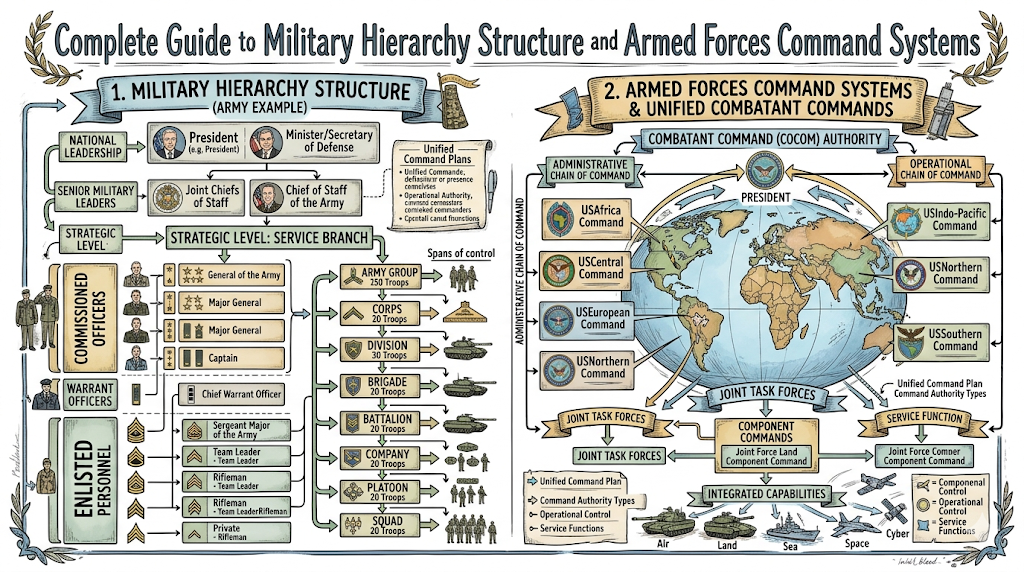
To manage millions of personnel across global territories, the military uses a highly structured, modular building-block system. Each layer of the organization builds upon the previous one, expanding in size, capability, and administrative complexity. Below is an educational breakdown of how these tiers are structured, moving from individual personnel to massive strategic entities.
Individual Personnel
The foundational atom of any military organization is the individual service member. At this entry level, the focus is entirely on personal mastery of foundational skills, adherence to institutional discipline, and the execution of specific, highly localized tasks. Individual personnel do not manage others; they are responsible for maintaining their own equipment, physical readiness, and professional technical competencies.
Teams and Squads
A team typically consists of three to four individuals and represents the smallest structural element in the organization. It is led by a junior non-commissioned officer, such as a Corporal. A squad aggregates two to three teams, resulting in a total of eight to twelve personnel led by a Sergeant. The primary organizational role of a squad is to execute precise, highly focused tasks where close-quarters synchronization and direct, verbal communication are essential.
Platoons
A platoon is a more complex organizational block, combining three to four squads into a cohesive unit of roughly 30 to 50 personnel.
- Leadership Structure: Led by a junior commissioned officer (usually a Second Lieutenant or First Lieutenant), partnered with a highly experienced senior non-commissioned officer (Platoon Sergeant).
- Organizational Function: The platoon is the first level where leadership requires the coordination of different specialties (such as mixing standard personnel with specialized heavy equipment operators) to achieve localized administrative goals.
Companies
A company integrates three to four platoons along with an expanded headquarters and logistical support element, totaling 100 to 250 personnel. Led by a Captain, a company is an independent administrative unit, meaning it possesses its own internal capacity to handle disciplinary records, supply distribution, and basic maintenance, making it a largely self-contained operational block.
Battalions
Comprising three to five companies and numbering between 500 to 1,000 personnel, a battalion is commanded by a Lieutenant Colonel. This level represents a massive structural shift: it is the smallest unit to feature a dedicated staff. A battalion commander does not manage every individual directly; instead, they operate through a structured network of specialized departments, including personnel (S-1), intelligence (S-2), operations (S-3), and logistics (S-4).
Brigades
A brigade functions as a major independent pivot point within the defense framework, consolidating two to five battalions into an enterprise of 3,000 to 5,000 personnel. Commanded by a Colonel or a Brigadier General, brigades are designed to be “modular.” They possess enough internal logistics, medical, and administrative infrastructure to operate independently in a specific region for extended periods without relying on constant external support.
Divisions
A division is a massive organizational echelon commanded by a Major General, encompassing 10,000 to 15,000 personnel spread across multiple brigades. Divisions are categorized by their specific operational focus—such as armored, infantry, or aviation divisions. At this level, the focus shifts away from daily administrative management toward the long-term coordination of multi-faceted regional operations.
Corps
A corps represents the highest level of purely single-service management, combining two to five divisions into an organizational force of 20,000 to 45,000+ personnel. Commanded by a Lieutenant General, a corps is responsible for macro-level operational management, focusing on sustained campaigns, massive logistical lines, and the deep integration of wide-area assets.
Larger Joint Commands
At the apex of global defense architecture sit Joint Commands, often known as Combatant Commands. These massive entities span across thousands of personnel from all branches—Army, Navy, Air Force, and Marines—operating within a vast geographic region or a specific functional domain (such as Space or Cyber). Commanded by a four-star General or Admiral, these structures interface directly with national political leaders, translating national security policies into long-term global stability strategies.
Key Takeaways
- Modular Architecture: Military organization relies on a building-block approach, allowing small, standardized units to scale up into massive institutional structures.
- Administrative Independence: As units grow from platoons to companies and battalions, they gain internal staff departments, making them more self-sustaining.
- Shift in Scope: Low-level structures focus on immediate technical execution, while high-level structures focus on macro-logistics and long-term strategic planning.
Understanding Military Ranks
Military rank is an explicit system that defines an individual’s legal authority, level of professional responsibility, and position within the institutional hierarchy. It is divided into three distinct categories, each serving a unique function within the organizational management of the armed forces.
| Rank Category | Typical Positions | Primary Organizational Focus |
| Enlisted Personnel | Specialist, Private, Seaman | Technical execution, hands-on task management, equipment operation |
| Non-Commissioned Officers (NCOs) | Sergeant, Staff Sergeant, Chief Petty Officer | Line-level supervision, personnel training, enforcing institutional standards |
| Commissioned Officers | Captain, Major, Colonel, Admiral | Strategic direction, resource allocation, institutional governance, ultimate accountability |
Enlisted Personnel
Enlisted personnel represent the foundational workforce of the military enterprise. They are the technical specialists, operators, and frontline executors who interact directly with equipment, administrative systems, and physical assets.
- Roles and Responsibilities: Their focus is downward and inward—mastering specific technical crafts, maintaining individual readiness, and executing daily directives with high precision. They do not hold broad organizational authority; instead, they serve as the vital labor force that powers the institution’s daily routines.
Non-Commissioned Officers (NCOs)
Non-Commissioned Officers are experienced enlisted personnel who have been promoted to leadership roles based on performance, technical merit, and leadership capability. They are frequently referred to as “the backbone of the military.”
- Leadership Functions: NCOs act as line-level supervisors and assistant managers. They bridge the gap between executive planning and frontline execution. An NCO’s primary responsibility is the direct oversight, welfare, and training of enlisted personnel. They enforce organizational standards, monitor safety, maintain discipline, and ensure that the directives issued by commissioned officers are executed properly on the ground.
Commissioned Officers
Commissioned officers are executives who derive their authority directly from the head of state or the national governing body. They enter the military as leaders, having completed rigorous university-level education or officer candidate programs designed to teach macro-level management.
- Command Responsibilities: Commissioned officers hold legal command authority, meaning they are legally accountable for the assets, personnel, budgets, and outcomes under their purview. Their focus is outward and forward—setting organizational goals, managing multi-million dollar resource allocations, designing training programs, and making high-stakes decisions that affect hundreds or thousands of lives.
Senior Leadership
Senior leadership consists of general and flag officers (Generals and Admirals) who occupy the highest tiers of corporate military management.
- Strategic Oversight: Operating at the four-star level, these individuals rarely interact with daily frontline activities. Instead, they operate in the realm of national strategy, international diplomacy, defense budget negotiations, and institutional long-term planning. They ensure that the entire military enterprise remains aligned with the shifting economic, political, and security landscapes of the modern world.
In Simple Terms:
Think of rank categories like a large automobile manufacturing company. Enlisted personnel are the highly skilled assembly line technicians who build the vehicles. Non-Commissioned Officers (NCOs) are the floor managers and shop foremen who train the workers and ensure quality control. Commissioned Officers are the corporate plant managers and department executives who oversee budgets and set production goals. Senior Leadership represents the C-suite executives and Board of Directors who determine the global future of the entire corporation.
Key Takeaways
- Functional Division: Ranks separate the workforce into distinct roles: execution (Enlisted), supervision (NCOs), management (Officers), and corporate strategy (Senior Leadership).
- Legal Authority: Commissioned officers hold formal legal accountability for institutional resources, while NCOs exercise authority over daily behavioral discipline.
- Synergetic Leadership: A functional structure requires close partnership between officers (who decide what to do) and NCOs (who determine how to best train personnel to do it).
Command vs. Leadership
While often used interchangeably in casual conversation, command and leadership represent two fundamentally distinct mechanisms for directing human effort within an organization. A successful military structure requires an understanding of how these two forces interact.
Understanding Authority
Command is a formal, legal state. It is an explicit bundle of rights and powers granted to an individual by an organization, tied directly to a specific position or rank. Command gives an individual the legal authority to issue binding directives, allocate institutional budgets, assign duties, and administer formal disciplinary actions. It is structural, rigid, and exists entirely on paper. An individual possesses command authority simply because of the badge they wear or the office they occupy, regardless of their personal character.
Understanding Influence
Leadership, by contrast, is a human and psychological phenomenon. It is the ability to influence, inspire, and motivate people to work willingly toward a common goal, based on trust, respect, and shared values. Leadership cannot be granted by an executive decree or a promotion board; it must be earned through consistent integrity, empathy, and professional competence. While command forces compliance through formal structures, true leadership inspires commitment through personal character.
Decision-Making Responsibilities
The intersection of command and leadership becomes visible during critical decision-making. A commander uses their formal authority to establish boundaries, assign responsibilities, and make final, definitive choices when consensus cannot be reached. However, a commander who relies only on authority will quickly face organizational friction, low morale, and malicious compliance.
An effective leader utilizes their personal influence to explain the “why” behind a difficult decision, ensuring that the team understands the underlying purpose and embraces the objective as their own.
Building Organizational Trust
Trust is the ultimate bridge between formal command and genuine leadership. In high-risk environments, personnel must trust that their leaders possess the competence to design viable plans and the integrity to value their welfare. This trust is built when leaders demonstrate that they are subject to the same rules, discomforts, and ethical standards as their lowest-ranking subordinates. When an organization successfully marries formal command authority with high-quality personal leadership, it creates a highly resilient culture capable of executing complex strategies under extreme conditions.
Key Takeaways
- Legal vs. Personal: Command is legally granted authority tied to a position; leadership is personal influence earned through character and competence.
- Compliance vs. Commitment: Command ensures that personnel follow instructions out of structural obligation; leadership ensures they execute those instructions with genuine commitment.
- The Trust Factor: Blending formal authority with earned trust creates a resilient organizational culture that functions smoothly under stress.
How Orders Move Through a Chain of Command
The transmission of directives through a military hierarchy is a highly structured process designed to convert broad national policy into precise, localized action. This communication channel relies on a series of distinct phases to ensure that intent is never lost in translation as it travels downward.
[ Strategic Direction ]  -> High-level policy (e.g., Secure a region)
         │
         ▼
[ Operational Planning ] -> Resource allocation & timeline development
         │
         ▼
[ Tactical Execution ]   -> Frontline tasks (e.g., Setting up a specific checkpoint)
         │
         ▼
[ Feedback & Reporting ] -> Status data travels back up to inform strategy
Strategic Direction
The journey begins at the highest levels of governance, where national civilian leaders and senior military executives define broad, long-term strategic goals. These directives are intentionally macro-level, focusing on political outcomes, international alliances, and nationwide resource mobilizations. For example, a strategic directive might state: “Establish a secure logistical corridor through the eastern sector to support regional humanitarian efforts over the next twelve months.”
Operational Planning
Once the strategic direction is issued, it moves down to mid-level management—specifically, the staff officers at the division and brigade levels. These operational planners analyze the broad goal and determine the concrete steps required to achieve it. They balance resources, establish timelines, organize transport networks, and allocate specific tasks to subordinate units. They translate the “what” of national strategy into the “how” of institutional planning, producing detailed operational frameworks that align multiple moving parts.
Tactical Execution Oversight
The refined plans then filter down to the frontline leaders—company commanders, platoon leaders, and squad sergeants. At this level, the operational plans are broken down into immediate, actionable tasks. A broad directive to secure a logistical corridor becomes a series of specific assignments: a platoon is directed to establish a specific checkpoint, a team is assigned to inspect incoming cargo vehicles, and a maintenance crew is ordered to ensure zero equipment downtime. Frontline leaders supervise these precise actions to ensure they conform exactly to the established standards.
Feedback and Reporting
Crucially, communication is never a one-way street. As tactical actions are executed, real-time data regarding vehicle breakdowns, supply shortages, or changing local conditions is generated. This information is systematically reported back up the chain of command. Frontline sergeants report to platoon leaders, who aggregate the data for company commanders, eventually reaching the strategic planners. This continuous feedback loop ensures that senior executives can adjust their macro-strategy based on the objective realities occurring on the ground.
Key Takeaways
- Granular Refinement: Directives become increasingly detailed and localized as they travel down from strategic executives to frontline teams.
- The Planning Bridge: Mid-level staff serve as a critical translation layer, turning broad corporate visions into concrete logistical frameworks.
- Continuous Loop: Upward feedback is just as vital as downward orders; it ensures that senior leadership remains grounded in real-world data.
Benefits of a Clear Chain of Command
Implementing a highly formalized, unbroken chain of command provides massive structural advantages to any large-scale enterprise, drastically improving performance across several core dimensions.
Faster Decision-Making
When a crisis occurs, ambiguity is the ultimate enemy of speed. In a flat or poorly structured organization, valuable time is wasted debating who has the right to make a call or waiting for a massive committee consensus. A clear chain of command eliminates this friction by explicitly mapping out decision-making ownership. Every individual knows exactly which types of decisions fall within their jurisdiction, allowing them to act instantly with full institutional backing.
Improved Coordination
Large organizations frequently suffer from internal tribalism, where different departments independently pursue conflicting goals. A structured chain of command forces vertical alignment. Because all lines of authority converge at a single point of command, all subordinate units are directed to operate in harmony, ensuring that logistical assets, administrative resources, and operational efforts are synchronized toward a singular corporate objective.
Accountability
Without a clear chain of command, tracking down the root cause of an organizational failure becomes an exercise in bureaucratic finger-pointing. A formal hierarchy ensures that every node has an explicit owner. If a project fails, a budget is mismanaged, or a safety protocol is breached, the organization can immediately identify the responsible manager. This absolute clarity drives individuals to maintain high oversight standards, as they cannot hide behind shared anonymity.
Reduced Confusion
When employees receive conflicting instructions from multiple managers, morale plummets, and productivity stalls. A strict vertical command pipeline guarantees that every team member answers to a single immediate supervisor. This layout ensures that instructions remain completely consistent, priorities are clearly understood, and individuals can focus their energy on executing tasks rather than decoding mixed messages from competing executives.
Better Crisis Management
During unexpected disruptions—such as a supply chain collapse, a natural disaster, or a sudden market shift—organizations can easily panic. A formal chain of command provides an immediate stabilizing framework. It establishes an orderly rhythm for processing emergency data, formulating responses, and pushing out emergency directives. This structured flow ensures that even under extreme pressure, the institution maintains its composure and acts with deliberate intent.
Key Takeaways
- Eliminating Friction: Explicit ownership of decision rights allows organizations to react to challenges with maximum speed.
- Enforcing Ownership: Clear reporting lines ensure that successes are repeatable and failures are traced to a specific point of correction.
- Stabilizing Frameworks: Formal structures act as an organizational shock absorber, keeping the institution steady during unexpected crises.
Common Misconceptions About Military Hierarchy
Due to popular culture and media portrayals, civilian observers frequently misunderstand how a modern military hierarchy actually operates. Correcting these myths is essential for a true understanding of defense organization.
Rank Is Not Just Power
The most prevalent myth is that high rank equates to a license to wield absolute, unchecked power over others for personal gratification.
- Correction: In a professional military, rank does not signify privilege; it signifies an expansion of legal liability. A higher rank simply means that an individual is held personally accountable for a larger number of human lives, broader institutional budgets, and more significant strategic outcomes. Rank is a tool for administrative functionality, not a personal reward.
Leadership Requires Responsibility
Many believe that military leaders simply sit back and issue detached commands while subordinates shoulder all the burdens of execution.
- Correction: True military hierarchy is built on the absolute principle of leader responsibility. Leaders are expected to eat last, sleep less, and endure the same hardships as their teams. The culture dictates that a manager’s primary duty is to support their workforce—ensuring they have the proper training, working equipment, and emotional support required to succeed.
Authority Has Limits
There is a widespread assumption that a military superior can issue any arbitrary command they desire, and subordinates are forced to comply blindly.
- Correction: Command authority is strictly governed by institutional law and ethical frameworks. A leader cannot issue illegal, unethical, or immoral directives. Subordinates are explicitly trained to recognize and refuse unlawful orders. If a commander attempts to step outside their legally defined authority, the very hierarchy they rely upon will hold them legally accountable through a separate military justice system.
Communication Flows Both Ways
The media often portrays the military as an environment where senior officers talk, and lower-level personnel silently nod without ever speaking up.
- Correction: Modern defense organizations heavily encourage open communication and intellectual dissent during the planning phases of an operation. Senior leaders actively rely on the specialized expertise of their junior specialists and NCOs. While execution requires strict adherence once a decision is finalized, the process leading up to that decision is highly collaborative, ensuring that frontline realities shape corporate strategy.
Key Takeaways
- Liability over Privilege: Higher rank scales an individual’s professional and legal accountability, not their personal privileges.
- Legal Boundaries: Command authority is completely bound by law; blind obedience to illegal orders is fundamentally rejected by modern milities.
- Collaborative Planning: Effective military structures demand robust upward communication to ensure that executive plans match ground realities.
Command and Control (C2) Systems
What Is Command and Control?
Command and Control—frequently abbreviated as C2—is the essential framework of personnel, equipment, communications, facilities, and procedures used by a commander to plan, direct, coordinate, and control forces and operations to accomplish a mission. If the hierarchy is the skeleton of the military, C2 is the central nervous system. It is the practical methodology through which leadership directives are transformed into synchronized operational actions across vast distances.
Information Management
A major challenge facing any modern enterprise is preventing information paralysis. C2 systems are designed to ingest massive streams of raw data from multiple sources—including field reports, logistical databases, weather sensors, and financial tracking—and filter that data into a cohesive picture. This process ensures that key decision-makers are not buried under a mountain of trivial details, but instead receive a refined, clear stream of critical data relevant to their specific level of command.
Decision Support
Modern C2 frameworks utilize advanced technological platforms to assist leaders in evaluating potential choices. These decision support tools can automatically calculate fuel consumption rates, project delivery timelines, track personnel health status, and simulate various logistical scenarios. By providing clear, data-driven visualizations of the operating environment, C2 systems allow commanders to make highly informed decisions based on hard evidence rather than intuitive guesswork.
Coordination Across Organizations
When multiple distinct entities—such as the Army, Navy, and civilian humanitarian agencies—must collaborate on a joint task, coordination can easily break down due to incompatible communication styles. C2 systems provide a standardized language and shared infrastructure that bridges these institutional divides. It ensures that everyone operates from a single, unified data source, preventing dangerous misunderstandings and ensuring all units move in perfect harmony.
Modern Communication Systems
At its physical core, modern C2 relies on secure, redundant communication networks. These systems utilize encrypted satellite links, hardened mobile data networks, and secure cloud architectures to pass information instantly across the globe. By building multiple layers of technical redundancy, defense organizations ensure that even if one communication channel is compromised or disrupted, the chain of command remains fully connected and capable of executing its strategic mandates.
Military Hierarchy in Different Branches
While the core principles of hierarchy and chain of command remain uniform across the entire defense sector, the specific structural layout changes based on the environment in which each military branch operates.
       [ Joint Operations Structure ]
         /            |             \
 [ Army ]          [ Navy ]       [ Air Force ]
(Geographic/      (Vessel-Centric/ (Functional/Task-Based/
 Unit-Based)       Crew-Isolated)   Highly Decentralized)
Army Structures
The Army is inherently geographic and unit-based. Because it operates on land where terrain fragments communication, its hierarchy is highly decentralized and modular. It relies heavily on the building blocks discussed earlier (Squads, Platoons, Companies, Battalions) to maintain control over large land areas. Power is distributed down to lower-level managers to ensure that if a local unit becomes physically separated from the main headquarters, it can continue to operate independently.
Navy Structures
The Navy features a unique, vessel-centric hierarchy shaped by the isolation of operating at sea. On a naval warship, the ship itself functions as a completely self-contained ecosystem. The commanding officer of a ship possesses absolute authority over everything inside that vessel, operating with a level of immediate, localized autonomy rarely seen on land. The hierarchy inside a ship is strictly divided between the engineering crews below deck, the operational staff on the bridge, and the specialized technical teams managing weapons and sensor suites.
Air Force Structures
The Air Force operates within a highly centralized, functional, and task-based hierarchy. Because aircraft travel at extreme speeds across vast distances, the overall management of air operations is kept highly centralized at a single, overarching headquarters. However, actual execution is deeply decentralized. A small team consisting of a pilot and a co-pilot holds immense responsibility over a multi-million dollar asset, requiring a culture where high-ranking executives trust junior operators to make split-second, strategic decisions independently while in flight.
Joint Operations Structures
In the modern era, military branches rarely operate in isolation. Instead, they combine their unique capabilities within a Joint Operations Structure. In this setup, branch-specific hierarchies are temporarily subordinate to a single Joint Force Commander. This integrated model ensures that the land mass of the Army, the maritime access of the Navy, and the aerial dominance of the Air Force are directed as a single, perfectly woven instrument of national strategy, eliminating inter-service rivalries and maximizing institutional efficiency.
Key Takeaways
- Environmental Adaptation: Branch hierarchies are customized to fit their operating environments—land requires modular units, sea requires vessel autonomy, and air requires centralized tracking with decentralized flight execution.
- Unified Direction: Joint operations structures eliminate service tribalism by placing all distinct branches under a single, localized commander.
- Shared Core Values: Despite structural differences, all branches utilize the exact same foundational principles of rank accountability and unbroken communication lines.
Leadership Responsibilities at Different Levels
As an individual progresses through the tiers of a military hierarchy, the nature of their leadership undergoes a complete transformation. The skills required to manage a small frontline team are fundamentally different from those needed to direct a global enterprise.
Frontline Leadership
Operating at the squad and platoon levels, frontline leaders focus entirely on direct interpersonal supervision and tactical execution.
- Scope: Their window of responsibility is immediate—measured in hours and days. They are physically present with their workforce, focusing on hands-on training, personal safety, immediate task completion, and maintaining basic behavioral discipline. They do not design long-term corporate strategy; instead, they ensure that the work right in front of them is executed perfectly.
Mid-Level Management
Occupying the battalion and brigade levels, mid-level managers act as the vital translation layer of the institution.
- Scope: Their outlook spans weeks and months. They no longer supervise individual employees directly. Instead, they manage through subordinate leaders. Their responsibility shifts toward resource allocation, scheduling, coordinating logistical support, and translating macro-strategic goals into actionable tasks for frontline units. They must balance the administrative demands of upper executives with the physical realities of their workforce.
Senior Leadership
Operating at the division and corps levels, senior leaders manage massive, multi-faceted ecosystems.
- Scope: Their planning horizon extends from months to years. They focus on organizational development, major technological acquisitions, long-term talent management, and wide-area operational coordination. They rarely see the daily execution of technical tasks; instead, they manage the organization via data streams, performance metrics, and policy frameworks, ensuring the enterprise remains sustainable over the long haul.
Strategic Leadership
At the highest echelons of the joint staff and defense ministry, strategic leaders operate at the intersection of national policy, global economics, and international relations.
- Scope: Their vision spans decades. They do not manage operations; they manage the entire institution’s future. Their responsibilities include advising national political executives, negotiating international defense treaties, shaping nationwide research and development, and ensuring that the military enterprise evolves to meet the long-term geopolitical challenges of the future.
Real-World Lessons for Civilian Organizations
The organizational principles polished by centuries of military experience offer profound, practical lessons for civilian corporations, public administrations, and non-profit enterprises seeking to improve their management frameworks.
Organizational Discipline
In civilian business, discipline is frequently misunderstood as a punishing system of corporate rules. Military architecture demonstrates that true discipline is the deliberate cultivation of standardized habits that ensure operational safety and predictability. When a civilian company institutes rigorous, disciplined adherence to quality control checklists, data-protection protocols, and customer-service standards, it eliminates systemic errors, protects its brand reputation, and allows diverse teams to collaborate smoothly.
Accountability Structures
Many corporate cultures suffer from a chronic lack of clarity regarding who owns a project, leading to costly delays and internal blame-shifting when things go wrong. Adopting the military model of absolute commander responsibility means that every corporate project is assigned to a single owner. This individual is granted full authority over their budget and team, but they also accept full accountability for the outcome. This clear ownership drives deeper engagement and faster problem-solving.
Leadership Development
The military is one of the few organizations in the world that never hires executives from the outside; every single general starts as a junior lieutenant. This forces the institution to prioritize systematic, continuous leadership development.
Civilian enterprises can learn from this by building clear, structured career progression tracks, providing mandatory management training at every promotion tier, and deliberately mentoring junior employees to step into executive roles smoothly as the company grows.
Crisis Management
When a market disruption or PR crisis hits a civilian firm, the lack of a structured communication hierarchy can cause immediate internal panic and conflicting public messaging. Implementing a clear, military-style command and control framework during an emergency ensures that a dedicated crisis team can ingest data rapidly, formulate a unified corporate response, and push out explicit instructions to all branches, allowing the firm to navigate turbulent waters with confidence.
Communication Efficiency
Corporate offices are frequently bogged down by excessive, unstructured emails and endless, non-productive meetings. The military avoids this through highly standardized communication frameworks, such as the “BLUF” format (Brevity, Line-of-sight, Directness, Upfront reporting). By training employees to present the bottom line upfront, state requirements clearly, and respect vertical communication channels, civilian companies can drastically reduce administrative bloat and accelerate their operational speed.
Key Takeaways
- Standardized Habits: True discipline builds operational predictability, drastically lowering error rates across complex civilian workflows.
- Single-Point Ownership: Eliminating shared ambiguity ensures that corporate initiatives are managed with deep focus and clear accountability.
- Continuous Grooming: Investing heavily in internal leadership pipelines protects organizations from executive talent shortages during periods of rapid growth.
Challenges in Large Command Structures
Despite its profound strengths, a massive, highly formalized hierarchy introduces inherent administrative friction that can degrade organizational agility if left unmanaged.
Communication Delays
Because information must travel sequentially through multiple layers of management, critical messages can easily slow down as they move up or down the chain. By the time a frontline insight passes through five tiers of supervisors to reach an executive decision-maker, the situation on the ground may have completely changed, rendering the eventual corporate directive obsolete.
Information Overload
Senior leaders sitting at the apex of a massive hierarchy can easily be overwhelmed by the sheer volume of data filtering up from dozens of subordinate units. If every minor update, statistical report, and administrative query lands on an executive’s desk, their decision-making capacity becomes completely paralyzed, creating a massive institutional bottleneck.
Bureaucratic Complexity
As hierarchies grow, they naturally generate a dense web of administrative regulations, formal approval loops, and specialized departments. This structural bloat can create a culture of risk-aversion, where employees become more focused on following complex internal procedures than actually achieving the core mission of the institution.
Structural Solutions
To combat these inherent structural challenges, modern defense organizations implement specific management solutions designed to maintain agility:
- Mission Command: A management philosophy where senior executives issue clear intent and broad objectives, but explicitly delegate the authority to determine the execution methods to frontline managers. This allows local teams to adapt instantly to shifting realities without waiting for distant approvals.
- Liaison Officers: Placing dedicated communication specialists within adjacent departments to bypass vertical pipelines, allowing different branches to share data horizontally in real time.
- Exception-Based Reporting: Structuring communication systems so that only data that deviates significantly from the planned framework is escalated to senior leadership, keeping executive desks clear of routine clutter.
Technology and Modern Command Structures
The digital revolution has transformed how military hierarchies manage information and execute authority, introducing powerful tools that enhance traditional command principles.
Digital Communication Systems
The days of relying entirely on slow, paper-based dispatches or easily disrupted radio lines are gone. Modern organizations utilize secure, high-speed digital networks that allow text, voice, and video data to be shared instantly across global distances. These networks feature advanced encryption standards that protect proprietary corporate and defense data from external manipulation, ensuring the integrity of the chain of command.
Information Sharing
Advanced database systems and secure cloud architectures allow for unprecedented levels of horizontal information sharing. Rather than forcing data to travel all the way up a chain and back down an adjacent line, modern command systems allow cross-functional teams to access a shared, real-time operating picture simultaneously, ensuring that logistics, finance, and operational teams are all looking at the exact same metrics.
Decision Support Technologies
Artificial Intelligence and automated data analytics are playing an increasingly vital role in supporting corporate and defense leaders. Modern software can ingest millions of data points—from global supply chain disruptions to local weather shifts—and instantly flag potential logistical bottlenecks, calculate optimal delivery routes, and suggest resource reallocations, allowing leaders to make highly sophisticated, forward-looking decisions.
Data-Driven Leadership
Technology has shifted leadership away from subjective intuition toward empirical accuracy. Modern management dashboards allow executives to monitor the real-time operational readiness, budgetary compliance, and training status of thousands of personnel at a glance. This absolute visibility ensures that resource allocations and strategic planning are backed by hard, objective data, maximizing institutional efficiency.
The Future of Command and Organizational Structures
As the world becomes increasingly fast-paced and interconnected, the traditional, rigid pyramids of military and corporate command are evolving into more dynamic, adaptable designs.
Network-Centric Organizations
The future belongs to network-centric structures that combine the stability of a formal hierarchy with the speed of a flat network. In this model, while formal rank and ultimate accountability remain strictly vertical, day-to-day communication and operational execution are carried out by highly interconnected, cross-functional teams that can form, execute a task, and dissolve rapidly in response to real-time market or security shifts.
Faster Information Flow
Emerging technologies—including 5G communication frameworks, edge computing, and decentralized data networks—are driving information delays down to near zero.
This hyper-speed flow ensures that data collected on the absolute frontline of an operation is instantly visible to strategic planners, allowing organizations to compress their decision-making cycles and out-pace slower, more bureaucratic competitors.
Integrated Operations Management
We are witnessing a profound convergence of diverse operational domains. Future structures will see the total integration of physical assets, digital systems, and automated technologies into a single, seamless management framework. Leaders will be trained to manage hybrid ecosystems where human teams, artificial intelligence agents, and automated logistics networks operate in perfect synchronization under a unified command structure.
Common Beginner Mistakes When Learning Military Organization
When students, historians, and management professionals first begin studying military command structures, they frequently fall into predictable analytical traps. Recognizing these mistakes is the first step toward true organizational understanding.
Focusing Only on Rank
The most common error is memorizing a list of rank insignia and assuming one completely understands how the military operates. Rank is merely a marker of status; the true engine of the military is the functional unit structure and the staff departments that manage resources. To truly understand defense operations, one must analyze how a battalion staff processes data, not just what a Lieutenant Colonel wears on their shoulder.
Ignoring Leadership Principles
Beginners often assume that because the military features a strict, legal chain of command, interpersonal leadership skills do not matter. They imagine that a commander simply barks orders, and the job gets done. In reality, because the stakes are so high, the military places a far higher premium on empathy, morale-building, emotional intelligence, and trust than almost any civilian corporation in existence.
Overlooking Organizational Design
Many learners treat the military as a single, homogenous block, failing to see the brilliant, modular design that underpins the entire framework. They miss the intentional balancing act between a company’s administrative independence and a brigade’s regional self-sufficiency. Failing to see the military as a masterclass in structural engineering leads to a shallow understanding of how large-scale coordination is achieved.
Misunderstanding Authority
It is a mistake to view command authority as a license for unrestricted personal power. Beginners frequently fail to see the dense web of legal boundaries, ethical codes, and statutory limitations that hem in a commander’s options. In a professional defense force, authority is always paired with a corresponding restriction on personal behavior, ensuring that power is used solely to serve the institution’s designated purpose.
FAQ Section
- What is a military chain of command?A military chain of command is the continuous, unbroken line of formal authority that links the highest strategic leaders of the defense institution down to the lowest-ranking entry-level personnel. It serves as the primary communication channel for passing executive orders downward and delivering critical operational status reports upward.
- Why is hierarchy important in the military?Hierarchy is vital because it establishes total predictability, clear accountability, and orderly structure within an organization that must operate under extreme duress. It eliminates ambiguity regarding who has the legal right to make decisions and who is responsible for executing them, preventing organizational paralysis.
- What is the difference between rank and leadership?Rank is a formal, legally defined status tied to a specific position within the organizational structure that grants command authority. Leadership is a personal quality involving influence, character, and competence that inspires individuals to work toward a common goal out of genuine trust rather than structural obligation.
- How do orders move through a command structure?Orders move vertically downward through a process of gradual refinement. High-level strategic goals are set by senior executives, translated into detailed resource and logistical plans by mid-level staff officers, and then broken down into precise, actionable tasks executed by frontline teams.
- What is command and control (C2)?Command and Control refers to the central nervous system of a military organization—encompassing the personnel, secure digital communication systems, database architectures, and standardized procedures used by a commander to plan, direct, and coordinate forces across vast distances.
- Can a military subordinate refuse an order?Yes, a subordinate is legally and ethically obligated to refuse an order if it is explicitly unlawful, unethical, or immoral. Command authority is strictly bound by national and international law, and personnel are trained to recognize and reject instructions that violate these established boundaries.
- What is meant by the phrase “span of control”?Span of control refers to the specific number of direct reports or subordinate units that a single manager can effectively supervise and coordinate without becoming an administrative bottleneck. In military design, this number is typically optimized between three and seven.
- What role do Non-Commissioned Officers (NCOs) play in the hierarchy?Non-Commissioned Officers serve as line-level supervisors and assistant managers. They act as the vital bridge between executive planning and frontline execution, focusing on the direct daily training, behavior discipline, equipment maintenance, and personal welfare of the enlisted workforce.
- How do civilian corporations benefit from studying military structure?Civilian firms can adopt military principles to establish absolute project ownership, eliminate communication bloat, design robust internal leadership development pipelines, maintain operational discipline via checklists, and manage market crises using clear command and control steps.
- What is “Mission Command” in modern organizational design?Mission Command is a management philosophy where senior executives issue clear overall intent and specific objectives, but deliberately delegate the tactical authority to choose the execution methods to frontline managers, maximizing organizational speed and local agility.
Final Summary
The highly refined architecture of military hierarchy and chain of command represents one of the most sophisticated organizational management frameworks ever designed. By separating personnel into explicit tiers of responsibility, establishing unbroken lines of communication, and maintaining a strict balance between legal command authority and earned personal leadership, the military demonstrates how vast institutions can coordinate thousands of moving parts under intense pressure.
From the foundational technical execution of enlisted personnel to the long-term planning of strategic executives, every element of the modular structure is engineered to maximize accountability, reduce administrative confusion, and accelerate decision-making speeds. While modern technology continues to reshape these systems into more agile networks, the foundational principles of unity of command and clear spans of control remain timeless.