Introduction
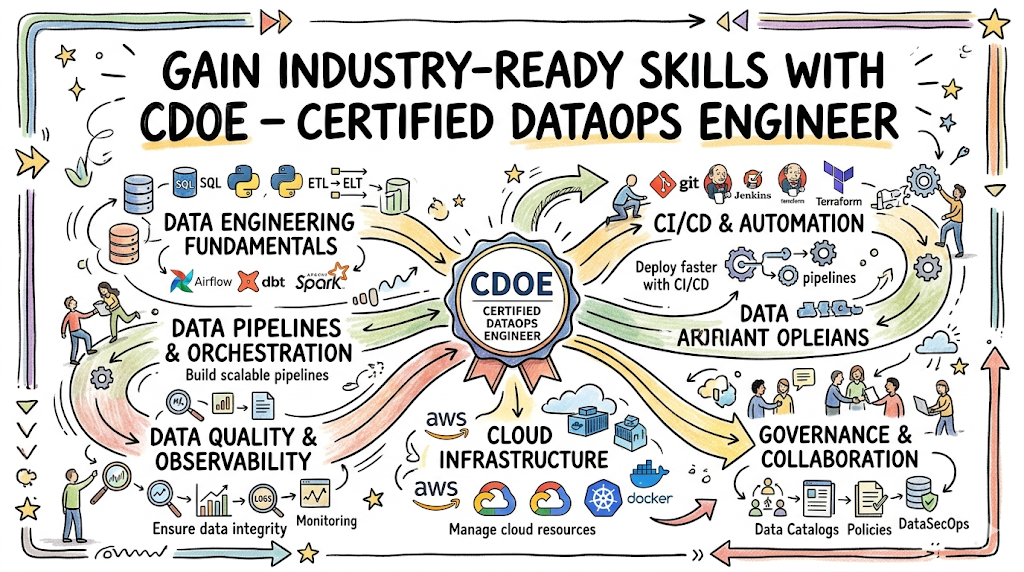
The CDOE – Certified DataOps Engineer is a professional credential designed to validate expertise in the automated and collaborative management of data lifecycles. This guide is curated for engineers and technical leads who aim to implement agile methodologies within data engineering to improve quality and reduce cycle times. By pursuing training through Dataopsschool, professionals are equipped with the skills necessary to handle complex data architectures in cloud-native environments. This comprehensive resource is intended to assist technical professionals in making informed decisions regarding their career progression and technical specialization in data-focused operations.
What is the CDOE – Certified DataOps Engineer?
The CDOE – Certified DataOps Engineer represents a standardized approach to integrating DevOps principles with data management and analytics. It is established to address the operational challenges of maintaining brittle data pipelines and the lack of communication between data scientists and infrastructure teams. The focus is placed on production-grade learning, where the emphasis is shifted from theoretical data modeling to the practical orchestration of resilient data systems. By aligning with modern enterprise practices, this certification ensures that engineers can treat data as code, enabling continuous integration and continuous delivery for data-driven applications.
Who Should Pursue CDOE – Certified DataOps Engineer?
This certification is intended for software engineers, data engineers, and SREs who are responsible for the availability and performance of data platforms. It is also highly relevant for cloud architects and security professionals who must ensure that data movement is both efficient and compliant with global regulations. Beginners with a strong technical foundation can use this path to enter the specialized field of DataOps, while senior managers can utilize the framework to lead large-scale digital transformation projects. The curriculum is designed to meet the needs of both the Indian market and the global technology landscape, where data-driven decision-making is paramount.
Why CDOE – Certified DataOps Engineer is Valuable and Beyond
The value of the CDOE – Certified DataOps Engineer is found in the increasing enterprise adoption of large-scale data platforms and the subsequent demand for operational stability. As organizations transition away from manual data handling, professionals who can automate these workflows are prioritized for high-impact roles. The certification provides long-term career relevance by focusing on core principles that remain consistent even as specific tools and cloud providers change. It offers a significant return on investment by positioning engineers as experts who can reduce operational costs while increasing the velocity of data delivery to business stakeholders.
CDOE – Certified DataOps Engineer Certification Overview
The program is structured to provide a comprehensive understanding of data orchestration and is hosted on the official platform of Dataopsschool. It is delivered through a series of technical modules that cover everything from version control for data to the implementation of automated quality gates. The assessment approach is practical and performance-based, ensuring that candidates are tested on their ability to solve real-world operational issues. The certification ownership ensures that the content remains aligned with the latest industry standards and is recognized by major enterprises globally as a benchmark for technical excellence.
CDOE – Certified DataOps Engineer Certification Tracks & Levels
The certification is organized into three progressive levels: Foundation, Professional, and Advanced. The Foundation level is designed to introduce the cultural and technical basics of DataOps, while the Professional level focuses on the advanced automation of pipelines and cloud integration. The Advanced level is geared toward architectural design and strategic leadership in data operations. These levels allow professionals to align their learning with their current career stage, providing a clear path for growth from an individual contributor to a technical leader or architect within the data domain.
Complete CDOE – Certified DataOps Engineer Certification Table
| Track | Level | Who it’s for | Prerequisites | Skills Covered | Recommended Order |
| Core Engineering | Foundation | Aspiring Engineers | Linux & SQL | Git, Docker, DataOps Basics | 1 |
| Automation | Professional | Data & DevOps Engineers | Foundation Level | Jenkins, Airflow, CI/CD | 2 |
| Architecture | Advanced | Technical Architects | Professional Level | Multi-cloud, Governance | 3 |
| Security | Professional | Security Engineers | Foundation Level | Data Masking, Encryption | 2 |
| Reliability | Professional | SREs | Foundation Level | SLOs, Monitoring, Logging | 2 |
| Optimization | Professional | FinOps / Managers | Foundation Level | Cost Control, Resource Scaling | 2 |
Detailed Guide for Each CDOE – Certified DataOps Engineer Certification
CDOE – Foundation Level
What it is
The Foundation level validates the basic understanding of the DataOps philosophy and the essential tools required to manage data environments. It is designed to ensure that candidates can contribute to a DataOps team by understanding common workflows and technical requirements.
Who should take it
This level is suitable for entry-level engineers, system administrators, and technical analysts who are new to the field of data operations. It is also recommended for managers who need to speak the same technical language as their engineering teams.
Skills you’ll gain
- Application of version control principles to data transformation scripts.
- Basic containerization of data workloads using industry-standard tools.
- Understanding of the data lifecycle from ingestion to visualization.
- Creation of automated unit tests for validating data integrity.
Real-world projects you should be able to do
- Setup of a version-controlled sandbox for data experimentation.
- Development of a simple automated data ingestion pipeline.
- Implementation of basic data quality checks in a local development environment.
Preparation plan
The 7-day strategy involves reviewing the core tenets of the DataOps manifesto. The 30-day plan includes completing hands-on labs for Git and Docker. The 60-day approach focuses on building a complete end-to-end data pipeline in a controlled environment.
Common mistakes
Candidates often focus too heavily on specific tools while neglecting the underlying cultural principles of collaboration. Another common error is underestimating the complexity of data versioning compared to standard software versioning.
Best next certification after this
- Same-track option: CDOE Professional Level
- Cross-track option: Certified DevSecOps Professional
- Leadership option: DataOps Team Lead
CDOE – Professional Level
What it is
The Professional level is an intermediate certification that validates the ability to build and maintain complex, automated data pipelines. It focuses on the integration of disparate tools into a unified, resilient system that can handle production-level data volumes.
Who should take it
This is intended for engineers with 2 to 5 years of experience who are responsible for the reliability of data delivery. It is ideal for those who are tasked with scaling data operations within a cloud-native infrastructure.
Skills you’ll gain
- Orchestration of complex data workflows using DAG-based tools.
- Implementation of full CI/CD cycles for data pipelines.
- Advanced monitoring and alerting for data quality and pipeline health.
- Management of data environments using Infrastructure as Code (IaC).
Real-world projects you should be able to do
- Deployment of a multi-stage data pipeline with automated error recovery.
- Configuration of a centralized monitoring dashboard for data latency.
- Setup of an automated data masking process for non-production environments.
Preparation plan
The 7-day plan involves studying advanced orchestration patterns. The 30-day strategy requires intensive practice with CI/CD tools and cloud data services. The 60-day plan focuses on architecting a resilient data platform and conducting failover testing.
Common mistakes
One frequent mistake is creating overly complex orchestration logic that becomes difficult to maintain. Additionally, failing to account for data drift and silent quality issues can lead to certification assessment failures.
Best next certification after this
- Same-track option: CDOE Advanced Level
- Cross-track option: Certified Cloud Architect
- Leadership option: Engineering Manager (Data Focus)
Choose Your Learning Path
DevOps Path
The DevOps path is designed for engineers who want to extend their knowledge of software delivery to the data domain. It focuses on creating a unified pipeline where both application code and data schemas are deployed simultaneously. This path ensures that data is treated with the same level of automation and rigor as any other software component, leading to faster release cycles and higher system stability.
DevSecOps Path
The DevSecOps path emphasizes the integration of security and compliance into the automated data flow. Professionals on this path learn how to automate data privacy, implement encryption at rest and in transit, and conduct automated audits within the pipeline. This ensures that the data platform is not only fast and efficient but also fully compliant with legal and security standards from the start.
SRE Path
The SRE path focuses on the reliability and performance of data platforms. Engineers learn how to define Service Level Objectives (SLOs) for data availability and how to build self-healing systems that can recover from pipeline failures. This path is essential for organizations where data downtime has a direct impact on business operations and revenue, requiring a focus on high availability.
AIOps Path
The AIOps path leverages artificial intelligence to enhance IT operations through automated data analysis. Professionals learn how to build the data infrastructure that supports AI-driven insights and how to use machine learning to predict and prevent operational outages. This path is ideal for those looking to work at the intersection of data engineering and autonomous system management.
MLOps Path
The MLOps path is specifically tailored for the lifecycle of machine learning models. It covers the automation of data preparation, model training, and deployment, ensuring that models are fed with high-quality data in production. This path bridges the gap between data scientists and operational engineers, creating a seamless workflow for delivering AI-powered features to end-users.
DataOps Path
The pure DataOps path is the core journey for those dedicated to mastering the data factory concept. It covers the end-to-end orchestration of data from multiple sources into a centralized, usable format. This path focuses on reducing the technical debt associated with legacy data systems and replacing them with modern, automated, and collaborative workflows that benefit the entire organization.
FinOps Path
The FinOps path addresses the economic aspects of running large-scale data platforms in the cloud. Professionals learn how to monitor data-related cloud spend, optimize storage costs, and ensure that data pipelines are running as efficiently as possible. This path is critical for ensuring that technical data initiatives remain aligned with the financial goals and budgets of the enterprise.
Role → Recommended CDOE – Certified DataOps Engineer Certifications
| Role | Recommended Certifications |
| DevOps Engineer | CDOE Foundation, Professional (Engineering) |
| SRE | CDOE Professional (Reliability Track) |
| Platform Engineer | CDOE Professional, Advanced (Architecture) |
| Cloud Engineer | CDOE Foundation, Professional (Optimization) |
| Security Engineer | CDOE Professional (Security Track) |
| Data Engineer | CDOE Foundation, Professional, Advanced |
| FinOps Practitioner | CDOE Foundation, Professional (FinOps) |
| Engineering Manager | CDOE Foundation, Advanced (Leadership) |
Next Certifications to Take After CDOE – Certified DataOps Engineer
Same Track Progression
Upon completion of the CDOE Advanced level, a natural progression involves seeking deep technical specializations in specific cloud data platforms. This allows a professional to combine methodology-driven expertise with high-level technical proficiency in tools like Snowflake, BigQuery, or Databricks. Maintaining this progression ensures that an engineer remains a top-tier expert in the rapidly evolving data landscape.
Cross-Track Expansion
Broadening one’s skill set by pursuing certifications in MLOps or Kubernetes security is highly recommended for those looking to become multi-disciplinary leads. By understanding how data operations interact with machine learning and container security, an engineer becomes an invaluable asset capable of managing complex, cross-functional projects. This expansion is particularly useful for those moving into principal engineering roles.
Leadership & Management Track
For those transitioning into executive or management roles, certifications in technical leadership or project management are beneficial. These programs help bridge the gap between technical execution and business strategy. Combining the CDOE Advanced credentials with formal management training prepares professionals for high-level roles such as Director of Data Operations or Chief Data Officer.
Training & Certification Support Providers for CDOE – Certified DataOps Engineer
DevOpsSchool
DevOpsSchool is a leading institution dedicated to providing high-quality training in modern engineering practices. The curriculum is meticulously designed to cover the full spectrum of DataOps, ensuring that students gain both theoretical knowledge and practical skills. With a focus on hands-on labs and real-world scenarios, DevOpsSchool prepares professionals for the challenges of managing production-grade data pipelines. The platform is known for its experienced instructors who provide personalized mentorship, helping students to navigate complex technical concepts and advance their careers. By emphasizing a project-based learning approach, the school ensures that graduates have a portfolio of work that demonstrates their competency to potential employers in the global technology market.
Cotocus
Cotocus is a specialized consulting and training provider that focuses on enabling organizations to adopt agile and automated operations. Their training programs are deeply rooted in industry experience, offering students insights into the practical implementation of DataOps at scale. Cotocus provides a range of services, including corporate training and technical workshops, which are tailored to meet the specific needs of modern enterprises. The instructors at Cotocus are industry veterans who bring a wealth of knowledge to the classroom, helping students to understand the nuances of data orchestration and cloud integration. Their commitment to excellence and practical learning makes them a preferred partner for professionals seeking to master the complexities of data-driven infrastructure.
Scmgalaxy
Scmgalaxy is a comprehensive resource hub and training provider that has been serving the DevOps and SCM community for over a decade. They offer a wide array of tutorials, study guides, and certification support for various engineering disciplines, including DataOps. The platform is designed to be a one-stop-shop for technical professionals looking to upgrade their skills and stay current with industry trends. Scmgalaxy provides a supportive community where learners can interact, share knowledge, and solve technical problems together. Their training modules are highly structured and focus on the practical application of tools and methodologies, ensuring that students are well-prepared for both certification exams and real-world job responsibilities in the data field.
BestDevOps
BestDevOps is committed to delivering streamlined and effective training solutions for technical professionals. Their courses are designed to be concise yet comprehensive, focusing on the most relevant tools and practices in the DataOps ecosystem. BestDevOps prioritizes a hands-on learning experience, providing students with access to state-of-the-art lab environments where they can practice building and managing data pipelines. The platform is ideal for those who want to quickly gain practical skills and apply them in a professional setting. With a focus on cloud-native technologies and automated workflows, BestDevOps ensures that its graduates are equipped to handle the demands of modern, high-velocity data environments while maintaining the highest standards of quality.
Devsecopsschool.com
This platform is a premier destination for professionals looking to integrate security into their automated workflows. While the primary focus is on DevSecOps, the institution provides specialized training on how to secure data pipelines and ensure compliance throughout the data lifecycle. The curriculum covers essential topics such as automated data masking, secure access control, and compliance as code. By training at this school, engineers learn how to build resilient data platforms that are protected against modern security threats. The instructors are experts in both security and operations, providing a unique perspective that is highly valued in the industry. Graduates are prepared to lead security-focused data initiatives in any enterprise setting.
Sreschool.com
sreschool.com is an educational platform dedicated to the principles of Site Reliability Engineering. They offer specialized training on how to apply SRE methodologies to data platforms, focusing on availability, performance, and scalability. Students learn how to use monitoring and observability tools to track the health of data pipelines and how to implement automated incident response strategies. The training at sreschool.com is highly technical and aimed at engineers who want to specialize in the reliability aspect of DataOps. By mastering these skills, professionals can ensure that their data platforms meet the high standards of uptime and reliability required by modern business applications, making them essential members of any high-performing engineering team.
Aiopsschool.com
This school focuses on the intersection of artificial intelligence and IT operations. Their training programs are designed to teach engineers how to manage the massive datasets required for AIOps and how to automate operational tasks using machine learning. The curriculum covers the design and implementation of data infrastructures that support real-time analysis and automated decision-making. At aiopsschool.com, students learn how to stay ahead of the curve by mastering the tools and techniques needed for the next generation of autonomous IT operations. The institution provides a forward-thinking environment where professionals can explore the latest trends in AI and data engineering, preparing them for leadership roles in the evolving technology landscape.
As the official host of the CDOE certification, this institution provides the most direct and thorough preparation for the credential. Their training programs are perfectly aligned with the certification syllabus, covering every objective from the foundation to the advanced level. Students benefit from a mix of instructor-led sessions and self-paced modules, providing the flexibility needed for working professionals. The platform offers comprehensive lab exercises that simulate real-world data challenges, ensuring that candidates are fully prepared for the performance-based assessment. By training at dataopsschool.com, professionals gain a deep understanding of the DataOps manifesto and the technical expertise required to lead successful data initiatives in a wide range of industries.
Finopsschool.com
finopsschool.com provides essential training on the financial management of cloud and data operations. In an era where cloud costs can quickly escalate, the skills taught at this school are vital for maintaining economic efficiency. The curriculum focuses on how to track, analyze, and optimize the costs associated with data storage and processing. Students learn how to align technical pipeline performance with business budgetary goals, ensuring that data operations provide a clear return on investment. The institution offers practical tools and frameworks for implementing FinOps within a DataOps team, making it an ideal choice for engineers and managers who want to take a proactive approach to cloud cost management and organizational accountability.
Frequently Asked Questions (General)
- How difficult is the CDOE certification exam?
The difficulty level is considered moderate to high, as the exam requires a strong demonstration of practical skills in addition to theoretical knowledge.
- What are the prerequisites for starting the CDOE journey?
A working knowledge of Linux, basic SQL, and a general understanding of the software development lifecycle is recommended before starting.
- How long does it take to prepare for the Foundation level?
On average, a professional can be prepared within 30 to 60 days of consistent study and hands-on practice.
- Is the CDOE certification recognized by major tech companies?
Yes, it is widely recognized as a benchmark for professionals who specialize in the operational aspects of data engineering and automation.
- What kind of jobs can I get after becoming a Certified DataOps Engineer?
Roles include DataOps Engineer, Senior Data Engineer, SRE (Data Platform), and Technical Data Architect.
- Are the exams conducted online or in person?
The exams are typically conducted online through a secure, proctored platform to accommodate a global audience.
- How often is the certification curriculum updated?
The curriculum is updated annually to ensure it reflects the latest tools, cloud services, and industry best practices.
- Does the certification focus on a specific cloud provider?
No, the certification is designed to be vendor-neutral, focusing on principles that apply to AWS, Azure, Google Cloud, and on-premises systems.
- What is the passing score for the CDOE exams?
The passing score is generally set at 70%, although this can vary slightly based on the specific level and version of the exam.
- Can I retake the exam if I do not pass on the first attempt?
Yes, retake policies are available, usually requiring a short waiting period between attempts to allow for further study.
- Are there hands-on labs included in the training programs?
Yes, all recommended training providers include extensive hands-on labs to ensure practical competency.
- Is there a community group for CDOE certified professionals?
Yes, a private community group is available for networking, sharing job opportunities, and discussing advanced technical challenges.
FAQs on CDOE – Certified DataOps Engineer
- What is the primary goal of the CDOE certification?
The primary goal is to standardize the skills required to build automated, collaborative, and high-quality data pipelines in an enterprise environment.
- How does DataOps differ from traditional DevOps?
While DevOps focuses on application code, DataOps addresses the unique challenges of data, such as schema changes, data quality, and massive storage requirements.
- Does the CDOE cover data governance and compliance?
Yes, it includes specific modules on how to automate governance and maintain compliance within the data pipeline.
- Is programming knowledge required for this certification?
A basic understanding of scripting, particularly in Python or Shell, is necessary to handle the automation aspects of the curriculum.
- How does this certification help with data reliability?
It teaches SRE principles like monitoring, alerting, and automated testing, which are essential for ensuring that data is accurate and available.
- Can a project manager benefit from the CDOE Foundation level?
Yes, it provides the necessary technical context to effectively manage data engineering teams and understand their operational hurdles.
- What tools are most commonly used in the CDOE labs?
Common tools include Git, Docker, Jenkins, Airflow, and various data quality testing frameworks.
- What is the long-term career outlook for a Certified DataOps Engineer?
The outlook is exceptionally strong as more companies move toward AI and automated analytics, requiring robust data operations to succeed.
Final Thoughts
From the perspective of a technical mentor, the CDOE – Certified DataOps Engineer is a critical investment for those who wish to remain competitive in the modern data landscape. The shift toward automated, cloud-native data platforms is not a passing trend but a fundamental change in how technology serves the business. This certification provides the structured methodology and technical validation needed to lead these initiatives effectively.
Engineers who master DataOps are often the ones who drive the most significant value within their organizations by turning chaotic data environments into streamlined, reliable systems. While the certification requires dedication and practical effort, the resulting career growth and technical proficiency are well worth the commitment. For any professional serious about their career in data or operations, the CDOE offers a clear and respected path to excellence.