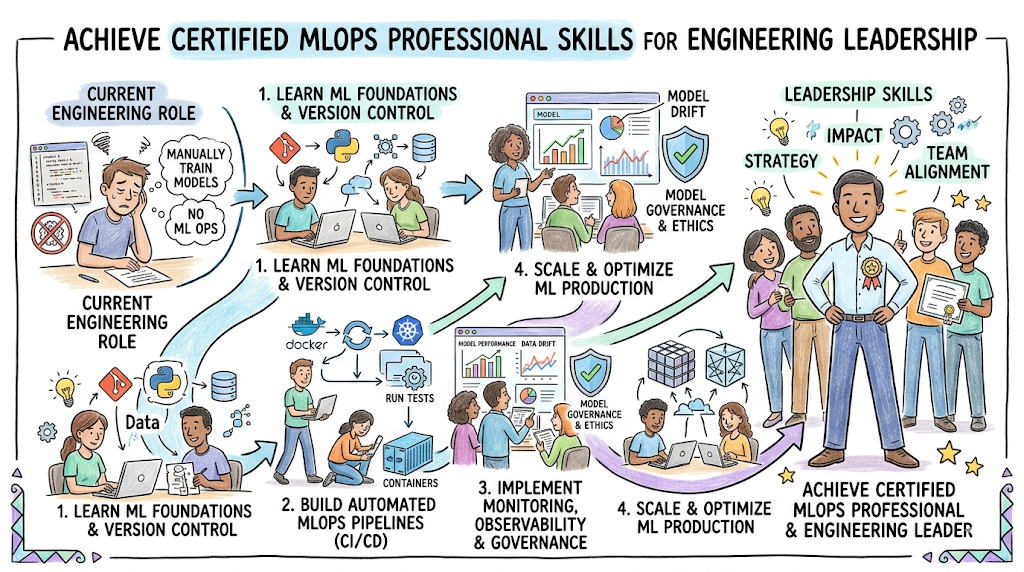
Introduction
The transition from experimental data science to production-grade machine learning requires a rigorous framework known as MLOps. This guide explores the Certified MLOps Professional program, designed to bridge the gap between model development and operational reliability. For engineers and managers navigating the complexities of cloud-native environments, understanding how to automate the lifecycle of machine learning models is no longer optional.
In the modern enterprise, platform engineering and DevOps teams are increasingly tasked with supporting data science workloads at scale. This comprehensive walkthrough, hosted by AIOpsSchool, provides the roadmap necessary to master the intersection of data, code, and infrastructure. By focusing on practical application, professionals can make informed decisions about their career trajectory and technical stack.
What is the Certified MLOps Professional?
The Certified MLOps Professional designation represents a specialized mastery of the tools and processes required to manage machine learning systems in production. Unlike traditional data science courses that focus heavily on algorithms and model training, this program emphasizes the operational aspects of the ML lifecycle. It exists to solve the “last mile” problem, where models often fail to provide business value because they cannot be deployed or maintained effectively.
This certification aligns with modern engineering workflows by treating machine learning models as first-class citizens within the DevOps pipeline. It introduces concepts like Continuous Integration, Continuous Delivery, and Continuous Training (CI/CD/CT) specifically for data-intensive applications. For the enterprise, this means faster time-to-market for AI products and a significant reduction in technical debt associated with manual model management.
Who Should Pursue Certified MLOps Professional?
This certification is ideal for software engineers, SREs, and cloud architects who want to specialize in the rapidly growing field of AI infrastructure. It is equally valuable for data engineers who need to understand how their pipelines interact with deployment targets, and for security professionals concerned with the integrity of model artifacts. Both beginners looking for a structured entry point and experienced seniors seeking to formalize their knowledge will find the curriculum relevant.
From a global perspective, the demand for MLOps talent is skyrocketing as companies shift from AI experimentation to AI-driven operations. In regions like India, where the tech ecosystem is heavily focused on digital transformation, having a validated skill set in MLOps provides a distinct competitive advantage. Engineering managers and technical leaders should also consider this path to better understand how to structure their teams for high-velocity ML delivery.
Why Certified MLOps Professional is Valuable in Beyond
The longevity of this certification is rooted in the fact that it focuses on principles and architectures rather than just transient tools. As enterprises continue to adopt cloud-native technologies, the need for standardized ML operations will only grow, ensuring that this knowledge remains relevant for years to come. Investing time in MLOps mastery provides a high return on investment because it addresses a critical bottleneck in the modern corporate technology stack.
By becoming a certified professional, you demonstrate the ability to handle complex challenges like data drift, model decay, and resource orchestration. This expertise allows you to stay ahead of the curve as the industry moves toward more automated, self-healing AI systems. The career impact is significant, often leading to roles with higher responsibility and the ability to lead cross-functional teams in high-stakes environments.
Certified MLOps Professional Certification Overview
The program is delivered via the official training portal and is hosted on the AIOpsSchool platform, which provides a centralized environment for learning and assessment. The certification uses a practical, hands-on approach to validation, ensuring that candidates can perform tasks in a simulated production environment rather than just answering multiple-choice questions. It is structured to guide a learner from foundational knowledge to expert-level architectural design.
The assessment approach is designed to test real-world troubleshooting skills and the ability to design resilient pipelines. Ownership of the certification lies with an organization dedicated to the advancement of operational excellence in AI and machine learning. By completing the program, professionals gain a credential that is recognized by industry leaders as a mark of technical proficiency and operational maturity.
Certified MLOps Professional Certification Tracks & Levels
The certification is divided into three distinct levels: Foundation, Professional, and Advanced, allowing for a logical progression of skills. The Foundation level introduces core concepts of MLOps, including version control for data and basic containerization. The Professional level dives deep into pipeline automation, monitoring, and model governance, which are essential for mid-level roles in the industry.
For those seeking to reach the top tier of the profession, the Advanced levels offer specialization tracks that integrate MLOps with other disciplines like DevSecOps, SRE, and FinOps. This modular structure ensures that professionals can align their learning path with their specific career goals. As you progress through these levels, the complexity of the projects increases, preparing you for the most demanding leadership roles in platform engineering.
Complete Certified MLOps Professional Certification Table
| Track | Level | Who it’s for | Prerequisites | Skills Covered | Recommended Order |
| Core MLOps | Foundation | Beginners, Junior Engineers | Basic Python, Git | Data Versioning, Docker basics | 1st |
| Core MLOps | Professional | Mid-level Engineers, SREs | Foundation level, Kubernetes | CI/CD/CT Pipelines, Monitoring | 2nd |
| Core MLOps | Advanced | Architects, Lead Engineers | Professional level, Cloud Exp | Scalability, Security, Governance | 3rd |
| MLOps + Security | Specialist | DevSecOps Engineers | Professional level | ML Model Security, Compliance | 4th (Optional) |
| MLOps + FinOps | Specialist | Cloud FinOps, Managers | Professional level | ML Cost Optimization, GPU management | 4th (Optional) |
Detailed Guide for Each Certified MLOps Professional Certification
Certified MLOps Professional – Foundation
What it is
This certification validates a professional’s understanding of the basic pillars of MLOps and their ability to collaborate within a data science team.
Who should take it
It is suitable for junior developers, data analysts, or traditional IT professionals who want to understand the lifecycle of a machine learning project.
Skills you’ll gain
- Basic understanding of the ML lifecycle (Plan, Build, Deploy, Monitor).
- Proficiency in using Git for versioning code and data.
- Knowledge of containerization basics using Docker for ML environments.
- Awareness of common MLOps tools and cloud providers.
Real-world projects you should be able to do
- Containerize a simple Python-based ML model and run it locally.
- Create a basic automated workflow that triggers on a code change.
- Set up a version-controlled repository for a small dataset and model.
Preparation plan
- 7–14 days: Review core MLOps terminology and basic Git workflows.
- 30 days: Complete hands-on labs focusing on Docker and basic Python scripting for ML.
- 60 days: Build and document a small end-to-end ML project on a local machine.
Common mistakes
- Focusing too much on ML algorithms and not enough on the infrastructure.
- Ignoring the importance of data versioning and documentation.
Best next certification after this
- Same-track option: Certified MLOps Professional – Professional Level.
- Cross-track option: Certified Cloud Practitioner (AWS/Azure/GCP).
- Leadership option: Certified Scrum Master for technical teams.
Certified MLOps Professional – Professional
What it is
This certification validates the ability to design, implement, and maintain automated ML pipelines in a production-ready cloud environment.
Who should take it
Mid-level DevOps engineers, SREs, and data engineers with experience in automation and cloud orchestration.
Skills you’ll gain
- Designing Continuous Integration and Continuous Delivery (CI/CD) for ML.
- Implementing automated model testing and validation.
- Monitoring models for data drift and performance degradation.
- Managing model registries and deployment strategies (Canary, Blue-Green).
Real-world projects you should be able to do
- Build a fully automated pipeline that retrains a model when performance drops.
- Deploy an ML model as a scalable microservice on a Kubernetes cluster.
- Implement a centralized dashboard for tracking model metrics across multiple versions.
Preparation plan
- 7–14 days: Deep dive into Kubernetes and CI/CD tools like Jenkins or GitLab CI.
- 30 days: Practice implementing monitoring solutions like Prometheus and Grafana for ML.
- 60 days: Design a complete ML lifecycle pipeline on a major cloud platform.
Common mistakes
- Building brittle pipelines that cannot handle data schema changes.
- Neglecting the monitoring aspect, leading to silent model failures.
Best next certification after this
- Same-track option: Certified MLOps Professional – Advanced/Specialist.
- Cross-track option: Certified Kubernetes Administrator (CKA).
- Leadership option: MLOps Team Lead or Engineering Manager certification.
Choose Your Learning Path
DevOps Path
The DevOps path focuses on the seamless integration of machine learning into the existing software delivery lifecycle. Professionals on this track will spend significant time mastering CI/CD tools and infrastructure-as-code to ensure that ML models are treated with the same rigor as traditional software. This involves creating reusable templates for model deployment and automating the provisioning of specialized hardware like GPUs. The goal is to reduce friction between data scientists and operations teams.
DevSecOps Path
In the DevSecOps path, the primary focus is on securing the machine learning pipeline from end to end. This includes scanning container images for vulnerabilities, securing the data supply chain, and ensuring that model secrets are managed properly. Professionals here learn how to implement automated compliance checks and audit model access to prevent adversarial attacks. This path is critical for industries with high regulatory requirements, such as finance or healthcare.
SRE Path
The Site Reliability Engineering path focuses on the availability, latency, and performance of ML systems in production. SREs in the MLOps space work on defining Service Level Objectives (SLOs) for model inference and building automated failover mechanisms. They focus on the “Day 2” operations, ensuring that the system can scale to meet demand without compromising reliability. This path emphasizes observability and incident response for complex, distributed ML applications.
AIOps Path
The AIOps path is unique because it uses machine learning itself to improve IT operations. Professionals on this track learn how to implement models that can predict outages, automate root cause analysis, and manage large-scale logs. It bridges the gap between traditional monitoring and intelligent automation, making it essential for managing massive, modern infrastructures. This path requires a deep understanding of pattern recognition and anomaly detection.
MLOps Path
The dedicated MLOps path is the core journey for those who want to be specialists in the machine learning lifecycle. It covers every stage from data ingestion and transformation to model training, deployment, and continuous monitoring. The focus is on creating a robust, reproducible system that allows data scientists to experiment rapidly while ensuring that production models remain stable. This path is the foundation for anyone looking to become an ML Infrastructure Engineer.
DataOps Path
The DataOps path focuses on the “Data” part of machine learning, ensuring that the data pipelines feeding the models are reliable and high-quality. Professionals learn to apply DevOps principles to data management, including versioning data, automating data quality checks, and managing data catalogs. This ensures that the foundation of any ML model is sound and that data engineers can provide consistent, clean datasets for training and inference.
FinOps Path
The FinOps path for MLOps is becoming increasingly important as the cost of training and running large models rises. This track teaches professionals how to monitor cloud spending related to ML, optimize GPU utilization, and implement cost-aware architectural designs. By aligning technical decisions with business value and budget constraints, FinOps practitioners help organizations scale their AI initiatives sustainably without unexpected financial burdens.
Role → Recommended Certified MLOps Professional Certifications
| Role | Recommended Certifications |
| DevOps Engineer | MLOps Foundation, MLOps Professional |
| SRE | MLOps Professional, SRE Specialist |
| Platform Engineer | MLOps Professional, Advanced Architect |
| Cloud Engineer | MLOps Foundation, Professional level |
| Security Engineer | MLOps Professional, DevSecOps Specialist |
| Data Engineer | DataOps Specialist, MLOps Foundation |
| FinOps Practitioner | MLOps Professional, FinOps Specialist |
| Engineering Manager | MLOps Foundation, Management Track |
Next Certifications to Take After Certified MLOps Professional
Same Track Progression
Once you have mastered the professional level, the logical next step is to pursue advanced specialist certifications that focus on niche areas like Large Language Model Operations (LLMOps). These programs delve into the specific challenges of managing massive models, including prompt engineering infrastructure and efficient fine-tuning pipelines. This deep specialization ensures you remain at the cutting edge of the industry as AI technology continues to evolve into more complex forms.
Cross-Track Expansion
For those who want to broaden their impact, expanding into Kubernetes administration or cloud architecture is highly recommended. Certifications like the CKA (Certified Kubernetes Administrator) or platform-specific Professional Architect exams complement MLOps skills by providing a deeper understanding of the underlying infrastructure. This cross-training allows you to see the “big picture” and design systems that are not only operationally sound but also perfectly integrated with the broader enterprise ecosystem.
Leadership & Management Track
If you aim to move into leadership roles, look toward certifications that focus on engineering management and strategic technology implementation. Understanding how to lead cross-functional teams and align AI initiatives with business goals is a different skill set than technical implementation. Certifications in Agile leadership or IT service management can help bridge this gap, preparing you to lead entire MLOps departments or become a Chief Technical Officer in an AI-first company.
Training & Certification Support Providers for Certified MLOps Professional
DevOpsSchool offers an extensive range of resources for engineers looking to master automation and CI/CD frameworks. Their curriculum is designed to provide hands-on experience with the tools that form the backbone of modern MLOps pipelines. By focusing on practical labs and real-world scenarios, they help students transition from theoretical understanding to professional competency in managing complex software environments and scalable infrastructure.
Cotocus provides specialized technical training that caters to the needs of modern enterprise environments. Their approach emphasizes the integration of various “Ops” disciplines, helping professionals understand how MLOps fits into a broader digital transformation strategy. With a focus on high-quality content and expert instructors, they support candidates in achieving their certification goals and advancing their careers in the cloud-native ecosystem.
Scmgalaxy is a long-standing community and training provider known for its deep focus on software configuration management and DevOps practices. They offer a wealth of tutorials, forums, and structured courses that help professionals stay updated with the latest trends in the industry. Their support for MLOps certifications includes detailed guides on version control and pipeline orchestration, making them a valuable resource for engineers at all levels.
BestDevOps focuses on providing curated learning paths for those who want to excel in the DevOps and SRE domains. Their training modules are structured to be easy to follow while maintaining the technical depth required for professional certifications. They offer specialized support for those moving into MLOps, ensuring that learners have the foundational knowledge needed to tackle more advanced machine learning infrastructure challenges.
devsecopsschool.com is the premier destination for professionals looking to integrate security into every stage of the development and operations lifecycle. As security becomes a critical component of MLOps, their courses provide the necessary skills to protect data pipelines and model artifacts. They offer specialized training that ensures MLOps practitioners can meet the rigorous security requirements of the modern enterprise.
sreschool.com focuses on the principles of reliability and performance in high-scale systems. Their training is essential for MLOps professionals who need to ensure that their machine learning models remain available and responsive under heavy loads. By teaching the core tenets of Site Reliability Engineering, they help engineers build resilient AI systems that can survive the rigors of a production environment.
aiopsschool.com is the hosting platform for the Certified MLOps Professional program and offers a wide array of specialized AI and operations courses. Their focus is specifically on the intersection of artificial intelligence and technical operations, providing a unique perspective on how to manage the next generation of IT systems. They are the primary source for the most up-to-date information regarding this certification.
dataopsschool.com addresses the critical need for operational excellence in data management. Their training programs help professionals understand how to build reliable data pipelines that serve as the foundation for any successful MLOps initiative. By teaching the principles of DataOps, they enable teams to deliver high-quality data at the speed required by modern machine learning applications.
finopsschool.com provides essential training for managing the financial aspects of cloud and AI infrastructure. As the cost of running machine learning workloads becomes a significant concern for enterprises, their courses teach engineers how to optimize resources and control spending. This knowledge is vital for MLOps professionals who want to ensure their projects remain economically viable for their organizations.
Frequently Asked Questions (General)
- How difficult is the MLOps certification exam?
The exam is considered moderately difficult because it requires a mix of data science knowledge and deep operational skills in cloud and containerization. - Do I need a degree in Data Science to take this?
No, a formal degree is not required, but a strong background in software engineering or systems administration is highly beneficial for success. - How long does it take to prepare for the professional level?
Most professionals with some experience in DevOps or cloud can prepare sufficiently within 30 to 60 days of focused study and hands-on practice. - Is Kubernetes mandatory for MLOps?
While not strictly mandatory for all roles, Kubernetes is the industry standard for orchestrating ML models at scale and is a core part of the certification. - What is the difference between DevOps and MLOps?
DevOps focuses on the software lifecycle, while MLOps adds the complexity of managing data versioning, model training, and continuous monitoring for drift. - Can I take the exam online?
Yes, the certification assessment is delivered through the official online platform, allowing candidates to take it from anywhere in the world. - Does this certification expire?
Most professional certifications require renewal or continuing education every two to three years to ensure your skills remain current with technology changes. - Is Python knowledge necessary?
Yes, Python is the primary language used in the machine learning ecosystem, and a basic to intermediate understanding is required for the practical tasks. - Are there any labs included in the training?
Yes, the program is heavily focused on hands-on labs that simulate real-world production environments and common troubleshooting scenarios. - What kind of salary increase can I expect?
While it varies by region, MLOps specialists often command significantly higher salaries than general DevOps engineers due to the specialized nature of the work. - Should I learn AIOps before MLOps?
Not necessarily. MLOps is about the lifecycle of ML models, while AIOps is about using ML for IT operations. You can start with whichever aligns more with your role. - How does this help an Engineering Manager?
It provides managers with the technical context needed to hire the right talent, set realistic deadlines, and choose the correct architectural patterns for their teams.
FAQs on Certified MLOps Professional
- What specific tools are covered in this certification?
The program covers a wide range of industry-standard tools including Docker, Kubernetes, Jenkins, MLflow, and various cloud-native ML services from major providers. - How does the certification handle the concept of “Model Drift”?
It teaches you how to implement automated monitoring systems that compare live inference data against training data to detect and alert on performance drops. - Is there a focus on specific cloud providers like AWS or Azure?
The certification is designed to be cloud-agnostic, focusing on principles that apply across all platforms while providing examples in the most popular environments. - Does it cover Large Language Model Operations (LLMOps)?
The professional and advanced levels introduce the foundational concepts of managing large-scale models, though specific LLM specializations may be separate tracks. - What is the role of CI/CD in the MLOps curriculum?
CI/CD is central to the curriculum, as the goal is to automate the testing and deployment of both the code and the model artifacts. - How is data security addressed in the program?
Security is integrated throughout, covering topics like data encryption, secure model registries, and role-based access control for ML pipelines. - Can this certification help me move from a Windows Admin role?
Yes, by mastering the cloud and automation skills in this program, you can effectively transition from traditional administration to modern MLOps roles. - Is there a community for certified professionals?
Yes, successful candidates gain access to a global network of professionals and mentors who share best practices and job opportunities in the field.
Final Thoughts
From the perspective of a senior mentor, the Certified MLOps Professional designation is a worthy investment for anyone serious about a career in modern infrastructure. The industry is moving past the era of manual model deployments, and those who cannot automate the ML lifecycle will find their roles increasingly marginalized. This certification provides a structured, disciplined approach to a complex subject that is often learned in a fragmented way.
It is not a magic bullet for a career, but it is a powerful validator of your commitment to operational excellence. If you are willing to put in the work to master the labs and understand the underlying principles, the return on your time will be evident in your ability to solve real production problems. Focus on the learning first, and the career advancement will naturally follow as a byproduct of your increased technical value.