Introduction
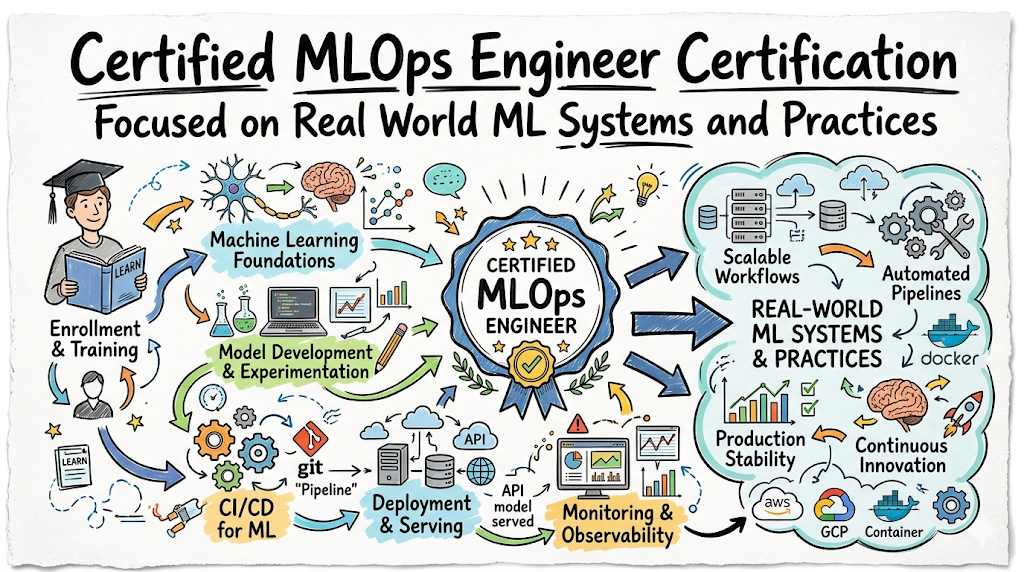
The Certified MLOps Engineer is a professional credential designed for those who want to master the intersection of machine learning and operational excellence. This guide is crafted for engineers and managers who recognize that the real challenge of AI is not just building a model, but maintaining it in a production environment. By following this path, professionals can learn to bridge the gap between data science and IT operations, ensuring that machine learning projects are scalable, reliable, and secure.
This guide helps professionals make informed career decisions by mapping out the necessary skills and certifications required in today’s competitive market. Whether you are coming from a DevOps background or a data science role, understanding MLOps is critical for modern platform engineering. All resources and assessments mentioned in this guide are hosted and managed by aiopsschool.com, providing a centralized platform for your professional development journey.
What is the Certified MLOps Engineer?
The Certified MLOps Engineer represents a high standard of professional competency in the field of machine learning operations. It exists because the industry has moved beyond the experimental phase of AI and now requires engineers who can handle the complexities of production-scale machine learning. This certification focuses on teaching you how to build automated pipelines that handle data versioning, model training, and continuous deployment with minimal manual intervention.
Unlike theoretical courses, this program emphasizes real-world applications and enterprise practices. It aligns with modern engineering workflows by treating machine learning assets as standard software components that must pass through rigorous testing and monitoring phases. By obtaining this certification, you demonstrate that you can manage the full lifecycle of an AI product, from the initial data ingestion to the final monitoring of model performance in a live environment.
Who Should Pursue Certified MLOps Engineer?
This certification is ideal for software engineers, DevOps specialists, and Site Reliability Engineers who are looking to expand their skill set into the AI domain. It is also highly relevant for data engineers and machine learning professionals who want to learn the operational side of their work. Technical leaders and engineering managers will find value in this path as it provides the strategic framework needed to oversee complex AI transformations within their organizations.
From a global perspective, the demand for MLOps expertise is surging in major tech hubs, including India and Silicon Valley. Beginners can use this certification to build a strong foundation, while experienced veterans can use it to formalize their knowledge of cloud-native AI infrastructure. Regardless of your current level, this path provides a clear roadmap for anyone involved in the design, deployment, or management of machine learning systems at scale.
Why Certified MLOps Engineer is Valuable and Beyond
In the current landscape of technology, the ability to operationalize machine learning is becoming a mandatory requirement for enterprise adoption. Companies are no longer looking for just “model builders”; they are seeking “system builders” who can ensure that AI features remain accurate and cost-effective over time. This certification provides long-term value because it focuses on core architectural patterns that remain relevant even as specific tools and frameworks evolve.
The return on career investment for a Certified MLOps Engineer is significant, as it places you in a high-demand niche with fewer competitors than traditional software roles. It allows you to stay ahead of the curve in an industry that is increasingly moving toward automated, intelligent platforms. By mastering these skills, you ensure your longevity in the field, moving from a standard engineering role into a more strategic, high-impact position that drives business value through AI.
Certified MLOps Engineer Certification Overview
The program is delivered via the official training platform and hosted on the primary provider website mentioned in the introduction. The certification is structured to be practical and assessment-driven, moving away from simple multiple-choice questions toward performance-based evaluations. This ensures that every certified professional has a hands-on understanding of how to configure and manage an MLOps ecosystem using modern cloud tools and container orchestration.
The certification tracks are divided into logical levels that cater to different career stages, ensuring a smooth progression from basic knowledge to advanced architectural design. Ownership of the certification resides with a team of industry experts who regularly update the curriculum to reflect current enterprise trends. By participating in this program, you gain access to a structured learning path that is both academically rigorous and professionally relevant, designed to meet the needs of the modern workforce.
Certified MLOps Engineer Certification Tracks & Levels
The certification hierarchy begins with the Foundation level, which establishes a common vocabulary and understanding of the MLOps lifecycle. This is followed by the Professional level, where the focus shifts to technical implementation, automation, and CI/CD for machine learning. Finally, the Advanced level is designed for those who need to architect global-scale ML platforms and lead organizational shifts toward MLOps best practices.
Beyond these core levels, there are specialized tracks that allow you to align your certification with your specific job role, such as SRE, Security, or FinOps. This modular approach ensures that you can customize your learning journey to fit your career goals. Each level builds upon the previous one, creating a comprehensive professional development framework that supports long-term career growth and helps you become a recognized expert in the field of machine learning operations.
Complete Certified MLOps Engineer Certification Table
| Track | Level | Who it’s for | Prerequisites | Skills Covered | Recommended Order |
| Core MLOps | Foundation | Beginners, Managers | Basic IT awareness | Lifecycle, Glossary | 1 |
| Implementation | Professional | DevOps, ML Engineers | Foundation Cert | CI/CD, Containerization | 2 |
| Architecture | Advanced | Tech Leads, Architects | Professional Cert | Scaling, Governance | 3 |
| Reliability | Specialist | SREs, Platform Teams | Professional Cert | Monitoring, Drift | Optional |
| Automation | Specialist | Automation Experts | Foundation Cert | Pipelines, Tooling | Optional |
Detailed Guide for Each Certified MLOps Engineer Certification
Certified MLOps Engineer – Foundation
What it is
This certification validates a baseline understanding of the machine learning operations lifecycle and the core principles of MLOps. It ensures that candidates can identify the different stages of a model’s life and understand the roles of various team members.
Who should take it
This is intended for entry-level engineers, project managers, and traditional IT professionals who are new to the AI domain. It is also suitable for students who want to build a career in the intersection of data and operations.
Skills you’ll gain
- Understanding the differences between DevOps and MLOps.
- Knowledge of the machine learning development lifecycle.
- Familiarity with data versioning and model registry concepts.
- Basic understanding of production monitoring for AI.
Real-world projects you should be able to do
- Map out a manual ML workflow and identify areas for automation.
- Create a basic documentation set for a machine learning project lifecycle.
- Identify the necessary resources for a small-scale ML deployment.
Preparation plan
For a 7-day plan, focus on learning the core vocabulary and high-level concepts of the MLOps framework. A 30-day plan should include reading case studies and watching demonstrations of MLOps tools in action. A 60-day strategy involves building a small, manual pipeline to understand the challenges of the process before moving to automated tools.
Common mistakes
Candidates often focus too much on the math of the models rather than the infrastructure. Another mistake is ignoring the importance of data quality in the early stages of the pipeline. Some also underestimate the cultural change required to implement MLOps effectively.
Best next certification after this
Include:
Same-track option: Certified MLOps Engineer – Professional
Cross-track option: Certified DataOps Engineer
Leadership option: Engineering Management Foundation
Certified MLOps Engineer – Professional
What it is
The Professional level validates the technical ability to implement and manage automated machine learning pipelines. It focuses on the hands-on skills required to containerize models and integrate them into standard CI/CD workflows for reliable delivery.
Who should take it
This level is designed for practicing DevOps engineers, machine learning engineers, and cloud professionals. Candidates should have some experience with automation tools and a firm grasp of the MLOps foundation.
Skills you’ll gain
- Building automated CI/CD pipelines for machine learning.
- Containerizing models using Docker and deploying with Kubernetes.
- Implementing automated testing for model performance and data.
- Managing model versions and metadata in a professional registry.
Real-world projects you should be able to do
- Set up a fully automated retraining pipeline triggered by data changes.
- Deploy a containerized model to a cloud-based Kubernetes cluster.
- Implement an automated testing suite that validates model accuracy before deployment.
Preparation plan
A 14-day plan should focus on mastering containerization and basic Kubernetes commands. For a 30-day plan, you should build a complete CI/CD pipeline using a tool like Jenkins or GitHub Actions. A 60-day plan involves deploying multiple models and setting up basic monitoring and alerting for performance drift.
Common mistakes
A common mistake is failing to account for the unique resource requirements of ML models, such as GPU allocation. Many candidates also neglect to secure the model endpoints during the deployment phase. Another error is over-automating too early without stable manual processes.
Best next certification after this
Include:
Same-track option: Certified MLOps Engineer – Advanced
Cross-track option: Certified SRE Professional
Leadership option: Technical Lead Certification
Certified MLOps Engineer – Advanced
What it is
This advanced certification validates the expertise required to design and lead complex, enterprise-grade MLOps architectures. It focuses on strategic decision-making, global scalability, and the long-term governance of AI platforms.
Who should take it
This is intended for principal engineers, technical architects, and directors of engineering. It is for those who are responsible for the overall technical roadmap and the success of AI initiatives at a company-wide level.
Skills you’ll gain
- Designing multi-cloud and hybrid MLOps architectures.
- Implementing enterprise-wide model governance and compliance.
- Scaling ML platforms to support hundreds of models simultaneously.
- Leading organizational change and establishing MLOps best practices.
Real-world projects you should be able to do
- Design a global model deployment strategy that ensures low latency for users.
- Create a comprehensive governance framework for model auditing and bias detection.
- Architect a cost-effective infrastructure for large-scale distributed model training.
Preparation plan
For 14 days, study enterprise architectural patterns and multi-cloud strategies. A 30-day plan should involve reviewing large-scale case studies and focusing on cost management. A 60-day plan includes designing a hypothetical end-to-end global ML platform and documenting the architectural decisions made.
Common mistakes
Focusing too much on a single tool rather than an architectural pattern is a major pitfall. Candidates also often overlook the financial implications of large-scale ML infrastructure. Failing to plan for model sunsetting and lifecycle management is another common error at this level.
Best next certification after this
Include:
Same-track option: Specialty Certifications in AI Security
Cross-track option: Certified FinOps Professional
Leadership option: CTO Leadership Program
Choose Your Learning Path
DevOps Path
The DevOps path focuses on the seamless integration of machine learning into existing software delivery systems. You will learn how to treat machine learning models as first-class citizens in a CI/CD pipeline, ensuring they are tested and deployed with the same rigor as traditional code. This path is ideal for those who want to apply the principles of automation and infrastructure as code to the world of AI. It helps bridge the gap between development teams and operations, ensuring a faster time-to-market for intelligent applications.
DevSecOps Path
The DevSecOps path emphasizes the critical importance of security throughout the machine learning lifecycle. You will learn how to protect data privacy, secure model endpoints, and scan for vulnerabilities in the containers used for ML workloads. This path also covers how to implement automated compliance checks to ensure that AI models meet legal and ethical standards. It is essential for professionals working in highly regulated industries like finance, healthcare, or government where security is a top priority.
SRE Path
The SRE path is dedicated to ensuring the reliability and performance of machine learning systems in production environments. You will learn how to set up robust monitoring for model drift and how to automate responses to performance degradation. This path teaches you how to manage the unique challenges of ML observability, ensuring that services remain available and performant for end-users. It is perfect for those who enjoy solving complex operational problems and maintaining high-uptime AI platforms.
AIOps Path
The AIOps path focuses on using artificial intelligence and machine learning to improve and automate IT operations themselves. Instead of just deploying models, you are learning how to use AI to analyze logs, predict potential system failures, and automate incident response. This path is at the cutting edge of infrastructure management, allowing you to build “self-healing” systems that can handle the complexity of modern cloud environments. It is a highly strategic path for those looking to modernize their operational capabilities.
MLOps Path
The MLOps path is the primary journey for those who want to specialize deeply in the operational side of the machine learning lifecycle. It covers everything from experiment tracking and model registries to automated retraining and deployment strategies. You will master the specific tools and workflows that allow data scientists and engineers to collaborate effectively. This path is the foundation for anyone who wants to hold the title of MLOps Engineer and lead the technical execution of AI projects.
DataOps Path
The DataOps path focuses on the “upstream” part of the machine learning cycle, ensuring that the data pipelines are reliable, high-quality, and scalable. You will learn how to apply DevOps-like principles to data management, including versioning, automated testing, and continuous delivery of data assets. Since the quality of an ML model depends entirely on the data it is trained on, this path is critical for ensuring the overall success of any MLOps initiative. It is ideal for data engineers looking to broaden their operational skills.
FinOps Path
The FinOps path addresses the financial side of machine learning operations, focusing on cost optimization and resource management in the cloud. You will learn how to track the spending associated with expensive GPU instances and large-scale data processing tasks. This path provides you with the skills to implement “showback” or “chargeback” models, ensuring that the cost of AI is understood and managed across the organization. It is increasingly important as companies look to balance innovation with financial sustainability.
Role → Recommended Certified MLOps Engineer Certifications
| Role | Recommended Certifications |
| DevOps Engineer | Certified MLOps Engineer (Foundation & Professional) |
| SRE | Certified MLOps Engineer (Professional & Reliability Specialist) |
| Platform Engineer | Certified MLOps Engineer (Professional & Advanced) |
| Cloud Engineer | Certified MLOps Engineer (Foundation & Professional) |
| Security Engineer | Certified MLOps Engineer (Foundation & DevSecOps Specialist) |
| Data Engineer | Certified MLOps Engineer (Foundation & DataOps Specialist) |
| FinOps Practitioner | Certified MLOps Engineer (Foundation & FinOps Specialist) |
| Engineering Manager | Certified MLOps Engineer (Foundation & Advanced) |
Next Certifications to Take After Certified MLOps Engineer
Same Track Progression
After completing the core Certified MLOps Engineer levels, the next step is to pursue highly specific technical certifications that focus on niche tools or emerging technologies. This might include deep-dive certifications in specific cloud-native orchestration platforms or advanced automated testing frameworks for AI. By staying on this track, you position yourself as a specialized technical expert who can solve the most difficult problems in the MLOps domain. Continuous learning in this area is essential to stay ahead of the rapid changes in the AI industry.
Cross-Track Expansion
If you want to become a more versatile technical leader, expanding your knowledge into adjacent fields like DataOps, SRE, or FinOps is a great strategy. Broadening your skill set allows you to understand the entire technical landscape of a company, from the initial data source to the final financial impact. This cross-track expansion makes you a more effective collaborator and a better architect, as you can design systems that account for security, reliability, and cost from the very beginning. It prepares you for high-level consulting or senior architectural roles.
Leadership & Management Track
For those who want to move into management or executive roles, the leadership track is the logical next step. This involves pairing your technical MLOps expertise with certifications in engineering management, strategic leadership, and business operations. This combination is highly valuable, as it allows you to lead technical teams while also communicating effectively with business stakeholders. Moving into leadership allows you to shape the culture and strategy of an organization’s AI initiatives, ensuring that technology is used to drive meaningful business outcomes at a large scale.
Training & Certification Support Providers for Certified MLOps Engineer
DevOpsSchool provides a comprehensive ecosystem for learners, offering a wide range of training programs that cover the fundamentals of DevOps and automation. They focus on delivering a blend of theoretical knowledge and practical, hands-on labs that prepare students for real-world engineering challenges. Their community-driven approach allows students to learn from industry experts and connect with other professionals in the field. For those pursuing MLOps, DevOpsSchool offers the foundational technical training required to understand the broader context of software delivery and infrastructure management. Their resources are designed to help professionals transition smoothly into modern, automated roles.
Cotocus is known for its high-impact technical consulting and training services, specifically focusing on cloud-native technologies and advanced automation. They provide deep-dive sessions that help engineers master complex tools like Kubernetes and container orchestration, which are critical for any MLOps professional. Their training is highly practical, emphasizing the implementation of production-grade systems rather than just passing an exam. For candidates aiming for the Professional or Advanced levels of MLOps certification, Cotocus provides the technical depth and architectural insights needed to succeed. Their expertise helps bridge the gap between basic automation and complex, scalable platform engineering.
Scmgalaxy is a leading knowledge hub for the global software configuration management and DevOps community. They offer an extensive library of tutorials, articles, and training programs that help professionals understand the intricacies of version control, CI/CD, and infrastructure management. Their focus on the “configuration” side of technology is particularly useful for MLOps, where managing data and model versions is a core challenge. Scmgalaxy provides a structured way for learners to build their skills from the ground up, ensuring they have a solid understanding of the tools and processes that drive modern software operations.
BestDevOps focuses on identifying and teaching the most effective tools and practices in the DevOps industry today. They provide a curated learning experience that helps professionals filter out the noise and focus on the skills that have the most significant impact on their careers. Their training materials are designed to be concise, practical, and highly relevant to the needs of the current enterprise market. For those interested in MLOps, BestDevOps offers a clear perspective on how to integrate AI into a high-functioning DevOps culture, ensuring that technology serves the needs of the business and the end-user.
devsecopsschool.com is the premier destination for learning how to integrate security into every stage of the software development lifecycle. Their curriculum is essential for anyone in MLOps who must ensure that their data pipelines and model deployments are secure and compliant. They offer specialized training on container security, secrets management, and automated compliance auditing. As the importance of secure AI grows, the skills learned at this school become a critical differentiator for any professional. They provide the tools and knowledge needed to build systems that are not only automated but also fundamentally safe and trustworthy.
sreschool.com focuses entirely on the principles and practices of Site Reliability Engineering, which is the backbone of high-uptime production systems. They teach professionals how to apply SRE concepts like Service Level Objectives (SLOs) and error budgets to modern cloud workloads. For an MLOps engineer, this knowledge is vital for maintaining the performance and availability of machine learning services. By learning at sreschool.com, you gain the operational discipline needed to manage complex systems at scale. Their training ensures that your AI models are not just “live,” but are reliably meeting the needs of your users.
aiopsschool.com is the core platform for the Certified MLOps Engineer program, offering specialized training that focuses on the intersection of AI and operations. They provide a comprehensive curriculum that covers everything from the basics of MLOps to advanced AIOps strategies for enterprise platforms. The platform is designed to be the primary home for anyone looking to master the operational side of artificial intelligence. Their focus on practical, performance-based learning ensures that every student is ready for the technical and strategic challenges of the modern AI industry. It is the definitive resource for certification and professional development.
dataopsschool.com addresses the specific challenges of managing the large, complex data pipelines that power modern machine learning systems. They focus on the principles of DataOps, teaching professionals how to bring the same level of automation and quality control to data that they bring to code. For MLOps practitioners, this school provides the specialized training needed to handle data versioning, orchestration, and quality assurance. Their curriculum ensures that the data used by your models is always accurate, timely, and reliable. This focus on the “data” part of the lifecycle is essential for the success of any AI-driven project.
finopsschool.com provides critical training on the financial management of cloud and AI infrastructure. They teach professionals how to track costs, optimize resource usage, and ensure that technical projects remain financially sustainable. In the world of MLOps, where training large models can be extremely expensive, these skills are highly sought after by enterprise organizations. Their training helps engineers and managers speak the language of finance, enabling them to make better strategic decisions about infrastructure investments. FinOps knowledge is a key component for anyone looking to lead large-scale, high-budget technical initiatives in the AI space.
Frequently Asked Questions (General)
- What is the main goal of the Certified MLOps Engineer program?
The primary goal is to provide engineers and managers with the skills needed to operationalize machine learning models in a production environment using automated, scalable processes.
- Do I need to be a data scientist to take this certification?
No, the certification is designed for a broad range of technical roles, including DevOps, SRE, and platform engineers who focus on the infrastructure and operations side of machine learning.
- Is there a specific order I should follow for the certifications?
It is generally recommended to start with the Foundation level to build a common glossary before moving on to the Professional and Advanced levels for technical implementation and architecture.
- How long does it take to prepare for the Professional exam?
Most candidates with a background in DevOps or cloud-native technologies spend between 30 and 60 days of focused study and practical lab work to prepare for the Professional level.
- Are the certifications tool-specific?
While the training may use popular industry tools for demonstration, the certification itself is designed to be tool-agnostic, focusing on universal principles and architectural patterns.
- Is there a practical lab component in the assessment?
Yes, the higher-tier certifications include hands-on assessments where you must demonstrate your ability to solve real-world problems in a simulated production environment.
- How does this certification help my career in India?
India has a massive and growing tech sector where companies are rapidly adopting AI; this certification places you in a high-demand category of professionals who can manage these systems.
- Can managers benefit from this certification?
Managers find the Foundation and Advanced levels particularly useful for understanding the strategic requirements of AI projects and for leading multidisciplinary engineering teams.
- What is the difference between MLOps and AIOps in this context?
MLOps focuses on the lifecycle of machine learning models, while AIOps focuses on using machine learning to automate and improve traditional IT operations and infrastructure.
- Are there any prerequisites for the Foundation level?
There are no formal prerequisites for the Foundation level, although a general awareness of cloud computing and software development lifecycles is helpful.
- How often is the certification curriculum updated?
The curriculum is reviewed and updated regularly by industry experts to ensure it reflects the latest trends, tools, and best practices in the enterprise AI market.
- Does this certification cover data security and privacy?
Yes, especially in the DevSecOps track, the program covers the critical aspects of securing data pipelines and ensuring that AI models comply with privacy regulations.
FAQs on Certified MLOps Engineer
- Why is MLOps different from traditional DevOps?
Traditional DevOps manages code and infrastructure, whereas MLOps must also manage data versioning and model state, which adds a layer of complexity to the pipeline.
- What role does containerization play in MLOps?
Containers ensure that the model environment remains consistent from training to production, preventing “it works on my machine” issues and allowing for easy scaling.
- How does MLOps handle model performance over time?
MLOps includes automated monitoring for drift, which identifies when a model’s accuracy drops in production and triggers an automated retraining process to fix it.
- What is a model registry?
A model registry is a centralized place to store, version, and manage machine learning models, ensuring that the right version of a model is always deployed.
- How does this certification address cloud costs?
The FinOps track specifically teaches how to optimize the use of expensive cloud resources like GPUs to ensure that machine learning projects remain cost-effective.
- Is automated testing different for machine learning?
Yes, in addition to standard unit tests, ML requires data validation tests and performance benchmarks to ensure the model’s predictions are accurate and unbiased.
- What is the significance of data lineage in MLOps?
Data lineage allows you to track exactly which version of the data was used to train a specific model, which is critical for reproducibility and auditing.
- Can I use these skills for both small startups and large enterprises?
The principles taught are scalable, meaning they can be applied to simple pipelines in small teams or complex, global architectures in major corporations.
Final Thoughts: Is Certified MLOps Engineer Worth It?
From the perspective of a veteran engineer, I can say that the shift toward MLOps is one of the most significant changes in our industry. The days of data scientists working in isolation are over. Today, the real value lies in the ability to create systems that can reliably deliver and maintain AI at scale. If you are willing to move beyond traditional software delivery and embrace the unique challenges of machine learning, this certification is an excellent investment in your future.
It is not just about a certificate; it is about the discipline and the mindset of operational excellence. The skills you gain here will make you a more versatile and valuable professional, capable of leading your organization through the complexities of the AI era. My advice is to approach this with a practical, hands-on attitude and focus on the architectural patterns that solve real problems. In a world increasingly driven by AI, the engineers who can actually make it work are the ones who will thrive.