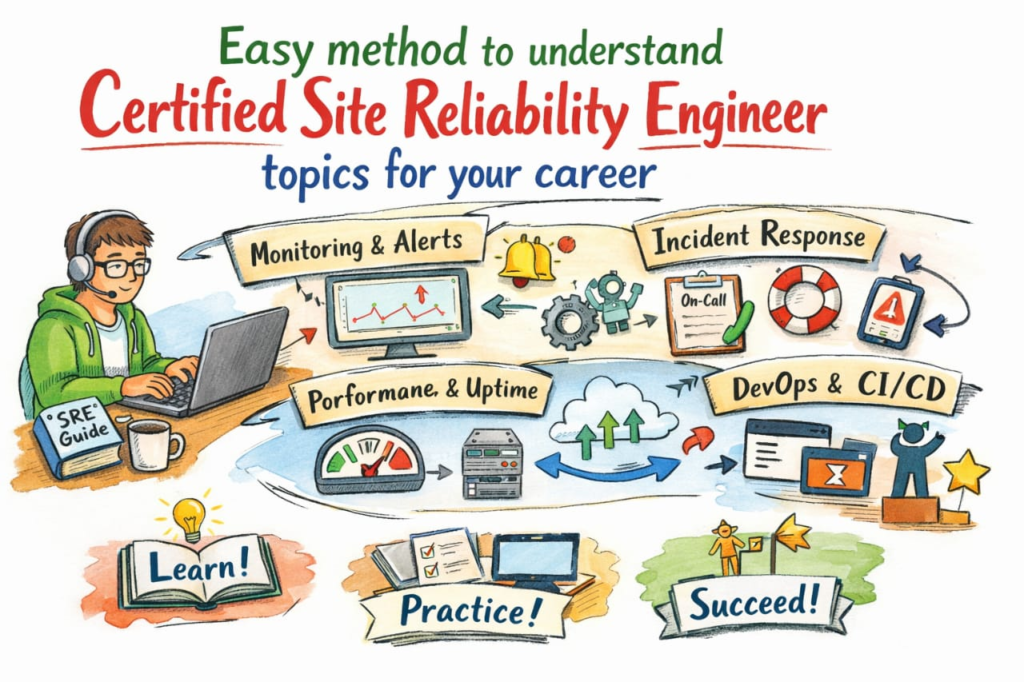
Introduction
In the current landscape of high-scale cloud environments, the Certified Site Reliability Engineer program has emerged as a vital credential for modern infrastructure professionals. This guide is designed to navigate the complexities of production systems and explain why transitioning from traditional operations to an engineering-first mindset is essential. As software delivery accelerates, the need for stable, scalable, and self-healing systems has never been more critical for global enterprises.
Whether you are a software developer looking to understand production or a system administrator aiming to modernize your toolkit, this roadmap provides clarity. By leveraging resources from Sreschool, professionals can gain the technical depth required to manage distributed systems effectively. This guide serves as a career compass, helping you evaluate the professional impact and long-term benefits of mastering reliability engineering in a competitive market.
What is the Certified Site Reliability Engineer?
The Certified Site Reliability Engineer designation is more than just a certificate; it is a validation of an engineer’s ability to apply software engineering principles to operational challenges. It exists to standardize the practices originally developed by industry giants to manage massive scale without increasing headcount. The focus is on creating a bridge between the feature-driven goals of developers and the stability requirements of operations teams.
This program prioritizes real-world application over abstract concepts, ensuring that learners can handle the pressures of live production environments. It aligns perfectly with modern cloud-native architectures where manual intervention is no longer a viable strategy for growth. By focusing on automation and data-driven decision-making, it prepares engineers to manage the lifecycle of complex, global services with confidence and precision.
Who Should Pursue Certified Site Reliability Engineer?
This certification is highly recommended for DevOps practitioners, cloud architects, and platform engineers who want to specialize in high availability. It is also an excellent path for traditional systems engineers who need to pivot toward automation and infrastructure as code. Even security professionals and data engineers find value here, as reliability is the foundational layer upon which all other system features are built.
The curriculum is structured to support everyone from entry-level candidates to seasoned technical leads and engineering managers. In major tech markets like India and the United States, there is a distinct preference for SREs who can demonstrate a structured approach to incident response. By pursuing this path, professionals can prove they have the skills to handle the uptime requirements of mission-critical enterprise applications.
Why Certified Site Reliability Engineer is Valuable Today and Beyond
The value of this certification lies in its focus on enduring engineering principles rather than fleeting tool popularity. As organizations adopt multi-cloud and hybrid-cloud strategies, the demand for experts who can maintain consistency and reliability across different platforms continues to rise. It offers a clear return on investment by positioning you for roles that are central to a company’s operational success.
Furthermore, this certification helps engineers stay relevant in an era of rapid technological shifts. While specific cloud services may change, the fundamental need to manage latency, availability, and capacity remains constant. By mastering the SRE discipline, you ensure your career longevity and open doors to leadership positions within global engineering organizations.
Certified Site Reliability Engineer Certification Overview
The program is officially delivered through the curriculum found at Certified Site Reliability Engineer and is hosted on the Sreschool ecosystem. It utilizes a structured approach that moves from conceptual understanding to advanced architectural mastery. The certification process is rigorous, requiring candidates to demonstrate both theoretical knowledge and practical troubleshooting skills.
The ownership of the program ensures that the content is updated frequently to reflect current industry standards and emerging technologies. This practical focus makes the certification highly reputable among hiring managers who need engineers ready for “on-call” responsibilities. The modular structure allows learners to build their expertise incrementally, ensuring a solid grasp of each core reliability pillar.
Certified Site Reliability Engineer Certification Tracks & Levels
The certification is categorized into three distinct levels: Foundation, Professional, and Advanced. The Foundation level focuses on the SRE philosophy, terminology, and the basic metrics used to define success in a production environment. It is the starting point for those looking to change their career direction toward reliability engineering.
The Professional level dives into implementation strategies, including automation, observability, and incident management protocols. Finally, the Advanced level is designed for those who will architect the next generation of resilient systems and lead large engineering teams. Each level is carefully mapped to specific career milestones, providing a clear progression path for professional growth.
Complete Certified Site Reliability Engineer Certification Table
| Track | Level | Who it’s for | Prerequisites | Skills Covered | Recommended Order |
| Core SRE | Foundation | Developers, Junior Ops | Basic Linux | SLOs, SLIs, Toil | 1 |
| SRE Ops | Professional | DevOps, Cloud Engineers | Core SRE | Incident Response, Monitoring | 2 |
| SRE Design | Advanced | Senior SREs, Architects | SRE Ops | Capacity Planning, Resilience | 3 |
| SRE Lead | Expert | Managers, Staff Engineers | 5+ Years Exp | Team Culture, Error Budgets | 4 |
Detailed Guide for Each Certified Site Reliability Engineer Certification
Certified Site Reliability Engineer – Foundation
What it is This certification validates the fundamental understanding of the SRE mindset and the core pillars of reliability. It covers the essential vocabulary and the conceptual framework needed to support high-scale systems.
Who should take it It is ideal for software developers, junior system administrators, and technology students who want to enter the reliability field. Anyone looking to understand the core principles of uptime and scalability should start here.
Skills you’ll gain
- Mastery of the SRE terminology and basic philosophies.
- Understanding how to measure reliability through SLIs and SLOs.
- Techniques for identifying and eliminating manual operational toil.
- Basic understanding of monitoring versus observability concepts.
Real-world projects you should be able to do
- Create a reliability roadmap for a simple web application.
- Draft an initial set of service level objectives for a business service.
- Identify three areas of toil in a standard deployment pipeline.
Preparation plan
- 7–14 days: Study the official SRE handbooks and foundational blog posts.
- 30 days: Complete the interactive modules and foundational labs on the platform.
- 60 days: Join community study groups and take several full-length practice exams.
Common mistakes
- Trying to memorize definitions without understanding the underlying logic.
- Ignoring the cultural aspects of the SRE role in favor of only technical tools.
Best next certification after this
- Same-track option: Certified Site Reliability Engineer – Professional
- Cross-track option: Certified DevOps Associate
- Leadership option: Technical Team Lead Foundation
Certified Site Reliability Engineer – Professional
What it is This level focuses on the technical execution of SRE principles in active production environments. It validates the ability to build automated systems that monitor, alert, and recover from failures with minimal human intervention.
Who should take it Middle-level engineers who have already mastered the foundations and are currently working in a cloud or DevOps environment. It is the gold standard for practitioners who are responsible for daily system stability.
Skills you’ll gain
- Implementing complex observability stacks with logging and tracing.
- Managing incident lifecycles and facilitating blameless post-mortems.
- Automating infrastructure changes through code and deployment pipelines.
- Fine-tuning error budgets to manage the risk of new feature releases.
Real-world projects you should be able to do
- Build an automated alerting system based on golden signals.
- Lead a mock incident response session and document a post-mortem.
- Implement a canary release strategy for a distributed microservice.
Preparation plan
- 7–14 days: Review incident response protocols and documentation standards.
- 30 days: Engage in deep-dive technical labs focusing on observability tools.
- 60 days: Complete a full simulation of a production environment failure and recovery.
Common mistakes
- Over-complicating monitoring dashboards with too much irrelevant data.
- Failing to automate the “low-hanging fruit” that causes daily interruptions.
Best next certification after this
- Same-track option: Certified Site Reliability Engineer – Advanced
- Cross-track option: Certified DevSecOps Specialist
- Leadership option: Senior Engineering Manager
Certified Site Reliability Engineer – Advanced
What it is This advanced certification validates the expertise required to design and manage global-scale, high-availability architectures. It is focused on long-term strategy, resilience testing, and large-scale infrastructure efficiency.
Who should take it Senior engineers, principal architects, and infrastructure leads who design systems for millions of users. Candidates should have a background in handling multi-region deployments and complex disaster recovery scenarios.
Skills you’ll gain
- Architecting multi-cloud disaster recovery and failover strategies.
- Conducting chaos engineering experiments to verify system resilience.
- Advanced capacity planning and cost-efficient infrastructure design.
- Designing self-healing systems that utilize automated remediation.
Real-world projects you should be able to do
- Design a 99.99% available architecture for a global fintech platform.
- Execute a controlled chaos experiment in a staging environment.
- Create a five-year capacity and cost projection for a growing service.
Preparation plan
- 7–14 days: Study advanced distributed system patterns and consensus algorithms.
- 30 days: Analyze case studies of major outages from leading tech companies.
- 60 days: Develop a comprehensive disaster recovery plan for a multi-service architecture.
Common mistakes
- Designing overly complex systems that are difficult to troubleshoot.
- Neglecting the financial impact of high-availability design choices.
Best next certification after this
- Same-track option: SRE Fellow / Principal Specialist
- Cross-track option: Certified Solutions Architect Expert
- Leadership option: VP of Engineering / CTO Track
Choose Your Learning Path
DevOps Path
The DevOps path is centered on the seamless integration of development and operations cycles. Candidates learn how to build automated pipelines that not only deliver code but also ensure that the code is reliable from the start. This path emphasizes the “You Build It, You Run It” philosophy, empowering developers to take ownership of their production services. It is the ideal route for those who want to be the technical bridge within a modern software organization.
DevSecOps Path
The DevSecOps path integrates security as a core component of system reliability. Professionals following this route learn that a secure system is a reliable system, and they focus on automating security gates throughout the lifecycle. It involves mastering threat modeling, automated vulnerability scanning, and secure configuration management. This is a critical path for those working in regulated industries where downtime and data breaches are equally catastrophic.
SRE Path
The specialized SRE path is for those who want to be the ultimate authority on production systems and infrastructure. This journey takes the learner through every level of reliability engineering, from basic metrics to advanced chaos engineering and global traffic management. It is a deep, technical dive into how large-scale systems are designed to survive the unpredictable nature of the internet. This path leads to the most senior infrastructure roles in the technology sector.
AIOps Path
The AIOps path focuses on the intersection of artificial intelligence and operations to handle the massive data generated by modern systems. Practitioners learn how to use machine learning models to identify patterns in telemetry data that a human might miss. The goal is to move from reactive monitoring to proactive, predictive maintenance. This path is essential for managing hyper-scale environments where manual oversight is no longer physically possible for a human team.
MLOps Path
The MLOps path applies the rigors of reliability engineering to the deployment and management of machine learning models. It addresses the unique challenges of data drift, model retraining pipelines, and low-latency inference at scale. Engineers on this path ensure that AI services are as reliable and observable as any other microservice in the stack. This is a fast-growing niche that is becoming a requirement for any organization investing heavily in artificial intelligence.
DataOps Path
The DataOps path focuses on the reliability and quality of data delivery pipelines. It applies SRE principles to data engineering, ensuring that data is available, accurate, and delivered within the required latency. Practitioners learn how to monitor data flows and automate the recovery of data processing jobs. This path is vital for companies that rely on real-time data for critical business intelligence and automated decision-making.
FinOps Path
The FinOps path merges reliability engineering with financial accountability to optimize cloud spending. Candidates learn to treat cloud costs as a performance metric that must be balanced against availability and speed. It involves analyzing resource usage data to ensure that the infrastructure is not just reliable, but also cost-effective. This path is highly valued by executive leadership for its direct impact on organizational efficiency and profitability.
Role → Recommended Certified Site Reliability Engineer Certifications
| Role | Recommended Certifications |
| DevOps Engineer | SRE Foundation, SRE Professional |
| SRE | SRE Foundation, SRE Professional, SRE Advanced |
| Platform Engineer | SRE Professional, SRE Advanced |
| Cloud Engineer | SRE Foundation, SRE Professional |
| Security Engineer | SRE Foundation, DevSecOps Professional |
| Data Engineer | SRE Foundation, DataOps Specialist |
| FinOps Practitioner | SRE Foundation, FinOps Professional |
| Engineering Manager | SRE Foundation, SRE Lead / Leadership |
Next Certifications to Take After Certified Site Reliability Engineer
Same Track Progression
For those who wish to remain deep in the infrastructure domain, moving toward expert-level certifications is the logical next step. This involves mastering niche areas like high-performance computing, specialized database reliability, or global network optimization. Continued growth in this track ensures you remain a top-tier technical individual contributor or an architect capable of handling the world’s most complex systems.
Cross-Track Expansion
Broadening your expertise into fields like DevSecOps or AIOps creates a more well-rounded technical profile. By understanding how security or machine learning impacts reliability, you can lead more diverse projects and solve more complex organizational problems. This cross-pollination of skills is highly sought after in modern platform engineering teams where versatility is a key asset.
Leadership & Management Track
If your goals involve leading people and defining strategy, the leadership track is the best way forward. This involves moving beyond the “how” of reliability and into the “why” and “at what cost.” You will learn to manage budgets, build high-performing engineering teams, and align technical roadmap priorities with broader business objectives. This path prepares you for roles such as Director of Infrastructure or VP of Operations.
Training & Certification Support Providers for Certified Site Reliability Engineer
DevOpsSchool DevOpsSchool is a leading global platform that provides extensive training and certification support for SRE and DevOps professionals. They offer a deep curriculum that covers everything from basic automation to advanced system design, delivered by instructors with decades of industry experience. Their program is designed to be highly interactive, offering live sessions that allow students to ask questions and solve problems in real-time. DevOpsSchool is particularly known for its strong presence in India, helping thousands of engineers transition into high-paying SRE roles. Their support includes study materials, lab environments, and career guidance, making it a comprehensive choice for anyone serious about the Certified Site Reliability Engineer track.
Cotocus Cotocus specializes in high-end technical consultancy and training for cloud-native technologies and site reliability engineering. They provide a hands-on learning environment where students can work on real-world scenarios that mimic the challenges faced by modern enterprises. Their curriculum is strictly aligned with industry needs, focusing on the tools and methodologies that matter most in production. Cotocus offers personalized mentoring, which is invaluable for senior professionals looking to master advanced architectural concepts. Their focus on the practical application of SRE principles ensures that candidates are not just exam-ready but also job-ready. They are a trusted partner for many organizations looking to upskill their internal engineering departments.
Scmgalaxy Scmgalaxy is a robust community-driven platform that offers a wealth of resources for software configuration management and SRE professionals. They provide detailed tutorials, video guides, and practice labs that are essential for mastering the technical aspects of reliability. Scmgalaxy has built a reputation over the years as a reliable source of information for troubleshooting and best practices in the DevOps space. Their support for the Certified Site Reliability Engineer program includes curated learning paths and a vibrant community forum where engineers can share knowledge. For self-paced learners, Scmgalaxy provides the necessary documentation and community support to navigate complex technical certifications effectively and efficiently.
BestDevOps BestDevOps focuses on providing streamlined, efficient training for busy professionals who want to master SRE concepts quickly without sacrificing depth. They offer a curated selection of courses that focus on the most impactful skills required to pass the certification and excel in the field. Their platform is designed for ease of use, with a focus on clear explanations and practical examples. BestDevOps provides excellent support through mock exams and quick-reference guides that help reinforce key concepts. They are an ideal choice for engineers who need to balance their learning with a full-time job. Their focus on high-yield topics ensures that you spend your time on what matters most for your career.
devsecopsschool.com This organization is the premier destination for learning how to integrate security into the reliability and operations lifecycle. They provide specialized training that covers the intersection of SRE and security engineering, ensuring that your systems are both resilient and protected. Their curriculum includes topics like automated security testing, secure supply chain management, and incident response for security events. Devsecopsschool.com is essential for SREs who want to add a high-value security layer to their professional profile. They offer hands-on labs that demonstrate how to use modern security tools within a standard SRE workflow. Their certifications are highly respected in sectors that handle sensitive data and require high security.
sreschool.com As the primary host for the Certified Site Reliability Engineer program, sreschool.com provides the official framework and curriculum for the certification. The platform is designed specifically for the SRE discipline, offering a specialized environment for labs and assessments. It serves as a central hub where learners can access the latest updates to the certification standards and interact with other SRE professionals. Sreschool.com is committed to maintaining a high bar for reliability engineering education, ensuring that the certification remains a prestigious credential. Their support includes direct access to the official study guides and a structured path through the various certification levels. It is the most direct route to achieving this specific professional milestone.
aiopsschool.com Aiopsschool.com is dedicated to the future of operations, where machine learning and artificial intelligence are used to manage complex systems. They provide training for SREs who want to stay ahead of the curve by mastering algorithmic monitoring and automated incident detection. Their courses cover data science basics for engineers, the implementation of AI-driven observability, and the use of predictive analytics in production. As environments grow beyond human scale, the skills taught here become critical for maintaining reliability. Aiopsschool.com offers a unique curriculum that bridges the gap between traditional SRE practices and modern data-driven automation. This is the place for engineers who want to lead the shift toward autonomous infrastructure.
dataopsschool.com This platform addresses the specific challenges of maintaining reliability within data pipelines and large-scale data systems. They offer training that applies SRE principles to the data engineering lifecycle, focusing on data quality, availability, and latency. Their support includes specialized labs for monitoring data flows and automating the recovery of data processing tasks. Dataopsschool.com is vital for organizations that treat data as a critical product and require high reliability for their analytics platforms. For engineers, this provides a pathway into the high-growth field of data infrastructure. Their curriculum is designed to help you ensure that your data is as reliable as the code it supports.
finopsschool.com Finopsschool.com focuses on the critical intersection of cloud reliability and financial management. They provide SREs with the training needed to understand and optimize the cost of the systems they build and maintain. Their curriculum covers cloud cost transparency, resource optimization strategies, and the cultural changes required for successful FinOps implementation. As companies look to tighten their cloud budgets, the ability to engineer cost-effective systems is a major career advantage. Finopsschool.com provides the tools and frameworks to make cost a first-class citizen in your engineering decisions. Their training helps you prove the business value of your technical reliability initiatives to executive leadership.
Frequently Asked Questions (General)
1. What is the passing score for the SRE certification exams? The passing score typically ranges between 70% and 75%, depending on the level and the complexity of the specific assessment version.
2. Do I need a computer science degree to get certified? No, a degree is not required. The certification focuses on practical skills and industry experience, making it accessible to self-taught engineers and career-changers.
3. Can I take the exam online? Yes, the certification exams are delivered through a secure online proctoring platform, allowing you to take them from anywhere in the world.
How often is the curriculum updated? The curriculum is reviewed annually and updated as needed to include new tools, technologies, and best practices emerging in the industry.
4. What programming languages should I know? While not specific to one language, proficiency in Python, Go, or Bash is highly recommended for the automation and lab portions of the program.
5. Is there a discount for bulk corporate certifications? Yes, most training providers listed offer corporate packages for engineering teams looking to standardize their SRE practices.
6. How does this certification compare to vendor-specific cloud certs? While cloud certs focus on “how to use a service,” this certification focuses on “how to engineer reliability” regardless of the underlying cloud provider.
7. What is the retake policy for the exam? Usually, candidates can retake the exam after a cooling-off period, although a retake fee may apply depending on the provider’s specific policy.
8. Is there a community for certified professionals? Yes, sreschool.com and other providers host alumni communities and forums where you can network with other certified reliability engineers.
9. What are the technical requirements for the labs? You will need a modern computer with a stable internet connection and the ability to run browser-based terminal emulators and cloud consoles.
10. Can I use the SRE title on my resume after the Foundation level? You can list the Foundation certification, but the “Certified Site Reliability Engineer” title is generally reserved for those who reach the Professional level.
11. What is the main benefit of the Advanced level? The Advanced level proves you can design for “high nines” (99.99%+) of availability and handle the most complex architectural challenges in the world.
12. Can I take the exam without prior DevOps experience?
Yes, the Foundation level is designed specifically for those transitioning into the field. It provides the necessary conceptual base and terminology required before you move into the more technical Professional and Advanced implementation tracks.
FAQs on Certified Site Reliability Engineer
1. How does the program handle the concept of Toil? The program teaches you how to identify, measure, and systematically eliminate toil through automation, ensuring that engineers spend at least 50% of their time on project work.
2. What is the focus on Incident Response? You are taught how to manage the full lifecycle of an incident, from detection and mitigation to the final blameless post-mortem and remediation tracking.
3. Are there specific tools covered in the Sreschool curriculum? While tool-agnostic in principle, the labs often use industry standards like Kubernetes, Prometheus, Grafana, and Terraform to demonstrate the concepts.
4. How does this certification impact salary? In the global market, certified SREs often see a salary increase of 20% to 40% compared to general systems administrators or junior developers.
5. What is the difference between the Lead and Advanced levels? Advanced focuses on the technical architecture, while the Lead level focuses on the people, culture, and business metrics required to run an SRE organization.
6. How are Error Budgets used in the training? Learners are taught how to calculate error budgets and use them as a “policy” to decide when to freeze feature releases in favor of stability.
7. Does the program cover Chaos Engineering? Yes, Chaos Engineering is a key part of the Advanced level, where you learn to inject failure into systems to proactively find weaknesses.
8. Is the certification recognized by major Indian tech firms? Yes, it is highly valued by top-tier Indian service providers and product companies that manage large-scale infrastructure for global clients.
Conclusion
From the perspective of a senior mentor, the transition toward a reliability-centric career is one of the smartest moves an engineer can make. The Certified Site Reliability Engineer path offers a structured, deep-dive into the realities of modern production that simply cannot be learned through quick tutorials or “on the job” firefighting alone. It forces you to think like an owner of the system, balancing the competing demands of speed and stability with a data-driven approach. The industry is moving away from manual operations, and those who do not adapt risk being left behind. By committing to this certification, you are not just getting a badge; you are acquiring a toolkit that will serve you for decades. It is a challenging journey, but the clarity and confidence you gain in managing complex systems make it an investment with a lifetime of returns. Focus on the principles, master the labs, and you will find yourself at the very top of the engineering talent pool.