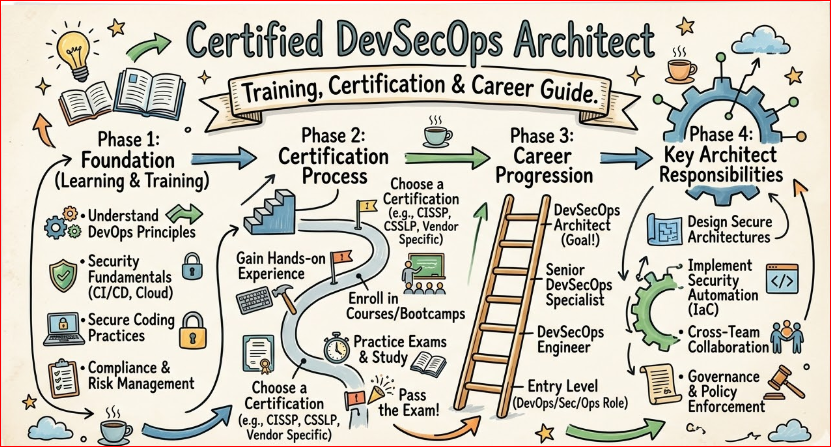
Security can no longer be an afterthought in software delivery. Modern teams must build systems where security, development, and operations work together from day zero. The Certified DevSecOps Architect program from DevSecOpsSchool is designed for professionals who want to design secure-by-default architectures, not just add tools in pipelines. It focuses on real-world enterprise environments, cloud-native platforms, and the full software supply chain. In this guide, you will learn what this certification is, who should take it, skills you will gain, how to prepare, and how it fits into broader DevOps, SRE, AIOps, MLOps, DataOps, and FinOps career paths.
Why DevSecOps Architecture Matters
Traditional security teams often work at the end of the delivery lifecycle, leading to delays, friction, and missed issues. DevSecOps architecture brings security into design, development, CI/CD, and operations.
A DevSecOps Architect helps organizations:
- Build secure CI/CD pipelines for multi‑cloud and hybrid setups.
- Apply shift-left security in design, coding, and testing.
- Automate security checks in containers, Kubernetes, serverless, and microservices.
- Align with regulations like ISO 27001, GDPR, HIPAA, and SOC 2.
This role is critical for companies that are serious about secure digital transformation and cloud adoption.
About Certified DevSecOps Architect
What it is
Certified DevSecOps Architect is a specialized certification that teaches you how to design end‑to‑end DevSecOps architectures for enterprises. It covers secure SDLC, secure CI/CD, cloud-native security, compliance as code, and security governance for modern engineering teams.
Who should take it
This certification is ideal for:
- DevOps Engineers moving into security and architecture.
- Security Engineers who want to work closely with DevOps and cloud teams.
- SREs and Platform Engineers responsible for production platforms.
- Cloud Architects who must embed security patterns into designs.
- Engineering Managers and Tech Leads who make architecture decisions.
Skills you will gain
After this certification, you should be able to:
- Architect secure CI/CD pipelines for multi‑cloud and hybrid environments.
- Apply shift-left security in design, coding, and testing stages.
- Use security as code and compliance as code in pipelines.
- Design security controls for containers, Kubernetes, and serverless.
- Build security reference architectures for microservices and APIs.
- Implement threat modeling and risk-based security decisions.
- Align architectures with standards like ISO 27001, SOC 2, GDPR, and HIPAA.
- Lead DevSecOps adoption and cultural change across teams.
Real-world projects you should be able to do
By the end, you should be confident with projects such as:
- Designing a secure CI/CD pipeline for a microservices-based application on AWS/Azure/GCP.
- Implementing container image scanning, dependency scanning, and policy checks in pipelines.
- Defining a secure architecture for Kubernetes clusters with network policies, secrets management, and RBAC.
- Creating a security blueprint for a multi‑cloud system that must be compliant with ISO 27001 and GDPR.
- Building a “security as code” setup with policy engines and automated enforcement in pipelines.
- Designing incident response and monitoring flows integrated with DevOps and SRE practices.
Preparation plan
You can choose a preparation path based on your background and available time.
7–14 days (intensive plan)
Best for: experienced DevOps, cloud, or security professionals with strong daily hands‑on exposure.
- Day 1–2: Review DevSecOps principles, secure SDLC, and shift‑left security.
- Day 3–4: Deep dive into CI/CD security patterns, gates, and automated checks.
- Day 5–6: Focus on containers, Kubernetes, secrets management, and cloud-native security.
- Day 7–10: Study threat modeling, policy as code, governance, and compliance frameworks.
- Day 11–14: Practice architecture scenarios, mock designs, and review sample case studies.
30 days (standard plan)
Best for: working engineers who can spare a few hours each day.
- Week 1: DevSecOps concepts, SDLC, risk models, shift‑left, and security checkpoints.
- Week 2: CI/CD security, pipeline stages, scanning tools, and approvals.
- Week 3: Containers, Kubernetes, cloud security baselines, secrets, and IAM.
- Week 4: Compliance as code, architecture patterns, incident response architecture, and revision.
60 days (deep transition plan)
Best for: professionals moving from pure DevOps or pure security into architecture.
- Month 1: Strengthen fundamentals in DevOps, cloud, CI/CD, containers, and vulnerability management.
- Month 2: Focus on architecture design, formal patterns, cloud hardening, security frameworks, and case-study based scenarios.
Common mistakes to avoid
Many learners and teams repeat the same mistakes when approaching DevSecOps architecture:
- Treating DevSecOps as only tool integration instead of architecture and culture.
- Focusing only on pipeline scans and ignoring design-time threat modeling.
- Ignoring governance, compliance, and audit needs in the architecture.
- Designing security in isolation without involving development and operations.
- Over‑engineering controls that slow delivery without clear risk justification.
- Not preparing with real scenarios and architecture diagrams before the exam.
Best next certification after this
After Certified DevSecOps Architect, your best next step depends on your career direction.
- Same track: a deeper DevSecOps or security architecture program (for example, advanced DevSecOps or cloud security specialist from the same ecosystem).
- Cross-track: SRE or Kubernetes Master‑level certification to strengthen reliability and platform knowledge.
- Leadership: a DevOps or SRE leadership/manager‑focused certification to move into strategy and decision‑making roles.
Certification Table – DevSecOps and Related Paths
The table below shows how Certified DevSecOps Architect fits into a broader certification journey using typical “Foundation–Practitioner–Master/Architect” patterns that DevOpsSchool style programs follow.
| Certification | Track | Level | Who it’s for | Prerequisites | Skills covered | Recommended order | Link |
|---|---|---|---|---|---|---|---|
| DevSecOps Foundation | DevSecOps | Foundation | Developers, DevOps, QA, junior security | Basic SDLC and Linux knowledge | DevSecOps basics, SDLC, security concepts, intro to CI/CD security | Start here if new to DevSecOps | – |
| DevSecOps Practitioner | DevSecOps | Practitioner | Working engineers in DevOps/security | Foundation-level understanding | Implementing checks in pipelines, basic threat modeling, tool integration | After DevSecOps Foundation | – |
| Certified DevSecOps Architect | DevSecOps | Architect | Senior engineers, architects, tech leads, managers | Strong DevOps/cloud and security experience | Architecture patterns, secure CI/CD, cloud-native security, governance | After Practitioner or equivalent | https://devsecopsschool.com/certifications/certified-devsecops-architect.html |
| DevOps Master | DevOps | Master | DevOps/SRE/Platform engineers | DevOps background | End‑to‑end DevOps, automation, delivery pipelines | Parallel or before Architect | – |
| SRE Master | SRE | Master | SREs and Ops teams | Ops/DevOps skills | Reliability, SLIs/SLOs, error budgets, incident response | Parallel or after Architect | – |
| AIOps Master | AIOps/MLOps | Master | SRE, platform, and data‑driven engineers | Monitoring/observability knowledge | Intelligent operations, anomaly detection, ML‑based operations | After solid SRE/DevOps foundation | – |
| DataOps Master | DataOps | Master | Data engineers, platform engineers | Data pipelines, basic DevOps | CI/CD for data, data quality, governance, automation | For data‑heavy organizations | – |
| FinOps Practitioner | FinOps | Practitioner | Cloud engineers, FinOps practitioners, managers | Public cloud usage experience | Cloud cost management, budgeting, chargeback/showback | Any time after cloud basics | – |
(Links are only added where official URLs were provided.)
Choose Your Path – 6 Learning Paths
Once you understand DevSecOps architecture, you can grow in multiple directions. These six learning paths help you plan your long‑term journey.
1. DevOps Path
Focus: delivery speed, automation, reliability, and platform engineering.
Typical sequence:
- DevOps Foundation → DevOps Practitioner → DevOps Master.
- Add Certified DevSecOps Architect to bring security into your DevOps designs.
This path is ideal if you enjoy CI/CD, automation, and platform work and want to ensure security is built in, not bolted on.
2. DevSecOps Path
Focus: secure SDLC, secure pipelines, and governance across the lifecycle.
Typical sequence:
Choose this if you want to be the security voice inside engineering, able to make architecture decisions and influence tools, policies, and ways of working.
3. SRE Path
Focus: reliability, performance, availability, and incident response.
Typical sequence:
- SRE Foundation → SRE Practitioner → SRE Master.
- Pair SRE Master with Certified DevSecOps Architect to design systems that are both secure and highly reliable.
This path suits engineers who love SLIs/SLOs, monitoring, and production ownership, but also want strong security posture.
4. AIOps/MLOps Path
Focus: using AI and ML to improve operations and software delivery.
Typical sequence:
- AIOps Foundation → AIOps Practitioner → AIOps Master or MLOps certifications.
- Combine with Certified DevSecOps Architect to secure ML pipelines, data flows, and automated decision systems.
This path is a good choice if you are excited about intelligent operations, anomaly detection, and ML‑driven tooling.
5. DataOps Path
Focus: data pipelines, data quality, governance, and analytics delivery.
Typical sequence:
- DataOps Foundation → DataOps Practitioner → DataOps Master.
- Use Certified DevSecOps Architect concepts to secure data pipelines and protect sensitive data in motion and at rest.
Choose this path if you work with data platforms, ETL/ELT, and analytics environments with strong compliance requirements.
6. FinOps Path
Focus: cloud cost optimization, budgeting, and financial accountability for engineering.
Typical sequence:
- FinOps Foundation → FinOps Practitioner.
- Combine with Certified DevSecOps Architect to design architectures that are secure, compliant, and cost‑optimized.
This path is ideal if you work with cloud spend, cost visibility, and capacity planning, especially in large cloud environments.
Role → Recommended Certifications
This section maps common roles to a simple certification plan that includes Certified DevSecOps Architect.
| Role | Primary focus | Recommended certifications including DevSecOps Architect |
|---|---|---|
| DevOps Engineer | CI/CD, automation, platforms | DevOps Foundation → DevOps Practitioner → DevOps Master → Certified DevSecOps Architect |
| SRE | Reliability, SLIs/SLOs, incident response | SRE Foundation → SRE Practitioner → SRE Master → Certified DevSecOps Architect |
| Platform Engineer | Internal platforms, Kubernetes, tooling | Kubernetes/Platform certifications → DevOps Master → Certified DevSecOps Architect |
| Cloud Engineer | Cloud infrastructure, networking, IAM | Cloud platform certifications → DevOps/DevSecOps Practitioner → Certified DevSecOps Architect |
| Security Engineer | Application and cloud security | Security/DevSecOps Foundation → DevSecOps Practitioner → Certified DevSecOps Architect |
| Data Engineer | Data pipelines and platforms | DataOps certifications → Cloud/Data platform credentials → Certified DevSecOps Architect (for secure data architectures) |
| FinOps Practitioner | Cloud cost management and governance | FinOps certifications → Cloud platform certifications → Certified DevSecOps Architect (to align cost and security) |
| Engineering Manager | Strategy, team leadership, governance | DevOps/DevSecOps/SRE leadership certifications → Certified DevSecOps Architect (for architectural decision‑making) |
This mapping helps you see where DevSecOps architecture fits into your career story.
Next Certifications to Take After Certified DevSecOps Architect
Once you complete Certified DevSecOps Architect, you can grow in three strategic directions.
1. Same track – deepen DevSecOps
Stay close to DevSecOps and security architecture:
- Take advanced DevSecOps or cloud security architect certifications.
- Focus on specialized topics like supply chain security, Kubernetes security, or zero‑trust architectures.
This option is best if you want to be recognized as a go‑to DevSecOps and security architecture specialist.
2. Cross-track – broaden into reliability and platforms
Expand into adjacent domains like SRE, platform engineering, and AIOps:
- SRE Master-level certifications to own reliability and uptime.
- Kubernetes and platform engineering certifications to deepen cluster, networking, and runtime knowledge.
This path makes you strong in both security and production reliability.
3. Leadership – move into strategic roles
Step into roles that shape teams and organizations:
- DevOps or SRE leadership certifications focusing on culture, org design, and strategy.
- Product or technical leadership programs that help you connect architecture decisions to business outcomes.
This path is ideal if you want to lead multiple teams, portfolios, or transformation programs.
Top Institutions for Certified DevSecOps Architect Training
The following institutions help learners prepare for DevSecOps and related certifications, including Certified DevSecOps Architect.
DevOpsSchool
DevOpsSchool offers a wide ecosystem of DevOps, DevSecOps, SRE, AIOps, DataOps, and FinOps certifications and training. It focuses on hands‑on labs, real project scenarios, and integrated learning paths so that learners can move from fundamentals to advanced architecture roles.
Cotocus
Cotocus is a consulting and training company that supports enterprise DevOps and DevSecOps transformations. It often works with organizations to design customized learning paths, including architect‑level preparation for engineers and managers.
ScmGalaxy
ScmGalaxy provides training and consulting for DevOps, CI/CD, configuration management, and related disciplines. Its programs help participants build strong fundamentals, which are critical before moving into advanced DevSecOps architecture work.
BestDevOps
BestDevOps functions as a knowledge and community hub around DevOps and related practices. It helps professionals discover relevant certifications, trainings, and communities, including DevSecOps‑focused programs.
devsecopsschool.com
DevSecOpsSchool is the dedicated provider for the Certified DevSecOps Architect certification and other DevSecOps programs. Its offerings concentrate on secure SDLC, secure pipelines, and architect‑level skills, with a strong focus on enterprise security challenges.
sreschool.com
SRESchool focuses on Site Reliability Engineering training and certifications. It complements DevSecOps by helping engineers learn how to design systems that are both reliable and secure in production.
aiopsschool.com
AIOpsSchool offers AIOps and intelligent operations training. Its programs support DevSecOps Architects who need to integrate observability, anomaly detection, and intelligent automation into secure architectures.
dataopsschool.com
DataOpsSchool concentrates on DataOps concepts such as data pipelines, quality, and governance. For DevSecOps Architects working with analytics platforms or regulated data, this is a strong companion path.
finopsschool.com
FinOpsSchool focuses on the financial side of cloud operations, including cost optimization, budgeting, and governance. DevSecOps Architects benefit from understanding FinOps to design architectures that balance cost, security, and performance.
FAQs on Certified DevSecOps Architect
1. How difficult is Certified DevSecOps Architect?
It is an advanced‑level certification, so the difficulty is moderate to high for those without strong DevOps or security experience. For engineers already working with CI/CD, cloud, and security tools, the difficulty becomes manageable with structured preparation.
2. How much time do I need to prepare?
Most working professionals need between 30 and 60 days of focused preparation, depending on their background. Experienced DevOps or security engineers can follow a 7–14 day intensive plan if they already live in these environments daily.
3. What are the prerequisites?
You should have strong understanding of DevOps and cloud concepts, basic application security, and experience with CI/CD pipelines. Experience in infrastructure or software architecture roles is highly beneficial but not strictly mandatory if you invest more preparation time.
4. In what sequence should I take DevSecOps certifications?
A common sequence is DevSecOps Foundation → DevSecOps Practitioner → Certified DevSecOps Architect. If you already have equivalent experience, you may move directly towards the Architect level after validating your fundamentals.
5. Is this certification useful for SREs and Platform Engineers?
Yes, it is very relevant because SREs and Platform Engineers own production systems where security, reliability, and performance meet. Certified DevSecOps Architect helps them design platforms that are secure by default, not just operationally strong.
6. How does this certification help my career?
It positions you as someone who can design and govern secure architectures, not only operate tools. This often leads to roles like DevSecOps Architect, Security Architect, Platform Architect, or lead/manager positions in large organizations.
7. Is Certified DevSecOps Architect suitable for managers?
Yes, especially for engineering managers, security managers, and architects who make design and policy decisions. Managers gain a structured framework to evaluate risks, select controls, and align teams around DevSecOps practices.
8. What real-world skills will I actually use on the job?
You will use skills such as threat modeling, secure pipeline design, policy as code, and cloud-native security patterns. You will also apply governance, compliance mapping, and cross‑team collaboration skills in everyday design and review work.
9. Can I take this certification if I am mainly a security engineer?
Yes, and it can be a strong bridge into engineering‑centric security roles. You will become more comfortable with pipelines, cloud platforms, and DevOps practices while keeping your security expertise as your core strength.
10. Is it vendor-specific or vendor-neutral?
The principles and patterns are generally vendor‑neutral, but examples often use common clouds and tools. This lets you apply the learning to AWS, Azure, GCP, and typical CI/CD tools in most organizations.
11. How does this compare to other DevSecOps certifications?
Many DevSecOps certifications focus on fundamentals or tooling, while Certified DevSecOps Architect focuses strongly on architecture and strategic design. It is especially useful if you want to move beyond “how to configure a tool” into “how to design the entire secure system.”
12. Does this certification help with compliance and audits?
Yes, a big part of DevSecOps architecture is mapping controls to standards like ISO 27001, SOC 2, GDPR, and HIPAA. This helps you design systems that are audit‑ready by design instead of scrambling during assessments.
FAQs focused on: difficulty, time, prerequisites, sequence, value, career outcomes
1. Is Certified DevSecOps Architect suitable for mid‑level engineers?
Yes, mid‑level engineers with solid DevOps, cloud, or security exposure can handle it if they prepare properly. It is challenging, but you do not need to be a “chief architect” to start.
2. Will I struggle if my experience is more on the development side than operations?
You may find the infrastructure and CI/CD parts a bit tougher at first, but it is still achievable. If you invest some time in learning pipelines, cloud basics, and container platforms, your development background becomes a strong advantage.
3. How many hours per week should I study while working full‑time?
Most working professionals aim for 7–10 hours per week. That usually means 1–2 focused hours on weekdays and a slightly longer block on weekends for hands‑on practice and architecture exercises.
4. Can I prepare only with theory, without hands‑on labs?
You can understand concepts from theory, but you will miss the depth needed for architecture‑level questions. Hands‑on labs, even in simple demo environments, make it much easier to reason about real‑world scenarios in the exam and on the job.
5. Do I need prior Kubernetes or container experience?
You don’t strictly have to be a Kubernetes expert, but basic container and cluster concepts help a lot. Since many modern DevSecOps architectures use containers and Kubernetes, some familiarity is strongly recommended.
6. Should I complete a cloud provider certification before this?
It is a good idea to complete at least one cloud certification (AWS, Azure, or GCP) or have equivalent experience. Understanding IAM, networking, and managed services makes DevSecOps architecture patterns more natural to apply.
7. Where does this certification fit in a long-term learning sequence?
Think of it as part of your “advanced stage” after you’ve done core DevOps/SRE/security learning. First you build foundations, then practitioner‑level skills, and finally you add Certified DevSecOps Architect as your architecture and strategy layer.
8. Is this certification valuable if my company has not adopted DevSecOps yet?
Yes, because it prepares you to be the change agent who can propose a practical DevSecOps roadmap. You will be able to explain what to change, in what order, and how to balance security with delivery speed.
Conclusion
Certified DevSecOps Architect is a powerful certification for engineers and managers who want to design secure, modern systems rather than bolt on tools later. It connects security, DevOps, SRE, AIOps, DataOps, and FinOps into one architectural viewpoint that matches how real organizations operate. If you are already working with cloud, CI/CD, and security, this is a natural next step to move into high‑impact architect or leadership roles. With a focused 30–60 day plan and the right learning path, you can use this certification to reshape your career around secure digital transformation.